Question: How good is Artemis's and Apollo's relationship? Cause I just read the bit where she asked Zeus that Apollo and her always be equals and that seems kinda... how should I put this, 'you and me against the world bro', if that makes any sense. In short, a dedicated and not betrayal-ridden relationship among two of the Theoi. Any other myths of them having each others backs?
As always, the greater part of any two gods' relationship is going to be up to an individual Storyteller's take on the situation. But we're happy to give some suggestions!
Artemis and Apollo are an interesting pair; by the Platonic era of mythology, they were set up as equal and opposing forces meant to balance and function as opposites against one another. Apollo was the sun to Artemis' moon and the light to her darkness, as well as the reason to her intuition, the civilization to her wilderness, the masculinity to her femininity and the adulthood to her childhood. However, a lot of these were ideas that the twins picked up over the long continuum of Greek mythology's evolution, especially the attachment to the sun and moon, which were mostly likely absorbed from the older cult figures of Helios and Selene as they fell out of favor while Apollo and Artemis rose in importance. Even if you go back to older versions of their myths, though, they're still a contrasting set that is clearly meant to be together, twins that are inseparable in spite of their different functions.
Artemis' request to Zeus to be an equal of Apollo's is actually phrased more like "so he can't lord over me" than "so we'll be buddies": since Artemis is all about feminininty and freedom, refusing to be owned by any man or constrained to any civilization, part of her request may simply be to ensure that, like any of her male siblings, she isn't automatically demoted to second-class citizen just because of her gender. The twins are inseparable in many myths, however, often appearing in tandem to perform similar tasks or back one another up, and that started at their birth. After all, when she was born first, Artemis turned right around and acted as midwife to bring her brother into the world. That's some pretty good sibling connection right there.
There are a few other myths in which the twins seem to obviously be acting in concert or to have each others' backs. In the story wherein the Cyclopes create Apollo's golden bow for him, Artemis boldly strides into their workshop and demands a bow, too, pointing out that she is of the same birth as he is and deserves every bit as much honor, which they obviously agree with because they hop to it. When Artemis comes to take her place among the Dodekatheon, according to Callimachus, the gods all invite her to choose her seat and she readily chooses to sit beside Apollo. In the Homeric hymns, Artemis is said to often visit Apollo's house to lead the muses in dance and merriment along with him, and when Heracles in one of his labors attempts to kill the great hind sacred to Artemis, Apollo shows up along with her to stop and chastize him. And more than once, when uppity people insulted or failed to properly respect their mother Leto, both of the siblings have arrived to lay down divinely vengeful smack on whomever decided hubris was in fashion that day (seriously, Niobe... calling Apollo girly for wearing a dress and Artemis too tomboyish for wearing short skirts was a terrible, terrible move). Apollo also comes to Artemis' rescue a few times with apparent sibling affection, notably when some of the Gigantes decided to try to sexually assault her and he tricked them into murdering one another instead.
Of course, they don't always agree. During the Trojan war, when Apollo decides he really doesn't want to fight Poseidon and Hera because that would be terrible decisions, Artemis gets very pissed off at him for being a coward and berates him for backing down from the conflict and striking only from afar with his arrows. The story of Orion might be the most controversial place to look at their relationship simply because it has so many versions; in some Orion attempts to assault Artemis or compete with her in hunting so she kills him, but in others it is Apollo, jealous and suspicious of Orion's intentions toward his sister, who tricks Artemis into killing him or even takes the hunter out with extreme prejudice himself. On the flip side, there are also several stories of Apollo's lovers being shot to death by Artemis, ostensibly because they insulted her but possibly also because she just doesn't like sharing her brother with any other uppity females (and Hyginus, at least, explicitly says that at least one she killed in direct revenge for him killing Orion).
Pretty standard Greek family stuff, really - they've got one anothers' backs until death do them part, but will also be as shitty to each other as they can get away with if upset or jealous. We tend to play them about the way we would play any other set of fractious siblings - they bicker a lot, drive each other nuts on purpose and will totally play mean jokes on one another, but they would never let anyone else hurt them or do anything they thought was really bad. Like any other set of close siblings, they can be absolutely shitful to one another... but nobody else is allowed to upset their sibling but themselves, and god help you if you try.

Showing posts with label Theoi. Show all posts
Showing posts with label Theoi. Show all posts
Thursday, April 17, 2014

Wednesday, April 2, 2014
Trouble at Home
Question: My friend uses your Darkness boons in our game. He just used his Heart of Darkness boon on Hera (he is a son of Zeus). Is he fucked?
Well, that depends.
First of all: which Virtues did the boon affect, and is she still under its effects right now? If he successfully turned her Vengeance into Forgiveness, she will not only not be upset with him for existing right now, but will probably actively seek to accept, forgive and welcome him into her family. The reversed Virtue will make her feel an overwhelming need to turn the other cheek when it comes to her husband's offenses against their marriage, and to accept his illegitimate offspring even though doing so flies in the face of both her own emotions and the laws of the pantheon.
While that's going on, he's safe - at least, from Hera herself. He is still an example of total not-okayness according to Greek law, so while no one will probably outright call him on it since they wouldn't want to risk going up against Zeus (and lots of them are in the same boat anyway, being illegitimate children themselves), people are still probably going to give him a bit of the side-eye. People like Apollo, Artemis, Dionysus, Persephone and Hermes are all Zeus' offspring by women other than his wife, and all of them have had to suffer her vengeance as a result, so many of them might be outright offended that your friend is "cheating" by bypassing that. They all had to pay their dues and have to live in constant awareness of Hera's bad mood, so they may not appreciate some uppity little former human child getting special treatment that they didn't. (A few of them might be okay with it for the moment just because Hera would also be willing to forgive and welcome them abnormally right now, too... but they probably know better than to think that's permanent.)
Secondly: does Hera know he did that? Did he straight up use a boon on her while standing in front of her when she was going to smite him, or something? Is there any chance she could think someone else might have done it? Because when she snaps out of it, not only is her Vengeance going to shoot back like the most painful, terrifying rubber band ever to be shot at your Scion's forehead, she's also going to be on the warpath for whomever dared screw around with her emotions that way. Hera is not stupid, and even if she didn't know the power was used at the moment it was, there's no way she'll think that she randomly had a change of heart for no reason when she hasn't had one in the past three millennia, that just happened to make her behave in a way that is counter to not just her own feelings but her entire existence as goddess of legitimate marriage. She will know someone used magic on her to force her to act in a way she will find abhorrent, and she's going to want someone's head for it. Like... she will have double Vengeance against him now.
Your friend's best bet at surviving (and/or not being consigned to misery forever because of unending curses/madness/murder of everyone he loves) Hera's likely backlash is to try to pin the crime on someone else. If she thinks somebody else did it - Hermes, say, who she never liked much anyway - he might escape the mightiest part of her wrath if it gets pointed at the messenger god instead. Of course, that won't protect him from her violent backlash if he's stupid enough to be in her presence when Heart of Darkness wears off, nor will it prevent him from being in trouble if she does blame Hermes and Hermes gets on the hatetrain to find out who just ruined his day, but it might give him a chance to prudently hide himself while the fallout dusts the lovely fields of Olympus.
The good news is that Hera also has Valor, and a hefty respect for her cranky husband, so she probably won't outright kill your friend. (Unless he is dumb enough to be like lying there letting her feed him grapes when she comes out of it or something, in which case he might be toast before she even thinks about it.) But she will destroy his tools and friends, kill people he loves, cause horrible misfortunes to follow him everywhere he goes, and generally make him wish he was dead in order to punish him for his deeds. He's already a Scion of Zeus, so some of that might have been in store for him anyway; maybe he thinks it was worth it for the couple of days of relief, since she hated him anyway, or maybe he'll discover that it somehow got way worse than he ever imagined. A lot of that is up to your Storyteller, and we can't predict what they might decide to do.
He could, I suppose, try to keep using it on her all the time so she never snaps out of it. But that's super hella dangerous and unlikely, since he would have to be near her every time it was time to refresh it, keep beating her probably very rad resistance roll every time, and hope that none of the other gods realized what he was up to and took issue with it (Ares, for example, is probably going to come at him with a dose of his own Vengeance if he realizes that this guy is mind-whammying his mom and setting himself up to be a member of the family the way only legitimate children like himself are supposed to be). And Hera having a ton of anti-Theoi Virtues is just going to cause general problems anyway; if your friend is changing all of them, there will be inevitable conflicts with the other gods when her Sadism Virtue starts causing massive problems for her pantheon full of Valor, or her Censorship clashes with their Expression in an ugly way.
And finally, when I posed this problem to John, his immediate response was, "Oh, shit. Zeus is going to kick that guy's ass." It might seem at first blush that Zeus would not care about this, because Hera being pissed off about his affairs is probably something he doesn't love dealing with, but honestly, this is way not worth it for him. Not only is it going to cause disharmony and fights within his already very temperamental and fractious family, but he's going to have to deal with a wife who has directly opposed Virtues to his own, which can't help but get nasty pretty quickly. And, while he does have to hide from Hera when he's out schmoozing or occasionally try to run interference to keep her from taking out his kids, that's probably not actually all that big a deal for him. Yeah, he loses some lovers and kids here and there, but he still gets to go have affairs, most of the kids live long enough to do important things that enhance his Legend, and at the end of the day he's still got Hera and his legitimate children, all of whom he loves. The current system has been working for him for thousands of years, and your friend probably just screwed a lot of it up.
So... I mean, yeah, he is going to have problems, your friend. Not necessarily insurmountable problems; he can probably find ways to weasel his way out of the worst of the trouble, find the gods who will high-five him for his actions instead of going after him with a pike, and add the tale to the canon of legends about impressive things he's done. But he's done a dangerous deed, and it's going to have dangerous consequences. You may want to avoid standing too close to him for a while.
Well, that depends.
First of all: which Virtues did the boon affect, and is she still under its effects right now? If he successfully turned her Vengeance into Forgiveness, she will not only not be upset with him for existing right now, but will probably actively seek to accept, forgive and welcome him into her family. The reversed Virtue will make her feel an overwhelming need to turn the other cheek when it comes to her husband's offenses against their marriage, and to accept his illegitimate offspring even though doing so flies in the face of both her own emotions and the laws of the pantheon.
While that's going on, he's safe - at least, from Hera herself. He is still an example of total not-okayness according to Greek law, so while no one will probably outright call him on it since they wouldn't want to risk going up against Zeus (and lots of them are in the same boat anyway, being illegitimate children themselves), people are still probably going to give him a bit of the side-eye. People like Apollo, Artemis, Dionysus, Persephone and Hermes are all Zeus' offspring by women other than his wife, and all of them have had to suffer her vengeance as a result, so many of them might be outright offended that your friend is "cheating" by bypassing that. They all had to pay their dues and have to live in constant awareness of Hera's bad mood, so they may not appreciate some uppity little former human child getting special treatment that they didn't. (A few of them might be okay with it for the moment just because Hera would also be willing to forgive and welcome them abnormally right now, too... but they probably know better than to think that's permanent.)
Secondly: does Hera know he did that? Did he straight up use a boon on her while standing in front of her when she was going to smite him, or something? Is there any chance she could think someone else might have done it? Because when she snaps out of it, not only is her Vengeance going to shoot back like the most painful, terrifying rubber band ever to be shot at your Scion's forehead, she's also going to be on the warpath for whomever dared screw around with her emotions that way. Hera is not stupid, and even if she didn't know the power was used at the moment it was, there's no way she'll think that she randomly had a change of heart for no reason when she hasn't had one in the past three millennia, that just happened to make her behave in a way that is counter to not just her own feelings but her entire existence as goddess of legitimate marriage. She will know someone used magic on her to force her to act in a way she will find abhorrent, and she's going to want someone's head for it. Like... she will have double Vengeance against him now.
Your friend's best bet at surviving (and/or not being consigned to misery forever because of unending curses/madness/murder of everyone he loves) Hera's likely backlash is to try to pin the crime on someone else. If she thinks somebody else did it - Hermes, say, who she never liked much anyway - he might escape the mightiest part of her wrath if it gets pointed at the messenger god instead. Of course, that won't protect him from her violent backlash if he's stupid enough to be in her presence when Heart of Darkness wears off, nor will it prevent him from being in trouble if she does blame Hermes and Hermes gets on the hatetrain to find out who just ruined his day, but it might give him a chance to prudently hide himself while the fallout dusts the lovely fields of Olympus.
The good news is that Hera also has Valor, and a hefty respect for her cranky husband, so she probably won't outright kill your friend. (Unless he is dumb enough to be like lying there letting her feed him grapes when she comes out of it or something, in which case he might be toast before she even thinks about it.) But she will destroy his tools and friends, kill people he loves, cause horrible misfortunes to follow him everywhere he goes, and generally make him wish he was dead in order to punish him for his deeds. He's already a Scion of Zeus, so some of that might have been in store for him anyway; maybe he thinks it was worth it for the couple of days of relief, since she hated him anyway, or maybe he'll discover that it somehow got way worse than he ever imagined. A lot of that is up to your Storyteller, and we can't predict what they might decide to do.
He could, I suppose, try to keep using it on her all the time so she never snaps out of it. But that's super hella dangerous and unlikely, since he would have to be near her every time it was time to refresh it, keep beating her probably very rad resistance roll every time, and hope that none of the other gods realized what he was up to and took issue with it (Ares, for example, is probably going to come at him with a dose of his own Vengeance if he realizes that this guy is mind-whammying his mom and setting himself up to be a member of the family the way only legitimate children like himself are supposed to be). And Hera having a ton of anti-Theoi Virtues is just going to cause general problems anyway; if your friend is changing all of them, there will be inevitable conflicts with the other gods when her Sadism Virtue starts causing massive problems for her pantheon full of Valor, or her Censorship clashes with their Expression in an ugly way.
And finally, when I posed this problem to John, his immediate response was, "Oh, shit. Zeus is going to kick that guy's ass." It might seem at first blush that Zeus would not care about this, because Hera being pissed off about his affairs is probably something he doesn't love dealing with, but honestly, this is way not worth it for him. Not only is it going to cause disharmony and fights within his already very temperamental and fractious family, but he's going to have to deal with a wife who has directly opposed Virtues to his own, which can't help but get nasty pretty quickly. And, while he does have to hide from Hera when he's out schmoozing or occasionally try to run interference to keep her from taking out his kids, that's probably not actually all that big a deal for him. Yeah, he loses some lovers and kids here and there, but he still gets to go have affairs, most of the kids live long enough to do important things that enhance his Legend, and at the end of the day he's still got Hera and his legitimate children, all of whom he loves. The current system has been working for him for thousands of years, and your friend probably just screwed a lot of it up.
So... I mean, yeah, he is going to have problems, your friend. Not necessarily insurmountable problems; he can probably find ways to weasel his way out of the worst of the trouble, find the gods who will high-five him for his actions instead of going after him with a pike, and add the tale to the canon of legends about impressive things he's done. But he's done a dangerous deed, and it's going to have dangerous consequences. You may want to avoid standing too close to him for a while.
Tuesday, March 25, 2014
I AM HERCULES!
Hey, look, it's a thing! John is so excited about it he's basically vibrating around the room and doing a lot of push-ups at unexplained intervals.
Dat Nemean Lion, folks.
Dat Nemean Lion, folks.
Saturday, March 22, 2014
Greek Week
Hey, everybody! It's vlog time, and this week is Greek Week! The kind where we talk about a bunch of Greek mythology stuff, not the kind with beer and toilet paper togas. (Although we could potentially do both. That would be a fun Saturday.)
Question: I read your blog about how the Theoi don't like anything that deviates from normal human physical perfection. So, then why do the Theoi have Gods with Animal associations? Wouldn't that mean that any Greek God with Animal would pretty much never use Animal Feature and/or Animal Form? Okay, maybe Aphrodite could get away with giving herself a pair of swan wings (since you mentioned that the Theoi don't mind wings) but if Ares gave himself ANY wolf feature, wouldn't that be kinda wrong to him?
Question: How do you guy treat Charon, as he is son of two Titans - a god, titanspawn, or even a Titan?
Question: When I was reading your post on how other pantheons laugh about the Greek/Romans small "swords", I realized that since different pantheons may have different standards of beauty, then how does having a high Apperance in one pantheon affect another who may have a different version of an ideal apperance?
Question: How might the Virtues of a Roman Scion differ from those of his or her Greek counterpart?
Question: Hera's Vengeance demands that she continue to punish Zeus' bastards forever. However, in some versions of the Heracles myth, Hera ritually adopts Heracles as her own son when he achieves apotheosis. Would that satisfy Hera's Vengeance toward him? Technically he isn't a bastard anymore. Hera has formally claimed him as her own son. Would she still need to fight her Vengeance around him? Would this option apply to other Scions of Zeus who manage to become gods?
Question: I know this will sound stupid, but what exactly is Tartarus?
Question: Valor is the Virtue of acting honorably, right? Does that mean Scions with Valor can't lie? Can't steal? Can't work undercover?
Please pardon the lack of question text in the video - the editor crashed on me so I had to rush it to make sure it go out on time.
Next week, more themes, plus the exact same faces and clothes you saw this week.
Question: I read your blog about how the Theoi don't like anything that deviates from normal human physical perfection. So, then why do the Theoi have Gods with Animal associations? Wouldn't that mean that any Greek God with Animal would pretty much never use Animal Feature and/or Animal Form? Okay, maybe Aphrodite could get away with giving herself a pair of swan wings (since you mentioned that the Theoi don't mind wings) but if Ares gave himself ANY wolf feature, wouldn't that be kinda wrong to him?
Question: How do you guy treat Charon, as he is son of two Titans - a god, titanspawn, or even a Titan?
Question: When I was reading your post on how other pantheons laugh about the Greek/Romans small "swords", I realized that since different pantheons may have different standards of beauty, then how does having a high Apperance in one pantheon affect another who may have a different version of an ideal apperance?
Question: How might the Virtues of a Roman Scion differ from those of his or her Greek counterpart?
Question: Hera's Vengeance demands that she continue to punish Zeus' bastards forever. However, in some versions of the Heracles myth, Hera ritually adopts Heracles as her own son when he achieves apotheosis. Would that satisfy Hera's Vengeance toward him? Technically he isn't a bastard anymore. Hera has formally claimed him as her own son. Would she still need to fight her Vengeance around him? Would this option apply to other Scions of Zeus who manage to become gods?
Question: I know this will sound stupid, but what exactly is Tartarus?
Question: Valor is the Virtue of acting honorably, right? Does that mean Scions with Valor can't lie? Can't steal? Can't work undercover?
Please pardon the lack of question text in the video - the editor crashed on me so I had to rush it to make sure it go out on time.
Next week, more themes, plus the exact same faces and clothes you saw this week.
Thursday, March 20, 2014
Do What You Do
Since we've gotten a bunch of these lately, here's a quick big-bang-style post with several questions about associations. Let's go at it!
Question: Why does Hera have Health associated?
Hera is strongly associated with childbirth and the health of children and pregnant women alike, which is covered by the Health purview. Not only is she one of the few gods to create children completely parthenogenically with no males involved (both Hephaestus and Typhon are said to be her children alone, although both also have alternative genealogies), but she was called upon to protect mothers and infants during pregnancy and birth and to prevent complications and diseases that might harm them, especially in her Roman guise as Juno. This is one of those places where an association comes more from cult associations than from a specific myth in which the association is demonstrated.
John would like to note that we're considering lately whether issues of childbirth and human fertility should contribute toward a Health association and how strongly, so if you have opinions, lay them on us.
Question: Does Epic Appearance really suit Tlaloc?
Have you seen him?
And many more. Some scholars think that these might be supposed to be geese instead of swans, in which case you could alternatively give her Animal (Goose), but we figured Swan fit with her aesthetic more. While we don't always give everyone an Animal association just because they appear with an animal in art a lot - sometimes the animal is just symbolic, or they have a myth that suggests it's not a good idea - Aphrodite is slim on associations like most Greek deities, and we figured she could use the help.
As for Fertility vs. Health, we're totally with you on the weirdness of that, but after doing as thorough a run through ancient Greek stories and descriptions of Aphrodite, that's where we ended up. Aphrodite is indeed associated with sex, but while Health does affect baby-making, it doesn't have a lot to do with the sex act itself beyond that, and so Aphrodite's strong connections to bangin' didn't really give her much of a connection there (although her Roman persona, Venus, is a little bit more linkable to Health as a concept). But the ancient Greeks connected human fertility and the fertility of the earth symbolically and even literally in many of their writings, so that Aphrodite is often praised as a bringer of earthly fertility despite not being a more classical plant-shaper. From Stasinus describing Aphrodite as eternally clothed in "crocus and hyacinth and flourishing violet and the rose's lovely bloom, so sweet and delicious, and heavenly buds, the flowers of the narcissus and lily; in such perfumed garments is Aphrodite clothed at all seasons," to the Homeric hymns stating that flowers spring up beneath her feet wherever she walks, plants turn up surprisingly frequently with Aphrodite. The reason is probably best summed up in Aeschylus' Danaides, in which Aphrodite herself describes the births of all the plants and trees and flowers of the world, and then claims, "Of all these things I am the cause," suggesting that because she is the motivator for sex which causes procreation, she is the root cause of all procreation of all life, even though she does not participate in the actual childbearing or mothering process.
Question: Shouldn't Hermes have Epic Dexterity and Illusion? Apologies if this has been answered already.
While Hermes certainly has decent amounts of both, neither was strong enough for us to want to give him the Ultimate expression of it. He does use Illusion occasionally, most notably in the tale where he makes himself a doppelgaenger of a man in order to drive him insane, but he doesn't do it all that often or all that impressively, so for the most part his trickery is probably the result of awesome Manipulation and Wits, and some low- to mid-level Illusion boons now and then. Dexterity doesn't really fit him, either; he does have the epithet "quick-footed", which helps, but for the most part the modern idea of him as super-fast comes from his role as messenger of the gods rather than any actual mythological association with speed of travel.
Question: Why does Njord have Fire associated?
Because of this passage in the Prose Edda:
The third among the Aesir is he that is called Njörd: he dwells in heaven, in the abode called Nóatún. He rules the course of the wind, and stills sea and fire; on him shall men call for voyages and for hunting.
Even more than Hel above, Njord suffers from the dearth of mythological information on the Aesir and Vanir. While his Water association as the god of the ocean is pretty solid, everything else tends to be like that - single statements that are clear, but don't have any other examples to back them up. Njord is supposed to be one of the most important and powerful of the Vanir, which is why he was traded to the Aesir in the first place, so we decided to give him Sky and Fire in spite of the lack of extra stories attached to them... but we feel like it's likely he may get demoted to a lot fewer associations in the future workup of lower-Legend gods. The Edda's very clear that he does those things, so we like them, but we also usually want more than one example, so thus is our quandary.
That's all our association questions for today - phew!
Question: Why does Hera have Health associated?
Hera is strongly associated with childbirth and the health of children and pregnant women alike, which is covered by the Health purview. Not only is she one of the few gods to create children completely parthenogenically with no males involved (both Hephaestus and Typhon are said to be her children alone, although both also have alternative genealogies), but she was called upon to protect mothers and infants during pregnancy and birth and to prevent complications and diseases that might harm them, especially in her Roman guise as Juno. This is one of those places where an association comes more from cult associations than from a specific myth in which the association is demonstrated.
John would like to note that we're considering lately whether issues of childbirth and human fertility should contribute toward a Health association and how strongly, so if you have opinions, lay them on us.
Question: Does Epic Appearance really suit Tlaloc?
Have you seen him?

Tlaloc is famously crazy-looking, even among the Mexican gods, where curlicue-faces and bizarre giant clothing styles are a way of life. He combines parts of a bunch of animals related to his elements, especially the crocodile teeth and giant frog eyes, and is so visually striking that he's one of the few gods we can pick out across various different levels of Mesoamerican myth in different cultures and time periods. The Googly-Eyed Rain Monster - that's a real term, I didn't make it up! - is a mainstay of wacky Mesoamerican religious art, and Tlaloc, representative of both the devouring earth that must be fed blood to be appeased and the terrible storm that devastates the landscape and brings disease and damage, is pretty clearly intended to be terrifying in a way that many others among the Teotl are not.
Question: why does Hel have Epic Stamina associated?
We'll admit to this one being more of a stretch. Hel lives in an area that is famously inhospitable, so much so that even the gods avoid it - freezing cold and filled with debilitating disease - seemingly without any problems, and also survived being "cast" or "thrown" from Yggdrasil into Helheim by Odin (it went better for her than the similar fall did for Hephaestus, at least!). We were at the time trying to make sure all Legend 12 deities had at least four associations, which we later relaxed to three, so this one is by far her least solid.
Question: Why does Hermes have Magic associated?
Because, as Hermes Trismegistus ("thrice-great Hermes" or "thrice-wise Hermes"), he is the inventer of sorcery and patron of the Hermetic order of magaicians, who of course named their organization after him. Hilariously, Hermes T is probably a combination of Hermes and Thoth, but at this point they're almost inseparable in that role, so we found that it made more sense to extend the association to both of them than to try to split them into separate parts. It's likely that Hermes/Mercury's association with magic originally comes from his association with luck, a necessary part of his function as god of shenanigans, thievery and other things you need good fortune to pull off, but it eventually evolved into a full-blown magic association that survives to this day. Not every branch of Greek or Roman religion accepted Hermes T as being the same as Hermes, so you could set him up as a completely different god if you wanted to, but we figured in this case simplicity was better.
Question: Where do you guys get Animal (Swan) and Fertility for Aphrodite? I mean, I know it's hard to figure out powers that she might have other than "being really hot" but I can't recall a single myth of her doing anything with swans or plant life. I could see the Health Purview, since it has powers that affect sex and HUMAN fertility, not to mention Human Clay would be a useful power for the Goddess of Beauty (she can give you beauty or take it away) but Fertility and Animal don't make much sense.
Aphrodite is actually associated with the swan all the time! The bird represented light and beauty to the ancient Greeks, which made it an easy one to associate with her. Take a gander (ha!) at all these ancient images of Aphrodite hanging out with swans:


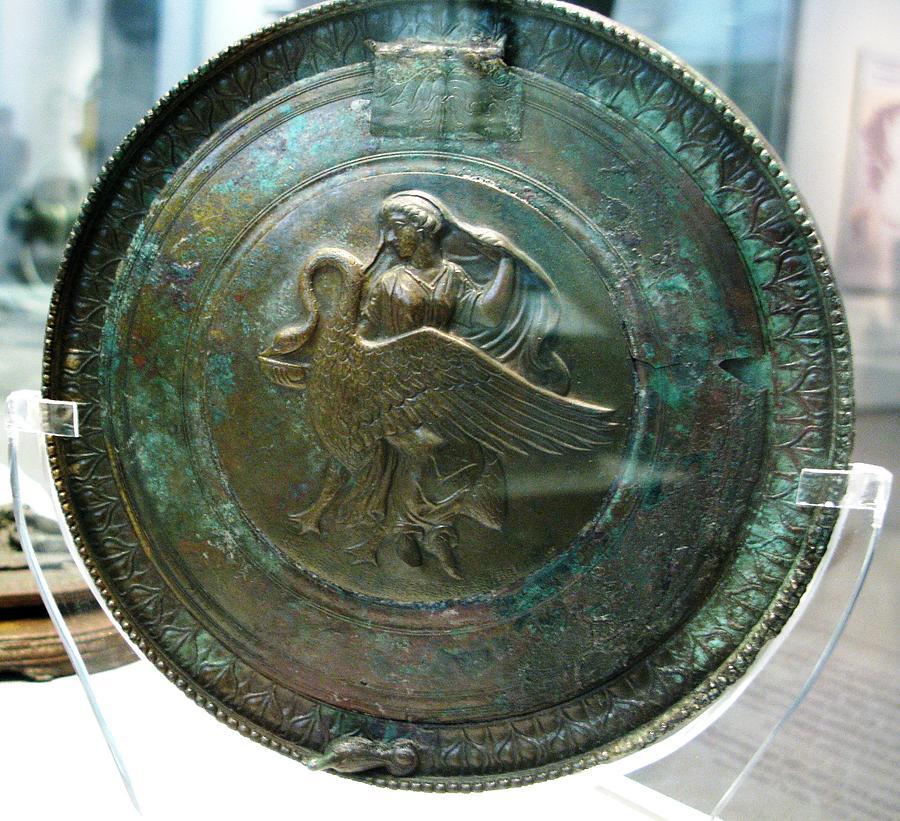
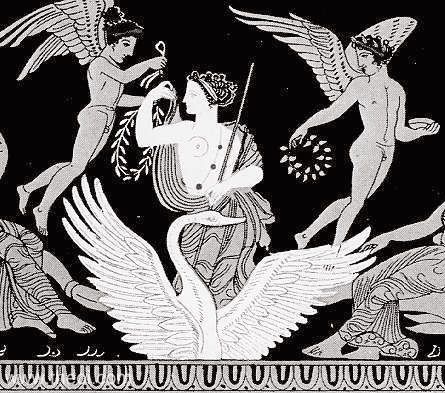
And many more. Some scholars think that these might be supposed to be geese instead of swans, in which case you could alternatively give her Animal (Goose), but we figured Swan fit with her aesthetic more. While we don't always give everyone an Animal association just because they appear with an animal in art a lot - sometimes the animal is just symbolic, or they have a myth that suggests it's not a good idea - Aphrodite is slim on associations like most Greek deities, and we figured she could use the help.
As for Fertility vs. Health, we're totally with you on the weirdness of that, but after doing as thorough a run through ancient Greek stories and descriptions of Aphrodite, that's where we ended up. Aphrodite is indeed associated with sex, but while Health does affect baby-making, it doesn't have a lot to do with the sex act itself beyond that, and so Aphrodite's strong connections to bangin' didn't really give her much of a connection there (although her Roman persona, Venus, is a little bit more linkable to Health as a concept). But the ancient Greeks connected human fertility and the fertility of the earth symbolically and even literally in many of their writings, so that Aphrodite is often praised as a bringer of earthly fertility despite not being a more classical plant-shaper. From Stasinus describing Aphrodite as eternally clothed in "crocus and hyacinth and flourishing violet and the rose's lovely bloom, so sweet and delicious, and heavenly buds, the flowers of the narcissus and lily; in such perfumed garments is Aphrodite clothed at all seasons," to the Homeric hymns stating that flowers spring up beneath her feet wherever she walks, plants turn up surprisingly frequently with Aphrodite. The reason is probably best summed up in Aeschylus' Danaides, in which Aphrodite herself describes the births of all the plants and trees and flowers of the world, and then claims, "Of all these things I am the cause," suggesting that because she is the motivator for sex which causes procreation, she is the root cause of all procreation of all life, even though she does not participate in the actual childbearing or mothering process.
Question: Shouldn't Hermes have Epic Dexterity and Illusion? Apologies if this has been answered already.
While Hermes certainly has decent amounts of both, neither was strong enough for us to want to give him the Ultimate expression of it. He does use Illusion occasionally, most notably in the tale where he makes himself a doppelgaenger of a man in order to drive him insane, but he doesn't do it all that often or all that impressively, so for the most part his trickery is probably the result of awesome Manipulation and Wits, and some low- to mid-level Illusion boons now and then. Dexterity doesn't really fit him, either; he does have the epithet "quick-footed", which helps, but for the most part the modern idea of him as super-fast comes from his role as messenger of the gods rather than any actual mythological association with speed of travel.
Question: Why does Njord have Fire associated?
Because of this passage in the Prose Edda:
The third among the Aesir is he that is called Njörd: he dwells in heaven, in the abode called Nóatún. He rules the course of the wind, and stills sea and fire; on him shall men call for voyages and for hunting.
Even more than Hel above, Njord suffers from the dearth of mythological information on the Aesir and Vanir. While his Water association as the god of the ocean is pretty solid, everything else tends to be like that - single statements that are clear, but don't have any other examples to back them up. Njord is supposed to be one of the most important and powerful of the Vanir, which is why he was traded to the Aesir in the first place, so we decided to give him Sky and Fire in spite of the lack of extra stories attached to them... but we feel like it's likely he may get demoted to a lot fewer associations in the future workup of lower-Legend gods. The Edda's very clear that he does those things, so we like them, but we also usually want more than one example, so thus is our quandary.
That's all our association questions for today - phew!
Monday, March 10, 2014
The Power of One
Question: Sorry to add to the questionado maelstrom, but I have a query about Artemis. In your family trees, she only has Moon as an associated purview. Is this right? It just seems a bit skimpy for the Goddess of the Hunt of the best-known Pantheon out there.
Yep, that's right.
This is kind of a perennial issue for the Theoi in general. The Greek religion, rather than having a smaller selection of deities who just do a ton of things (like the Aesir, for example), leaned heavily toward having an insane number of deities who all do only one or two things, making them far more specialized than gods in some other pantheons. Few of the Theoi rock more than a couple of associated purviews (though of course there are exceptions), because for the most part they're all very deliberately attached to only a couple of major ideas.
Artemis is like that. Moon is really the only purview she's associated with, although she clearly has that one in spades. She likely has some Health powers thanks to her associations with childbirth and pregnancy, and probably a little Animal from her wildlife associations and the times she turns people into beasts, but that's the extent of her other powers, and they're clearly not important enough to be Avatar-level. Artemis is indeed the goddess of the hunt, which is a large part of the reason she has Epic Perception associated. Perception is the hunting stat and set of powers; any time you are hunting, tracking, or otherwise looking for someone or something, you're using Perception, and Artemis is not only the preeminent hunter in her pantheon and famous for her skill, but she is also often mentioned as having incredible perceptive powers, described as "far-sighted" especially frequently (an epithet her brother Apollo also shares). Add to that Dexterity for her continuing descriptions of swiftness, uncanny aim and incredible ability to run down any prey, and she's got her three most important associations neatly sewed up. She doesn't have or demonstrate any other major powers.
But, as we have talked about in regards to Theoi gods before, that doesn't mean she's not powerful, important or is somehow "less" than other deities. All it means is that she's specialized more than some other gods. Some deities - Manannan mac Lir, for example - are all over the map, doing a thousand things dabbling-style, and some deities like Artemis are laser-focused on being the absolute best at the one or two specific things they and only they do in their pantheon. The Theoi are even supported in their specialization by Scion's mechanics, in that you can always assume that while they don't have a ton of purview or Epic associations, they most likely have a ton Arete maxed out for various abilities, the equivalent of having several purviews that are simply "invisible" on a list of associated powers.
We never give gods powers just to "round them out"; we're pretty committed to gods only having associations that are truly the most major concepts and abilities that they represent and demonstrate, and therefore we try not to give anyone extra associations just so we can feel like they have "enough". And really, they don't need more anyway. More purviews certainly means more options, but it doesn't mean a difference in power level - a god with just one purview Avatar to call up is just as powerful as one with five when both pop their ultimate power and go head to head. Particularly for the Theoi, who are usually associated with very strictly defined subject areas and rocking out insane rolls on them thanks to their innate Arete excellence, granting extra associations wouldn't fit for them, and would end up muddying what they're really all about.
Yep, that's right.
This is kind of a perennial issue for the Theoi in general. The Greek religion, rather than having a smaller selection of deities who just do a ton of things (like the Aesir, for example), leaned heavily toward having an insane number of deities who all do only one or two things, making them far more specialized than gods in some other pantheons. Few of the Theoi rock more than a couple of associated purviews (though of course there are exceptions), because for the most part they're all very deliberately attached to only a couple of major ideas.
Artemis is like that. Moon is really the only purview she's associated with, although she clearly has that one in spades. She likely has some Health powers thanks to her associations with childbirth and pregnancy, and probably a little Animal from her wildlife associations and the times she turns people into beasts, but that's the extent of her other powers, and they're clearly not important enough to be Avatar-level. Artemis is indeed the goddess of the hunt, which is a large part of the reason she has Epic Perception associated. Perception is the hunting stat and set of powers; any time you are hunting, tracking, or otherwise looking for someone or something, you're using Perception, and Artemis is not only the preeminent hunter in her pantheon and famous for her skill, but she is also often mentioned as having incredible perceptive powers, described as "far-sighted" especially frequently (an epithet her brother Apollo also shares). Add to that Dexterity for her continuing descriptions of swiftness, uncanny aim and incredible ability to run down any prey, and she's got her three most important associations neatly sewed up. She doesn't have or demonstrate any other major powers.
But, as we have talked about in regards to Theoi gods before, that doesn't mean she's not powerful, important or is somehow "less" than other deities. All it means is that she's specialized more than some other gods. Some deities - Manannan mac Lir, for example - are all over the map, doing a thousand things dabbling-style, and some deities like Artemis are laser-focused on being the absolute best at the one or two specific things they and only they do in their pantheon. The Theoi are even supported in their specialization by Scion's mechanics, in that you can always assume that while they don't have a ton of purview or Epic associations, they most likely have a ton Arete maxed out for various abilities, the equivalent of having several purviews that are simply "invisible" on a list of associated powers.
We never give gods powers just to "round them out"; we're pretty committed to gods only having associations that are truly the most major concepts and abilities that they represent and demonstrate, and therefore we try not to give anyone extra associations just so we can feel like they have "enough". And really, they don't need more anyway. More purviews certainly means more options, but it doesn't mean a difference in power level - a god with just one purview Avatar to call up is just as powerful as one with five when both pop their ultimate power and go head to head. Particularly for the Theoi, who are usually associated with very strictly defined subject areas and rocking out insane rolls on them thanks to their innate Arete excellence, granting extra associations wouldn't fit for them, and would end up muddying what they're really all about.
Friday, February 28, 2014
The Hills of Sunny Tuscany
Question: Will you guys ever think of doing an Etruscan pantheon, or is it to much influenced by the Greeks?
Question: Do you ever just want to take a break from exploring distant frontiers of exotic ancient civilizations and write an Etruscan pantheon?
Pfft, like the Etruscans aren't exotic? Please. We live in North Carolina. Any religion that isn't Southern baptist is considered "exotic" around here.
Actually, I have to admit that I am totally a fan of Etruscan mythology. It is heavily Greek-influenced, but its unique aspects are incredibly interesting; there's a lot of crazy stuff, including rampant haruspexy, surprising incest themes, and fantastic new relations between different gods that make it a joy to read about. Any pantheon with a secret shadow council of unknowable gods in charge of whether or not the thunder-god is allowed to use the Super Nuke Death Lightning can't help but be interesting. If you're interested in the details of Etruscan myth, we'd totally suggest getting your hands on Etruscan Myth, Sacred History and Legend by Nancy Thomson de Grummond; it's a great resource with a ton of interesting information, comparison to Greco-Roman myth and excellent reproductions of Etruscan mythological art.
However, we're not sure whether or not an entire Etruscan pantheon supplement is a feasible option. The Etruscans certainly have unique deities and ideas, but they are a poorly-preserved religion before the beginning of Greek influence, and once that Greek influence began to be felt in the religion, things got massively syncretized. The same problems inherent in trying to write a separate Roman pantheon are present for the Etruscans; the majority of their major gods are obvious imports of the major gods of the Theoi, or at best native gods who were assigned all the stories and attributes of Theoi gods until their own individuality has been severely compromised and difficult to identify under all the layers of Greekness. Tinia, for example, almost certainly began as a purely Italiante thunder god with his own myths and local significance, but once Greek influence arrived on the scene, he became so strongly identified with Zeus that we have almost no remaining myths of him or images of him in art that are not obviously borrowed. We would have a few interesting tidbits to say about Tinia, like the aforementioned council control of his most powerful thunderbolts, but for the most part all his myths are just myths of Zeus.
There are purely Etruscan gods in the pantheon; Tiv, for example, is clearly the native moon-god and was more important in that role that Aritimi, the much later imported version of Artemis, and Thufltha (owner of the most fun name to say among his pantheon) is a purely Etruscan deity of fortune and good will. But while we could certainly scrape several of them together and talk about their neat attributes and whatnot, we have the same problem that we have trying to write a Roman pantheon: we'd have to ignore the most important major deities because they're basically identical to the Theoi, and that leaves us with a pantheon that doesn't really represent Etruscan religion at all. But we also can't just throw all the Theoi-analogues in there, because then we have two weirdly pseudo-identical pantheons.
So it's not on our short list; it has problems that we aren't sure how to address yet. We do think there are definitely Etruscan gods in Scion's world, just like there are Roman gods, and that they are not necessarily best handled as part of the Theoi, but for the moment it's something that various Storytellers will probably have to handle. Some will probably say that they want to consider all three pantheons under the Theoi umbrella, and that they represent Theoi influence in a few different cultures that worshiped the same gods in slightly different, culture-appropriate ways. Some will probably say that all three are different, and have to figure out how to split up the major Olympians among them. Some will do the sub-pantheon thing, and others will probably go for a mixture somewhere in between all these options. But until we figure out exactly what we want to do with this perennial issue, we probably wouldn't try to write up the Etruscans separately.
Question: Do you ever just want to take a break from exploring distant frontiers of exotic ancient civilizations and write an Etruscan pantheon?
Pfft, like the Etruscans aren't exotic? Please. We live in North Carolina. Any religion that isn't Southern baptist is considered "exotic" around here.
Actually, I have to admit that I am totally a fan of Etruscan mythology. It is heavily Greek-influenced, but its unique aspects are incredibly interesting; there's a lot of crazy stuff, including rampant haruspexy, surprising incest themes, and fantastic new relations between different gods that make it a joy to read about. Any pantheon with a secret shadow council of unknowable gods in charge of whether or not the thunder-god is allowed to use the Super Nuke Death Lightning can't help but be interesting. If you're interested in the details of Etruscan myth, we'd totally suggest getting your hands on Etruscan Myth, Sacred History and Legend by Nancy Thomson de Grummond; it's a great resource with a ton of interesting information, comparison to Greco-Roman myth and excellent reproductions of Etruscan mythological art.
However, we're not sure whether or not an entire Etruscan pantheon supplement is a feasible option. The Etruscans certainly have unique deities and ideas, but they are a poorly-preserved religion before the beginning of Greek influence, and once that Greek influence began to be felt in the religion, things got massively syncretized. The same problems inherent in trying to write a separate Roman pantheon are present for the Etruscans; the majority of their major gods are obvious imports of the major gods of the Theoi, or at best native gods who were assigned all the stories and attributes of Theoi gods until their own individuality has been severely compromised and difficult to identify under all the layers of Greekness. Tinia, for example, almost certainly began as a purely Italiante thunder god with his own myths and local significance, but once Greek influence arrived on the scene, he became so strongly identified with Zeus that we have almost no remaining myths of him or images of him in art that are not obviously borrowed. We would have a few interesting tidbits to say about Tinia, like the aforementioned council control of his most powerful thunderbolts, but for the most part all his myths are just myths of Zeus.
There are purely Etruscan gods in the pantheon; Tiv, for example, is clearly the native moon-god and was more important in that role that Aritimi, the much later imported version of Artemis, and Thufltha (owner of the most fun name to say among his pantheon) is a purely Etruscan deity of fortune and good will. But while we could certainly scrape several of them together and talk about their neat attributes and whatnot, we have the same problem that we have trying to write a Roman pantheon: we'd have to ignore the most important major deities because they're basically identical to the Theoi, and that leaves us with a pantheon that doesn't really represent Etruscan religion at all. But we also can't just throw all the Theoi-analogues in there, because then we have two weirdly pseudo-identical pantheons.
So it's not on our short list; it has problems that we aren't sure how to address yet. We do think there are definitely Etruscan gods in Scion's world, just like there are Roman gods, and that they are not necessarily best handled as part of the Theoi, but for the moment it's something that various Storytellers will probably have to handle. Some will probably say that they want to consider all three pantheons under the Theoi umbrella, and that they represent Theoi influence in a few different cultures that worshiped the same gods in slightly different, culture-appropriate ways. Some will probably say that all three are different, and have to figure out how to split up the major Olympians among them. Some will do the sub-pantheon thing, and others will probably go for a mixture somewhere in between all these options. But until we figure out exactly what we want to do with this perennial issue, we probably wouldn't try to write up the Etruscans separately.
Wednesday, February 12, 2014
Baby Mama Drama
Question: My character had the... let's say "misfortune" to hook up with Aphrodite in our game and unfortunately rolled a 9 on the reproduction chart. If Ares finds out hes going to kill my character. What would you do in this situation? My character doesn’t yet know shes pregnant. How can I attempt to keep my character alive? And yes, my ST says there would be a death if there is a direct conflict with Ares.
We agree with your Storyteller. He is totally going to kill you if you are in the room when he finds out about this. We don't know what Legend your character is, but there's really no level of Legend where anyone is "safe" from Ares, anyway. We'll try to help anyway, though!
First of all, you can try to hide all this, but it probably won't work. Unfortunately, hiding a pregnancy like this is going to be next to impossible. Anyone with Assess Health (Apollo, Artemis and Hera at least, probably several others) will see that she's pregnant immediately - probably before either you or she knows, in fact. Even if she uses her Epic Appearance to avoid being visibly pregnant, folks with Ultimate Perception (again, Apollo and Artemis at least) will still know. She could go far, far away and not come back until the baby's born, but then everyone's going to want to know where she went and why, which means you need an amazing cover story and someone who can lie about it so fantastically that said people with Perception above won't immediately see right through it (not to mention somewhere for her to live for these nine months!). And even if you pull all that off, all it takes is one guy with Mystery to blow the lid off the whole thing, and you've got a ticking time bomb of a child running around who will almost certainly be a problem late ron. And remember that other gods from non-Greek pantheons may also run into her, and many of them may also find out about it and tell other people.
We'd also like to point out that other people besides Ares are probably going to be pissed off about this. You might get lucky, but there's a very good chance that a large number of Greek gods are now angry with you. Hephaestus, in particular, is a dangerous one; I don't know if your ST plays him as still married to Aphrodite or not, but even if he isn't, he was not pleased by all her cheating on him ever before and he probably won't appreciate that she's now sleeping with lowly Scions, even. His revenge is apt to be a lot more creative and difficult to see coming than Ares', and you'd better plan how to deal with the possibility of it before you end up in a throne-prison or wearing a cursed necklace or any of the other things he does to people he's mad at. Also, remember that Aphrodite is the belle of the ball on Olympus, and that all the other gods absolutely want to bang her and used to actively fight over her before she got married, so you're looking at a lot of gods - Apollo, Poseidon and Hermes are all named as her suitors - who will probably trigger jealous rages at the idea that not only did she turn them down, then she went and slept with you, who are basically a nobody. They may want to punish you, especially with Vengeance egging them on. And, of course, Hera is the goddess of faithful marriage, so she's not going to like this, and Ares is her son and may ask for her help, so Justice boons just came to the party. You may want to stay far, far away from the entire pantheon if you can.
Before you do anything, though you need to find out what Aphrodite's doing. It sounds like you have no idea what her take on the situation is or how she plans to handle it, which may be very literally fatal for you. Mystery can help, or you could simply try going to ask her (and hoping that she doesn't lie). She's not an idiot, so she will probably be figuring out her own plan for how to deal with this; she might abort the baby (basic Health powers make that pretty easy), use her Epic Appearance to hide evidence of the pregnancy so that Ares at least can't physically see it, claim it's Ares' kid, claim it's someone else's kid, claim it's immaculate conception, or even throw you under the bus by claiming that you assaulted her. She's definitely not going to just sit passively around and not try to make this come out the way she wants it to, so you need to find out what she's doing. If you come up with a brilliant plan to hide the whole thing, and then she just goes to Ares and tells him about it, you're 100% boned in spite of all your hard work. On the other hand, if she likes you enough, she might help you out. You'll never know until you try.
Once you know what she's doing (and assuming the answer isn't "I told him you attacked me, go draw up a will"), our next best suggestion is for you to go out and find a powerful protector. You know you can't survive Ares on a rampage, so start kissing butts - find somebody who can maybe protect or hide you, or convince Ares (or Ares' pantheon, so they can stop him) that killing you isn't worth it or isn't an option right now. The other Greeks may not be great choices, since they are all terrible vengeful people, but if you can find someone powerful enough in another pantheon and throw yourself on their mercy, they may be willing to help you in exchange for your services.
...what services those will be depend on the god, but be ready to have to do unpleasant tasks, talk to people you don't want to talk to, fight stuff, be experimented on, or whatever else they want in return for saving you. No one's going to do it for free, and they probably don't want anything you want to give. But hey, it beats being dead, right?
Other than that, we can only suggest that you be good at hiding. We would assume that Ares, or other offended parties, are going to find out about this sooner or later, so do your best to have a panic room/escape route/contingency plan. Ares isn't great at finding people, so you may be able to elude him for a while. Try to go somewhere he can't or won't chase you, or maybe create distractions or disturbances that cause him to veer off instead of pursuing you single-mindedly. Your life is all about survival right now, at least until this blows over, and your band will probably be along for the ride, since it's all too likely they'll get caught in the crossfire at some point.
Good luck, man. At least you'll have a very beautiful memory to keep you warm on those cold nights of hiding in the wilderness, hoping no one can find you.
We agree with your Storyteller. He is totally going to kill you if you are in the room when he finds out about this. We don't know what Legend your character is, but there's really no level of Legend where anyone is "safe" from Ares, anyway. We'll try to help anyway, though!
First of all, you can try to hide all this, but it probably won't work. Unfortunately, hiding a pregnancy like this is going to be next to impossible. Anyone with Assess Health (Apollo, Artemis and Hera at least, probably several others) will see that she's pregnant immediately - probably before either you or she knows, in fact. Even if she uses her Epic Appearance to avoid being visibly pregnant, folks with Ultimate Perception (again, Apollo and Artemis at least) will still know. She could go far, far away and not come back until the baby's born, but then everyone's going to want to know where she went and why, which means you need an amazing cover story and someone who can lie about it so fantastically that said people with Perception above won't immediately see right through it (not to mention somewhere for her to live for these nine months!). And even if you pull all that off, all it takes is one guy with Mystery to blow the lid off the whole thing, and you've got a ticking time bomb of a child running around who will almost certainly be a problem late ron. And remember that other gods from non-Greek pantheons may also run into her, and many of them may also find out about it and tell other people.
We'd also like to point out that other people besides Ares are probably going to be pissed off about this. You might get lucky, but there's a very good chance that a large number of Greek gods are now angry with you. Hephaestus, in particular, is a dangerous one; I don't know if your ST plays him as still married to Aphrodite or not, but even if he isn't, he was not pleased by all her cheating on him ever before and he probably won't appreciate that she's now sleeping with lowly Scions, even. His revenge is apt to be a lot more creative and difficult to see coming than Ares', and you'd better plan how to deal with the possibility of it before you end up in a throne-prison or wearing a cursed necklace or any of the other things he does to people he's mad at. Also, remember that Aphrodite is the belle of the ball on Olympus, and that all the other gods absolutely want to bang her and used to actively fight over her before she got married, so you're looking at a lot of gods - Apollo, Poseidon and Hermes are all named as her suitors - who will probably trigger jealous rages at the idea that not only did she turn them down, then she went and slept with you, who are basically a nobody. They may want to punish you, especially with Vengeance egging them on. And, of course, Hera is the goddess of faithful marriage, so she's not going to like this, and Ares is her son and may ask for her help, so Justice boons just came to the party. You may want to stay far, far away from the entire pantheon if you can.
Before you do anything, though you need to find out what Aphrodite's doing. It sounds like you have no idea what her take on the situation is or how she plans to handle it, which may be very literally fatal for you. Mystery can help, or you could simply try going to ask her (and hoping that she doesn't lie). She's not an idiot, so she will probably be figuring out her own plan for how to deal with this; she might abort the baby (basic Health powers make that pretty easy), use her Epic Appearance to hide evidence of the pregnancy so that Ares at least can't physically see it, claim it's Ares' kid, claim it's someone else's kid, claim it's immaculate conception, or even throw you under the bus by claiming that you assaulted her. She's definitely not going to just sit passively around and not try to make this come out the way she wants it to, so you need to find out what she's doing. If you come up with a brilliant plan to hide the whole thing, and then she just goes to Ares and tells him about it, you're 100% boned in spite of all your hard work. On the other hand, if she likes you enough, she might help you out. You'll never know until you try.
Once you know what she's doing (and assuming the answer isn't "I told him you attacked me, go draw up a will"), our next best suggestion is for you to go out and find a powerful protector. You know you can't survive Ares on a rampage, so start kissing butts - find somebody who can maybe protect or hide you, or convince Ares (or Ares' pantheon, so they can stop him) that killing you isn't worth it or isn't an option right now. The other Greeks may not be great choices, since they are all terrible vengeful people, but if you can find someone powerful enough in another pantheon and throw yourself on their mercy, they may be willing to help you in exchange for your services.
...what services those will be depend on the god, but be ready to have to do unpleasant tasks, talk to people you don't want to talk to, fight stuff, be experimented on, or whatever else they want in return for saving you. No one's going to do it for free, and they probably don't want anything you want to give. But hey, it beats being dead, right?
Other than that, we can only suggest that you be good at hiding. We would assume that Ares, or other offended parties, are going to find out about this sooner or later, so do your best to have a panic room/escape route/contingency plan. Ares isn't great at finding people, so you may be able to elude him for a while. Try to go somewhere he can't or won't chase you, or maybe create distractions or disturbances that cause him to veer off instead of pursuing you single-mindedly. Your life is all about survival right now, at least until this blows over, and your band will probably be along for the ride, since it's all too likely they'll get caught in the crossfire at some point.
Good luck, man. At least you'll have a very beautiful memory to keep you warm on those cold nights of hiding in the wilderness, hoping no one can find you.
Tuesday, February 11, 2014
From the Heart of the Vortex!
Today, we're clearing out a bunch of quick and easy answers! Blog attack, go!
Question: Would you use Larceny or Art/Science: Computer/Hacking for hacking?
Art (Computer), or, if you happen to have the Polymath boon, it would fall under Art (Modern). It's too specialized a skill to be done with plain old Larceny.
Question: Do improvements to relics always have to come from a crafter god, or can certain relics gain power through mythical events like their Scion owners gaining legend? For example, if a Scion defeated a powerful monster and gained a Legend dot, would her magic axe gain new abilities?
Relic improvements always need to come from Artistry within the game itself; you won't spontaneously gain new relic points from things you do, because that would be overpowered and difficult for a Storyteller to adjudicate (not to mention making people with Artistry have a purview that was way less useful). However, you gain new Birthright points when you become a Demigod and when you become a God, so you could have relics spontaneously gain dots at those jumps if you wanted to.
Question: Why doesn't Ra have Animal (Scarab)?
Because it's really Khepri, the scarab god, who has that association. Ra was syncretized with Khepri sometimes, where the beetle god was seen as Ra's aspect as the rising sun, but if we gave Ra associations for everyone he was ever syncretized with, he'd be Voltron.
Question: According to your posts, Hecate is still a titan (or at least very, very titanic). Does this mean she can't sire scions, or is she goddess enough to do so? Do her hypothetical kids have any side effects (showing up when scenting the titanic, gaining dark virtues etc) or are they just normal scions who might have to put up with some prejudice due to their heritage?
Hecate is a goddess for purposes of our games, and creates Scions normally as part of the Theoi. She is of Titanic lineage and occasionally called such in Greek mythology, but she's the same generation as Zeus' children and had a strong cult worship that made her close enough to humanity to be considered a god.
Question: What do Pakiy, Emamu and Stvaranje mean?
Etymological roots for all the Titanrealms can be found in this old post.
Question: Aura of Dread doesn't specify that it's only for Scions with Negative Epic Appearance, yet it is clearly the starting point for the Negative Knacks. Since it doesn't say "Negative only" does that mean an attractive Scion can still take that Knack? If I wanted my good-looking warrior Scion to still project a terrifying image on the battlefield, would that work?
No. Aura of Dread, like all the other knacks in the terrorizing tree, us usable by negative Epic Appearance only. It should say that, so we'll fix it, but it should also be pretty obvious, y'all.
Question: Are the Avatars going to get worked over with the boon revamp? Or is that a separate project?
It's a separate project, but one that we hope to work on soon, and we're talking about basic ideas for it while we work on the APP project.
Question: I was looking for how Sanctums worked, and found that your post from April 1, 2012 that said you were working on definite rules. Is that something thats progressing without a bar? has the project been demolished? up for vote? finished but not released?
It isn't being worked on at this particular moment, but we could certainly add it to the voting block if it's something you guys would like to happen sooner rather than later!
Question: Creatures are always lower legend than the scion. Does this also apply to Nahualli? I mean, they're YOU?
No. Nahualli are not Creature Birthrights and are not bound by that rule. They are a unique kind of Birthright all their own.
Question: Hello! If a Scion has a child as a Hero or Demigod, I know that the ichor would still flow from the grandparent and the grandparent will be able to activate the child, but what happens if the Demigod becomes a god - could they THEN activate their own child?
Yep, sure can.
Question: I was looking at your Perceptive Capacity table. Does it mean that the furthest any mortal can see is 12 yards (5 on the table)? That seems a little harsh to me, am I misunderstanding the rules?
You are, but that's okay, we explain it in this old post back here.
Question: Do the Aztecs have a legendary smith like Vølund or Hephaestus?
They do not; most of their armor and weapons were made of non-metal materials like obsidian and stiffened paper or cloth. They had artisans that performed goldsmithing (mostly for jewelry and ritual objects) and occasionally traded with their neighbors for bronze, but it wasn't an important enough style of crafting to merit its own deity.
Question: Do Fatebonds get the XP discount if the player has the appropriate Me PSP associated with a purview?
Yes, both the player and their Fatebonds get to buy (or unbuy) that purview at the lower rate thanks to Me.
Question: Do Empath auto-successes apply to Manipulation + Empathy rolls for lying?
Yes, they apply to anything that you roll Empathy for.
And that'll be it for now! Don't worry, we won't be doing a lot of these (we prefer the big in-depth posts!), but since the questionado has grown to a current maelstrom of 203, we figured we'd get a few of the quick ones out of the way.
Back into the fray!
Question: Would you use Larceny or Art/Science: Computer/Hacking for hacking?
Art (Computer), or, if you happen to have the Polymath boon, it would fall under Art (Modern). It's too specialized a skill to be done with plain old Larceny.
Question: Do improvements to relics always have to come from a crafter god, or can certain relics gain power through mythical events like their Scion owners gaining legend? For example, if a Scion defeated a powerful monster and gained a Legend dot, would her magic axe gain new abilities?
Relic improvements always need to come from Artistry within the game itself; you won't spontaneously gain new relic points from things you do, because that would be overpowered and difficult for a Storyteller to adjudicate (not to mention making people with Artistry have a purview that was way less useful). However, you gain new Birthright points when you become a Demigod and when you become a God, so you could have relics spontaneously gain dots at those jumps if you wanted to.
Question: Why doesn't Ra have Animal (Scarab)?
Because it's really Khepri, the scarab god, who has that association. Ra was syncretized with Khepri sometimes, where the beetle god was seen as Ra's aspect as the rising sun, but if we gave Ra associations for everyone he was ever syncretized with, he'd be Voltron.
Question: According to your posts, Hecate is still a titan (or at least very, very titanic). Does this mean she can't sire scions, or is she goddess enough to do so? Do her hypothetical kids have any side effects (showing up when scenting the titanic, gaining dark virtues etc) or are they just normal scions who might have to put up with some prejudice due to their heritage?
Hecate is a goddess for purposes of our games, and creates Scions normally as part of the Theoi. She is of Titanic lineage and occasionally called such in Greek mythology, but she's the same generation as Zeus' children and had a strong cult worship that made her close enough to humanity to be considered a god.
Question: What do Pakiy, Emamu and Stvaranje mean?
Etymological roots for all the Titanrealms can be found in this old post.
Question: Aura of Dread doesn't specify that it's only for Scions with Negative Epic Appearance, yet it is clearly the starting point for the Negative Knacks. Since it doesn't say "Negative only" does that mean an attractive Scion can still take that Knack? If I wanted my good-looking warrior Scion to still project a terrifying image on the battlefield, would that work?
No. Aura of Dread, like all the other knacks in the terrorizing tree, us usable by negative Epic Appearance only. It should say that, so we'll fix it, but it should also be pretty obvious, y'all.
Question: Are the Avatars going to get worked over with the boon revamp? Or is that a separate project?
It's a separate project, but one that we hope to work on soon, and we're talking about basic ideas for it while we work on the APP project.
Question: I was looking for how Sanctums worked, and found that your post from April 1, 2012 that said you were working on definite rules. Is that something thats progressing without a bar? has the project been demolished? up for vote? finished but not released?
It isn't being worked on at this particular moment, but we could certainly add it to the voting block if it's something you guys would like to happen sooner rather than later!
Question: Creatures are always lower legend than the scion. Does this also apply to Nahualli? I mean, they're YOU?
No. Nahualli are not Creature Birthrights and are not bound by that rule. They are a unique kind of Birthright all their own.
Question: Hello! If a Scion has a child as a Hero or Demigod, I know that the ichor would still flow from the grandparent and the grandparent will be able to activate the child, but what happens if the Demigod becomes a god - could they THEN activate their own child?
Yep, sure can.
Question: I was looking at your Perceptive Capacity table. Does it mean that the furthest any mortal can see is 12 yards (5 on the table)? That seems a little harsh to me, am I misunderstanding the rules?
You are, but that's okay, we explain it in this old post back here.
Question: Do the Aztecs have a legendary smith like Vølund or Hephaestus?
They do not; most of their armor and weapons were made of non-metal materials like obsidian and stiffened paper or cloth. They had artisans that performed goldsmithing (mostly for jewelry and ritual objects) and occasionally traded with their neighbors for bronze, but it wasn't an important enough style of crafting to merit its own deity.
Question: Do Fatebonds get the XP discount if the player has the appropriate Me PSP associated with a purview?
Yes, both the player and their Fatebonds get to buy (or unbuy) that purview at the lower rate thanks to Me.
Question: Do Empath auto-successes apply to Manipulation + Empathy rolls for lying?
Yes, they apply to anything that you roll Empathy for.
And that'll be it for now! Don't worry, we won't be doing a lot of these (we prefer the big in-depth posts!), but since the questionado has grown to a current maelstrom of 203, we figured we'd get a few of the quick ones out of the way.
Back into the fray!
Monday, February 3, 2014
The Lord of Dodona
Question: Why does Zeus have Prophecy associated?
Because Zeus is a god with a giant prophetic cult in his honor! Check this out:
This is the theatre of the Oracle of Dodona, once one of the most famous oracles in Greece, second only to the Oracle of Delphi in importance to the ancient Greeks. Where Apollo was the oracular power behind Delphi, dispensing visions of the future to its famous prophetess, Zeus was the power of Dodona, and granted to his priests visions and portents of the future through visions, the movement of his sacred oak trees, and the practice of augury based on the flight of birds. His oracle was the oldest in Greece, said by several Greek writers to be the first place prophecies were ever given in the land, and was visited by people from all over the ancient world, who came for the god's revelations of the future and predictions about what they should do next. The oracle is most famously mentioned in Greek myth in the Argonautica, where the prophetic powers of the Argo itself are attributed to the fact that it was built with a splinter of wood from the prophetic tree of Dodona.
Basically, he has Prophecy for the same reason that Apollo does. Several Greek gods had prophetic cults, but few as powerful and iconic as the oracles of Dodona and Delphi. Those oracles' powers were believed to come straight from their patron gods themselves, who were sometimes said to actually physically go to the seat of their oracle and at other times merely to send them the visions they dispensed to their seekers. The words of the oracle are directly the words of the god who inspired them, so it is Zeus who gives the prophecies at Dodona, from his own oracular powers. Dodona wasn't his only oracle, either, although it was by far his most famous one.
We don't always give a god an association based purely on cult worship, but in this case, the cult was so strong and influential, and it was so firmly based on the idea of the god himself having that power, that it was totally an easy choice for us. Zeus is a prophetic god with one of the most famous and influential oracles of the ancient world, and strongly associated with other prophecies besides, and that's good enough for us!
Because Zeus is a god with a giant prophetic cult in his honor! Check this out:

This is the theatre of the Oracle of Dodona, once one of the most famous oracles in Greece, second only to the Oracle of Delphi in importance to the ancient Greeks. Where Apollo was the oracular power behind Delphi, dispensing visions of the future to its famous prophetess, Zeus was the power of Dodona, and granted to his priests visions and portents of the future through visions, the movement of his sacred oak trees, and the practice of augury based on the flight of birds. His oracle was the oldest in Greece, said by several Greek writers to be the first place prophecies were ever given in the land, and was visited by people from all over the ancient world, who came for the god's revelations of the future and predictions about what they should do next. The oracle is most famously mentioned in Greek myth in the Argonautica, where the prophetic powers of the Argo itself are attributed to the fact that it was built with a splinter of wood from the prophetic tree of Dodona.
Basically, he has Prophecy for the same reason that Apollo does. Several Greek gods had prophetic cults, but few as powerful and iconic as the oracles of Dodona and Delphi. Those oracles' powers were believed to come straight from their patron gods themselves, who were sometimes said to actually physically go to the seat of their oracle and at other times merely to send them the visions they dispensed to their seekers. The words of the oracle are directly the words of the god who inspired them, so it is Zeus who gives the prophecies at Dodona, from his own oracular powers. Dodona wasn't his only oracle, either, although it was by far his most famous one.
We don't always give a god an association based purely on cult worship, but in this case, the cult was so strong and influential, and it was so firmly based on the idea of the god himself having that power, that it was totally an easy choice for us. Zeus is a prophetic god with one of the most famous and influential oracles of the ancient world, and strongly associated with other prophecies besides, and that's good enough for us!
Wednesday, January 15, 2014
Grand Theft Relic
Question: Hermes is known to like to steal things. What do you think he'd have handy from his pilfering on any given day that would be interesting, infuriating or a possible plot seed? You can apply the same question to any interesting gods known to steal.
This is a weird question. It's like a sideways version of the classic "who would win in a fight" question we get now and then, because it's a theoretical question about stuff that you could do in a game, but not that is actually going on in mythology. The answer could be literally anything; Hermes is the god of thieves and has Ultimate Attributes that make him able to steal from practically anybody. He could have anything in his closet. He might have any plan that involves stealing an important relic, or he might be fencing stolen things for others, or his Sanctum might look like an episode of Hoarders with all the random crap he's accumulated. Or he might not steal anything particularly interesting or important, because Mystery exists and unless he has a really great reason to take something it just may not be worth the hassle of people getting pissed off at him when they find out. I mean, he got out of that thing with Apollo intact, but that kind of thing's tiring..
So really, the answer is "Whatever your story needs him to have". There's really no way to guess what he should or might have because that depends completely on what he's doing in any given story. The same goes for the other famous gods who sometimes turn thief - Eshu, Loki, Quetzalcoatl, Stribog and so on. They have whatever they might have stolen to further whatever plot they're in right now. Without knowing what circumstances they're operating under, you might as well ask what clothes they'll be wearing next Tuesday. We don't freaking know.
This is a weird question. It's like a sideways version of the classic "who would win in a fight" question we get now and then, because it's a theoretical question about stuff that you could do in a game, but not that is actually going on in mythology. The answer could be literally anything; Hermes is the god of thieves and has Ultimate Attributes that make him able to steal from practically anybody. He could have anything in his closet. He might have any plan that involves stealing an important relic, or he might be fencing stolen things for others, or his Sanctum might look like an episode of Hoarders with all the random crap he's accumulated. Or he might not steal anything particularly interesting or important, because Mystery exists and unless he has a really great reason to take something it just may not be worth the hassle of people getting pissed off at him when they find out. I mean, he got out of that thing with Apollo intact, but that kind of thing's tiring..
So really, the answer is "Whatever your story needs him to have". There's really no way to guess what he should or might have because that depends completely on what he's doing in any given story. The same goes for the other famous gods who sometimes turn thief - Eshu, Loki, Quetzalcoatl, Stribog and so on. They have whatever they might have stolen to further whatever plot they're in right now. Without knowing what circumstances they're operating under, you might as well ask what clothes they'll be wearing next Tuesday. We don't freaking know.
Saturday, January 11, 2014
Turkish Delight
Today, we vlog about Turkey! Well, I vlog about Turkey, anyway. The place, not the bird.
Question: Anne, why do you personally love the Hittites so much? This is a shameless Hittite promotion phrased as a question, but a question regardless!
Question: Hey, so, about the Hittites. They are one of the top contenders for the original religion of the historical Troy, yes? Is there gunna be some cool stuff about the Trojan War when they come up? What about the Trojan side of that War and how to Theoi were all up in their business? Hittites, Troy, Trojan War, Greeks? So confuse. Messy mythohistroicology.
Question: We all know about Anne's love for the Hittites, but has she given any though to who their opposing Titanrealm would be?
You guys got me all excited about this. Now I have to go run around yelling Inuit things so I don't accidentally lose them in the sudden resurgance of interest in the Middle East.
Question: Anne, why do you personally love the Hittites so much? This is a shameless Hittite promotion phrased as a question, but a question regardless!
Question: Hey, so, about the Hittites. They are one of the top contenders for the original religion of the historical Troy, yes? Is there gunna be some cool stuff about the Trojan War when they come up? What about the Trojan side of that War and how to Theoi were all up in their business? Hittites, Troy, Trojan War, Greeks? So confuse. Messy mythohistroicology.
Question: We all know about Anne's love for the Hittites, but has she given any though to who their opposing Titanrealm would be?
You guys got me all excited about this. Now I have to go run around yelling Inuit things so I don't accidentally lose them in the sudden resurgance of interest in the Middle East.
Saturday, January 4, 2014
In the Name of Rome
Today on the vlog, we answer questions, I pronounce the word "jotun" wrong a lot, John passionately explains how much he loves Marduk, and a good time is had by all.
Question: Question about Form of the Giant/Jotun: upon activation, should I also use Undeniable Resemblance to shrink my size, do the bonus successes given stay? (Other than the DV bonus from Form of the Jotun, I know that one goes out.)
Question: Why do gods sleep with mortals? Compared to other gods and creatures of Legend, even the most amazing mortals are droll, hideous, stupid, and slow. Wouldn't it be like having sex with a chimp?
Question: Sexytimes with certain gods is probably really dangerous. How do you determine how much damage gets inflicted when you sleep with gods like the Morrigan, Sekhmet, Kali, or the Dagda?
Question: Is it possible for a relic to be some sort of reverse Maiming? I mean, it's like a tattoo and instead of taking your body part for power, the gods give/replace one for the power.
Question: Suppose a Scion was bored/curious/mischievous enough to shout the secret name of Rome in public within hearing distance of thousands of people. What might that do? Furthermore, how might the Roman gods and goddesses react?
Question: A question about 'purview lasers', or using purviews offensively against Titans/Titanspawn: Some applications are pretty easy to imagine, but what would a Psychopomp purview laser look like? Animal? Mystery? Artistry? Prophecy?
Question: Of all the pantheon heads, who do you consider the most beneficent King?
Question: In your games, if it has come up, how do the Aesir view their Marvel Comics counterparts?
The previous vlog where all this "purview laser" nonsense is explained can be found here. And the Marvel pantheons that appear in the Thor universe can be found checked out here if you're interested!
Question: Question about Form of the Giant/Jotun: upon activation, should I also use Undeniable Resemblance to shrink my size, do the bonus successes given stay? (Other than the DV bonus from Form of the Jotun, I know that one goes out.)
Question: Why do gods sleep with mortals? Compared to other gods and creatures of Legend, even the most amazing mortals are droll, hideous, stupid, and slow. Wouldn't it be like having sex with a chimp?
Question: Sexytimes with certain gods is probably really dangerous. How do you determine how much damage gets inflicted when you sleep with gods like the Morrigan, Sekhmet, Kali, or the Dagda?
Question: Is it possible for a relic to be some sort of reverse Maiming? I mean, it's like a tattoo and instead of taking your body part for power, the gods give/replace one for the power.
Question: Suppose a Scion was bored/curious/mischievous enough to shout the secret name of Rome in public within hearing distance of thousands of people. What might that do? Furthermore, how might the Roman gods and goddesses react?
Question: A question about 'purview lasers', or using purviews offensively against Titans/Titanspawn: Some applications are pretty easy to imagine, but what would a Psychopomp purview laser look like? Animal? Mystery? Artistry? Prophecy?
Question: Of all the pantheon heads, who do you consider the most beneficent King?
Question: In your games, if it has come up, how do the Aesir view their Marvel Comics counterparts?
The previous vlog where all this "purview laser" nonsense is explained can be found here. And the Marvel pantheons that appear in the Thor universe can be found checked out here if you're interested!
Monday, December 23, 2013
On a Wing and a Prayer
Question: Would the Greek gods look down on a fellow Greek god with animal features even if they look great? (Like, say the new god had raven wings.)
You know, this is a really interesting question, with a few angles going on.
In general, the Greeks don't care if your animal parts look great, they still find them gauche. One of the major features of Greek aesthetic sensibility is the idea of absolute perfection of the human form, of which the gods are the most excellent example; no matter how bangin' awesome you look with your animal parts, they would always believe you'd look better without them. You're supposed to look like the pinnacle of the humanoid form, so even attractive animal parts still represent a deviation from perfection. An Ultimate Appearance god with a tail is always going to be considered doing it wrong, even if he's technically exactly as hot as an Ultimate Appearance god without one.
However, wings are specifically an exception in Greek mythology. Despite the general disdain for people who look inhuman (which, by the way, doesn't only include animal parts - dudes like Priapus are not winning any points, either), many gods do appear with wings on their shoulders without any apparent stigma.
Various lesser gods are specifically said to be winged, and ancient writers seem perfectly happy to mention this without seeming to put any negative connotation on it.
The difference here between wings and other animal parts lies largely in their specific symbolism in Greek mythology. Where other animal parts usually represent bestiality, wildness and a lack of civilization and humanity, bird-like wings instead often represent swiftness and the ability to be ever-present, making them obvious choices for gods whose job it is to be everywhere all the time or to rush to and fro on their divine errands. Gods that travel constantly, like Iris, have wings to illustrate their fleetness, while gods that are capable of being present wherever needed, like Eros and Nike as the bringers of love and victory, have wings to show that they can instantly travel to anyone's side. Gods of swiftly-moving natural phenomena also often appear with wings, such as the gods of the four winds and their offspring, or Hypnos and Thanatos, lords of sleep and death, who must travel the world unceasingly to bestow their gifts on mankind.
Basically, in Greek iconography, wings are usually meant to suggest that the god that possesses them has Psychopomp or otherwise travels a lot, rather than meaning they necessarily have anything to do with birds or Animal. In fact, gods that do have to do with birds, like Aphrodite with swans, Hera with peacocks or Apollo with ravens, usually don't appear with bird parts in spite of their association.
So having wings might, depending on your Storyteller's interpretation, be the one permanent animal feature that a young god of the Theoi can get away with without courting social repercussions (the dreaded Greek God Snub). It really depends on whether your ST believes that those gods literally have wings - which they very well might - or prefers the interpretation that those wings are an affectation of Greek artists rather than a literal truth, in which case having actual wings might still be a problem for you. It's also worth noting that only lesser-Legend Greek gods usually rock the wings, which is most likely because grunt-work jobs like carrying messages or presiding tirelessly over human affairs are somewhat beneath the greater gods of Olympus, who are too important to be worrying about someone else's problems all the time. If you do choose to have permanent wings, it's likely that the other Theoi will automatically assume you're jockeying for one of these kinds of jobs, and to assign you to them even if that's not what you wanted; and if you do manage to get away from all of that, they're probably going to start questioning why you're being weird and wearing wings for no apparent reason.
Of course, you can always have animal parts regardless of what the Theoi think about it - it's not illegal to be creature-like, just considered in poor taste. As a new Scion trying to carve out a place for yourself, you can always decide to pal around with the other rustic gods and decide to ignore those stuffy old rules the geezers up on the mountain care about so much, or try to become a beloved figure among the Greek gods and start changing the status quo to become more accepting of alternative styles of beauty. But if you're looking to have a permanent animal feature (with Bestial Nature or relics or whatever else) and want to avoid the whole messy Mean Girls-esque political situation, wings are your best bet.
You know, this is a really interesting question, with a few angles going on.
In general, the Greeks don't care if your animal parts look great, they still find them gauche. One of the major features of Greek aesthetic sensibility is the idea of absolute perfection of the human form, of which the gods are the most excellent example; no matter how bangin' awesome you look with your animal parts, they would always believe you'd look better without them. You're supposed to look like the pinnacle of the humanoid form, so even attractive animal parts still represent a deviation from perfection. An Ultimate Appearance god with a tail is always going to be considered doing it wrong, even if he's technically exactly as hot as an Ultimate Appearance god without one.
However, wings are specifically an exception in Greek mythology. Despite the general disdain for people who look inhuman (which, by the way, doesn't only include animal parts - dudes like Priapus are not winning any points, either), many gods do appear with wings on their shoulders without any apparent stigma.

Iris, the rainbow-goddess and messenger of the gods

Eros, god of love
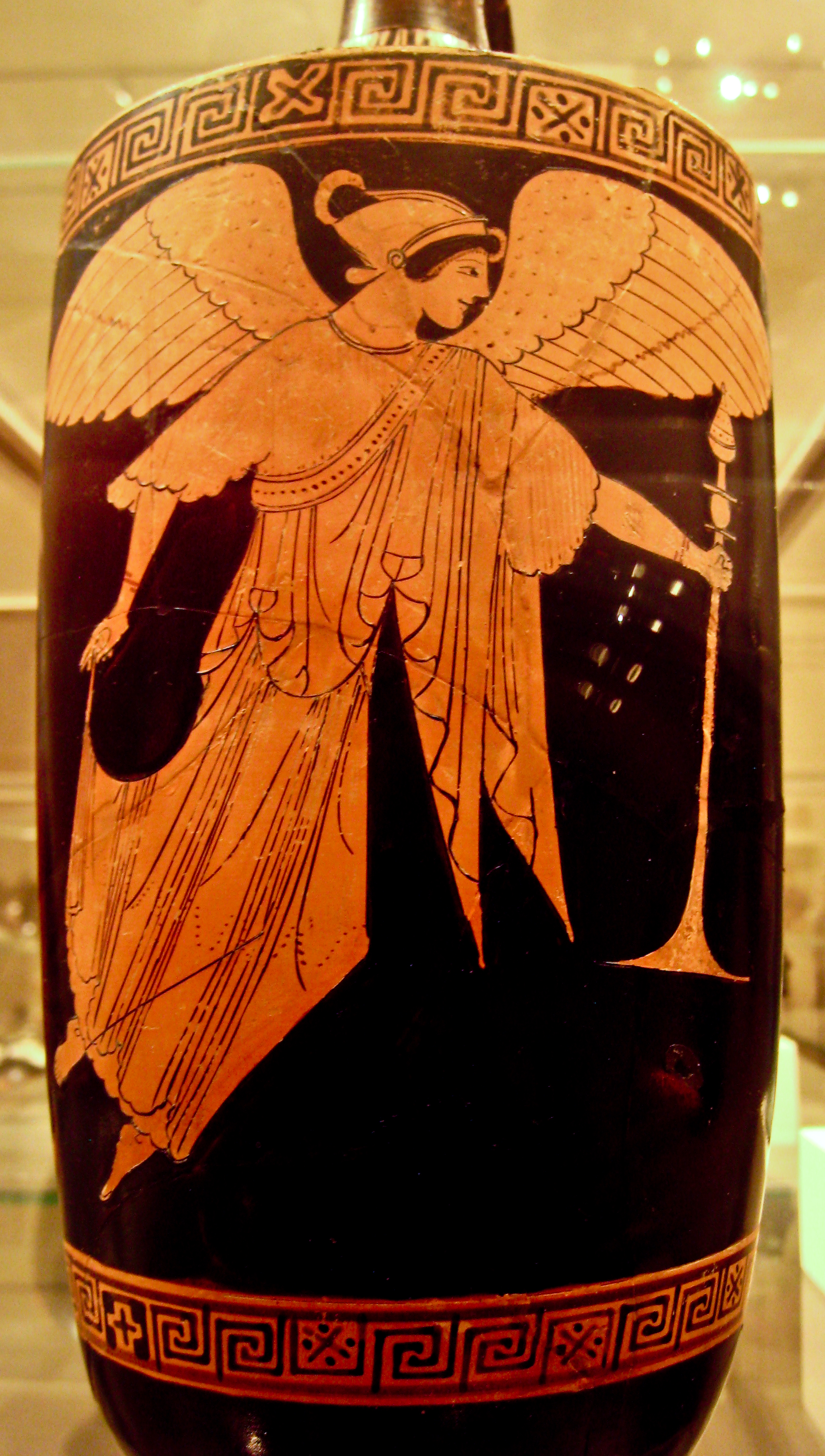
Nike, goddess of victory in battle and competition
Various lesser gods are specifically said to be winged, and ancient writers seem perfectly happy to mention this without seeming to put any negative connotation on it.
The difference here between wings and other animal parts lies largely in their specific symbolism in Greek mythology. Where other animal parts usually represent bestiality, wildness and a lack of civilization and humanity, bird-like wings instead often represent swiftness and the ability to be ever-present, making them obvious choices for gods whose job it is to be everywhere all the time or to rush to and fro on their divine errands. Gods that travel constantly, like Iris, have wings to illustrate their fleetness, while gods that are capable of being present wherever needed, like Eros and Nike as the bringers of love and victory, have wings to show that they can instantly travel to anyone's side. Gods of swiftly-moving natural phenomena also often appear with wings, such as the gods of the four winds and their offspring, or Hypnos and Thanatos, lords of sleep and death, who must travel the world unceasingly to bestow their gifts on mankind.
Basically, in Greek iconography, wings are usually meant to suggest that the god that possesses them has Psychopomp or otherwise travels a lot, rather than meaning they necessarily have anything to do with birds or Animal. In fact, gods that do have to do with birds, like Aphrodite with swans, Hera with peacocks or Apollo with ravens, usually don't appear with bird parts in spite of their association.
So having wings might, depending on your Storyteller's interpretation, be the one permanent animal feature that a young god of the Theoi can get away with without courting social repercussions (the dreaded Greek God Snub). It really depends on whether your ST believes that those gods literally have wings - which they very well might - or prefers the interpretation that those wings are an affectation of Greek artists rather than a literal truth, in which case having actual wings might still be a problem for you. It's also worth noting that only lesser-Legend Greek gods usually rock the wings, which is most likely because grunt-work jobs like carrying messages or presiding tirelessly over human affairs are somewhat beneath the greater gods of Olympus, who are too important to be worrying about someone else's problems all the time. If you do choose to have permanent wings, it's likely that the other Theoi will automatically assume you're jockeying for one of these kinds of jobs, and to assign you to them even if that's not what you wanted; and if you do manage to get away from all of that, they're probably going to start questioning why you're being weird and wearing wings for no apparent reason.
Of course, you can always have animal parts regardless of what the Theoi think about it - it's not illegal to be creature-like, just considered in poor taste. As a new Scion trying to carve out a place for yourself, you can always decide to pal around with the other rustic gods and decide to ignore those stuffy old rules the geezers up on the mountain care about so much, or try to become a beloved figure among the Greek gods and start changing the status quo to become more accepting of alternative styles of beauty. But if you're looking to have a permanent animal feature (with Bestial Nature or relics or whatever else) and want to avoid the whole messy Mean Girls-esque political situation, wings are your best bet.
Monday, December 9, 2013
Friday, November 22, 2013
Wife Swap
Question: If Metis comes back, what happens to Hera? Metis is the rightful wife of Zeus, so does Hera respect the sanctity of that union and back off, or fight for the sanctity of her own union?
Well, there are a few issues at work here.
The first is whether or not Metis actually ever was Zeus' wife. Hesiod does in fact refer to her as the first wife of Zeus in one passage. Apollodorus, on the other hand, claims that Metis tried to escape Zeus by shapechanging and that her conception of Athena was via rape, and nowhere mentions any permanent bond between them. Whether or not you consider them to have been married in the first place is really a matter of which source of the myth you prefer. It's not out of the question for Zeus to have married an ancient Titaness, especially one as useful to his newfound need to hold the throne as Metis, but then again the seek-and-seize attacks on women who then bear his children is one of Zeus' most traditional methods of relating to females.
If you do consider them married based on Hesiod, however, he also gives you the answer to the second part of the question: he, like everyone else, also calls Hera Zeus' wife, which he would not have done if she had been in any way considered not his legitimate spouse. Most of ancient Greece was monogamous, so it would not be likely for any of these ancient writers to consider Zeus married to more than one goddess at once. That means that if they consider Hera his legitimate wife, Metis must perforce no longer be considered so. That's most likely because Metis is effectively dead in Greek myth, because Zeus went ahead and ate her and that shit's pretty final; or, since most Greek deities weren't considered capable of dying, it might just be that the act of devouring your wife is a pretty clear declaration of divorce. Greek dudes could divorce their wives pretty easily, especially if there were problems with fidelity or children, and it's pretty clear that the ancient Greeks considered there to be an official break between Zeus and Metis at some point. Because, again... he ate her.
So no, Metis returning would not suddenly mean that Hera's position was necessarily threatened. She is Zeus' current, legitimate, by-law and by-bond wife, and the presence of Zeus' ex-wife (if you so assign her) won't suddenly change that. That union was broken before she ever married Zeus, or else she wouldn't have been able to marry him at all. It was totally possible for Greek men to have concubines while married, provided they didn't live with them and potentially disrupt the family unit, but there's a massive avalanche of evidence in Greek myth that Hera is definitely a wife and not a concubine, starting with the fact that no one ever fails to list her as his wife and ending with the fact that as the goddess of marriage and domesticity it would be massively counter to her very nature to fill that role. Zeus was once married to Metis, perhaps, but is not anymore.
That doesn't mean there couldn't be dramatic problems, of course, especially if Zeus decides he's interested in Metis again or vice versa. Zeus has the same problem he originally had with Metis - sleeping with her might lead to his downfall - so he may be able to control himself, and even if he does go for it he probably wouldn't divorce Hera since he's stuck with her through massive gymnastic numbers of affairs, but that won't make his potential interest in her less likely to piss Hera off (and maybe Metis, too, if Apollodorus is right and Zeus assaulted her). If Metis decides she wants Zeus again, we might be looking at an epic battle of Manipulation between her and Hera, as she tries to sway him to return to her and Hera tries to defend her marriage. Other gods might get involved, too, with those hoping to see Zeus go down trying to help get him together with Metis and those trying to protect him from himself doing their best to keep the two apart.
But as far as Hera goes, her marriage with Zeus is completely legal and current, and it's in her character and nature as a goddess to fight tooth and nail to keep it that way. Metis can't supplant her by just showing up, and is in for a rip-roaring fight if she wants to try to change the status quo.
Well, there are a few issues at work here.
The first is whether or not Metis actually ever was Zeus' wife. Hesiod does in fact refer to her as the first wife of Zeus in one passage. Apollodorus, on the other hand, claims that Metis tried to escape Zeus by shapechanging and that her conception of Athena was via rape, and nowhere mentions any permanent bond between them. Whether or not you consider them to have been married in the first place is really a matter of which source of the myth you prefer. It's not out of the question for Zeus to have married an ancient Titaness, especially one as useful to his newfound need to hold the throne as Metis, but then again the seek-and-seize attacks on women who then bear his children is one of Zeus' most traditional methods of relating to females.
If you do consider them married based on Hesiod, however, he also gives you the answer to the second part of the question: he, like everyone else, also calls Hera Zeus' wife, which he would not have done if she had been in any way considered not his legitimate spouse. Most of ancient Greece was monogamous, so it would not be likely for any of these ancient writers to consider Zeus married to more than one goddess at once. That means that if they consider Hera his legitimate wife, Metis must perforce no longer be considered so. That's most likely because Metis is effectively dead in Greek myth, because Zeus went ahead and ate her and that shit's pretty final; or, since most Greek deities weren't considered capable of dying, it might just be that the act of devouring your wife is a pretty clear declaration of divorce. Greek dudes could divorce their wives pretty easily, especially if there were problems with fidelity or children, and it's pretty clear that the ancient Greeks considered there to be an official break between Zeus and Metis at some point. Because, again... he ate her.
So no, Metis returning would not suddenly mean that Hera's position was necessarily threatened. She is Zeus' current, legitimate, by-law and by-bond wife, and the presence of Zeus' ex-wife (if you so assign her) won't suddenly change that. That union was broken before she ever married Zeus, or else she wouldn't have been able to marry him at all. It was totally possible for Greek men to have concubines while married, provided they didn't live with them and potentially disrupt the family unit, but there's a massive avalanche of evidence in Greek myth that Hera is definitely a wife and not a concubine, starting with the fact that no one ever fails to list her as his wife and ending with the fact that as the goddess of marriage and domesticity it would be massively counter to her very nature to fill that role. Zeus was once married to Metis, perhaps, but is not anymore.
That doesn't mean there couldn't be dramatic problems, of course, especially if Zeus decides he's interested in Metis again or vice versa. Zeus has the same problem he originally had with Metis - sleeping with her might lead to his downfall - so he may be able to control himself, and even if he does go for it he probably wouldn't divorce Hera since he's stuck with her through massive gymnastic numbers of affairs, but that won't make his potential interest in her less likely to piss Hera off (and maybe Metis, too, if Apollodorus is right and Zeus assaulted her). If Metis decides she wants Zeus again, we might be looking at an epic battle of Manipulation between her and Hera, as she tries to sway him to return to her and Hera tries to defend her marriage. Other gods might get involved, too, with those hoping to see Zeus go down trying to help get him together with Metis and those trying to protect him from himself doing their best to keep the two apart.
But as far as Hera goes, her marriage with Zeus is completely legal and current, and it's in her character and nature as a goddess to fight tooth and nail to keep it that way. Metis can't supplant her by just showing up, and is in for a rip-roaring fight if she wants to try to change the status quo.
Sunday, October 27, 2013
Brythonic Breeding
Question: I've heard that Merlin, of Athurian Myth, may have been an imported Zeus in ancient Brittonic times. I'm also curious, if Merlin were like this, would he have the same purviews he possessed in the Greek pantheon in addition to having Magic/Prophecy, or would Fate have changed things far too much?
Looks like someone has been reading Professor John Rhys. This is totally an opinion, so feel free to disagree with it, but: that guy is fucking crazy.
Actually, I have nothing against Rhys, who was a distinguished old scholar in the late nineteenth century and who did a lot of good work in the field of Celtic languages and folktales, but his views on Zeus are unorthodox, to say the least. You will not find much literature that links Merlin to Zeus other than Rhys' - in fact, there's hardly any, because it's not a theory that is shared by much of even the fringe community when it comes to Arthurian myth. Merlin is an enigmatic figure and it's a very popular notion among historians and mythographers that he might have roots in some Celtic deity or myth, but Zeus is usually not one of the people anyone is thinking about when they say that.
The evidence Rhys draws upon to link the two figures is sketchy at best. Being a linguist, he draws his conclusions from language, most prominently that he believed that the Irish Mac Og (a byname of Aengus) was the same root name as the Welsh Myrddin (which of course becomes Merlin after Geoffrey of Monmouth gets hold of it). Since he also believed that Mac Og and Zeus were the same (largely because both "overthrow" their fathers, Zeus in the Titanomachy and Mac Og in tricking the Dagda into giving up his home), it followed that Myrddin/Merlin, being Mac Og, must also be Zeus, albeit in a much later descended form. As for story evidence, Merlin turns Uther into Ygraine's husband in order to allow him to have sex with her without getting caught, which is similar to the myth in which Zeus turns himself into Alcmene's husband for the same reason, and Merlin was trapped by Nimue in an oak tree, which happens to be the tree sacred to Zeus. He also points to similarities between Greek temples to Zeus and Stonehenge, and theorizes that Stonehenge itself might have been dedicated to the worship of Merlin/Zeus.
There's a lot going on there, and not very much that we're particularly sold on, especially the root theory that Aengus and Zeus are the same dude (because they're not... like, at all). It's certainly possible, even likely, that Merlin has a basis in ancient mythology somewhere, and it's even possible that that mythology is from the more recent Greco-Roman imports instead of the native Celtic myths, but we don't think it's very likely. They just don't have very much in common, and the idea has been largely discarded in the last century or so of Celtic studies.
We'd suspect that Merlin is more likely to be an echo of one of the Celtic gods, especially one associated with magic or wizardry; maybe Manannan mac Lir or the Dagda or even Cernunnos. But, if you're really sold on the idea of Zeus-as-Merlin and we're just raining all over your Storytelling parade right now, it wouldn't be too far-fetched to decide that maybe Merlin was an Avatar form of Zeus, in which he decided to visit the World and meddle in the affairs of the northern Europeans for some reason, or even a Scion of Zeus (after all, Merlin is said to be half human!) who happens to resemble his father in a few key ways. The Fate half of your question is difficult to answer because we really don't think there's any way Zeus was worshiped as Merlin-a-god at any point so Fate doesn't give a damn about his associateds, but he already has Prophecy and probably at least a little bit of Magic for some of the shapechanging shenanigans he perpetrates on himself and others, so it wouldn't be much of a change even if you do go that route.
If you're going to roll with the wacky Merlin theory, we can only imagine you must have a truly amazing plot seed in mind.
Looks like someone has been reading Professor John Rhys. This is totally an opinion, so feel free to disagree with it, but: that guy is fucking crazy.
Actually, I have nothing against Rhys, who was a distinguished old scholar in the late nineteenth century and who did a lot of good work in the field of Celtic languages and folktales, but his views on Zeus are unorthodox, to say the least. You will not find much literature that links Merlin to Zeus other than Rhys' - in fact, there's hardly any, because it's not a theory that is shared by much of even the fringe community when it comes to Arthurian myth. Merlin is an enigmatic figure and it's a very popular notion among historians and mythographers that he might have roots in some Celtic deity or myth, but Zeus is usually not one of the people anyone is thinking about when they say that.
The evidence Rhys draws upon to link the two figures is sketchy at best. Being a linguist, he draws his conclusions from language, most prominently that he believed that the Irish Mac Og (a byname of Aengus) was the same root name as the Welsh Myrddin (which of course becomes Merlin after Geoffrey of Monmouth gets hold of it). Since he also believed that Mac Og and Zeus were the same (largely because both "overthrow" their fathers, Zeus in the Titanomachy and Mac Og in tricking the Dagda into giving up his home), it followed that Myrddin/Merlin, being Mac Og, must also be Zeus, albeit in a much later descended form. As for story evidence, Merlin turns Uther into Ygraine's husband in order to allow him to have sex with her without getting caught, which is similar to the myth in which Zeus turns himself into Alcmene's husband for the same reason, and Merlin was trapped by Nimue in an oak tree, which happens to be the tree sacred to Zeus. He also points to similarities between Greek temples to Zeus and Stonehenge, and theorizes that Stonehenge itself might have been dedicated to the worship of Merlin/Zeus.
There's a lot going on there, and not very much that we're particularly sold on, especially the root theory that Aengus and Zeus are the same dude (because they're not... like, at all). It's certainly possible, even likely, that Merlin has a basis in ancient mythology somewhere, and it's even possible that that mythology is from the more recent Greco-Roman imports instead of the native Celtic myths, but we don't think it's very likely. They just don't have very much in common, and the idea has been largely discarded in the last century or so of Celtic studies.
We'd suspect that Merlin is more likely to be an echo of one of the Celtic gods, especially one associated with magic or wizardry; maybe Manannan mac Lir or the Dagda or even Cernunnos. But, if you're really sold on the idea of Zeus-as-Merlin and we're just raining all over your Storytelling parade right now, it wouldn't be too far-fetched to decide that maybe Merlin was an Avatar form of Zeus, in which he decided to visit the World and meddle in the affairs of the northern Europeans for some reason, or even a Scion of Zeus (after all, Merlin is said to be half human!) who happens to resemble his father in a few key ways. The Fate half of your question is difficult to answer because we really don't think there's any way Zeus was worshiped as Merlin-a-god at any point so Fate doesn't give a damn about his associateds, but he already has Prophecy and probably at least a little bit of Magic for some of the shapechanging shenanigans he perpetrates on himself and others, so it wouldn't be much of a change even if you do go that route.
If you're going to roll with the wacky Merlin theory, we can only imagine you must have a truly amazing plot seed in mind.
Monday, October 21, 2013
What Runs in Your Blood
Question: Okay, so is it possible to have true Titanic Scions? I remember reading in the Grecian deluge myth that Prometheus had a demigod son.
No, it is not. Scions are specifically the children of gods; they are free of the taint of the Titans and made of equal parts divinity and humanity. Titans can corrupt humans to be their servants or have sex with humans to create Titanspawn offspring, but they can't make Scions. That ability lies with gods alone.
The person you are thinking of is Deucalion, so let's talk about him a little bit! There are actually a couple of Greek deluge myths, but Deucalion and his wife Pyrhha are the stars of the most famous one, in which Zeus floods the earth to destroy the people of the Bronze Age and only Prometheus' timely warning to his son allows the two of them to create an appropriate vessel and escape death. Deucalion and Pyrhha then repopulate the earth and foud a line of Grecian kings.
Greek heroes aren't always clearly labeled, and Deucalion is no exception. Apollodorus refers to him as "god-like", while Hyginus implies him to be part of the "human race"; Nonnus muddies the water by saying that "all mortal men perished" but Deucalion remained to repopulate with his wife. All different writers agree that Prometheus was Deucalion's father, while his mother is sometimes given as Pronoia (an Oceanid daughter of Oceanus and Tethys) but often goes mentioned. Deucalion does a lot of things that are Scion-esque, including receiving aid and favor from the gods to try to save himself from the flood, and he's considered to be dead but the manner of that death is never discussed, implying that he might have died of old age, a distinctly mortal condition. Pyrhha is clearly half-human, half-Titan, as a daughter of Epimetheus and Pandora, although depending on your take on the myth of Pandora's creation you might or might not consider her human.
All this certainly sounds like a Scion, but while we're totally down with running Deucalion as a Scion if you want to, we're not down with running him as the Scion of a Titan. That simply doesn't exist in Scion's framework - and shouldn't, in our opinion, because the creation of Scions is an important and unique feature of humanity that doesn't make sense for Titans, who are by definition no longer capable of interacting with humanity in that kind of close and positive way. This is a lot like that time we talked about Demeter trying to burn the mortality out of a kid with fire; Greek mythology (and every other mythology) occasionally does things that just don't fit into the game's world anywhere easily, because religions and gods are weird and you'll never be able to create a system that covers every ridiculous thing they've ever done, so if you want to reconcile it as a Storyteller, you have to be creative.
The first and most interesting option we'd explore is that Prometheus maybe wasn't a Titan at this point in time. While Pandora's existence tells us that this is after all his shenanigans with the stealing of sacrifices and dissemination of fire and earning Zeus' eternal hatred, Deucalion himself might still have been born before the battle lines between the two were drawn. Zeus himself helps Deucalion, which suggests that there are no hard feelings there. Prometheus is of course definitely of a Titanic generation, but he's also the same generation as Zeus (they're first cousins), so it's theoretically possible that he wasn't a Titan from the beginning and only defected later. Certainly he doesn't appear to have fought in the Titanomachy, and he's generally a more benevolent and unthreatening figure where humanity is concerned. If you go with that option, Deucalion really is just a normal Scion of Prometheus - possibly the only one that ever existed.
Another possibility is that Prometheus is Deucalion's father figuratively instead of literally, and that he's someone else's Scion (perhaps Zeus'?) that Prometheus acts as Guide or mentor for. We're not as big fans of this approach since Greek myth is very clear about repeating that Deucalion is Prometheus' son, but for those who want him to be Titanic from the very beginning but also want Deucalion to be a true Scion, this may be a useful compromise.
Or, you can also decide that Deucalion wasn't really a Scion at all, and proceed accordingly. He's very closely associated with humanity and rebuilding it after the flood, so maybe he was a Legendary mortal, created by Prometheus through the use of Artistry or other creative powers (which would explain why a mother is mentioned so seldom). Maybe he was a normal human that Prometheus decided to adopt, possibly because he married Pyrhha and therefore Prometheus felt some responsibility for her since he made her mother Pandora. Maybe he was actually a lesser immortal or Titanspawn of some kind or even a god, living in the World before the time that the gods left it for good; if his mother is an Oceanid, he could be one of the tritones, or any other kind of supernatural figure associated with water, which certainly couldn't hurt him in his quest to survive the great flood. The mortals that Deucalion engenders to repopulate the world aren't actually children of his but rather created from rock and earth, so he wouldn't need to be human in order to "create" human children in this way.
Honestly, this is one of those places where game rules don't match up and it's a pain in the ass. Use your best judgment, and best of luck to you.
No, it is not. Scions are specifically the children of gods; they are free of the taint of the Titans and made of equal parts divinity and humanity. Titans can corrupt humans to be their servants or have sex with humans to create Titanspawn offspring, but they can't make Scions. That ability lies with gods alone.
The person you are thinking of is Deucalion, so let's talk about him a little bit! There are actually a couple of Greek deluge myths, but Deucalion and his wife Pyrhha are the stars of the most famous one, in which Zeus floods the earth to destroy the people of the Bronze Age and only Prometheus' timely warning to his son allows the two of them to create an appropriate vessel and escape death. Deucalion and Pyrhha then repopulate the earth and foud a line of Grecian kings.
Greek heroes aren't always clearly labeled, and Deucalion is no exception. Apollodorus refers to him as "god-like", while Hyginus implies him to be part of the "human race"; Nonnus muddies the water by saying that "all mortal men perished" but Deucalion remained to repopulate with his wife. All different writers agree that Prometheus was Deucalion's father, while his mother is sometimes given as Pronoia (an Oceanid daughter of Oceanus and Tethys) but often goes mentioned. Deucalion does a lot of things that are Scion-esque, including receiving aid and favor from the gods to try to save himself from the flood, and he's considered to be dead but the manner of that death is never discussed, implying that he might have died of old age, a distinctly mortal condition. Pyrhha is clearly half-human, half-Titan, as a daughter of Epimetheus and Pandora, although depending on your take on the myth of Pandora's creation you might or might not consider her human.
All this certainly sounds like a Scion, but while we're totally down with running Deucalion as a Scion if you want to, we're not down with running him as the Scion of a Titan. That simply doesn't exist in Scion's framework - and shouldn't, in our opinion, because the creation of Scions is an important and unique feature of humanity that doesn't make sense for Titans, who are by definition no longer capable of interacting with humanity in that kind of close and positive way. This is a lot like that time we talked about Demeter trying to burn the mortality out of a kid with fire; Greek mythology (and every other mythology) occasionally does things that just don't fit into the game's world anywhere easily, because religions and gods are weird and you'll never be able to create a system that covers every ridiculous thing they've ever done, so if you want to reconcile it as a Storyteller, you have to be creative.
The first and most interesting option we'd explore is that Prometheus maybe wasn't a Titan at this point in time. While Pandora's existence tells us that this is after all his shenanigans with the stealing of sacrifices and dissemination of fire and earning Zeus' eternal hatred, Deucalion himself might still have been born before the battle lines between the two were drawn. Zeus himself helps Deucalion, which suggests that there are no hard feelings there. Prometheus is of course definitely of a Titanic generation, but he's also the same generation as Zeus (they're first cousins), so it's theoretically possible that he wasn't a Titan from the beginning and only defected later. Certainly he doesn't appear to have fought in the Titanomachy, and he's generally a more benevolent and unthreatening figure where humanity is concerned. If you go with that option, Deucalion really is just a normal Scion of Prometheus - possibly the only one that ever existed.
Another possibility is that Prometheus is Deucalion's father figuratively instead of literally, and that he's someone else's Scion (perhaps Zeus'?) that Prometheus acts as Guide or mentor for. We're not as big fans of this approach since Greek myth is very clear about repeating that Deucalion is Prometheus' son, but for those who want him to be Titanic from the very beginning but also want Deucalion to be a true Scion, this may be a useful compromise.
Or, you can also decide that Deucalion wasn't really a Scion at all, and proceed accordingly. He's very closely associated with humanity and rebuilding it after the flood, so maybe he was a Legendary mortal, created by Prometheus through the use of Artistry or other creative powers (which would explain why a mother is mentioned so seldom). Maybe he was a normal human that Prometheus decided to adopt, possibly because he married Pyrhha and therefore Prometheus felt some responsibility for her since he made her mother Pandora. Maybe he was actually a lesser immortal or Titanspawn of some kind or even a god, living in the World before the time that the gods left it for good; if his mother is an Oceanid, he could be one of the tritones, or any other kind of supernatural figure associated with water, which certainly couldn't hurt him in his quest to survive the great flood. The mortals that Deucalion engenders to repopulate the world aren't actually children of his but rather created from rock and earth, so he wouldn't need to be human in order to "create" human children in this way.
Honestly, this is one of those places where game rules don't match up and it's a pain in the ass. Use your best judgment, and best of luck to you.
Saturday, October 12, 2013
Political Pantheon Party!
Aha! I bet you thought we forgot to vlog today, didn't you? Shows what you know! Not only did we remember, we actually did a whole pile of vlogs in one day, so that if we end up in a scheduling crunch in the weeks to come, you won't go without answered questions and our cheerful faces.
Question: What would you guys think of a game where Scions deal with a number of NPCs in the world bringing their pantheons back to prominance, all the while secretly guarding Zeus's "successor"?
Question: Why does Hades have Epic Stamina associated?
Question: I'm a little bit intrigued by the Orisha. It's crazy how everyone is married to everyone. How does that really work? Are they a big happy family or what?
Question: I'm STing a game and my scions (of Hel, Hades and Odin) are getting to God soon, and I need some ideas on how to make their rise to God memorable.
Question: My scion of Izanagi is finding himself being attracted to Amaterasu. He blames his attraction on being named the god of the moon (Tsuki-Yomi died), so is this argument valid? Also, should he be disgusted with himself since he is attracted to his sister? Would she be his full or half sister, since Izanagi created her and her brothers?
Question: Hey, I noticed that in your Eastern Promises and Gangs of New York games you only allow your PCs to pick four pantheons that actually had some level of cultural interaction. Just wondering if any other major pantheons on your site that could have that kind of thing going on, like say the Celtic pantheons, for instance?
Question: In your games, when and how did the gods learn that the Titans had escaped? Was there some big explosion in the Underworld? Did they simply slip out unnoticed until someone actually checked and saw that they had flown the coop?
Question: The Aztecs have a god of homosexuality despite their obvious dislike of the concept. How does the rest of the pantheon treat him?
Question: Norse vs. Borgovi? SWEET! But, say Loki tricked Thor and Perun into a room together - what would happen? A SPECTACULAR light show, or lots of drinking? OR something else?
Question: Power and responsibility go hand in hand. And with every great decision comes regret. Regret for what could have been, should have been, and what ultimately was. What do the gods regret?
Today's vlog is about gods, pantheons and related issues of their politics and powers. Happy viewing!
Question: What would you guys think of a game where Scions deal with a number of NPCs in the world bringing their pantheons back to prominance, all the while secretly guarding Zeus's "successor"?
Question: Why does Hades have Epic Stamina associated?
Question: I'm a little bit intrigued by the Orisha. It's crazy how everyone is married to everyone. How does that really work? Are they a big happy family or what?
Question: I'm STing a game and my scions (of Hel, Hades and Odin) are getting to God soon, and I need some ideas on how to make their rise to God memorable.
Question: My scion of Izanagi is finding himself being attracted to Amaterasu. He blames his attraction on being named the god of the moon (Tsuki-Yomi died), so is this argument valid? Also, should he be disgusted with himself since he is attracted to his sister? Would she be his full or half sister, since Izanagi created her and her brothers?
Question: Hey, I noticed that in your Eastern Promises and Gangs of New York games you only allow your PCs to pick four pantheons that actually had some level of cultural interaction. Just wondering if any other major pantheons on your site that could have that kind of thing going on, like say the Celtic pantheons, for instance?
Question: In your games, when and how did the gods learn that the Titans had escaped? Was there some big explosion in the Underworld? Did they simply slip out unnoticed until someone actually checked and saw that they had flown the coop?
Question: The Aztecs have a god of homosexuality despite their obvious dislike of the concept. How does the rest of the pantheon treat him?
Question: Norse vs. Borgovi? SWEET! But, say Loki tricked Thor and Perun into a room together - what would happen? A SPECTACULAR light show, or lots of drinking? OR something else?
Question: Power and responsibility go hand in hand. And with every great decision comes regret. Regret for what could have been, should have been, and what ultimately was. What do the gods regret?
Today's vlog is about gods, pantheons and related issues of their politics and powers. Happy viewing!
Saturday, September 28, 2013
Librarian Glee!
John tagged me in for today's vlog, where I will be way too excited and jump around waving my favorite things in front of the camera. Join me!
Question: Some myths say Nut is the granddaughter of Ra, while others say she was his wife. Some myths say he stopped her from having children because he didn't want his throne taken over, others say it was because Ra was jealous of her sleeping with Geb. What's up?
Question: I understand that in your games, all of the different mythological origin stories are true. That being said, how do you tie in the fact that fossils of animals from millions of years ago, and thus don't match up, have been found?
Question: I had someone ask me the other day if a nuclear winter would be anything like Fimbulwintr from Norse mythology. In your opinion, could a nuclear winter trigger Ragnarok?
Question: Do you guys use the Order of the Divine Glory in your games? If so, how prevalent are they?
Question: Do you think Aphrodite's lack of purview's can be accounted for by a butt load of Arete in abilities such as presence and empathy and command that gives her supernatural power over peoples emotions without a purview or misplaced epic attributes.
Question: At least under one interpretation, Christians, Jews and Muslims are (inadvertent) Titan-worshipers (somewhat similar to how C. S. Lewis depicts Muslims as inadvertent demon-worshippers). Would the gods care about this? Would it matter for the Titans in question that they're being worshipped?
Question: Just wondering - have you guys ever used Neith in your games, and how would you handle her if you did?
Question: Do the Aesir have a god of dawn? I'm asking this because I'm making a NPC for my games who represents not the dawn itself, but renovation and new life, and dawn just looks like the perfect role for me. Any ideas? What associations do you think I could use?
Question: How do powers like Control Water affect water-based liquids like most alcoholic beverages or sodas?
Question: You mentioned in a post earlier in the year that divine parents grant Birthrights for purviews that they are not associated with, but what about the Animal purview for animals that no god currently has (such as extinct ones)? Would the Scion simply have to purchase the boons without having a corresponding relic?
If you're interested in joining me on cloud nine, Lacambalam, the codex artist, has a website here where he shows comparisons of his art to the originals, and a Flickr gallery here with prices and much better images of the codices than my webcam could give you.
Question: Some myths say Nut is the granddaughter of Ra, while others say she was his wife. Some myths say he stopped her from having children because he didn't want his throne taken over, others say it was because Ra was jealous of her sleeping with Geb. What's up?
Question: I understand that in your games, all of the different mythological origin stories are true. That being said, how do you tie in the fact that fossils of animals from millions of years ago, and thus don't match up, have been found?
Question: I had someone ask me the other day if a nuclear winter would be anything like Fimbulwintr from Norse mythology. In your opinion, could a nuclear winter trigger Ragnarok?
Question: Do you guys use the Order of the Divine Glory in your games? If so, how prevalent are they?
Question: Do you think Aphrodite's lack of purview's can be accounted for by a butt load of Arete in abilities such as presence and empathy and command that gives her supernatural power over peoples emotions without a purview or misplaced epic attributes.
Question: At least under one interpretation, Christians, Jews and Muslims are (inadvertent) Titan-worshipers (somewhat similar to how C. S. Lewis depicts Muslims as inadvertent demon-worshippers). Would the gods care about this? Would it matter for the Titans in question that they're being worshipped?
Question: Just wondering - have you guys ever used Neith in your games, and how would you handle her if you did?
Question: Do the Aesir have a god of dawn? I'm asking this because I'm making a NPC for my games who represents not the dawn itself, but renovation and new life, and dawn just looks like the perfect role for me. Any ideas? What associations do you think I could use?
Question: How do powers like Control Water affect water-based liquids like most alcoholic beverages or sodas?
Question: You mentioned in a post earlier in the year that divine parents grant Birthrights for purviews that they are not associated with, but what about the Animal purview for animals that no god currently has (such as extinct ones)? Would the Scion simply have to purchase the boons without having a corresponding relic?
If you're interested in joining me on cloud nine, Lacambalam, the codex artist, has a website here where he shows comparisons of his art to the originals, and a Flickr gallery here with prices and much better images of the codices than my webcam could give you.
Subscribe to:
Posts (Atom)