Question: We know the Orisha love Prophecy and Mystery (it's even in their PSP), but how do they feel about the Magic purview and the gods or Scions that use it?
To put it mildly, they are not big fans. The Orisha tend to shoot witches on sight and ask questions later, if they bother asking any questions at all instead of being relieved and having some celebratory palm wine.
Actually, their love of Prophecy and Mystery is tied into the same ideas here that probably make them extremely twitchy and unhappy around Magic. Yoruba religious philosophy holds that each person is born with a destiny to be achieved, chosen by them before their birth, but that they do not know its exact details. Each person is responsible for figuring out what to do in order to achieve their destiny in a sort of lifelong ongoing quest, and unlike in European cultures' conceptions of future and fate, the Yoruba are fully aware that this is not a foregone conclusion. It is entirely possibly to fail at one's destiny by not figuring out what you're supposed to do or even just not trying hard enough, and a failure to achieve your destiny means that you lived a literally wasted life, with no significance, importance or goodness to contribute to your people.
Since most normal people don't have a hotline to what Fate wants them to be doing, this is why divination, the practice of seeking oracular enlightenment, is so centrally important to the Orisha and their people. Seeking readings from prophets and oracles allows people to get small glimpses into what they're supposed to be doing and what it might be their destiny to achieve, giving them a significantly better chance of succeeding than if they just flailed around in the dark trying to guess what the best path might be. Orunmila, god of prophecy and enlightenment, has dedicated his entire existence to providing this all-important information to anyone who might need it, in tandem with Eshu, who despite being a seriously crazypants trickster who does a lot of things that make no sense just because he thinks its funn still takes that particular duty seriously most of the time. Even the other gods often stop to ask for divinations during their divine myths, looking for guidance as to what they need to be doing, such as when Obatala seeks a reading from Orunmila before he embarks on the journey that eventually lands him in Shango's dungeons or when Shango discovers his father's true identity through a divination and is able to set out to find him.
So, in the Yoruba religion, you have a bunch of people, including gods, who are striving to reach their all-important destinies, and who love to use Mystery and Prophecy to help guide them toward what they need to do in pursuit of that goal. When you introduce Magic, suddenly everything becomes problematic in a very, very big way.
Magic is the opposite of Prophecy and Mystery; instead of divining the will of Fate, it imposes itself upon Fate to twist it for its own ends, meaning that it directly confuses or perverts the intent of one or more peoples' destinies. Yoruba myth is replete with stories of witches, how terrible and dangerous they are, and how they have to be destroyed immediately for everyone's good; even in the modern day, believers in the Orisha visit priests when they experience a string of bad luck to ensure that they are not being afflicted by some witch's evil curse. If a being has the power to literally change your destiny, or at the very least confuse it so badly that you don't know which way is up, you're almost guaranteed not to be able to achieve it the way you were meant to.
So using Magic is basically the most anti-Orisha thing you can do, and they are not at all okay with it. Which is not to say that they don't have a few people among their ranks with that power; Oshun, in particular, is associated with the manipulation of destiny because she is the goddess of hairdressing, and destiny is according to Yoruba thought located in the ori or "head", meaning that to change your head is literally to change your fate, and similarly Eshu, who occasionally intentionally twists Orunmila's messages about fate for his own reasons (usually petty revenge), is known to be a weaver and worker. But as a generality, even though those gods are tentatively accepted because they never (or, in Eshu's case, seldom) use it for evil, it's an entire purview whose purpose is expressly to fuck the entire universe up. It ruins everything. It's the worst.
So, the Orisha are likely to look askance at anyone who demonstrates Magic under the best of circumstances, and to react with outright hostility and fear under the worst. Meddling in another person's destiny is perhaps the most serious sin you could commit to upset them, so while they aren't as likely to care if you just fuck around with your own fortune - after all, it's your problem if you screw up and can't figure out your destiny anymore - they will have very little tolerance for in any way manipulating someone else's. Even if you're behaving yourself, you're not likely to gain their trust; to them, you're walking around all the time wearing a giant ticking bomb strapped to yourself, and your constant assurance that it's okay, you're not going to use it isn't going to set very many of them at ease.
In our games, the Orisha have put up with a few Magic users in their vicinity out of necessity (particularly at the Kingsmoot, where they can't exactly start taking potshots at everyone else's viziers), but they aren't happy about it. Obatala in particular has been very vocal about wanting any "evil wizards" that might be nearby to be hunted down and destroyed, including Folkwardr, and only the fact that most of the major Magic gods are elsewhere trying to work on the Fate problem together has prevented probable violence from breaking out. Luckily, none of our Orisha Scions have ever been into Magic all that much except for poor Theo, and since he got eaten by Titans after only a fairly short career as a Scion, they're inclined to view him as having gotten his just deserts.
To be clear, it's not that you can't be a Scion of the Orisha and have Magic; you totally can, and several of them even pass it down as favored. But you'll be under constant surveillance and mistrusted by many, possibly all of the family members you deal with, so choose your powers - and how you use them! - wisely.

Showing posts with label Orisha. Show all posts
Showing posts with label Orisha. Show all posts
Wednesday, April 23, 2014

Thursday, March 27, 2014
Like Every Goddamn Question, Our Inbox Is So Full You Guys
It's time for another big fat post full of quickly-answered questions! Just know we love each and every one of you, question-askers, honest, and you can always ask for clarification in the comments if you didn't get what you were looking for.
Question: is there any mythological basis for Thor's greatest fear being a warm bed? (Just something I read in a novel).
Not that we know of, but we would hazard a guess that your book might be referring to the idea that Norse warriors aspired to die gloriously in battle, and would therefore be very unhappy with the idea of dying in bed.
Question: Sorry if this has already been covered, but doesn't Aengus have Artistry associated with him?
Nope, sure doesn't. While Aengus is theorized to be possibly associated with music and the arts, we don't have any real evidence of this and no stories of him being particularly artistic, so we did not give him the Avatar of Artistry. However, if your game likes a more artsy interpretation of Aengus, you can always assume he has some Artistry boons at his disposal.
Question: Months ago I asked why Cernunnos was so powerful because he had nine purviews. Rather than allude to his purviews this time, I'm just asking, why is he so powerful in general? Like, I know that he's the Horned God of Wicca, and I know he's a heavily occultic fertility deity, but based on his description in the Nemetondevos description, he seems like he should have intelligence and/or maybe wits as Associated as his attributes.
Cernunnos is undeniably the most recognizable (and therefore Legendary) of the Gaulish gods whose legends survive into the modern day, but unfortunately we don't really know all that much about him, nor do we have anything but piecemeal information about his associations and exploits. Cernunnos on our site is presented as an Odin-like patriarch because that's how he's written in the Scion Storyteller Screen, but honestly most of that is conjecture. You might want to check out this post about the problems of reconstructing Gaulish mythology.
Question: I want a sentient, witty, wise-cracking animal sidekick. Which would be better: creating a Follower or using Create Nemean/Typhonian? Thanks guys, love you guys and all your work!
Nemean and Typhonian creatures are generally not very bright or socially graceful, so you would probably want something smarter than that if you wanted a wise-cracking sidekick who you could actually have conversations with and hurl witty insults at enemies alongside. Birthright Creatures give you more opportunity to tailor your animal's stats to what you want it to do, and you can also use Epic Enhancement on them if you want to bolster any of their stats, so that's probably more what you're looking for.
Question: Was Anshar really evil? He kinda looks like a really senile sky god to me.
Anshar's clearly a Titan, so that really depends on whether or not you think all Titans are evil (we don't think so, although they are all pretty dangerous even if they aren't actively malicious). Like other ancient sky-father Titans, you could certainly play him as simply distant from and uninvolved in his pantheon.
Question: Are Dwarves and Svartalfar the same creature? Norse mythology is confusing.
No, but they do both live in Svartalfheim and some named svartalfar are occasionally also referred to or alluded to as dwarves, so the confusion is understandable. The Norse word for dwarves is dvergr, and is used to refer to creepy little short creatures that are crafty, morally questionable, and really awesome at making magical items like Mjolnir and Brisingamen. Svartalfar means "black elves" and is confusing because it's equated to both dverger and dokkalfar ("dark elves") in various places, which are fairly clearly attested as two different races, with the dark elves described as dwelling underground and being black of skin, and different in appearance from their light elf cousins.
Basically, some scholars think the svartalfar must be the same as the dvergr since they seem to live in the same or similar places and share some traits, but others point out that there are different terms and associations at work and that there's no reason to make that leap. So really, Storyteller's call on that one. We play them as different.
Question: Would it be possible for Artistry Gods to design relics that could enable Gods and Scions to better navigate the Titan Realms? Like relic goggles to give people temporary Epic Perception rankings to see around Keku? Or some kind of Fire-resistant suits to allow survival in Muspelheim?
Yep, sure is! Hephaestus actually made some flame-retardant armor for one of our groups to go to Muspelheim at one point. Artistry can make all kinds of neat stuff, although it's probably difficult and time-consuming to do so.
Question: When you have the Animal purview, you choose an animal to specialize in. We, in my game have been in minor fights about how specific you have to be. For example, the guy with Animal (Jackal) complaining over how he has less utility as the guy with Animal (Dog). Should one be penalized for being more general, or should I allow the more specialized guy to go outside the limits of his animal from time to time?
You might find this post helpful when trying to determine how specific an animal should be! Animals that are less commonly available do often have less utility than your Animal (Housefly) or Animal (Cow) people who can be fairly assured of their animals being around a lot, but Scions can always go seek out their animals at zoos, parks or in natural areas where they might occur, and of course at later levels they can summon or even create them at will. We do occasionally allow Scions with animals that are kind of close to try to use their boons on something that isn't technically their creature, but always at a disadvantage; for example, if your guy with Animal (Jackal) wanted to use his boons on a coyote, we would have him only understand some of what it was saying since the message would be garbled, or increase the difficulty of using other powers on it significantly to illustrate that he was trying to affect something that he isn't really aligned with.
Question: I know shape-shifting Appearance knacks makes this somewhat of a mote point, but for those Scion who don't invest in them, I was wondering what rolls would you make for disguise. And when say disguise, I'm taking about everything from putting on a wig and Groucho Marx glasses to applying Hollywood SFX prosthetics to change your race or sex.
It would depend on exactly what you were doing, but most of the time we would have you roll something along the lines of Appearance + Stealth or Manipulation + Stealth to actually sell the disguise itself, and probably a side order of Manipulation + Empathy and/or Wits + Empathy to not look suspicious while doing it. Tailor to individual Storyteller tastes.
Question: Can a scion with Animal Communication use social knacks on animals he can communicate with, or does he have to use Animal Obediance?
He has to use Animal Obedience, or else just be able to convince it to do what he wants through good old-fashioned charm. His refined powers of pulling a fast one on humanoids are lost on their animal brains.
Question: Have you ever considered a more free-form system for boons (e.g. Mage spheres or Dark Ages fae magic)? If you have, what worked? If you haven't, what would you imagine succeeding?
Nope, sorry. Spheres work pretty well in Mage, but we have no desire whatsoever to import them into Scion. You might want to check out the official forums, though, since we know there are a few games out there that do that sort of thing.
Question: What does the Darkness Virtue which Reverses Virtue due to the Inue? Nothing? Fire becoming Water? etc.
It reverses exactly; someone affected by Heart of Darkness with the Fire Virtue would abruptly have Anti-Fire. They would hate Fire in all its forms, attempt to stamp it out and campaign against its use and existence, and generally do everything that they could to destroy it with exactly as much fervor as they would normally want to protect and encourage it.
Question: What do you think the Godrealm and Underworld of the Orisha are?
You're looking for this post!
Question: How are Fatebonds handled with the Doppleganger boon from the Illusion tree? For example, say someone created a doppleganger of a fellow Scion and had the doppleganger interact with mortals--utilizing the boons it would have such as subtle knife and stolen face--would it be possible to incur a Fatebond in that way to the person being 'doppleganged'?
Question: Hello, John and Anne! Hope you guys are well. My group uses your resources and revisions on Scion (love 'em!) and I just recently started looking at the blog. You've answered a lot of questions that I've been curious about, and many that haven't even occurred to me. Now, I was wondering if you could answer another question, or if perhaps it's already been addressed. How exactly does a Fatebond work if you've stolen someone's face and then committed the acts that would Fatebond?
Fate is not fooled by your piddly doppelgaenger, nor your attempts to pretend you're someone else. It knows that the person being impersonated is not the one spending Legend, and therefore will not attach any Fatebonds to her; it also knows that you are the one spending Legend, so you're going to get the Fatebonds from doing so no matter what you look like. And before you ask, the same goes for any other way of impersonating someone or meddling with the free will of other people.
As always, jump into the comments if you're so moved.
Question: is there any mythological basis for Thor's greatest fear being a warm bed? (Just something I read in a novel).
Not that we know of, but we would hazard a guess that your book might be referring to the idea that Norse warriors aspired to die gloriously in battle, and would therefore be very unhappy with the idea of dying in bed.
Question: Sorry if this has already been covered, but doesn't Aengus have Artistry associated with him?
Nope, sure doesn't. While Aengus is theorized to be possibly associated with music and the arts, we don't have any real evidence of this and no stories of him being particularly artistic, so we did not give him the Avatar of Artistry. However, if your game likes a more artsy interpretation of Aengus, you can always assume he has some Artistry boons at his disposal.
Question: Months ago I asked why Cernunnos was so powerful because he had nine purviews. Rather than allude to his purviews this time, I'm just asking, why is he so powerful in general? Like, I know that he's the Horned God of Wicca, and I know he's a heavily occultic fertility deity, but based on his description in the Nemetondevos description, he seems like he should have intelligence and/or maybe wits as Associated as his attributes.
Cernunnos is undeniably the most recognizable (and therefore Legendary) of the Gaulish gods whose legends survive into the modern day, but unfortunately we don't really know all that much about him, nor do we have anything but piecemeal information about his associations and exploits. Cernunnos on our site is presented as an Odin-like patriarch because that's how he's written in the Scion Storyteller Screen, but honestly most of that is conjecture. You might want to check out this post about the problems of reconstructing Gaulish mythology.
Question: I want a sentient, witty, wise-cracking animal sidekick. Which would be better: creating a Follower or using Create Nemean/Typhonian? Thanks guys, love you guys and all your work!
Nemean and Typhonian creatures are generally not very bright or socially graceful, so you would probably want something smarter than that if you wanted a wise-cracking sidekick who you could actually have conversations with and hurl witty insults at enemies alongside. Birthright Creatures give you more opportunity to tailor your animal's stats to what you want it to do, and you can also use Epic Enhancement on them if you want to bolster any of their stats, so that's probably more what you're looking for.
Question: Was Anshar really evil? He kinda looks like a really senile sky god to me.
Anshar's clearly a Titan, so that really depends on whether or not you think all Titans are evil (we don't think so, although they are all pretty dangerous even if they aren't actively malicious). Like other ancient sky-father Titans, you could certainly play him as simply distant from and uninvolved in his pantheon.
Question: Are Dwarves and Svartalfar the same creature? Norse mythology is confusing.
No, but they do both live in Svartalfheim and some named svartalfar are occasionally also referred to or alluded to as dwarves, so the confusion is understandable. The Norse word for dwarves is dvergr, and is used to refer to creepy little short creatures that are crafty, morally questionable, and really awesome at making magical items like Mjolnir and Brisingamen. Svartalfar means "black elves" and is confusing because it's equated to both dverger and dokkalfar ("dark elves") in various places, which are fairly clearly attested as two different races, with the dark elves described as dwelling underground and being black of skin, and different in appearance from their light elf cousins.
Basically, some scholars think the svartalfar must be the same as the dvergr since they seem to live in the same or similar places and share some traits, but others point out that there are different terms and associations at work and that there's no reason to make that leap. So really, Storyteller's call on that one. We play them as different.
Question: Would it be possible for Artistry Gods to design relics that could enable Gods and Scions to better navigate the Titan Realms? Like relic goggles to give people temporary Epic Perception rankings to see around Keku? Or some kind of Fire-resistant suits to allow survival in Muspelheim?
Yep, sure is! Hephaestus actually made some flame-retardant armor for one of our groups to go to Muspelheim at one point. Artistry can make all kinds of neat stuff, although it's probably difficult and time-consuming to do so.
Question: When you have the Animal purview, you choose an animal to specialize in. We, in my game have been in minor fights about how specific you have to be. For example, the guy with Animal (Jackal) complaining over how he has less utility as the guy with Animal (Dog). Should one be penalized for being more general, or should I allow the more specialized guy to go outside the limits of his animal from time to time?
You might find this post helpful when trying to determine how specific an animal should be! Animals that are less commonly available do often have less utility than your Animal (Housefly) or Animal (Cow) people who can be fairly assured of their animals being around a lot, but Scions can always go seek out their animals at zoos, parks or in natural areas where they might occur, and of course at later levels they can summon or even create them at will. We do occasionally allow Scions with animals that are kind of close to try to use their boons on something that isn't technically their creature, but always at a disadvantage; for example, if your guy with Animal (Jackal) wanted to use his boons on a coyote, we would have him only understand some of what it was saying since the message would be garbled, or increase the difficulty of using other powers on it significantly to illustrate that he was trying to affect something that he isn't really aligned with.
Question: I know shape-shifting Appearance knacks makes this somewhat of a mote point, but for those Scion who don't invest in them, I was wondering what rolls would you make for disguise. And when say disguise, I'm taking about everything from putting on a wig and Groucho Marx glasses to applying Hollywood SFX prosthetics to change your race or sex.
It would depend on exactly what you were doing, but most of the time we would have you roll something along the lines of Appearance + Stealth or Manipulation + Stealth to actually sell the disguise itself, and probably a side order of Manipulation + Empathy and/or Wits + Empathy to not look suspicious while doing it. Tailor to individual Storyteller tastes.
Question: Can a scion with Animal Communication use social knacks on animals he can communicate with, or does he have to use Animal Obediance?
He has to use Animal Obedience, or else just be able to convince it to do what he wants through good old-fashioned charm. His refined powers of pulling a fast one on humanoids are lost on their animal brains.
Question: Have you ever considered a more free-form system for boons (e.g. Mage spheres or Dark Ages fae magic)? If you have, what worked? If you haven't, what would you imagine succeeding?
Nope, sorry. Spheres work pretty well in Mage, but we have no desire whatsoever to import them into Scion. You might want to check out the official forums, though, since we know there are a few games out there that do that sort of thing.
Question: What does the Darkness Virtue which Reverses Virtue due to the Inue? Nothing? Fire becoming Water? etc.
It reverses exactly; someone affected by Heart of Darkness with the Fire Virtue would abruptly have Anti-Fire. They would hate Fire in all its forms, attempt to stamp it out and campaign against its use and existence, and generally do everything that they could to destroy it with exactly as much fervor as they would normally want to protect and encourage it.
Question: What do you think the Godrealm and Underworld of the Orisha are?
You're looking for this post!
Question: How are Fatebonds handled with the Doppleganger boon from the Illusion tree? For example, say someone created a doppleganger of a fellow Scion and had the doppleganger interact with mortals--utilizing the boons it would have such as subtle knife and stolen face--would it be possible to incur a Fatebond in that way to the person being 'doppleganged'?
Question: Hello, John and Anne! Hope you guys are well. My group uses your resources and revisions on Scion (love 'em!) and I just recently started looking at the blog. You've answered a lot of questions that I've been curious about, and many that haven't even occurred to me. Now, I was wondering if you could answer another question, or if perhaps it's already been addressed. How exactly does a Fatebond work if you've stolen someone's face and then committed the acts that would Fatebond?
Fate is not fooled by your piddly doppelgaenger, nor your attempts to pretend you're someone else. It knows that the person being impersonated is not the one spending Legend, and therefore will not attach any Fatebonds to her; it also knows that you are the one spending Legend, so you're going to get the Fatebonds from doing so no matter what you look like. And before you ask, the same goes for any other way of impersonating someone or meddling with the free will of other people.
As always, jump into the comments if you're so moved.
Sunday, February 23, 2014
Lovely Lady of the Waves
Question: In Brazil, Iemanjá is perharps the most widely worshiped Orisha. Do you guys consider she's Legend 11 or 10, or is it more like in the Core where she's just an aspect of the water Titan Mami Wata?
Oh, we would definitely say she's much too important to be only Legend 10 or 11. Yemaja (or Iemanja, or Yemaya, or about ten other variations on her name) is a pivotally important figure in Orisha mythology and religions like Candomble that descended from it, and the mother of half the pantheon to boot.
We're most inclined to treat Yemanja as a Titan. She's definitely of the older generations of the Orisha, and while that doesn't automatically mean she has to be a Titan (after all, Obatala isn't!), it does position her as a primordial mother figure to many of the other gods, a role that Titans often fill. In addition, in Yoruba mythology she has a very troubled relationship with the rest of the Orisha thanks to her assault and rape by her son Orungan, after which she gave birth to most of the other major Orisha (including Ogun, Shango, Oshun and Oya) in the midst of her trauma (or, depending on the interpretation of the myth, as a result of committing suicide to escape Orungan). Being assaulted by her children and then giving birth to the rest of them as a direct result of that assault is not likely to make her be very invested in wanting to be a part of the pantheon, and she has more than enough reason to act toward them in enmity, or at least indifference to their problems.
There's a lot of interesting historical discussion going on about exactly what happened with Yemanja and her cult in the African diaspora. She was a fairly important, but not all-important, goddess in pre-slavery Yoruba society; she did have her shrines and worshipers, but as the older mother-goddess she was more of a figure of story than a currently active power, and the prevalence of other local river-goddesses made her less necessary as a major water functionary. When large numbers of Yoruba people were captured and taken as slaves across the Atlantic Ocean, Yemanja, as the mother goddess of water, was possibly called upon to intercede for them or help take care of them during the journey, and it's possible that she became much more important for those who had to cross the ocean and thrive in a new land under terrible conditions than she had been for those in the motherland for whom the status quo had not changed so drastically. Because there was also an ocean god in play - Olokun, who later probably became Agwe - it's also likely that Yemanja and Olokun shared some legendary aspects during the crossing and affected one anothers' cults, leading to Yemanja rising in supremacy while Olokun diminished in the New World. Yemanja therefore has an importance in South America that she perhaps didn't have in Africa, which results in more worship there than she might have had in traditional Yorube religion.
However, we've never liked calling her just a part of Mami Wata. While Mami Wata figures are widespread across various West African cultures and their diaspora peoples, they often represent water goddesses that have been heavily altered by syncretization or lost to historical omission of previous religions, and that doesn't apply much to the Orisha, who not only have and remember Yemanja quite well but also other major water deities like Oshun, Oya, Oba or Erinle (indeed, Mami Wata is a figure borrowed from other coastal African peoples, not a native Yoruba figure). Mami Wata is a comparatively younger creature as well as a more narrow interpretation of what a water goddess might do and represent (i.e., often she is a siren-like bombshell but lacks Yemanja's connotations of motherhood or sustenance of life), and with Yemanja having such a central and important place in Yoruba mythology, it doesn't make much sense to us to remove her and replace her with an only somewhat-related figure who isn't really from the same culture in the first place.
So we do consider Yemanja to probably be a Titan, but she doesn't necessarily have all that much to do with the original books' Mami Wata. If anything, Mami Wata would be an aspect of Yemanja and not the other way around.
Oh, we would definitely say she's much too important to be only Legend 10 or 11. Yemaja (or Iemanja, or Yemaya, or about ten other variations on her name) is a pivotally important figure in Orisha mythology and religions like Candomble that descended from it, and the mother of half the pantheon to boot.
We're most inclined to treat Yemanja as a Titan. She's definitely of the older generations of the Orisha, and while that doesn't automatically mean she has to be a Titan (after all, Obatala isn't!), it does position her as a primordial mother figure to many of the other gods, a role that Titans often fill. In addition, in Yoruba mythology she has a very troubled relationship with the rest of the Orisha thanks to her assault and rape by her son Orungan, after which she gave birth to most of the other major Orisha (including Ogun, Shango, Oshun and Oya) in the midst of her trauma (or, depending on the interpretation of the myth, as a result of committing suicide to escape Orungan). Being assaulted by her children and then giving birth to the rest of them as a direct result of that assault is not likely to make her be very invested in wanting to be a part of the pantheon, and she has more than enough reason to act toward them in enmity, or at least indifference to their problems.
There's a lot of interesting historical discussion going on about exactly what happened with Yemanja and her cult in the African diaspora. She was a fairly important, but not all-important, goddess in pre-slavery Yoruba society; she did have her shrines and worshipers, but as the older mother-goddess she was more of a figure of story than a currently active power, and the prevalence of other local river-goddesses made her less necessary as a major water functionary. When large numbers of Yoruba people were captured and taken as slaves across the Atlantic Ocean, Yemanja, as the mother goddess of water, was possibly called upon to intercede for them or help take care of them during the journey, and it's possible that she became much more important for those who had to cross the ocean and thrive in a new land under terrible conditions than she had been for those in the motherland for whom the status quo had not changed so drastically. Because there was also an ocean god in play - Olokun, who later probably became Agwe - it's also likely that Yemanja and Olokun shared some legendary aspects during the crossing and affected one anothers' cults, leading to Yemanja rising in supremacy while Olokun diminished in the New World. Yemanja therefore has an importance in South America that she perhaps didn't have in Africa, which results in more worship there than she might have had in traditional Yorube religion.
However, we've never liked calling her just a part of Mami Wata. While Mami Wata figures are widespread across various West African cultures and their diaspora peoples, they often represent water goddesses that have been heavily altered by syncretization or lost to historical omission of previous religions, and that doesn't apply much to the Orisha, who not only have and remember Yemanja quite well but also other major water deities like Oshun, Oya, Oba or Erinle (indeed, Mami Wata is a figure borrowed from other coastal African peoples, not a native Yoruba figure). Mami Wata is a comparatively younger creature as well as a more narrow interpretation of what a water goddess might do and represent (i.e., often she is a siren-like bombshell but lacks Yemanja's connotations of motherhood or sustenance of life), and with Yemanja having such a central and important place in Yoruba mythology, it doesn't make much sense to us to remove her and replace her with an only somewhat-related figure who isn't really from the same culture in the first place.
So we do consider Yemanja to probably be a Titan, but she doesn't necessarily have all that much to do with the original books' Mami Wata. If anything, Mami Wata would be an aspect of Yemanja and not the other way around.
Saturday, February 8, 2014
Fighting the Good Fight
Iiiiit's vlog time! Today we have those fancy new lights and I look less like a zombie, but I'm also on pain drugs so I sound a little bit more like a crazy person than usual. Trade-off. Next week I hope to be more functional, and of course John is here being a helpful rock of sanity.
Today's questions are on a bunch of topics including Titans, relics and politics, but they're all about the greater world of Scion at large. So here we go!
Question: In your games, I'm assuming that the gods are very much besieged on all sides by Titanrealms and Avatars aplenty, and the corebooks make a point of saying how Avatars have to stay in their realms most of the time to avoid being rebound. My question is, if the terrifying nature of the Titanrealms is what is preventing various pantheons from attacking them en masse, what is it that's preventing Avatars from doing the same to the gods? Do Overworlds (and Underworlds, I guess) have similar built-in defenses?
Question: Why do relics bite when not bound to you? There seem to be multiple myths where people take each others' weapons and use them, and I can't name any where that has actually damaged the person (without the involvement of a curse/geasa).
Question: How do you deal with gods that have unique powers that don't seem to fit in with any of the purviews? The best examples I can come up with are mostly from the Deva. For example, Shiva's "Destructo-Eye?" The guy opens his third eye and shit just blows up! How does one make that happen in Scion? For that matter, Shiva and Kali are both known for their destructive dances wherein they dance and the world just starts to fall apart. How do these things work in your system?
Question: How would you represent Diomedes in Scion, given how he's Mr. "I'm totally a mortal man but I'm so badass that I fuck up Scions and gods alike, and then Athena made me into a god when I died?" I mean, the dude got in a fight with *Ares* and kicked his ass!
Question: I've been doing some (admittedly small) amount of research into the Orisha. Is Courage really a valid Virtue for them? They certainly talk a big game, but most of their conflicts are tricks and pranks against each other rather than huge monsters (compare to the Theoi). At the same time, they seem to highly value Intellect. Particularly with Orunmila.
Question: Could the Olympic Games have been a Birthright? It may sound stupid, but you've discussed relic songs before, and your Birthright PDF has a Shinto shrine for the Kami. Could Zeus have gotten some cool bonuses when mortals dedicated their great victories in his honor?
Question: This might be a weird question, but what are the likely consequences (politically) when a Titan (and its Avatar) manages to overpower a pantheon?
Question: How do you guys feel about the idea of making Titanrealms a one-per-purview deal? Currently I'm having to choose between one realm per pantheon (where the realms don't match up to purviews, e.g. the Kami opposed by the realm of corruption) and one per purview (e.g. the kami are opposed by Izanami as a death titan but the realm itself is split between them and the K'uh), and I can't decide which I prefer. What do you think?
Question: So my game master is most likely planning to have my character's godly parent marry her away as part of inter-pantheon politics. I know how common a practice that has been through time; is that something you have dealt with before? I'd like to know more about how the gods use their children in the politics game now that it has expanded so much since the start of the war.
Question: So, among a handful of us, "Goddamnit, Stribog" has become a touch memetic. What the chuffing hell is he doing?
Oh, Stribog. I know the players hope you never change.
Today's questions are on a bunch of topics including Titans, relics and politics, but they're all about the greater world of Scion at large. So here we go!
Question: In your games, I'm assuming that the gods are very much besieged on all sides by Titanrealms and Avatars aplenty, and the corebooks make a point of saying how Avatars have to stay in their realms most of the time to avoid being rebound. My question is, if the terrifying nature of the Titanrealms is what is preventing various pantheons from attacking them en masse, what is it that's preventing Avatars from doing the same to the gods? Do Overworlds (and Underworlds, I guess) have similar built-in defenses?
Question: Why do relics bite when not bound to you? There seem to be multiple myths where people take each others' weapons and use them, and I can't name any where that has actually damaged the person (without the involvement of a curse/geasa).
Question: How do you deal with gods that have unique powers that don't seem to fit in with any of the purviews? The best examples I can come up with are mostly from the Deva. For example, Shiva's "Destructo-Eye?" The guy opens his third eye and shit just blows up! How does one make that happen in Scion? For that matter, Shiva and Kali are both known for their destructive dances wherein they dance and the world just starts to fall apart. How do these things work in your system?
Question: How would you represent Diomedes in Scion, given how he's Mr. "I'm totally a mortal man but I'm so badass that I fuck up Scions and gods alike, and then Athena made me into a god when I died?" I mean, the dude got in a fight with *Ares* and kicked his ass!
Question: I've been doing some (admittedly small) amount of research into the Orisha. Is Courage really a valid Virtue for them? They certainly talk a big game, but most of their conflicts are tricks and pranks against each other rather than huge monsters (compare to the Theoi). At the same time, they seem to highly value Intellect. Particularly with Orunmila.
Question: Could the Olympic Games have been a Birthright? It may sound stupid, but you've discussed relic songs before, and your Birthright PDF has a Shinto shrine for the Kami. Could Zeus have gotten some cool bonuses when mortals dedicated their great victories in his honor?
Question: This might be a weird question, but what are the likely consequences (politically) when a Titan (and its Avatar) manages to overpower a pantheon?
Question: How do you guys feel about the idea of making Titanrealms a one-per-purview deal? Currently I'm having to choose between one realm per pantheon (where the realms don't match up to purviews, e.g. the Kami opposed by the realm of corruption) and one per purview (e.g. the kami are opposed by Izanami as a death titan but the realm itself is split between them and the K'uh), and I can't decide which I prefer. What do you think?
Question: So my game master is most likely planning to have my character's godly parent marry her away as part of inter-pantheon politics. I know how common a practice that has been through time; is that something you have dealt with before? I'd like to know more about how the gods use their children in the politics game now that it has expanded so much since the start of the war.
Question: So, among a handful of us, "Goddamnit, Stribog" has become a touch memetic. What the chuffing hell is he doing?
Oh, Stribog. I know the players hope you never change.
Sunday, December 15, 2013
High-Level Conflict
Question: What would happen if Cernunnos and Eshu fought against each other? Both deities have very unique reputations among the gods, and both deities have an absurd number of purviews, not to mention that they both seem to be very magic-heavy. Also, what would a battle of wills and minds be like between them?
Why not invite Tezcatlipoca, too, and make it a party?
Honestly, as usual with these who-would-win-in-a-fight questions, there's no real answer to this one. Both gods have so many powers and possibilities at their command that trying to guess which one would be used when is an exercise in futility, and why they're fighting, when and where and who else is around could all potentially make a very big difference as well. And, as is usually the case with gods who are not generally meatheads, these two would probably never actually up and fight one another. That would be dangerous. Someone could get hurt. Much better idea to just subtly ruin one anothers' lives remotely in an ever-escalating war of influence, shenanigans and Fate-tweaking.
Sorry we don't have much more for you than that. Your imagination will have to run wild without us.
Why not invite Tezcatlipoca, too, and make it a party?
Honestly, as usual with these who-would-win-in-a-fight questions, there's no real answer to this one. Both gods have so many powers and possibilities at their command that trying to guess which one would be used when is an exercise in futility, and why they're fighting, when and where and who else is around could all potentially make a very big difference as well. And, as is usually the case with gods who are not generally meatheads, these two would probably never actually up and fight one another. That would be dangerous. Someone could get hurt. Much better idea to just subtly ruin one anothers' lives remotely in an ever-escalating war of influence, shenanigans and Fate-tweaking.
Sorry we don't have much more for you than that. Your imagination will have to run wild without us.
Monday, November 25, 2013
The Source of Saturday
Question: Can you recommend a good source for the Baron Samedi-Samhain connection theory you once mentioned?
Actually, no, although I can tell you where we tripped over it. This is one of those theories that is floating around and referenced by several different works, but that is never visited in-depth enough that we could say, "Oh, here's the book/article/whatever that explains it thoroughly."
For those who haven't seen us mention it before, the basic gist of the theory is that Baron Samedi, a New-World-only loa with no African roots that we know of who seems to have sprung up out of nowhere to become part of his current religion, is influenced by or even a later version of the lesser Irish god Samhain, who was brought over by Irish migrant workers and indentured servants who shared their stories with the local African slaves, thus creating a modern synthesis deity where none had existed before.
We first ran into the idea of Irish influence on African diaspora religions in Margarite Olmos & Lizabeth Paravisini-Gebert's Creole Religions of the Caribbean, which does not mention Irish influence on the Baron but does point out that his wife, Maman Brigitte, has been pretty obviously influenced by the Irish Brigid and that the rainbow-goddess Ayeda Wedo has gained a few suspiciously Celtic traits, most noticeably the legend that her crown or treasure may be found at the end of the rainbow (and, incidentally, Ayeda is married to Damballah, who is frequently associated with the Irish Saint Patrick because of the former's status as a god of serpents and the latter's famous exploits driving said serpents out of Ireland). From the other end of the spectrum, Sean O'Callaghan's To Hell or Barbados, which is mainly concerned with the cultural movement of Irish people displaced or forced into slavery in the Americas in the seventeenth century, spends some time discussing the influence of Irish myth and religious practices on both indigenous people and African diaspora slaves that they came into contact with, including a nod to the Baron. We've also seen the Samedi theory pop up in various books on modern vodun worship, but not much from the scholarly end of the spectrum, so I don't have a great citation for you there.
Maman Brigitte's Irish roots are much easier to find information on, and you can usually find at least a throwaway line about how Brigid probably influenced her in both diaspora religion texts that mention that Brigid might have been imported to color Maman Brigitte and Irish mythology texts that mention that Maman Brigitte may be a much later form of the older Brigid (in particular, they often cite Maman Brigitte's connection with death as possibly being descended from Brigid's invention of mourning for her slain son Ruadan). Her clearer connection to Celtic myth doesn't necessarily mean that her husband also came from the isles, of course, especially given the cavalier mix-and-match of American religions around that time period, but it still does paint a picture of some filtered European influence from that area in Loa that don't occur in the old African religions.
Basically, to us it looks like a theory someone once came up with that a lot of people said, "Hey, that might be plausible, neat!" but then no one ever actually did any thorough research or wrote any authoritative paper on it, so it remains ethereal and homeless in the scholarly community.
We like to use the theory of an Irish-based Baron Samedi (because what other theories do we even have about that guy?)and Maman Brigitte as an in-game universe explanation for where the "rootless" gods of the American religions might have come from, but it's only a theory, and not a very solid one at that. No one should confuse it for gospel truth, and while we might use it as an in-game plot device, it would be super religiously incorrect (not to mention very douchey) to try to use it to tell actual modern-day worshipers of vodun that any of their loa don't "belong to them" or are otherwise secretly Europeans in disguise. Even those gods who clearly do have European influence in their history are firmly part of the diaspora religions now and have their own unique character and religious importance.
So for us, in the game world where gods are discrete beings who can run around and do things and be interacted with as characters, Samedi and Brigitte are former members of the Tuatha who migrated to the New World and reinvented themselves as loa who spend their time bolstering the ranks of the Orisha; but don't go extending that to how real people might experience their religions in the real world. We like our games rooted in authenticity, but they're still just games, and like everyone else on the planet, sometimes we just have to take a guess and pick the theory we like most.
Actually, no, although I can tell you where we tripped over it. This is one of those theories that is floating around and referenced by several different works, but that is never visited in-depth enough that we could say, "Oh, here's the book/article/whatever that explains it thoroughly."
For those who haven't seen us mention it before, the basic gist of the theory is that Baron Samedi, a New-World-only loa with no African roots that we know of who seems to have sprung up out of nowhere to become part of his current religion, is influenced by or even a later version of the lesser Irish god Samhain, who was brought over by Irish migrant workers and indentured servants who shared their stories with the local African slaves, thus creating a modern synthesis deity where none had existed before.
We first ran into the idea of Irish influence on African diaspora religions in Margarite Olmos & Lizabeth Paravisini-Gebert's Creole Religions of the Caribbean, which does not mention Irish influence on the Baron but does point out that his wife, Maman Brigitte, has been pretty obviously influenced by the Irish Brigid and that the rainbow-goddess Ayeda Wedo has gained a few suspiciously Celtic traits, most noticeably the legend that her crown or treasure may be found at the end of the rainbow (and, incidentally, Ayeda is married to Damballah, who is frequently associated with the Irish Saint Patrick because of the former's status as a god of serpents and the latter's famous exploits driving said serpents out of Ireland). From the other end of the spectrum, Sean O'Callaghan's To Hell or Barbados, which is mainly concerned with the cultural movement of Irish people displaced or forced into slavery in the Americas in the seventeenth century, spends some time discussing the influence of Irish myth and religious practices on both indigenous people and African diaspora slaves that they came into contact with, including a nod to the Baron. We've also seen the Samedi theory pop up in various books on modern vodun worship, but not much from the scholarly end of the spectrum, so I don't have a great citation for you there.
Maman Brigitte's Irish roots are much easier to find information on, and you can usually find at least a throwaway line about how Brigid probably influenced her in both diaspora religion texts that mention that Brigid might have been imported to color Maman Brigitte and Irish mythology texts that mention that Maman Brigitte may be a much later form of the older Brigid (in particular, they often cite Maman Brigitte's connection with death as possibly being descended from Brigid's invention of mourning for her slain son Ruadan). Her clearer connection to Celtic myth doesn't necessarily mean that her husband also came from the isles, of course, especially given the cavalier mix-and-match of American religions around that time period, but it still does paint a picture of some filtered European influence from that area in Loa that don't occur in the old African religions.
Basically, to us it looks like a theory someone once came up with that a lot of people said, "Hey, that might be plausible, neat!" but then no one ever actually did any thorough research or wrote any authoritative paper on it, so it remains ethereal and homeless in the scholarly community.
We like to use the theory of an Irish-based Baron Samedi (because what other theories do we even have about that guy?)and Maman Brigitte as an in-game universe explanation for where the "rootless" gods of the American religions might have come from, but it's only a theory, and not a very solid one at that. No one should confuse it for gospel truth, and while we might use it as an in-game plot device, it would be super religiously incorrect (not to mention very douchey) to try to use it to tell actual modern-day worshipers of vodun that any of their loa don't "belong to them" or are otherwise secretly Europeans in disguise. Even those gods who clearly do have European influence in their history are firmly part of the diaspora religions now and have their own unique character and religious importance.
So for us, in the game world where gods are discrete beings who can run around and do things and be interacted with as characters, Samedi and Brigitte are former members of the Tuatha who migrated to the New World and reinvented themselves as loa who spend their time bolstering the ranks of the Orisha; but don't go extending that to how real people might experience their religions in the real world. We like our games rooted in authenticity, but they're still just games, and like everyone else on the planet, sometimes we just have to take a guess and pick the theory we like most.
Saturday, October 12, 2013
Political Pantheon Party!
Aha! I bet you thought we forgot to vlog today, didn't you? Shows what you know! Not only did we remember, we actually did a whole pile of vlogs in one day, so that if we end up in a scheduling crunch in the weeks to come, you won't go without answered questions and our cheerful faces.
Question: What would you guys think of a game where Scions deal with a number of NPCs in the world bringing their pantheons back to prominance, all the while secretly guarding Zeus's "successor"?
Question: Why does Hades have Epic Stamina associated?
Question: I'm a little bit intrigued by the Orisha. It's crazy how everyone is married to everyone. How does that really work? Are they a big happy family or what?
Question: I'm STing a game and my scions (of Hel, Hades and Odin) are getting to God soon, and I need some ideas on how to make their rise to God memorable.
Question: My scion of Izanagi is finding himself being attracted to Amaterasu. He blames his attraction on being named the god of the moon (Tsuki-Yomi died), so is this argument valid? Also, should he be disgusted with himself since he is attracted to his sister? Would she be his full or half sister, since Izanagi created her and her brothers?
Question: Hey, I noticed that in your Eastern Promises and Gangs of New York games you only allow your PCs to pick four pantheons that actually had some level of cultural interaction. Just wondering if any other major pantheons on your site that could have that kind of thing going on, like say the Celtic pantheons, for instance?
Question: In your games, when and how did the gods learn that the Titans had escaped? Was there some big explosion in the Underworld? Did they simply slip out unnoticed until someone actually checked and saw that they had flown the coop?
Question: The Aztecs have a god of homosexuality despite their obvious dislike of the concept. How does the rest of the pantheon treat him?
Question: Norse vs. Borgovi? SWEET! But, say Loki tricked Thor and Perun into a room together - what would happen? A SPECTACULAR light show, or lots of drinking? OR something else?
Question: Power and responsibility go hand in hand. And with every great decision comes regret. Regret for what could have been, should have been, and what ultimately was. What do the gods regret?
Today's vlog is about gods, pantheons and related issues of their politics and powers. Happy viewing!
Question: What would you guys think of a game where Scions deal with a number of NPCs in the world bringing their pantheons back to prominance, all the while secretly guarding Zeus's "successor"?
Question: Why does Hades have Epic Stamina associated?
Question: I'm a little bit intrigued by the Orisha. It's crazy how everyone is married to everyone. How does that really work? Are they a big happy family or what?
Question: I'm STing a game and my scions (of Hel, Hades and Odin) are getting to God soon, and I need some ideas on how to make their rise to God memorable.
Question: My scion of Izanagi is finding himself being attracted to Amaterasu. He blames his attraction on being named the god of the moon (Tsuki-Yomi died), so is this argument valid? Also, should he be disgusted with himself since he is attracted to his sister? Would she be his full or half sister, since Izanagi created her and her brothers?
Question: Hey, I noticed that in your Eastern Promises and Gangs of New York games you only allow your PCs to pick four pantheons that actually had some level of cultural interaction. Just wondering if any other major pantheons on your site that could have that kind of thing going on, like say the Celtic pantheons, for instance?
Question: In your games, when and how did the gods learn that the Titans had escaped? Was there some big explosion in the Underworld? Did they simply slip out unnoticed until someone actually checked and saw that they had flown the coop?
Question: The Aztecs have a god of homosexuality despite their obvious dislike of the concept. How does the rest of the pantheon treat him?
Question: Norse vs. Borgovi? SWEET! But, say Loki tricked Thor and Perun into a room together - what would happen? A SPECTACULAR light show, or lots of drinking? OR something else?
Question: Power and responsibility go hand in hand. And with every great decision comes regret. Regret for what could have been, should have been, and what ultimately was. What do the gods regret?
Today's vlog is about gods, pantheons and related issues of their politics and powers. Happy viewing!
Thursday, July 11, 2013
Upstairs, Downstairs
Question: Do the Orisha have the same Overworld/Underworld as the Loa?
Question: What is the Overworld for the Orisha?
The short answer is no, and the long answer is in this previous post about the Orisha cosmos and how it doesn't want to conform to any of our silly European notions of Overworld and Underworld.
The modern ideas of the Loa Underworld and Overworld are heavily based on Christianity, but you can certainly use them for Scion's purposes if you want to; the Orisha are the Loa as well, so that new cosmology can be used to replace the haziness of the old if you need a neat solution. Syncretic religions are kind of pick and choose menu of things to include as necessary, so there's no reason to ignore them unless you're planning to play more purely African.
Question: What is the Overworld for the Orisha?
The short answer is no, and the long answer is in this previous post about the Orisha cosmos and how it doesn't want to conform to any of our silly European notions of Overworld and Underworld.
The modern ideas of the Loa Underworld and Overworld are heavily based on Christianity, but you can certainly use them for Scion's purposes if you want to; the Orisha are the Loa as well, so that new cosmology can be used to replace the haziness of the old if you need a neat solution. Syncretic religions are kind of pick and choose menu of things to include as necessary, so there's no reason to ignore them unless you're planning to play more purely African.
Sunday, June 30, 2013
Orisha Housekeeping
Question: So, love the site, and truly appreciate all the work you guys do in researching the mythologies and pantheons. What I wondered was this: is there any way I can get an easier to read version of the Oruba? The downloadable pantheons you have are great for ease of reasing, but the family tree format is a bit tougher when you just want to look the entire pantheon up at one time. Thanks!
Question: Which Ori boons can a Bogovi Scion use with Dva Dukhom and Dvoinobog?
A little Orisha housekeeping! As the only pantheon that we've done in quite that format - written directly for the site instead of for PDF - it has a few weird wrinkles that others don't.
To start with, there is indeed no PDF version of the Orisha. They weren't the same kind of pantheon project we normally do, like the K'uh or Elohim; instead of writing a new pantheon from scratch, we were in a sense updating one that already existed in the game line, much as we'd edited and updated the Aesir or Pesedjet. It was just on a much more ambitious scale than usual, being as it was an update from the modern Loa to the ancient Orisha and an addition and serious overhaul of the entire pantheon and PSP. But that does mean there's a lot of new stuff in all kinds of different places on the site and it's not centralized conveniently anywhere. Bummer.
We weren't planning on doing a full PDF for the Orisha, partly because it's a lot of extra work and partly because it would lack a lot of the things we normally include in PDFs, such as a Titanrealm, Birthrights and extra non-Legend-12 gods. But we can definitely see that having it all in one document would be helpful. Quick experiment: how many of you would find that useful? I'm happy to whip something up, but it'll be higher on the priority scale if more people would be using it.
As for the second question... holy crap, it's definitive proof that we're the worst RPG game tinkerers ever. Way back when we released the Orisha (which was in March, for god's sake), we said, "Oh, hey, we have to figure out how the Slavic PSP interacts with the Yoruba one, we'll have that done as soon as possible!" Then we didn't do it, because we're terrible. And then we forgot we were even supposed to be doing it, because we're awful. Way to fail, us.
So I'm putting it on the Do It Now, Dummy list to make sure we do it soon, and our profound apologies to everybody. Sorry for sucking.
Anybody got any other Orisha issues, while we're at it?
Question: Which Ori boons can a Bogovi Scion use with Dva Dukhom and Dvoinobog?
A little Orisha housekeeping! As the only pantheon that we've done in quite that format - written directly for the site instead of for PDF - it has a few weird wrinkles that others don't.
To start with, there is indeed no PDF version of the Orisha. They weren't the same kind of pantheon project we normally do, like the K'uh or Elohim; instead of writing a new pantheon from scratch, we were in a sense updating one that already existed in the game line, much as we'd edited and updated the Aesir or Pesedjet. It was just on a much more ambitious scale than usual, being as it was an update from the modern Loa to the ancient Orisha and an addition and serious overhaul of the entire pantheon and PSP. But that does mean there's a lot of new stuff in all kinds of different places on the site and it's not centralized conveniently anywhere. Bummer.
We weren't planning on doing a full PDF for the Orisha, partly because it's a lot of extra work and partly because it would lack a lot of the things we normally include in PDFs, such as a Titanrealm, Birthrights and extra non-Legend-12 gods. But we can definitely see that having it all in one document would be helpful. Quick experiment: how many of you would find that useful? I'm happy to whip something up, but it'll be higher on the priority scale if more people would be using it.
As for the second question... holy crap, it's definitive proof that we're the worst RPG game tinkerers ever. Way back when we released the Orisha (which was in March, for god's sake), we said, "Oh, hey, we have to figure out how the Slavic PSP interacts with the Yoruba one, we'll have that done as soon as possible!" Then we didn't do it, because we're terrible. And then we forgot we were even supposed to be doing it, because we're awful. Way to fail, us.
So I'm putting it on the Do It Now, Dummy list to make sure we do it soon, and our profound apologies to everybody. Sorry for sucking.
Anybody got any other Orisha issues, while we're at it?
Saturday, June 22, 2013
Is This Thing On?
Solo vlog flight! Today, clearing out a bunch of older questions that have just been waiting for their turn in the sun! Talkin' 'bout associated powers, Appearance knacks, character concepts and the checkered history of African civilization.
Question: What do you think about people using Unusual Alteration to turn themselves into trees or animals? How would that function differently from Animal Form or other shapeshifting boons?
Question: Brahma seems so powerful, yet he has so few associated purviews and Epics. What's up with that? How do you reconcile what the gods can do and how important they are with how they are mechanically represented in Scion?
Question: What would you think of a character - a Japanese Scion or other - trying to model themselves off an anime character?
Question: What does The Sentinel going rampant look like? If a god with the Avatar of the Guardian purview gets killed, I somehow can't imagine the consequences.
Question: Code of Heaven says the Orisha are against slavery, and yet Shango has slaves. Can you explain?
Question: Do the social sciences belong in the Science ability?
Question: May I use the name Ian Jupiter (not the character, just the name) for my story? He's going to be the name of a reincarnated Zeus.
Back into the Industry/boons/Atua/Seamus mines with me!
Question: What do you think about people using Unusual Alteration to turn themselves into trees or animals? How would that function differently from Animal Form or other shapeshifting boons?
Question: Brahma seems so powerful, yet he has so few associated purviews and Epics. What's up with that? How do you reconcile what the gods can do and how important they are with how they are mechanically represented in Scion?
Question: What would you think of a character - a Japanese Scion or other - trying to model themselves off an anime character?
Question: What does The Sentinel going rampant look like? If a god with the Avatar of the Guardian purview gets killed, I somehow can't imagine the consequences.
Question: Code of Heaven says the Orisha are against slavery, and yet Shango has slaves. Can you explain?
Question: Do the social sciences belong in the Science ability?
Question: May I use the name Ian Jupiter (not the character, just the name) for my story? He's going to be the name of a reincarnated Zeus.
Back into the Industry/boons/Atua/Seamus mines with me!
Sunday, June 16, 2013
And That's How You Get Tidal Waves
Question: Hello. I was curious. Your page on Olokun mentions that Obatala bound him to his palace at the beginning of the world. Are there any myths explaining how he escaped for his other antics amongst the Orisha?
There are not; no myth exists in which Olokun breaks his chains, escapes from the ocean or otherwise gets away from the consequences of his misbehavior at the creation of the world. However, that doesn't mean you can't use him for all kinds of fun stuff, or that his other stories don't make sense! "Bound" might mean a lot of different things, in the context of mythology and the context of a Scion game.
Theoretically, not only has Olokun never been released from his palace, but he actually must still be chained there, because if he were loose he would probably be spitefully flooding everything again, as he is prone to doing. Divine Vengeance lasts a long time and is best served cold and very, very salty. But being chained to his palace doesn't necessarily mean he can't go do other things as well; it's all about what "chained" really means.
To start with, it's easiest for Scion to assume that the chains are metaphorical, magical or in some other way not literal, specific chains. The myth might mean that Olokun is unable to leave the ocean for long periods of time thanks to being chained there by his Fate, or that he's still chained but that those chains are flexible (perhaps allowing him to do things if he behaves himself but snapping him back if he tries to go on a rampage) and extend far enough for him to go hang out on the shore (the site of most of his other myths), leaving you all kinds of cool room to mess with what those chains look like and whether or not he tries to hide them. Or, for Scion's purposes, maybe he's temporarily off the chain, able to gallivant around in support of the war against the Titans but on a sort of probation; anything goes, really, since there's no right answer.
There are a lot of gods in various mythologies who are technically confined to their usual haunts, including Hel, Tecciztecatl, Izanami, the Vanir and others. But since kicking them out of the game would suck, Scion has a little wiggle room to figure out what they can do and how they can still be involved in stories despite their special circumstances. We'd say that Olokun can probably do almost anything other gods can for purposes of the game, but that there's always that possibility, in the back of everyone's minds, that he could be leashed back to the ocean if things got out of hand.
There are not; no myth exists in which Olokun breaks his chains, escapes from the ocean or otherwise gets away from the consequences of his misbehavior at the creation of the world. However, that doesn't mean you can't use him for all kinds of fun stuff, or that his other stories don't make sense! "Bound" might mean a lot of different things, in the context of mythology and the context of a Scion game.
Theoretically, not only has Olokun never been released from his palace, but he actually must still be chained there, because if he were loose he would probably be spitefully flooding everything again, as he is prone to doing. Divine Vengeance lasts a long time and is best served cold and very, very salty. But being chained to his palace doesn't necessarily mean he can't go do other things as well; it's all about what "chained" really means.
To start with, it's easiest for Scion to assume that the chains are metaphorical, magical or in some other way not literal, specific chains. The myth might mean that Olokun is unable to leave the ocean for long periods of time thanks to being chained there by his Fate, or that he's still chained but that those chains are flexible (perhaps allowing him to do things if he behaves himself but snapping him back if he tries to go on a rampage) and extend far enough for him to go hang out on the shore (the site of most of his other myths), leaving you all kinds of cool room to mess with what those chains look like and whether or not he tries to hide them. Or, for Scion's purposes, maybe he's temporarily off the chain, able to gallivant around in support of the war against the Titans but on a sort of probation; anything goes, really, since there's no right answer.
There are a lot of gods in various mythologies who are technically confined to their usual haunts, including Hel, Tecciztecatl, Izanami, the Vanir and others. But since kicking them out of the game would suck, Scion has a little wiggle room to figure out what they can do and how they can still be involved in stories despite their special circumstances. We'd say that Olokun can probably do almost anything other gods can for purposes of the game, but that there's always that possibility, in the back of everyone's minds, that he could be leashed back to the ocean if things got out of hand.
Friday, May 31, 2013
General Mayhem
Question: Is there any particular reason why Ogun doesn't have Epic Strength? I'm pretty sure I read that he is referred to as a powerful war god.
Yep, and it's the usual reason: Ogun doesn't do much that suggests he has Ultimate Strength. Oh, he's definitely a badass and he kills a lot of dudes, but there are no particularly impressive feats of strength or might in his stories, nor does he have any widespread epithets having to do with being awesomely strong. There's that one story where his first wife has to go get him to lift a tree out of the way for her, but let's be real, tree-lifting is not exactly the stuff of the strongest gods on the planet.
Ogun is an exceptionally powerful war god, but that doesn't necessarily mean he has Ultimate Strength, just that he has The General.
Yep, and it's the usual reason: Ogun doesn't do much that suggests he has Ultimate Strength. Oh, he's definitely a badass and he kills a lot of dudes, but there are no particularly impressive feats of strength or might in his stories, nor does he have any widespread epithets having to do with being awesomely strong. There's that one story where his first wife has to go get him to lift a tree out of the way for her, but let's be real, tree-lifting is not exactly the stuff of the strongest gods on the planet.
Ogun is an exceptionally powerful war god, but that doesn't necessarily mean he has Ultimate Strength, just that he has The General.
Thursday, May 23, 2013
Hera vs Oshun
What happened in your game to make Hera hate Oshun? Or is it what Oshun represents that makes Hera hate her?
Hera and Oshun are kinda polar opposites when it comes to queenly rule. Hera is very much a one man lady. And she expects(but doesnt get) Zeus' eternal fidelity. Oshun is kinda the opposite of that. Her existence almost spits in the face of everything Hera stands for. She is ok with her husband being married to other ladies, and shes having sex with and even marrying all the other dudes. On some level, Hera probably thinks Oshuns very existence leads men towards unfaithfulness. She also doesnt want Zeus getting any ideas about multiple wives.
Hera and Oshun are kinda polar opposites when it comes to queenly rule. Hera is very much a one man lady. And she expects(but doesnt get) Zeus' eternal fidelity. Oshun is kinda the opposite of that. Her existence almost spits in the face of everything Hera stands for. She is ok with her husband being married to other ladies, and shes having sex with and even marrying all the other dudes. On some level, Hera probably thinks Oshuns very existence leads men towards unfaithfulness. She also doesnt want Zeus getting any ideas about multiple wives.
Monday, May 13, 2013
Snake in the Grass
Question: Why is Damballah, of the Loa, not listed in the Orisha?
Oh, this one's easy! Because Damballa isn't an orisha.
While it's easy to make generalizations about the loa of the Afro-American religions and we often talk a lot about how the loa are just the orisha wearing different clothes, in fact they do have among their ranks gods who are not and never were orisha. The African slave trade didn't just target the Yoruba but rather brought peoples from many different African cultures and religions to the western world, where they syncretized their own beliefs with those of the native Americans and their European masters until they ended up with the vibrant modern diaspora religions. And while the orisha may be the dominant force among the loa, with most of them clearly showing roots stretching back to Yorubaland, they're not the only African imports to be preserved and venerated by their displaced people.
Damballa is one of these non-orisha gods. He's certainly African in origin, and also unquestionably important in Haitian vodun, but he hails not from the Yoruba but from their nearby neighbors the Fon, an African people centered in Dahomey (modern-day coastal Nigeria and Togo, rubbing elbows with the Yoruba from day one). There he was (and still is) worshiped as Da, the rainbow serpent, father of humanity and lord of pythons; in the Americas, he has been split from his originally dual-natured form into a married pair, Damballa and Ayeda Wedo, who together oversee snakes and rainbows alike.
While the Fon and the Yoruba are certainly close neighbors who have shared a lot of culture and ideas over the years, it wouldn't be accurate to say that they're the same people any more than it would be accurate to say that the Chinese and Tibetans are. While they do have a few crossover gods - the most obvious is the trickster god, Eshu to the Yoruba and Legba to the Fon, who is almost identical between the two - they also have plenty of differences. The Yoruba have their own rainbow serpent orisha, Oshumare, and while he shares superficial characteristics with Da, his cult worship is different (and less prominent than Da's, traditionally) and his divine character unique.
So Damballa isn't among the ranks of the Orisha because, well, he isn't. He would be high on the list if you put together a Fon pantheon, however, and is a candidate for that someday-my-dreams-will-come project where we stat up gods who are important but don't have full pantheon writeups yet.
Oh, this one's easy! Because Damballa isn't an orisha.
While it's easy to make generalizations about the loa of the Afro-American religions and we often talk a lot about how the loa are just the orisha wearing different clothes, in fact they do have among their ranks gods who are not and never were orisha. The African slave trade didn't just target the Yoruba but rather brought peoples from many different African cultures and religions to the western world, where they syncretized their own beliefs with those of the native Americans and their European masters until they ended up with the vibrant modern diaspora religions. And while the orisha may be the dominant force among the loa, with most of them clearly showing roots stretching back to Yorubaland, they're not the only African imports to be preserved and venerated by their displaced people.
Damballa is one of these non-orisha gods. He's certainly African in origin, and also unquestionably important in Haitian vodun, but he hails not from the Yoruba but from their nearby neighbors the Fon, an African people centered in Dahomey (modern-day coastal Nigeria and Togo, rubbing elbows with the Yoruba from day one). There he was (and still is) worshiped as Da, the rainbow serpent, father of humanity and lord of pythons; in the Americas, he has been split from his originally dual-natured form into a married pair, Damballa and Ayeda Wedo, who together oversee snakes and rainbows alike.
While the Fon and the Yoruba are certainly close neighbors who have shared a lot of culture and ideas over the years, it wouldn't be accurate to say that they're the same people any more than it would be accurate to say that the Chinese and Tibetans are. While they do have a few crossover gods - the most obvious is the trickster god, Eshu to the Yoruba and Legba to the Fon, who is almost identical between the two - they also have plenty of differences. The Yoruba have their own rainbow serpent orisha, Oshumare, and while he shares superficial characteristics with Da, his cult worship is different (and less prominent than Da's, traditionally) and his divine character unique.
So Damballa isn't among the ranks of the Orisha because, well, he isn't. He would be high on the list if you put together a Fon pantheon, however, and is a candidate for that someday-my-dreams-will-come project where we stat up gods who are important but don't have full pantheon writeups yet.
Tuesday, May 7, 2013
Kingdom of Oyo
Question: What region of Africa actually worshiped the Orisha?
I'll answer your question, but first I'll object to the past tense in it. While it's true that some of Scion's pantheons come from religions that are functionally dead, especially the really old ones like the Anunna or Pesedjet, the worship of the Orisha is alive and kicking; there are estimated to be a few million practitioners of Orisha worship in western Africa even in the modern day, though some of their traditions have been understandably colored by syncretization with and influence from Islam and Christianity.
The Orisha are the gods of the religion of the Yoruba people, an ethnic group that is still very much alive and active today. The Yoruba ethnic group spans a fairly large area in western Africa, mostly covering Nigeria, Togo, Benin and some adjacent territories. Their traditional territory doesn't conform to any country lines because, unlike most country borders farther north, the states in Africa were carved out by colonizing imperialists from Europe instead of according to ethnic groups and traditional boundaries.
As you can see, they take up a pretty good chunk of the African landscape - about the same size as Germany and Austria combined, give or take a little - but are nowhere near being in charge of the whole continent. Which of course makes sense; we may be predisposed to think of Africa and African gods as some kind of Lion King-esque conglomeration of a single culture over the continent, but guys, Africa is huge. Before the invasions from the north, it probably had more distinct ethnic groups and tribal religions than Europe ever did.
In the modern day, Orisha worship is no longer that widespread; the map above shows where the Yoruba people traditionally live, but Sierra Leone and Ghana have pretty much ceased practicing the religion much due to evolving cultures and outside influences, leaving the core of the gods' territory in Nigeria, Togo and Benin. But while that's probably pretty saddening for the gods of the western coast, they've more than made up for it by expanding like crazy motherfuckers all over the rest of the world. The Orisha, in various forms, are worshiped all over the western world, from their dominating power in Brazil and the Caribbean islands on up to their famous vodun incarnations in Haiti and the southeastern United States. If there's one thing you can say about the Orisha, it's that they have staying power; being thoroughly and ruthlessly colonized by Europe not only didn't stamp out the religion on the home front, it actually enabled them to spread all over new territories and become a thriving religious force in the modern world.
The Yoruba religion also influenced several of its neighbors, most notably the Fon, and you'll find traces of them all over western Africa as a result, even in areas where they aren't traditionally worshiped. Shango is, after all, always on the lookout for opportunities for glorious conquest.
I'll answer your question, but first I'll object to the past tense in it. While it's true that some of Scion's pantheons come from religions that are functionally dead, especially the really old ones like the Anunna or Pesedjet, the worship of the Orisha is alive and kicking; there are estimated to be a few million practitioners of Orisha worship in western Africa even in the modern day, though some of their traditions have been understandably colored by syncretization with and influence from Islam and Christianity.
The Orisha are the gods of the religion of the Yoruba people, an ethnic group that is still very much alive and active today. The Yoruba ethnic group spans a fairly large area in western Africa, mostly covering Nigeria, Togo, Benin and some adjacent territories. Their traditional territory doesn't conform to any country lines because, unlike most country borders farther north, the states in Africa were carved out by colonizing imperialists from Europe instead of according to ethnic groups and traditional boundaries.
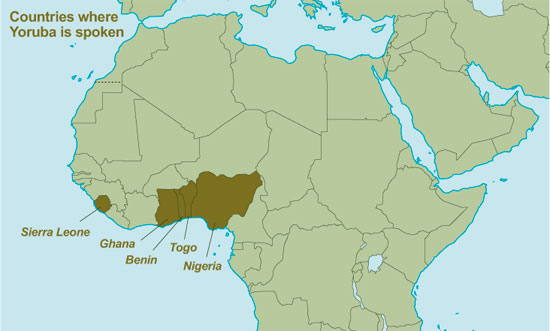
As you can see, they take up a pretty good chunk of the African landscape - about the same size as Germany and Austria combined, give or take a little - but are nowhere near being in charge of the whole continent. Which of course makes sense; we may be predisposed to think of Africa and African gods as some kind of Lion King-esque conglomeration of a single culture over the continent, but guys, Africa is huge. Before the invasions from the north, it probably had more distinct ethnic groups and tribal religions than Europe ever did.
In the modern day, Orisha worship is no longer that widespread; the map above shows where the Yoruba people traditionally live, but Sierra Leone and Ghana have pretty much ceased practicing the religion much due to evolving cultures and outside influences, leaving the core of the gods' territory in Nigeria, Togo and Benin. But while that's probably pretty saddening for the gods of the western coast, they've more than made up for it by expanding like crazy motherfuckers all over the rest of the world. The Orisha, in various forms, are worshiped all over the western world, from their dominating power in Brazil and the Caribbean islands on up to their famous vodun incarnations in Haiti and the southeastern United States. If there's one thing you can say about the Orisha, it's that they have staying power; being thoroughly and ruthlessly colonized by Europe not only didn't stamp out the religion on the home front, it actually enabled them to spread all over new territories and become a thriving religious force in the modern world.
The Yoruba religion also influenced several of its neighbors, most notably the Fon, and you'll find traces of them all over western Africa as a result, even in areas where they aren't traditionally worshiped. Shango is, after all, always on the lookout for opportunities for glorious conquest.
Saturday, April 27, 2013
Man in the Woods
Today, John goes out into the woods and vlogs alone, like the man of nature he obviously is, to answer a bunch of questions like some kind of crochety forest troll. I hope you're ready for his manly beard and masculine robe and hat combo.
Question: In Follower Upgrade, you mention having a list of adjusted templates for Creatures and Followers. Would you please post it? It doesn't need to be a beautiful PDF, I would gladly take a Google Doc or .txt!
Question: Just how is marriage structured in the Orisha pantheon, and by extension the Yoruba? It seems that everyone is married to everyone else, both male and female, and that the women are pretty much equal to the men unless Shango is wailing on them.
Question: Did you ever see the History Channel's "Clash of the Gods"? And if so, what did you think?
Question: Do all dogs go to heaven? Do animals have souls? And most of all, how do I get spectral wolves to do my bidding?
Question: Have you ever considered scaling the Legend point gains from Raise Your Glass, making it usable more than once per day or in the presence of people who have seen you use it already? I understand why the limits are what they are, but I think the knack would still be balanced (maybe even a little fairer, since one Legend doesn't seem like much of a reward at late Demigod or God) if any of those were removed.
Question: Mictlantecuhtli is presented in the Scion RAW as a completely evil misanthrope, that apparently only exists to torture his own Scions and everyone else for that matter. Since you guys deal with a lot of Aztec politics in games, I just wanted to ask how you characterize him?
Question: Any players thinking of creating a new Orisha PC for your next game?
Question: We know a lot about your god game, but what can you tell us about your other two games? Still hush-hush?
Question: Is stunting pretty much limited by your own imagination (in conjunction with the rules)?
Question: In your game, what did Odin do to make Amaterasu his enemy? Was it because of the Aesir assault on Japan, and what's up with that?
Question: Does your PSP count as a Birthright that takes up one of your five Birthright points?
Question: In a game that's all about smashing monsters, what good way is there to play a character with the Pacifist Nature?
Question: Could a character use high levels of Epic Manipulation to convince mortals that he is really great at a purview and gain Fatebonds from those mortals (assuming he spent Legend around them)? Like, if he tells great tales (lies) of destroying entire cities and civilizations with Fire when he has actually never used the Fire purview? If this does not work, how is it different from mortals misconstruing an event they see a PC perform from one purview to another and Fatebinding based on that?
Question: What kind of asks do you reject or refuse to answer?
That was delightful. I don't have much extra to add except that if you're the question-asker who wanted to know about Epic Manipulation and Fatebonds, there are also a couple of old posts here and here that might also help.
Question: In Follower Upgrade, you mention having a list of adjusted templates for Creatures and Followers. Would you please post it? It doesn't need to be a beautiful PDF, I would gladly take a Google Doc or .txt!
Question: Just how is marriage structured in the Orisha pantheon, and by extension the Yoruba? It seems that everyone is married to everyone else, both male and female, and that the women are pretty much equal to the men unless Shango is wailing on them.
Question: Did you ever see the History Channel's "Clash of the Gods"? And if so, what did you think?
Question: Do all dogs go to heaven? Do animals have souls? And most of all, how do I get spectral wolves to do my bidding?
Question: Have you ever considered scaling the Legend point gains from Raise Your Glass, making it usable more than once per day or in the presence of people who have seen you use it already? I understand why the limits are what they are, but I think the knack would still be balanced (maybe even a little fairer, since one Legend doesn't seem like much of a reward at late Demigod or God) if any of those were removed.
Question: Mictlantecuhtli is presented in the Scion RAW as a completely evil misanthrope, that apparently only exists to torture his own Scions and everyone else for that matter. Since you guys deal with a lot of Aztec politics in games, I just wanted to ask how you characterize him?
Question: Any players thinking of creating a new Orisha PC for your next game?
Question: We know a lot about your god game, but what can you tell us about your other two games? Still hush-hush?
Question: Is stunting pretty much limited by your own imagination (in conjunction with the rules)?
Question: In your game, what did Odin do to make Amaterasu his enemy? Was it because of the Aesir assault on Japan, and what's up with that?
Question: Does your PSP count as a Birthright that takes up one of your five Birthright points?
Question: In a game that's all about smashing monsters, what good way is there to play a character with the Pacifist Nature?
Question: Could a character use high levels of Epic Manipulation to convince mortals that he is really great at a purview and gain Fatebonds from those mortals (assuming he spent Legend around them)? Like, if he tells great tales (lies) of destroying entire cities and civilizations with Fire when he has actually never used the Fire purview? If this does not work, how is it different from mortals misconstruing an event they see a PC perform from one purview to another and Fatebinding based on that?
Question: What kind of asks do you reject or refuse to answer?
That was delightful. I don't have much extra to add except that if you're the question-asker who wanted to know about Epic Manipulation and Fatebonds, there are also a couple of old posts here and here that might also help.
Wednesday, April 24, 2013
The King Did Not Hang Himself
Question: Shango was the king of the Loa, but who rules the Orisha?
Still Shango!
Possible the most important thing about Shango is the fact that he is The King. Most of his myths revolve around his kingship, either threats to it, laws imposed by it or extending it to conquer other territories, and he absolutely suffers no challenges to his authority. In fact, Shango's identity as a monarch is so strong that that's the entire reason he was also considered king of the Loa, despite the fact that he's of lesser importance in some of the New World religions than he was in the ancient Yoruba one.
There are other figures of authority among the Orisha, of course. Ogun may not be king right now, but he was for a very brief period of time (or, at the very least, challenged Shango fairly evenly for it before giving it up) and has several stories in which the other Orisha ask him to take the throne, perhaps hoping he'd be less insane than Shango when it comes to divine administration. Obatala, whose most common epithet is King of the White Cloth, has never officially been the pantheon's leader but nevertheless wields enormous influence and political power as the oldest among the gods and the one who most often directly works for Olodumare. And Olodumare, of course, is the ultimate authority over the gods, though he doesn't directly rule or interact with them much and leaves questions of law and enforcement to his children to sort out for themselves.
Someone else is only going to get power over this pantheon by prying it from Shango's clenched and dead hands, and even then they'd probably better beware - he has a habit of getting back up after that sort of thing.
Still Shango!
Possible the most important thing about Shango is the fact that he is The King. Most of his myths revolve around his kingship, either threats to it, laws imposed by it or extending it to conquer other territories, and he absolutely suffers no challenges to his authority. In fact, Shango's identity as a monarch is so strong that that's the entire reason he was also considered king of the Loa, despite the fact that he's of lesser importance in some of the New World religions than he was in the ancient Yoruba one.
There are other figures of authority among the Orisha, of course. Ogun may not be king right now, but he was for a very brief period of time (or, at the very least, challenged Shango fairly evenly for it before giving it up) and has several stories in which the other Orisha ask him to take the throne, perhaps hoping he'd be less insane than Shango when it comes to divine administration. Obatala, whose most common epithet is King of the White Cloth, has never officially been the pantheon's leader but nevertheless wields enormous influence and political power as the oldest among the gods and the one who most often directly works for Olodumare. And Olodumare, of course, is the ultimate authority over the gods, though he doesn't directly rule or interact with them much and leaves questions of law and enforcement to his children to sort out for themselves.
Someone else is only going to get power over this pantheon by prying it from Shango's clenched and dead hands, and even then they'd probably better beware - he has a habit of getting back up after that sort of thing.
Sunday, April 21, 2013
Eyes Full of Light
Question: Are there no sun or moon gods among the Orisha? Were they not important to the Yoruba, or not prominent enough to feature as PC parents?
Actually, there really aren't. There is no Huitzilopochtli among the Yoruba gods, nor is there an Orisha equivalent to Artemis. It's an apparent omission that baffled scholars studying the religion early in the nineteenth century, especially the crazy ones who were convinced that the Yoruba religion must have grown out of the Egyptian one but who couldn't figure out where Ra and Horus disappeared to. The sun and the moon are certainly important, the way they are for most human cultures, but they don't have dedicated deities of their own.
One of the reasons the lights in the heavens don't get their own deities is that they're assumed to be the purview of Olodumare, the great father-god of the Orisha. Olodumare created sun, moon and stars and, as the lights in the vault of heaven, they are controlled and owned by him as the great primordial sky god. None of the Orisha can really compete with the big man when it comes to the affairs of the sky; even Shango is only in charge of storms, not the sky in which they rage.
The only myth we know of that directly involves someone other than Olodumare affecting the sun or moon is about Obatala, which isn't surprising since he's the second-most powerful creator deity in the pantheon. In that story, Obatala consecrates a sacred tree, turns it into sparkling metal and sends it off to Ogun to have it fashioned into a pot. He then puts the pot into a boat with his slave (possibly the same slave that once tried to kill him with a rock) and sends him to fly it back and forth to the earth each day, driving a solar boat for the rest of time. Based on that story, Obatala's the only one close to having Sun, but it's still a bit fishy - Ogun's crafting abilities are also involved and the slave is technically the guy actually doing the sun-driving - and we ended up deciding that it might not be quite strong enough on its own since the god has no whisper of solar connotations in any other story or cult practice.
Our only other possibility is Shango, who at some point during the religion's evolution was syncretized with a neighboring culture's deity named Jakuta who some scholars believe might have originally been solar in nature. Shango has of course lost that association almost completely at this point, but you could decide that he might have a few boons from the purview still kicking around.
It is surprising to see a culture that really doesn't do much in the way of direct veneration of the celestial bodies, especially sun-worship, which is nearly ubiquitous across a great number of different cultures. But every mythology is different, and in the case of the Yoruba there's no direct person representing for the sun or moon. Instead, everyone is covered in water, dirt and plants, and that's how the gods of western Africa roll.
Actually, there really aren't. There is no Huitzilopochtli among the Yoruba gods, nor is there an Orisha equivalent to Artemis. It's an apparent omission that baffled scholars studying the religion early in the nineteenth century, especially the crazy ones who were convinced that the Yoruba religion must have grown out of the Egyptian one but who couldn't figure out where Ra and Horus disappeared to. The sun and the moon are certainly important, the way they are for most human cultures, but they don't have dedicated deities of their own.
One of the reasons the lights in the heavens don't get their own deities is that they're assumed to be the purview of Olodumare, the great father-god of the Orisha. Olodumare created sun, moon and stars and, as the lights in the vault of heaven, they are controlled and owned by him as the great primordial sky god. None of the Orisha can really compete with the big man when it comes to the affairs of the sky; even Shango is only in charge of storms, not the sky in which they rage.
The only myth we know of that directly involves someone other than Olodumare affecting the sun or moon is about Obatala, which isn't surprising since he's the second-most powerful creator deity in the pantheon. In that story, Obatala consecrates a sacred tree, turns it into sparkling metal and sends it off to Ogun to have it fashioned into a pot. He then puts the pot into a boat with his slave (possibly the same slave that once tried to kill him with a rock) and sends him to fly it back and forth to the earth each day, driving a solar boat for the rest of time. Based on that story, Obatala's the only one close to having Sun, but it's still a bit fishy - Ogun's crafting abilities are also involved and the slave is technically the guy actually doing the sun-driving - and we ended up deciding that it might not be quite strong enough on its own since the god has no whisper of solar connotations in any other story or cult practice.
Our only other possibility is Shango, who at some point during the religion's evolution was syncretized with a neighboring culture's deity named Jakuta who some scholars believe might have originally been solar in nature. Shango has of course lost that association almost completely at this point, but you could decide that he might have a few boons from the purview still kicking around.
It is surprising to see a culture that really doesn't do much in the way of direct veneration of the celestial bodies, especially sun-worship, which is nearly ubiquitous across a great number of different cultures. But every mythology is different, and in the case of the Yoruba there's no direct person representing for the sun or moon. Instead, everyone is covered in water, dirt and plants, and that's how the gods of western Africa roll.
Thursday, April 11, 2013
Swords to Ploughshares
Question: Why does Oko have melee as an associated ability?
Because of a neat myth that leads to his cult being strongly associated with swords! Hooray! Swords! It's on his god page, but I'll reproduce it here just for you guys.
A plague of blackbirds once descended upon the land, devouring all the crops and leaving the people starving and desperate. The birds returned every year, gobbling up all the peoples' hard work, and no arrows could harm them, nor could they be caught to stop the famine. In desperation, the people appealed to Oko for help; he then prepared a powerful medicine from secret herbs known only to him, and it drove the birds away so that the crops were saved.
The people rejoiced, but soon began to fear him, wondering if he would use the same medicine against them in turn, and though Orisha Oko gave them no sign that he would turn on them, they eventually demanded that he leave and take his frightening powers with him. No sooner had he done so, however, than the birds returned and destroyed the crops, and the chagrined people were forced to find his hut in the forest and beg him to come back, offering to make him king if he did so. He refused, disgusted by their fickleness, but granted them his sword, telling them that if they were ever in true danger, they had only to plant the sword in the ground to call upon him. He then disappeared into the earth, and the sword was kept in his shrine from that day forward.
Many shrines to Oko still contain ceremonial swords or staves (which are another important cult feature and dually symbolize fertility and, well, penises) in his honor, which are wielded ceremonially by his worshipers and those who the god chooses to ride. It's a neat connection between a god who doesn't do much in the way of fighting and the weapons and instruments of conflict with which he is nevertheless strongly connected.
Oko himself doesn't do a lot of beating people about the head with his weapons, but he had plenty of open slots for associations, and the strength of his cult attachment to such implements was good enough for us to want to represent it. He's a cool example of someone who has Melee associated without necessarily being a god of ass-whupping.
Because of a neat myth that leads to his cult being strongly associated with swords! Hooray! Swords! It's on his god page, but I'll reproduce it here just for you guys.
A plague of blackbirds once descended upon the land, devouring all the crops and leaving the people starving and desperate. The birds returned every year, gobbling up all the peoples' hard work, and no arrows could harm them, nor could they be caught to stop the famine. In desperation, the people appealed to Oko for help; he then prepared a powerful medicine from secret herbs known only to him, and it drove the birds away so that the crops were saved.
The people rejoiced, but soon began to fear him, wondering if he would use the same medicine against them in turn, and though Orisha Oko gave them no sign that he would turn on them, they eventually demanded that he leave and take his frightening powers with him. No sooner had he done so, however, than the birds returned and destroyed the crops, and the chagrined people were forced to find his hut in the forest and beg him to come back, offering to make him king if he did so. He refused, disgusted by their fickleness, but granted them his sword, telling them that if they were ever in true danger, they had only to plant the sword in the ground to call upon him. He then disappeared into the earth, and the sword was kept in his shrine from that day forward.
Many shrines to Oko still contain ceremonial swords or staves (which are another important cult feature and dually symbolize fertility and, well, penises) in his honor, which are wielded ceremonially by his worshipers and those who the god chooses to ride. It's a neat connection between a god who doesn't do much in the way of fighting and the weapons and instruments of conflict with which he is nevertheless strongly connected.
Oko himself doesn't do a lot of beating people about the head with his weapons, but he had plenty of open slots for associations, and the strength of his cult attachment to such implements was good enough for us to want to represent it. He's a cool example of someone who has Melee associated without necessarily being a god of ass-whupping.
Tuesday, April 9, 2013
Pansexual Freedom
Question: With a new pantheon up, I feel it's time to revive your Ancient Sex Blog! So, I read a story about young Erinle going hunting in the forest against Yemoja's warnings and then being kept there by Osanyin "because of his beauty". Maybe I'm overinterpreting this after reading too much Greek mythology, but it sounds like an affair to me. What was the Yoruba's actual position to homosexuality/ephebophilia?
Yay! Ancient Sex Blog powers activate!
This is actually a really interesting question because traditional Yoruba society and religion view gender roles, and thus homosexuality, very differently from most western European cultures. Men might sometimes take on "female" roles and vice versa without this being viewed as abnormal, from male priests who dress up as women in order to more appropriately serve their patrons to women who marry other women in order to keep families together and a lot of other things in between. European cultures tend to have very rigid ideas of what male and female mean and how they are different, but for the ancient Yoruba the line was much less clear, and it was possible to cross over it in various ways and for various reasons without necessarily incurring any stigma.
There's very little mention of homosexuality in accounts of the ancient Yoruba, which is mostly the result of rampant confusion on the parts of both the invading Europeans and the bewildered Africans they were talking to. The Yoruba didn't really distinguish between the ideas of sex between opposite sexes and sex between members of the same sex, so they didn't have separate words for them and lacked any specific term for "homosexuality", meaning that many of their explanations of their culture just talked about "sex" and were interpreted by Europeans as just talking about "normal" heterosexual practices. European chroniclers were also very confused by what seemed to them to be a society that had none of the normal, sensible divisions between the sexes, and many of them either censored evidence of homosexuality or revised it so that it made more sense to them, making note of same-sex married partners as "husband and wife" to make the idea more easy to understand for the Europeans.
We do know from the few possibly-reliable records we have of the time when European colonists first encountered the Yoruba that homosexual practices did exist and were considered fairly normal. A few historians mention that men slept with other men or young boys if no women were available, and since priests of the Orisha are considered their spouses, often women become the husband of a goddess or men become the wife, to the point that even in the modern day priests of Shango often dress in womens' clothing in case they should be called upon by their husband. But this is also the pre-colonial Yoruba, and nowadays modern definitions and prohibitions against homosexuality have led to current adherents to the religion in Africa moving toward the religion specifically forbidding homosexuality. The rules are different across all the many diaspora religions, and further vary across regions within them just as they do within any other country and religion, so there's no overall "right" answer for this in the modern religions that call the Orisha their gods.
In Yoruba mythology, it's obvious that sexes are fluid and don't always matter very much when it comes to a god's character; they're more often tools that allow a god to represent one thing or another without locking them into a single sexual role. You'll see genderswapping all over the Yoruba myths, starting with Obatala transforming into a woman in order to sleep with Aganju and give birth to Shango or Oya growing a manly beard whenever she marches to war. Many of the Orisha are variously described as male or female in different stories, and the fact that Olokun is a man in one tale and a woman in another doesn't give them any pause or suggest any particular contradiction. In addition to the general Yoruba flexibility when it comes to gender and sex, the gods are also gods, and the Yoruba didn't think that gods necessarily had to conform to anything that humans did. If a god is a god, who cares whether it's appearing as male or female, when surely it has power over both? Gods like Obatala, Erinle, Olokun or Oshumare might appear as male or female, and it only matters as much as whether or not a mortal shows up wearing a button-down shirt or a t-shirt.
Many of the Orisha have both male and female "forms" that turn up at random in their stories, usually without bothering to explain why or how they changed sex, assuming that the listener of the story won't find it particularly odd. Often these stories are also being told in translation by people who didn't necessarily understand the Yoruba worldview or religion, and they may have arbitrarily assigned sexes in order to make a story "make sense" when in fact the original myth either didn't specifically note sexes or referred to a homosexual relationship that was confusing or abhorrent to a later reteller's sensibilities. And there's a further layer of complexity in that, in the American religions that came with the slaves kidnapped from the Yoruba of Africa, many of the Orisha changed sex again to fit the needs of their new religions, and Christian ideas of sexual proprieties and divisions syncretically colored the results. At this point, it's basically impossible to tell which stories might have either provided examples of or condemned homosexuality without a time machine and a universal translator.
So the interpretation of Osanyin's motives is really on the shoulders of whomever is doing the interpreting. It's certainly possible that Osanyin might have had a sexual motive in keeping young Erinle with him, which might or might not be homosexual (Erinle's one of the constant sex-swappers among the Orisha, and traditionally spends half the year as each sex). He also might simply have wanted to keep someone beautiful with him because of his own ugliness, either out of spite against the rest of the pantheon who exiled him because of his deformity or to have something beautiful of his own to counteract his own unpleasant presence.
When you're talking about ancient Yoruba stories, it's really not a question of whether or not the culture was comfortable with homosexuality; it's really a question of understanding that homosexuality isn't a separate and rigid concept for that culture the way it is for many others, and that thanks to the cultural kaleidoscope of interpretation that all our stories have come through, any given tale may be accidentally hiding implications that are no longer visible.
If you see a possible sexual interpretation of a Yoruba myth as a Storyteller, there's really just about as much chance that you're right as that you're wrong. There's nothing to stop you from running with the idea, and thanks to the constant swapping and cycling of sexes among the Orisha, also nothing to prevent you from running a given relationship as heterosexual, homosexual or both as you think will best suit your story.
Other pantheons have a lot of rules about who can sleep with whom, but the Orisha do what they want. Nobody is the boss of their bedrooms!
Yay! Ancient Sex Blog powers activate!
This is actually a really interesting question because traditional Yoruba society and religion view gender roles, and thus homosexuality, very differently from most western European cultures. Men might sometimes take on "female" roles and vice versa without this being viewed as abnormal, from male priests who dress up as women in order to more appropriately serve their patrons to women who marry other women in order to keep families together and a lot of other things in between. European cultures tend to have very rigid ideas of what male and female mean and how they are different, but for the ancient Yoruba the line was much less clear, and it was possible to cross over it in various ways and for various reasons without necessarily incurring any stigma.
There's very little mention of homosexuality in accounts of the ancient Yoruba, which is mostly the result of rampant confusion on the parts of both the invading Europeans and the bewildered Africans they were talking to. The Yoruba didn't really distinguish between the ideas of sex between opposite sexes and sex between members of the same sex, so they didn't have separate words for them and lacked any specific term for "homosexuality", meaning that many of their explanations of their culture just talked about "sex" and were interpreted by Europeans as just talking about "normal" heterosexual practices. European chroniclers were also very confused by what seemed to them to be a society that had none of the normal, sensible divisions between the sexes, and many of them either censored evidence of homosexuality or revised it so that it made more sense to them, making note of same-sex married partners as "husband and wife" to make the idea more easy to understand for the Europeans.
We do know from the few possibly-reliable records we have of the time when European colonists first encountered the Yoruba that homosexual practices did exist and were considered fairly normal. A few historians mention that men slept with other men or young boys if no women were available, and since priests of the Orisha are considered their spouses, often women become the husband of a goddess or men become the wife, to the point that even in the modern day priests of Shango often dress in womens' clothing in case they should be called upon by their husband. But this is also the pre-colonial Yoruba, and nowadays modern definitions and prohibitions against homosexuality have led to current adherents to the religion in Africa moving toward the religion specifically forbidding homosexuality. The rules are different across all the many diaspora religions, and further vary across regions within them just as they do within any other country and religion, so there's no overall "right" answer for this in the modern religions that call the Orisha their gods.
In Yoruba mythology, it's obvious that sexes are fluid and don't always matter very much when it comes to a god's character; they're more often tools that allow a god to represent one thing or another without locking them into a single sexual role. You'll see genderswapping all over the Yoruba myths, starting with Obatala transforming into a woman in order to sleep with Aganju and give birth to Shango or Oya growing a manly beard whenever she marches to war. Many of the Orisha are variously described as male or female in different stories, and the fact that Olokun is a man in one tale and a woman in another doesn't give them any pause or suggest any particular contradiction. In addition to the general Yoruba flexibility when it comes to gender and sex, the gods are also gods, and the Yoruba didn't think that gods necessarily had to conform to anything that humans did. If a god is a god, who cares whether it's appearing as male or female, when surely it has power over both? Gods like Obatala, Erinle, Olokun or Oshumare might appear as male or female, and it only matters as much as whether or not a mortal shows up wearing a button-down shirt or a t-shirt.
Many of the Orisha have both male and female "forms" that turn up at random in their stories, usually without bothering to explain why or how they changed sex, assuming that the listener of the story won't find it particularly odd. Often these stories are also being told in translation by people who didn't necessarily understand the Yoruba worldview or religion, and they may have arbitrarily assigned sexes in order to make a story "make sense" when in fact the original myth either didn't specifically note sexes or referred to a homosexual relationship that was confusing or abhorrent to a later reteller's sensibilities. And there's a further layer of complexity in that, in the American religions that came with the slaves kidnapped from the Yoruba of Africa, many of the Orisha changed sex again to fit the needs of their new religions, and Christian ideas of sexual proprieties and divisions syncretically colored the results. At this point, it's basically impossible to tell which stories might have either provided examples of or condemned homosexuality without a time machine and a universal translator.
So the interpretation of Osanyin's motives is really on the shoulders of whomever is doing the interpreting. It's certainly possible that Osanyin might have had a sexual motive in keeping young Erinle with him, which might or might not be homosexual (Erinle's one of the constant sex-swappers among the Orisha, and traditionally spends half the year as each sex). He also might simply have wanted to keep someone beautiful with him because of his own ugliness, either out of spite against the rest of the pantheon who exiled him because of his deformity or to have something beautiful of his own to counteract his own unpleasant presence.
When you're talking about ancient Yoruba stories, it's really not a question of whether or not the culture was comfortable with homosexuality; it's really a question of understanding that homosexuality isn't a separate and rigid concept for that culture the way it is for many others, and that thanks to the cultural kaleidoscope of interpretation that all our stories have come through, any given tale may be accidentally hiding implications that are no longer visible.
If you see a possible sexual interpretation of a Yoruba myth as a Storyteller, there's really just about as much chance that you're right as that you're wrong. There's nothing to stop you from running with the idea, and thanks to the constant swapping and cycling of sexes among the Orisha, also nothing to prevent you from running a given relationship as heterosexual, homosexual or both as you think will best suit your story.
Other pantheons have a lot of rules about who can sleep with whom, but the Orisha do what they want. Nobody is the boss of their bedrooms!
Subscribe to:
Posts (Atom)