Question: I know you guys haven't gotten to the mess that is the CB yet, but I wanted to pick your brains about Guanyin. How much Justice do you think she has? I feel like some of the boons make perfect sense for her (Pardon and Shield of Righteousness in particular) but I feel like Justice just doesn't really fit her, especially in regards to her having the Arbiter.
I think we agree with you, anonymous asker who loves Chinese goddesses. We would probably say that Guanyin might have some Justice, but she definitely does not have all the Justice. All the Justice belongs more with people like Yanluo, who can and will chase a criminal through the mountains to his doom, or Xiwangmu, who enforces the laws of Taoism like it ain't no thang.
Justice is the purview of law and order; it governs the creation of laws, the staving off of chaos, and the punishment (and in some cases rehabilitation) of those who do evil deeds or destabilize society. You usually see it wielded by gods who are kings or judges, arbiters or lawmakers, even sometimes executioners or doers of other unpleasant things that result in eradicating disorder and crime. It walks a thin line between being used for good or being used for evil, all dependent on what laws are in place and what crimes are considered punishable.
Guanyin is probably in favor of there not being chaos or misbehavior, but she's also not the kind of goddess who enforces those sorts of things; she doesn't go out there and bring people to justice, she doesn't judge the worth or behavior of those around her, and she doesn't make rules that she expects others to abide by. As the goddess of compassion and understanding, she wants to alleviate suffering and help everyone be free, enlightened and happy, but Justice doesn't always mean those things. In fact, Justice often directly contradicts them.
I'm sure Guanyin probably would like to use Pardon to alleviate the suffering of former criminals, but Pardon requires that the criminal in question has appropriately served his sentence, or else been convicted in error. How many suffering lawbreakers would she want to pardon, only for the boon to refuse to work because they hadn't yet been punished enough? Shield of Righteousness saves the innocent from being wrongfully lashed out against, but it can't save the guilty, and doesn't Guanyin care about their pain and fear just as much? If anything, Justice's hardline refusal to work against the law, regardless of mitigating circumstances or emotional trauma, seems like something that would make it very difficult for Guanyin to use. Justice is the kind of purview you use to put Valjean in jail for decades for stealing bread from a rich man to feed his starving neice; Guanyin is the kind of lady who would let him hide out in her shed and tell Javert he just missed him. I mean, this is a person who let herself be executed for literally no reason at all because she didn't want the executioner to get fired for failing.
We don't think it's impossible for her to have any boons in the purview, but she's definitely not an Arbiter, and it would take some spectacular new myths about her legal exploits to make us reconsider. We think it's likely that she has way more Guardian than Justice, which is a purview that can save and protect people regardless of who they are or what they've done.

Showing posts with label Guanyin. Show all posts
Showing posts with label Guanyin. Show all posts
Sunday, September 1, 2013

Monday, February 11, 2013
Our Lady of Mercy
Question: Wait, what Guanyin's a guy as well? I thought she was a goddess!
She is! But yes, she is also a guy, too. Once again, it's time for the wonderful world of religious borrowing!
Guanyin, as she appears in Scion and arguably her most famous form, is the Chinese goddess of compassion, harmony and peace; her name literally means "she who hears the weeping of the world", and she usually appears as a serene, beautiful woman, hands open to provide mercy and understanding to her people.
This is probably by far the most famous version of her. But, even within China itself, she also often appears as a dude - in every way the same figure, but a male bodhisattva instead of a female one, still concerned with the wellbeing of the common man and the alleviation of suffering.
Chinese mythology never addresses this bewildering genderbend; there are no stories in which Guanyin flips gender, changes form or does anything to explain why some artwork shows her as a man and some as a woman. The Chinese themselves seem unfazed by the issue, since s/he's a bodhisattva in either case and represents the same concepts of compassion and gentleness, so who cares what body parts s/he might have?
But of course, that leaves us wondering why on earth Guanyin seems to have been male at some point in Chinese mythology and is now inexplicably female. Certainly, the prevailing modern image of her is totally female, so where did the old male image come from? The answer is that it came from Avalokitasvara, the male god from India who was borrowed into Chinese Buddhism and transformed into Guanyin.
Like Guanyin, his name means "he who hears the cries of the world", and he is considered the bodhisattva of mercy, compassion and kindness. The crazy proliferation of arms is due to a myth he shares with Guanyin, in which he is so distressed by all the people in the world who need help that he grows a thousand arms to be able to reach out to them all simultaneously. There's been a lot of scholarly discussion on why the Chinese should have recast Guanyin as female, and honestly the answer is that we really don't know; the best guess we have is that, as a culture, they found the idea of a deity of mercy to make more sense from a nurturing female figure than a male. The general answer for modern Buddhism is that Guanyin, having achieved nirvana, now transcends gender. Which is as good an answer as any, when it comes to deities and their unfathomable ways.
As far as Scion goes, it's an easy thing to switch gender at the drop of a hat; the Undeniable Resemblance knack over in Appearance makes that a cinch. Guanyin could easily appear as whichever sex she wishes depending on what she's doing and who she's helping. She could also appear as any one of her many forms - not just the ones above but also Kannon of Japanese Buddhism (who also appears variously as male or female!), the Korean Gwaneum, the Tibetan Arya Tara or even the Virgin Mary. As one of the most widespread deities across Asia, she's one of the most flexible goddesses when it comes to what she looks like and does.
So, male or female, Guanyin can pretty much look like whatever she needs to in your chronicles. For a deity concerned with alleviating suffering and bringing compassionate love to those who need it, she most likely turns up as whichever sex is most appropriate to the situation. Love crosses all gender lines!
She is! But yes, she is also a guy, too. Once again, it's time for the wonderful world of religious borrowing!
Guanyin, as she appears in Scion and arguably her most famous form, is the Chinese goddess of compassion, harmony and peace; her name literally means "she who hears the weeping of the world", and she usually appears as a serene, beautiful woman, hands open to provide mercy and understanding to her people.
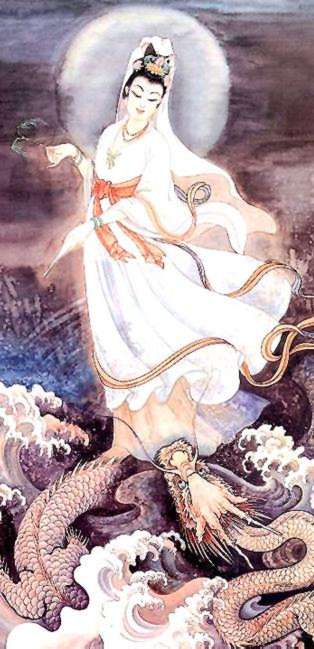
This is probably by far the most famous version of her. But, even within China itself, she also often appears as a dude - in every way the same figure, but a male bodhisattva instead of a female one, still concerned with the wellbeing of the common man and the alleviation of suffering.

Chinese mythology never addresses this bewildering genderbend; there are no stories in which Guanyin flips gender, changes form or does anything to explain why some artwork shows her as a man and some as a woman. The Chinese themselves seem unfazed by the issue, since s/he's a bodhisattva in either case and represents the same concepts of compassion and gentleness, so who cares what body parts s/he might have?
But of course, that leaves us wondering why on earth Guanyin seems to have been male at some point in Chinese mythology and is now inexplicably female. Certainly, the prevailing modern image of her is totally female, so where did the old male image come from? The answer is that it came from Avalokitasvara, the male god from India who was borrowed into Chinese Buddhism and transformed into Guanyin.

Like Guanyin, his name means "he who hears the cries of the world", and he is considered the bodhisattva of mercy, compassion and kindness. The crazy proliferation of arms is due to a myth he shares with Guanyin, in which he is so distressed by all the people in the world who need help that he grows a thousand arms to be able to reach out to them all simultaneously. There's been a lot of scholarly discussion on why the Chinese should have recast Guanyin as female, and honestly the answer is that we really don't know; the best guess we have is that, as a culture, they found the idea of a deity of mercy to make more sense from a nurturing female figure than a male. The general answer for modern Buddhism is that Guanyin, having achieved nirvana, now transcends gender. Which is as good an answer as any, when it comes to deities and their unfathomable ways.
As far as Scion goes, it's an easy thing to switch gender at the drop of a hat; the Undeniable Resemblance knack over in Appearance makes that a cinch. Guanyin could easily appear as whichever sex she wishes depending on what she's doing and who she's helping. She could also appear as any one of her many forms - not just the ones above but also Kannon of Japanese Buddhism (who also appears variously as male or female!), the Korean Gwaneum, the Tibetan Arya Tara or even the Virgin Mary. As one of the most widespread deities across Asia, she's one of the most flexible goddesses when it comes to what she looks like and does.


So, male or female, Guanyin can pretty much look like whatever she needs to in your chronicles. For a deity concerned with alleviating suffering and bringing compassionate love to those who need it, she most likely turns up as whichever sex is most appropriate to the situation. Love crosses all gender lines!
Subscribe to:
Posts (Atom)