Question: Have you heard about the "Maushop is Moby Dick" Theory?
Question: So I heard about the mythical story of Maushop (also know as Moby-Dick to you whaling fans) at the MLK Day Wampanoag Storytime in my neighborhood. So what would he call this HUGELY popular figure (pun intended) in Scion? (i.e. legendary mortal, titan avatar, really tall scion of the Algonquin pantheon, etc.)
Maushop is a neat dude. We should all know more about him.
Essentially, Maushop is a giant creator deity figure from Wampanoag mythology; various myths exist about him creating many of the landscape features, plants and animals humans rely on to survive, teaching humanity to harness fire for warmth and cooking and how to make useful tools and weapons, and generally being a benevolent and helpful guy as much as possible. He's usually portrayed as fond of mortals and wishing to make their lives easier, to which end many of the good things in life were made specifically out of his goodwill toward them. We would definitely consider him to be a deity; his exploits are way too gigantic (ha) to be those of a mere Scion or lesser immortal, and generally too benevolent and non-dangerous to peg him as a Titan (although he does have his moments, as do most gods).
Maushop's connection to Moby Dick, the giant white sperm whale of Melville's massive tome of nineteenth-century existential misery, is twofold. He is often related to whales in Wampanoag myth simply because of his massive size; because he is far larger than any human, he often sleeps in the ocean because it's more comfortable than the mountainous land, and eats whales the way a human might eat fish. In some myths, he is called upon to handle the danger to humanity after the creation of the first sharks and sea birds, turns his own children into orcas so that they can live in the waters, and converses with porpoises and other sea creatures, all of which suggests that while he is generally referred to as humanoid when hanging out with humans, he has more than a passing connection to the ocean. And perhaps most importantly, in the myth in which he departs from hanging out with humanity forever, he does so by walking away into the ocean, appearing one last time as a colossal white whale before swimming away from his people.
The second connection comes from the white American settlers in the same area, much later. When Melville was writing Moby-Dick, he was inspired greatly by the real-life tale of a white sperm whale that had recently finally been killed after terrorizing multiple whaling ships for quite a few years. That particular whale was referred to by the locals as Mocha-Dick; "Dick", the second half of the name, was likely simply pasted on thanks to a custom of naming particularly famous whales with human male designations for storytelling ease (you can see Melville refer to other whales by suffix names like Jack and Tom in the book, actually), but "Mocha" bears more than a little resemblance to Maushop's name. Local lore claims that the whale was called Mocha because it tended to appear around Mocha island, which is off the coast of Chile considerably farther southwest than New England.
But honestly, as far as we know, the conflation of Moby Dick with Maushop is probably mostly a recent embellishment rather than a real case of related stories; the Mocha-Maushop connection is probably just a coincidence, since Maushop was certainly unknown in South America and the whale itself was nowhere near Wampanoag waters (and anyway, "Mocha" is from a vastly different language), and while the story of Maushop turning into a white whale upon his departure is super neat, there's no evidence anywhere that Melville, who was heavily leaning on the story of the Chilean whale, knew about it or incorporated it into his writing. Mocha-Dick wasn't the first or the last white whale of that time period, either, with at least two other white sperm whales killed or captured in the Americas during the nineteenth century and even contemporary sightings of some nowadays (although the confirmed albino whales we have right now are humpbacks, not sperms).
However, Maushop did in fact turn into a great white whale when he left humanity, so players of Scion may yet run into him or discover that he has a connection to the rare albino cetaceans and their generally angry antics. Maybe, like the orcas of myth, these white whales are his children released into the world for whatever purpose he deems necessary, explaining their legendary fame, prodigious strength and often surprising size. Maybe each white whale is Maushop himself, who doesn't truly die when harpooned but remains patrolling the oceans to remind humanity not to get too uppity and forget who the true masters of the sea are, or to punish the European invaders who mistreated his beloved people. Maybe Melville had an encounter with Maushop that the history books don't know about and was writing about him, perhaps as a Herald or in some other Fatebound role. There are plenty of possibilities for those who want to tie the popular novel into Wampanoag myth in their games.
So we say, go for it. The terrifying grandeur of a pissed-off whale is something that players are seldom prepared for.

Showing posts with label history. Show all posts
Showing posts with label history. Show all posts
Monday, April 21, 2014

Friday, April 18, 2014
Kings of the Cenote
Question: I was rereading your K'uh supplement, and I was wondering why you decided to make Yum Cimil/Cizin a god rather than a titan of Xibalba. After all, he is, well, from Xibalba. Is it because you had to fill the RAW Scion ideas of having an Overworld, Underworld, and Titanrealm for your pdfs, and you needed to put someone in charge of Metnal? Or is there some other reason that he fits more as a god than as a Titan?
Yum Cimil is a very interesting (and weird) dude when it comes to researching Maya mythology, so I'm glad you asked about him! Let's talk about all his unsightly, rotting problems.
Yum Cimil/Yum Cimih, depending on the era of your scholar's translations, is generally better known by letter as are many of the Maya gods; his codical designation is God A, as he's the first identifiable deity appearing in the Yucatec codices, where he often hangs out with God A', his equally skeletal buddy. When the two of them appear together, they are extremely similar in iconography and doubled symbolism to the Lords of Xibalba mentioned in the Popol Vuh, which would lead to the natural conclusion that they're probably the same guys. This is all pretty legit, so you're not wrong about wondering why he's appearing separately from them in the supplement.
The problem with Maya mythology is that it's very fragmented. We have mythology from various different time periods and various different smaller groups within the Maya, not all of which agree with one another; the Classical Maya civilization was very different from the much later K'iche civilization from which we got the PV, and even yet more different were various semi-isolated Maya kingdoms in the jungles of the Yucatana, Belize and Guatemala. Some were so isolated that they even survived relatively late into the modern era, such as the Tzotzil or Lacandon people, who also had their own evolved myths from the same base. And, of course, some of these places and times have more, better, or simply different mythological information than others; for example, the Classical Yucatec Maya mythology we have is largely culled from reliefs, paintings and codices, but lacks any storytelling to interpret the gods and scenes we are seeing, while much farther south you have the PV with its Guatemala-specific flavor and elsewhere you have modern Maya beliefs that have begun to absorb influence from Christianity and/or other Mesoamerican cultures.
So whenever we try to figure out what the "Maya pantheon" looked like, we're facing a pretty giant challenge rating in attempting to not only untangle all of those sources but also to make them make coherent sense with one another. All of the gods in the supplement, and in Maya studies in general, suffer from scholars sometimes just having to make a call and run with it, at least until better evidence surfaces.
But anyway, back to Yum Cimil. Calendrical God A is an ugly son of a bitch, in keeping with the general Maya dislike of death, but nobody can say he doesn't look like he enjoys his job.
His buddy, A', is no more of a joy to look at, and generally even more violent in his death imagery - he's usually committing suicide whenever he appears, which is weird, but that's death gods for you. The dual gods of the underworld seem like shoo-ins to be identical to the twin Lords of Xibalba in the K'iche tradition, but because Yucatec Maya myth is so much harder to interpret, there are also enough differences to cause us to pause when writing. A and A', to begin with, are far more important and active in ritual and life than the Lords of Xibalba; they appear as hunters chasing various uay and mortals, and are present in scenes depicting the Jaguar God of the Underworld (probably K'inich Ahau in his nighttime form), suggesting that they are involved in some way in his carrying of the sun through the netherworld. Some scholars also believe that A at least may be a lunar god, based on his appearance in various sacred calendar texts and the prevalence of a crescent-moon symbol associated with him.
By contrast, the Lords of Xibalba from the PV are purely creatures of death. They do not leave the underworld, have no connection to any celestial or divine powers outside their own realm, and are purely antagonistic toward gods and heroes that are not under their power, which is pretty obviously illustrated by their massive superiority complex and attempts to utterly crush the Hero Twins for basically not a whole lot of concrete reasons. As far as we can tell - which isn't super far, because apart from the PV, which is no doubt not in even its original K'iche form much less the form it might have appeared in earlier Maya civilizations - they have no connection to other deities, locations or powers. They are the dead, and they are pleased to wield their terrible power over the living without any need for further functions.
These aren't necessarily enough differences to definitively decide that A and A' are different people from Hun Came and Vucub Came, but they are still real details and suggest that alternative interpretations might be very possible. In particular, the fact that A and A' don't always appear together and aren't as identical as the Lords (A' in fact seems to be less important than his supposed twin) suggests that they may be more their own bags of bones, and the K'iche story of the Lords' defeat and permanent barring from the affairs of the world seems heavily at odds with A and A', who clearly nobody likes but who also seem to be effective and influential divine figures.
At this point, we could have tipped either way, honestly. We think it's almost beyond question that even if the Lords are basically different figures from A and A' at this point, that they came from the same original root, so deciding when or if to separate them is as tricky as it ever is when considering continual evolution within a religion. We might well have decided to just conflate them and assume that their differences were cosmetic interpretations of different areas of the same religion...
...if it weren't for the Lacandon and others of their ilk. The Lacandon Maya people were possibly the longest-surviving Maya civilization that avoided contact with Europeans and Christianity until the beginning of the twentieth century, thanks to living in generally impenetrable jungle and having little interest in what white people were up to in their general vicinity. The Lacandon had (and still have) the latest and most long-running version of Maya religion still being practiced widely among them, and their death god, Kisin/Cizin, was absolutely not identical to the Lords of Death (although it's still likely they had common roots). As a sole ruler of the underworld, he was the sometime-antagonist to Hachakyum, the lord of the heavens, and both feared as a terrible representative of death but also understood to be the ultimate final authority over most of those who had died. Kisin has a whole slew of myths that are purely unique to him, including the story of his banishment to rule the underworld and subsequent tantrums in which he shakes the world with earthquakes, his treatment of the dead in which the worthy are purified by his horrific torture and the unworthy utterly destroyed, and his creation of animals (and possibly even uay) to parallel Hachakyum's creation of mankind. He doesn't fit with the Lords of Xibalba at all, especially because he performs a duty (however unpleasant) for the souls of mankind, but he does have a few things in common with God A, most especially the belief that he hunts the underworld for the spirit twins of humans who are meant to die, which might be the very scene that our unexplained artwork of A on the hunt is depicting.
So, we've got these Lords of Xibalba, and they are definitely A Thing. And we've got Kisin, and he's definitely A Thing. And then we've got A and A', and while they are Things, they are probably Things that belong aligned with one or the other, and whose information just isn't as easy to interpret as it is for some other gods. Trying to align Lacandon mythology, which had a couple of extra centuries to evolve past other Maya beliefs, with any other religion is tricky anyway, but in this case we're looking at a bunch of deities who are probably very firmly related but not necessarily all exactly the same.
So, based on all of that, we saw no option but to let Kisin, in all his gross-smelling, bad-attitude glory, be the main man of the underworld as he obviously is in Lacandon myth, while the Lords of Xibalba, clearly Titans defeated by the Hero Twins in Guatemalan myths that had no parallel with Kisin, were separate beings. And while we could have aligned A and A' with the Lords instead of Kisin, we found their differences too intriguing and the possibilities for connecting them with Kisin (and possibly his brother Sucuncyum, even) too compelling. Since we wanted to keep the pantheon using their Yucatec names wherever possible, we refer to him as Yum Cimil, the calendrical god A's name, but retained for the vast majority of his characterization the stories of Kisin and his fractious relations with the rest of the cosmology of death in the Maya universe.
The difference between Metnal and Xibalba, by the way, is a whole ball of wax all its own - both are clearly places of the dead, but depending on the material and the scholar, different people consider them the same place, separate places that are linked, that one is inside the other, or even that one is not an underworld at all but merely a place where terrible deathly things reside. Metnal being the Yucatec death-realm (with a name that most likely has a linguistic connection to the Aztec Mictlan as well) and Xibalba the K'iche, we decided to associate the first with Yum Cimil as the representative of Yucatec interests, and the second with the Lords of Death, whose realm to control it clearly is.
I could probably give a pretty massive dissertation on all the gymnastics we did to try to align as much material from various different Maya peoples together to make it both gel into a usable worldview but also still preserve its unique character and mythology wherever applicable, but that would be a whole lotta words. Suffice it to say that, after intense research, consultation with others and thorough consideration, we as writers made a call that Yum Cimil was more likely his own man than merely a manifestation of the Lords, and went from there.
The one thing we weren't doing here, though, was worrying about making sure to have a playable death god in charge of the underworld because that's what Scion always does for every pantheon. As I'm sure you might have noticed, we tend to wave our middle fingers cheerfully at Scion's arbitrary cosmology rules whenever they get in the way of representing a culture's myths in a more fun or accurate way - hell, the supplement for the Alihah didn't even have an underworld. We obey the RAW in areas where we have to in order for people to be able to use our supplements in a compatible way with their current games, but that's pretty much the only way we feel obligated to do so.
Yum Cimil is a very interesting (and weird) dude when it comes to researching Maya mythology, so I'm glad you asked about him! Let's talk about all his unsightly, rotting problems.
Yum Cimil/Yum Cimih, depending on the era of your scholar's translations, is generally better known by letter as are many of the Maya gods; his codical designation is God A, as he's the first identifiable deity appearing in the Yucatec codices, where he often hangs out with God A', his equally skeletal buddy. When the two of them appear together, they are extremely similar in iconography and doubled symbolism to the Lords of Xibalba mentioned in the Popol Vuh, which would lead to the natural conclusion that they're probably the same guys. This is all pretty legit, so you're not wrong about wondering why he's appearing separately from them in the supplement.
The problem with Maya mythology is that it's very fragmented. We have mythology from various different time periods and various different smaller groups within the Maya, not all of which agree with one another; the Classical Maya civilization was very different from the much later K'iche civilization from which we got the PV, and even yet more different were various semi-isolated Maya kingdoms in the jungles of the Yucatana, Belize and Guatemala. Some were so isolated that they even survived relatively late into the modern era, such as the Tzotzil or Lacandon people, who also had their own evolved myths from the same base. And, of course, some of these places and times have more, better, or simply different mythological information than others; for example, the Classical Yucatec Maya mythology we have is largely culled from reliefs, paintings and codices, but lacks any storytelling to interpret the gods and scenes we are seeing, while much farther south you have the PV with its Guatemala-specific flavor and elsewhere you have modern Maya beliefs that have begun to absorb influence from Christianity and/or other Mesoamerican cultures.
So whenever we try to figure out what the "Maya pantheon" looked like, we're facing a pretty giant challenge rating in attempting to not only untangle all of those sources but also to make them make coherent sense with one another. All of the gods in the supplement, and in Maya studies in general, suffer from scholars sometimes just having to make a call and run with it, at least until better evidence surfaces.
But anyway, back to Yum Cimil. Calendrical God A is an ugly son of a bitch, in keeping with the general Maya dislike of death, but nobody can say he doesn't look like he enjoys his job.
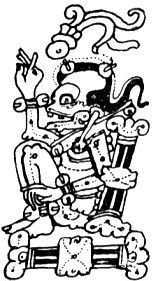
His buddy, A', is no more of a joy to look at, and generally even more violent in his death imagery - he's usually committing suicide whenever he appears, which is weird, but that's death gods for you. The dual gods of the underworld seem like shoo-ins to be identical to the twin Lords of Xibalba in the K'iche tradition, but because Yucatec Maya myth is so much harder to interpret, there are also enough differences to cause us to pause when writing. A and A', to begin with, are far more important and active in ritual and life than the Lords of Xibalba; they appear as hunters chasing various uay and mortals, and are present in scenes depicting the Jaguar God of the Underworld (probably K'inich Ahau in his nighttime form), suggesting that they are involved in some way in his carrying of the sun through the netherworld. Some scholars also believe that A at least may be a lunar god, based on his appearance in various sacred calendar texts and the prevalence of a crescent-moon symbol associated with him.
By contrast, the Lords of Xibalba from the PV are purely creatures of death. They do not leave the underworld, have no connection to any celestial or divine powers outside their own realm, and are purely antagonistic toward gods and heroes that are not under their power, which is pretty obviously illustrated by their massive superiority complex and attempts to utterly crush the Hero Twins for basically not a whole lot of concrete reasons. As far as we can tell - which isn't super far, because apart from the PV, which is no doubt not in even its original K'iche form much less the form it might have appeared in earlier Maya civilizations - they have no connection to other deities, locations or powers. They are the dead, and they are pleased to wield their terrible power over the living without any need for further functions.
These aren't necessarily enough differences to definitively decide that A and A' are different people from Hun Came and Vucub Came, but they are still real details and suggest that alternative interpretations might be very possible. In particular, the fact that A and A' don't always appear together and aren't as identical as the Lords (A' in fact seems to be less important than his supposed twin) suggests that they may be more their own bags of bones, and the K'iche story of the Lords' defeat and permanent barring from the affairs of the world seems heavily at odds with A and A', who clearly nobody likes but who also seem to be effective and influential divine figures.
At this point, we could have tipped either way, honestly. We think it's almost beyond question that even if the Lords are basically different figures from A and A' at this point, that they came from the same original root, so deciding when or if to separate them is as tricky as it ever is when considering continual evolution within a religion. We might well have decided to just conflate them and assume that their differences were cosmetic interpretations of different areas of the same religion...
...if it weren't for the Lacandon and others of their ilk. The Lacandon Maya people were possibly the longest-surviving Maya civilization that avoided contact with Europeans and Christianity until the beginning of the twentieth century, thanks to living in generally impenetrable jungle and having little interest in what white people were up to in their general vicinity. The Lacandon had (and still have) the latest and most long-running version of Maya religion still being practiced widely among them, and their death god, Kisin/Cizin, was absolutely not identical to the Lords of Death (although it's still likely they had common roots). As a sole ruler of the underworld, he was the sometime-antagonist to Hachakyum, the lord of the heavens, and both feared as a terrible representative of death but also understood to be the ultimate final authority over most of those who had died. Kisin has a whole slew of myths that are purely unique to him, including the story of his banishment to rule the underworld and subsequent tantrums in which he shakes the world with earthquakes, his treatment of the dead in which the worthy are purified by his horrific torture and the unworthy utterly destroyed, and his creation of animals (and possibly even uay) to parallel Hachakyum's creation of mankind. He doesn't fit with the Lords of Xibalba at all, especially because he performs a duty (however unpleasant) for the souls of mankind, but he does have a few things in common with God A, most especially the belief that he hunts the underworld for the spirit twins of humans who are meant to die, which might be the very scene that our unexplained artwork of A on the hunt is depicting.
So, we've got these Lords of Xibalba, and they are definitely A Thing. And we've got Kisin, and he's definitely A Thing. And then we've got A and A', and while they are Things, they are probably Things that belong aligned with one or the other, and whose information just isn't as easy to interpret as it is for some other gods. Trying to align Lacandon mythology, which had a couple of extra centuries to evolve past other Maya beliefs, with any other religion is tricky anyway, but in this case we're looking at a bunch of deities who are probably very firmly related but not necessarily all exactly the same.
So, based on all of that, we saw no option but to let Kisin, in all his gross-smelling, bad-attitude glory, be the main man of the underworld as he obviously is in Lacandon myth, while the Lords of Xibalba, clearly Titans defeated by the Hero Twins in Guatemalan myths that had no parallel with Kisin, were separate beings. And while we could have aligned A and A' with the Lords instead of Kisin, we found their differences too intriguing and the possibilities for connecting them with Kisin (and possibly his brother Sucuncyum, even) too compelling. Since we wanted to keep the pantheon using their Yucatec names wherever possible, we refer to him as Yum Cimil, the calendrical god A's name, but retained for the vast majority of his characterization the stories of Kisin and his fractious relations with the rest of the cosmology of death in the Maya universe.
The difference between Metnal and Xibalba, by the way, is a whole ball of wax all its own - both are clearly places of the dead, but depending on the material and the scholar, different people consider them the same place, separate places that are linked, that one is inside the other, or even that one is not an underworld at all but merely a place where terrible deathly things reside. Metnal being the Yucatec death-realm (with a name that most likely has a linguistic connection to the Aztec Mictlan as well) and Xibalba the K'iche, we decided to associate the first with Yum Cimil as the representative of Yucatec interests, and the second with the Lords of Death, whose realm to control it clearly is.
I could probably give a pretty massive dissertation on all the gymnastics we did to try to align as much material from various different Maya peoples together to make it both gel into a usable worldview but also still preserve its unique character and mythology wherever applicable, but that would be a whole lotta words. Suffice it to say that, after intense research, consultation with others and thorough consideration, we as writers made a call that Yum Cimil was more likely his own man than merely a manifestation of the Lords, and went from there.
The one thing we weren't doing here, though, was worrying about making sure to have a playable death god in charge of the underworld because that's what Scion always does for every pantheon. As I'm sure you might have noticed, we tend to wave our middle fingers cheerfully at Scion's arbitrary cosmology rules whenever they get in the way of representing a culture's myths in a more fun or accurate way - hell, the supplement for the Alihah didn't even have an underworld. We obey the RAW in areas where we have to in order for people to be able to use our supplements in a compatible way with their current games, but that's pretty much the only way we feel obligated to do so.
Monday, April 7, 2014
No Such Thing as Academic Authority
Question: How often do you have to strip away euhemerization to get to the actual myths you research?
This is a weird question. Euhemerization - the practice of later interpreters of myths ascribing the deeds of gods and mythic heroes to those of mere overblown historical humans - is definitely a pernicious problem in any kind of religious study, but it's very complicated and hard to get around. After all, if it were easy to just do a little legwork to get around the issue, scholars wouldn't be so eternally disgruntled about it.
Euhemerism basically assumes that mythology is what happens when so much time goes by that history becomes distorted into exaggerated, fanciful or mystical versions of itself that stop becoming a faithful record of things that happened and starts being passed down as a story for other purposes instead. A euhemeristic approach to mythology seeks to pare it down and try to figure out where the core kernel of "real history" occurred that resulted in this story being told; for example, a euhemerist might say that a story about a god fighting a primordial dragon was originally a tale of a person fighting a large and dangerous animal, maybe on a hunt for food, which got exaggerated over time until the original person was transformed into a god and the original animal into a supernatural monster. Pure euhemerism suggests that all myths are actually just distorted history, although various scholars, philosophers and historians have ascribed to some areas' myths being true history and others true folklore in different time periods and fields of study.
The place we run into the most trouble with this concept is when the only, or most of the only, remaining mythology is recorded by someone with euhemeristic tendencies. The Norse and Irish mythologies traditionally have massive problems with this; because almost everyone who recorded their myths was Christian, many of them had a vested interest in proving that no other religions could possibly be valid, and therefore they presented the mythology either with side interpretations suggesting that it was referring to misconstrued historical events (Snorri does this a lot) or just outright rewriting them to be about humans doing human-level things (Saxo Grammaticus' favorite) with only occasional side notes mentioning that silly pagan people later confused them with gods. We actually have very little remaining mythology of the Aesir, Tuatha or Bogovi that isn't pretty heavily euhemerized, and that means that we actually can't "strip away" the result; instead, we have to attempt to interpret what we've got, in the hopes of correctly evaluating where ancient writers inserted their own biases or added material, and where they were faithfully recording things that they had heard, with a side order of trying to guess what they might have left out in the name of humanizing the story.
And while we hear about it more in connection with European mythologies, which get way more attention and press in western scholarship, this is actually an even more rampant problem in the myths of Africa, Australia and the Americas. Because the vast majority of our preserved and written-down mythology for many of those cultures was written down by European invaders who conquered the local cultures, euhemerism is rampant throughout it. Most of these conquerors were monotheists (usually Christian or Muslim) and therefore used euhemerization as a useful tool to discredit the religions of the "heathens" or "savages" as being obvious claptrap dreamed up by silly natives who couldn't tell the difference between reality and fantasy, and as imperialist conquerors they also often had a strong motive to assert that the indigenous beliefs of places they had conquered weren't real or valid anyway, and that replacing them with "real" religions was in fact culturally helpful instead of erasing their cultural identities. Scholars referring to the native religions of conquered territories as "folktales", "fairytales", or "distorted stories" was a very large force in ensuring that those cultures were never taken seriously as having legitimate stories, religions or histories of their own.
And really, what that actually means is that most of the time there's no such thing as evaluating a myth without euhemerism influencing any conclusions we can come to. Especially for those of us who don't read ancient languages or have access to firsthand sources or oral histories, most research options come from the pens of old, predominantly European writers, all of whom had their own agenda, opinions and biases when they were recording myths. History and mythology aren't objective; they are always told by people, and people always inject their own biases, and when the people telling the story for the past few centuries aren't even the people who originally came up with the story, things are bound to be skewed a thousand different ways. It's literally impossible to begin from those sources and strip away all, or even most, of the material and interpretation added by centuries of later scholarship from the original stories, even when we have something solid to begin with (which we often don't).
So... there's no answer to your question. Researching mythology for the clearest picture of an ancient culture's beliefs and gods is a neverending journey of interpretation and reinterpretation, reading scholars and questioning whether or not they are saying something legitimate, looking at sources and trying to decide their relative importance, and a thousand other things. We can never be totally accurate, in fact probably never even close, and we have to constantly be aware of the fact that not just our own preconceived notions about various cultures and their myths will shape our thoughts and decisions, but also the preconceived notions of generations of historians, chroniclers and writers before us.
We do our best to try to find out as much information as we can and put it in the best cultural context we can, but euhemerism is only one of the many obstacles on the road to success. We have to just keep doing our best, and accept that we're always learning!
This is a weird question. Euhemerization - the practice of later interpreters of myths ascribing the deeds of gods and mythic heroes to those of mere overblown historical humans - is definitely a pernicious problem in any kind of religious study, but it's very complicated and hard to get around. After all, if it were easy to just do a little legwork to get around the issue, scholars wouldn't be so eternally disgruntled about it.
Euhemerism basically assumes that mythology is what happens when so much time goes by that history becomes distorted into exaggerated, fanciful or mystical versions of itself that stop becoming a faithful record of things that happened and starts being passed down as a story for other purposes instead. A euhemeristic approach to mythology seeks to pare it down and try to figure out where the core kernel of "real history" occurred that resulted in this story being told; for example, a euhemerist might say that a story about a god fighting a primordial dragon was originally a tale of a person fighting a large and dangerous animal, maybe on a hunt for food, which got exaggerated over time until the original person was transformed into a god and the original animal into a supernatural monster. Pure euhemerism suggests that all myths are actually just distorted history, although various scholars, philosophers and historians have ascribed to some areas' myths being true history and others true folklore in different time periods and fields of study.
The place we run into the most trouble with this concept is when the only, or most of the only, remaining mythology is recorded by someone with euhemeristic tendencies. The Norse and Irish mythologies traditionally have massive problems with this; because almost everyone who recorded their myths was Christian, many of them had a vested interest in proving that no other religions could possibly be valid, and therefore they presented the mythology either with side interpretations suggesting that it was referring to misconstrued historical events (Snorri does this a lot) or just outright rewriting them to be about humans doing human-level things (Saxo Grammaticus' favorite) with only occasional side notes mentioning that silly pagan people later confused them with gods. We actually have very little remaining mythology of the Aesir, Tuatha or Bogovi that isn't pretty heavily euhemerized, and that means that we actually can't "strip away" the result; instead, we have to attempt to interpret what we've got, in the hopes of correctly evaluating where ancient writers inserted their own biases or added material, and where they were faithfully recording things that they had heard, with a side order of trying to guess what they might have left out in the name of humanizing the story.
And while we hear about it more in connection with European mythologies, which get way more attention and press in western scholarship, this is actually an even more rampant problem in the myths of Africa, Australia and the Americas. Because the vast majority of our preserved and written-down mythology for many of those cultures was written down by European invaders who conquered the local cultures, euhemerism is rampant throughout it. Most of these conquerors were monotheists (usually Christian or Muslim) and therefore used euhemerization as a useful tool to discredit the religions of the "heathens" or "savages" as being obvious claptrap dreamed up by silly natives who couldn't tell the difference between reality and fantasy, and as imperialist conquerors they also often had a strong motive to assert that the indigenous beliefs of places they had conquered weren't real or valid anyway, and that replacing them with "real" religions was in fact culturally helpful instead of erasing their cultural identities. Scholars referring to the native religions of conquered territories as "folktales", "fairytales", or "distorted stories" was a very large force in ensuring that those cultures were never taken seriously as having legitimate stories, religions or histories of their own.
And really, what that actually means is that most of the time there's no such thing as evaluating a myth without euhemerism influencing any conclusions we can come to. Especially for those of us who don't read ancient languages or have access to firsthand sources or oral histories, most research options come from the pens of old, predominantly European writers, all of whom had their own agenda, opinions and biases when they were recording myths. History and mythology aren't objective; they are always told by people, and people always inject their own biases, and when the people telling the story for the past few centuries aren't even the people who originally came up with the story, things are bound to be skewed a thousand different ways. It's literally impossible to begin from those sources and strip away all, or even most, of the material and interpretation added by centuries of later scholarship from the original stories, even when we have something solid to begin with (which we often don't).
So... there's no answer to your question. Researching mythology for the clearest picture of an ancient culture's beliefs and gods is a neverending journey of interpretation and reinterpretation, reading scholars and questioning whether or not they are saying something legitimate, looking at sources and trying to decide their relative importance, and a thousand other things. We can never be totally accurate, in fact probably never even close, and we have to constantly be aware of the fact that not just our own preconceived notions about various cultures and their myths will shape our thoughts and decisions, but also the preconceived notions of generations of historians, chroniclers and writers before us.
We do our best to try to find out as much information as we can and put it in the best cultural context we can, but euhemerism is only one of the many obstacles on the road to success. We have to just keep doing our best, and accept that we're always learning!
Friday, March 14, 2014
Living Words, Dead Religions
Question: I have heard that pre-Snorri oral tradition said that it was Utgard-Loki bound to the rock with venom dripping on him, and that Hod killed Baldur out of jealousy, and Loki was not even involved. Any thoughts on this?
Well, not really. The problem with pre-Snorri oral tradition is that it was oral, meaning it was never written down, which in turn means we have almost no idea what it could possibly have been about. We have literally no way of knowing what oral tradition was like in, say, first-century Iceland; we weren't there, and nobody wrote it down for us to learn about later, so it is an utter and total blank. They could have passed around oral tales of how Loki turned into an elephant and sucked the entire ocean into his trunk and then blew it back out in a shower of glittering rainbow sneezes and that's where the stars come from, for all we know.
Snorri's preservations of Icelandic mythology are from the thirteenth century and the Icelandic sagas are from the tenth, and along with the twelfth-century historical records of Saxo Grammaticus these are the earliest and most complete sources we still have. There are a few fragmentary poems from mainland German sources that are a little earlier (ninth or tenth century at best), but they're highly piecemeal and usually only mention mythological figures rather than recording any stories about them. But that's pretty much the entire extent of our sources for Norse mythology, which means that we know precious little about what happened before Christianity started coloring Norse religious ideas, and almost nothing about what oral stories might have been told in the many centuries before people started writing them down.
Like Greek mythology, the Norse legends of their gods and heroes enjoyed a sudden resurgence in popularity and study during teh nineteenth century, when mythology as a study discipline was firmly in vogue and the idea of the ancient yet noble religions and ideas of the ancestors of Europeans became a subject of much popular interest (and later, the Nazi party in twentieth-century Germany embraced some parts of Norse mythology as the indigenous religion of their "perfect race" and rewrote much of it in order to support their own agendas, which also helped keep the pantheon in the public eye). Unlike Greek mythology, however, Norse mythology didn't have a wealth of well-preserved epics and myths, just the few Icelandic and Danish sources that we already noted, and so scholars, as scholars always do, started making things up and trying to guess whether or not they were right.
Scholars love to theorize about Norse mythology and have been doing it for centuries, so I'm not surprised you've heard some theories about what pre-Snorri myths might have been like. Questions of whether or not some myths might be referencing Utgard-Loki instead of Loki are frequently popular, as well as the theory that the two figures are actually one and the same and their separation an accident of translation or the result of stories being confused over time. The idea of Hod killing Baldur out of jealousy actually probably comes from the Danish stories of Saxo Grammaticus, which we wrote about recently, in which Hod and Baldur are in direct conflict over Nanna and fight many battles for her love; because Hod wins Nanna in that story but she is married to Baldur in the Edda, scholars frequently theorize over what might have happened that changed that relationship and whether or not Hod might have "lost" her to him, resulting in a jealous motive for killing Baldur. Other theories of what pre-literate Norse myth might have been include the idea of Loki as a fire god (mostly based on extremely tenuous linguistic evidence, and a little bit of archaeology), the idea that Tyr was originally the All-Father and later superceded in importance by Odin's cult, the idea that Frigg and Freyja (as well as several other etymologically-similarly-named goddesses) were originally the same figure but were only separated in later myth, and a giant bucketful more on top of that.
So really, while Norse mythology certainly existed before Snorri, we can't know what it looked like. Early oral tradition hasn't been preserved, so all we know about it are guesses - very scholarly, very educated guesses, and that's definitely worth something, but guesses nonetheless! - and we therefore don't really know one way or the other whether either of the theories you mention are true. Unless new evidence about ancient Norse myths comes to light, we won't ever know one way or the other, which is one of those sad truths about mythology: we've probably forgotten at least as much as we remember, so learning about those old, old religions is a journey without an end. When it comes to Scion, each Storyteller has to basically choose which, if any, of the scholarly theories about Norse mythology they want to run with, because everyone's guess is pretty much as good as the next one's.
(It is important to note that orally-preserved mythology is no less real and importan, and that stories that have never been written down are not any less legitimate sources for studying a religion, but the different ways that oral mythologies have to be approached and the problems that academia has with accepting them in spite of their lack of citation are continuing issues in mythological studies, but that's a whole giant post on its own and I need to go to bed!)
Well, not really. The problem with pre-Snorri oral tradition is that it was oral, meaning it was never written down, which in turn means we have almost no idea what it could possibly have been about. We have literally no way of knowing what oral tradition was like in, say, first-century Iceland; we weren't there, and nobody wrote it down for us to learn about later, so it is an utter and total blank. They could have passed around oral tales of how Loki turned into an elephant and sucked the entire ocean into his trunk and then blew it back out in a shower of glittering rainbow sneezes and that's where the stars come from, for all we know.
Snorri's preservations of Icelandic mythology are from the thirteenth century and the Icelandic sagas are from the tenth, and along with the twelfth-century historical records of Saxo Grammaticus these are the earliest and most complete sources we still have. There are a few fragmentary poems from mainland German sources that are a little earlier (ninth or tenth century at best), but they're highly piecemeal and usually only mention mythological figures rather than recording any stories about them. But that's pretty much the entire extent of our sources for Norse mythology, which means that we know precious little about what happened before Christianity started coloring Norse religious ideas, and almost nothing about what oral stories might have been told in the many centuries before people started writing them down.
Like Greek mythology, the Norse legends of their gods and heroes enjoyed a sudden resurgence in popularity and study during teh nineteenth century, when mythology as a study discipline was firmly in vogue and the idea of the ancient yet noble religions and ideas of the ancestors of Europeans became a subject of much popular interest (and later, the Nazi party in twentieth-century Germany embraced some parts of Norse mythology as the indigenous religion of their "perfect race" and rewrote much of it in order to support their own agendas, which also helped keep the pantheon in the public eye). Unlike Greek mythology, however, Norse mythology didn't have a wealth of well-preserved epics and myths, just the few Icelandic and Danish sources that we already noted, and so scholars, as scholars always do, started making things up and trying to guess whether or not they were right.
Scholars love to theorize about Norse mythology and have been doing it for centuries, so I'm not surprised you've heard some theories about what pre-Snorri myths might have been like. Questions of whether or not some myths might be referencing Utgard-Loki instead of Loki are frequently popular, as well as the theory that the two figures are actually one and the same and their separation an accident of translation or the result of stories being confused over time. The idea of Hod killing Baldur out of jealousy actually probably comes from the Danish stories of Saxo Grammaticus, which we wrote about recently, in which Hod and Baldur are in direct conflict over Nanna and fight many battles for her love; because Hod wins Nanna in that story but she is married to Baldur in the Edda, scholars frequently theorize over what might have happened that changed that relationship and whether or not Hod might have "lost" her to him, resulting in a jealous motive for killing Baldur. Other theories of what pre-literate Norse myth might have been include the idea of Loki as a fire god (mostly based on extremely tenuous linguistic evidence, and a little bit of archaeology), the idea that Tyr was originally the All-Father and later superceded in importance by Odin's cult, the idea that Frigg and Freyja (as well as several other etymologically-similarly-named goddesses) were originally the same figure but were only separated in later myth, and a giant bucketful more on top of that.
So really, while Norse mythology certainly existed before Snorri, we can't know what it looked like. Early oral tradition hasn't been preserved, so all we know about it are guesses - very scholarly, very educated guesses, and that's definitely worth something, but guesses nonetheless! - and we therefore don't really know one way or the other whether either of the theories you mention are true. Unless new evidence about ancient Norse myths comes to light, we won't ever know one way or the other, which is one of those sad truths about mythology: we've probably forgotten at least as much as we remember, so learning about those old, old religions is a journey without an end. When it comes to Scion, each Storyteller has to basically choose which, if any, of the scholarly theories about Norse mythology they want to run with, because everyone's guess is pretty much as good as the next one's.
(It is important to note that orally-preserved mythology is no less real and importan, and that stories that have never been written down are not any less legitimate sources for studying a religion, but the different ways that oral mythologies have to be approached and the problems that academia has with accepting them in spite of their lack of citation are continuing issues in mythological studies, but that's a whole giant post on its own and I need to go to bed!)
Wednesday, February 5, 2014
Creeping Fear
Question: Are there any Titan Avatars that represent the concept of terror? And if there were, would you place them all in Keku, because darkness kinda represents fear, or would you separate them?
There are none that I'm aware of, although despite my efforts I am not yet a giant magical repository of all mythic knowledge from around the globe, so I could totally be missing someone.
There are very few deities, Titan or otherwise, that could really be said to represent fear or terror. Greece has Phobos and Deimos, the personifications of panic and rout on the battlefield, but on the whole there's almost nobody out there who is specifically a god of fear or a representative of fear. This is mostly because fear, as a general abstract concept, is not something that comes up in very many ancient narratives; rather, gods that are fearsome are usually portrayed as being so because they represent something that causes fear all by itself. People don't fear Nyx because she's a goddess of fear; they fear her because she's a goddess of the deep, impenetrable darkness of night and the ancient powers that formed the world, and those things are scary. People don't fear Mictlantecuhtli because he's a god of fear; they fear him because he's a god of death and decay, and death and decay are terrifying.
This means that 99% of the time, when a culture has a god of a frightening thing, he's frightening because he's associated with that thing, not the other way around. Gods with Darkness, Death, Chaos, Fire and War are often these kinds of scary gods, because they are tied to things that are dangerous or frightening and therefore people tend to give them a wide berth whenever they can. Phobos and Deimos are exceptions to the rule for a few reasons; they're the children of Ares, and as such are meant to represent that he can inspire terror and dread from his incredible warlike prowess, making them more adjuncts to his role than deities in their own right, and they're also from a culture that loves to personify abstract ideas way more than many other mythologies (thus why there are umpty bazillion lesser Theoi who have only a single idea to their name). Outside of the two of them, we don't see the idea much, which isn't surprising - most cultures are not going to worship a god of fear, because they probably don't like fear very much, so most of them won't invent one.
So if we did come up with a Titan with terror as a heavy component, we'd probably put him or her in whatever Titanrealm made most sense for what they do. Terror of dying? Xibalba. Terror of disasters? Whatever elemental realm is most appropriate, or maybe Pakiy. Terror of monsters? Emamu, and so on and so forth. If there were a hypothetical Titan who represented terror itself, as a primal force that was not connected to anything else, we would have trouble choosing the optimal place for them; Keku is certainly an option, since Darkness does represent much of that primordial sense of fear, but it would also depend on whether that Titan did anything else or had any other associations, and exactly how their home culture viewed them.
As always, Scions can totally set out to become gods (or Titans, though we don't recommend it) of an abstract concept like fear, and find ways to knock it out of the park. It doesn't occur much in ancient myth, but that doesn't mean modern myth can't embrace it.
There are none that I'm aware of, although despite my efforts I am not yet a giant magical repository of all mythic knowledge from around the globe, so I could totally be missing someone.
There are very few deities, Titan or otherwise, that could really be said to represent fear or terror. Greece has Phobos and Deimos, the personifications of panic and rout on the battlefield, but on the whole there's almost nobody out there who is specifically a god of fear or a representative of fear. This is mostly because fear, as a general abstract concept, is not something that comes up in very many ancient narratives; rather, gods that are fearsome are usually portrayed as being so because they represent something that causes fear all by itself. People don't fear Nyx because she's a goddess of fear; they fear her because she's a goddess of the deep, impenetrable darkness of night and the ancient powers that formed the world, and those things are scary. People don't fear Mictlantecuhtli because he's a god of fear; they fear him because he's a god of death and decay, and death and decay are terrifying.
This means that 99% of the time, when a culture has a god of a frightening thing, he's frightening because he's associated with that thing, not the other way around. Gods with Darkness, Death, Chaos, Fire and War are often these kinds of scary gods, because they are tied to things that are dangerous or frightening and therefore people tend to give them a wide berth whenever they can. Phobos and Deimos are exceptions to the rule for a few reasons; they're the children of Ares, and as such are meant to represent that he can inspire terror and dread from his incredible warlike prowess, making them more adjuncts to his role than deities in their own right, and they're also from a culture that loves to personify abstract ideas way more than many other mythologies (thus why there are umpty bazillion lesser Theoi who have only a single idea to their name). Outside of the two of them, we don't see the idea much, which isn't surprising - most cultures are not going to worship a god of fear, because they probably don't like fear very much, so most of them won't invent one.
So if we did come up with a Titan with terror as a heavy component, we'd probably put him or her in whatever Titanrealm made most sense for what they do. Terror of dying? Xibalba. Terror of disasters? Whatever elemental realm is most appropriate, or maybe Pakiy. Terror of monsters? Emamu, and so on and so forth. If there were a hypothetical Titan who represented terror itself, as a primal force that was not connected to anything else, we would have trouble choosing the optimal place for them; Keku is certainly an option, since Darkness does represent much of that primordial sense of fear, but it would also depend on whether that Titan did anything else or had any other associations, and exactly how their home culture viewed them.
As always, Scions can totally set out to become gods (or Titans, though we don't recommend it) of an abstract concept like fear, and find ways to knock it out of the park. It doesn't occur much in ancient myth, but that doesn't mean modern myth can't embrace it.
Tuesday, January 28, 2014
Vestiges of a Distant Past
Question: With the Nemetondevos, how much information about them is still available in the world? Is your write-up about their temperament and powers backed up by actual facts? Or are you just kinda making things up for them?
Well, first of all, we are not making anything up. We try not to do that. But the Nemetondevos stuff on this site is under the “inactive pantheons” cut on its page for a reason, and that’s because the supplement detailing them is for the most part scraped together with a butter knife and filled in with cement.
There is information left about the Nemetondevos, but there isn’t very much. Several of them are clearly cognate deities with Irish or Welsh gods of other pantheons (especially the smith god Gobnhios, who is clearly borrowed from the Tuatha Goibhniu), while others gained Roman cults among the conquering armies of Caesar (the most famous of these is the horse goddess Epona, who became the patron of the Roman cavalry). But for those who are purely continental Celts, there is very little to go on; their peoples were pre-literate and therefore did not write down any stories, the majority of their worship centers were open-air and made from natural materials which means they fell apart over time, and the conquest of Rome replaced a great deal of indigenous belief with transplanted mythic ideas from the Roman pantheon. For many Gaulish gods, we know only vague associations, such as the fact that Belenos’ name comes from a root meaning “light” and therefore he’s probably a sun god, or the fact that Borvo’s shrines are almost always located near springs and therefore he’s probably a god of water. For others, we know only their names.
In Scion’s framework, the Nemetonevos are probably, as a majority, not Legend 12, and so while we have used them in our games occasionally, they are no longer on our major rosters and will probably be dispersed to appropriate places later on. A few of them do make the cut, with Cernunnos probably the most famous, but in general most of what you see on them came from the Biblioteque Interdite supplement and was invented for Scion, so it has only a little grounding in what the ancient Gauls themselves might have believed.
Well, first of all, we are not making anything up. We try not to do that. But the Nemetondevos stuff on this site is under the “inactive pantheons” cut on its page for a reason, and that’s because the supplement detailing them is for the most part scraped together with a butter knife and filled in with cement.
There is information left about the Nemetondevos, but there isn’t very much. Several of them are clearly cognate deities with Irish or Welsh gods of other pantheons (especially the smith god Gobnhios, who is clearly borrowed from the Tuatha Goibhniu), while others gained Roman cults among the conquering armies of Caesar (the most famous of these is the horse goddess Epona, who became the patron of the Roman cavalry). But for those who are purely continental Celts, there is very little to go on; their peoples were pre-literate and therefore did not write down any stories, the majority of their worship centers were open-air and made from natural materials which means they fell apart over time, and the conquest of Rome replaced a great deal of indigenous belief with transplanted mythic ideas from the Roman pantheon. For many Gaulish gods, we know only vague associations, such as the fact that Belenos’ name comes from a root meaning “light” and therefore he’s probably a sun god, or the fact that Borvo’s shrines are almost always located near springs and therefore he’s probably a god of water. For others, we know only their names.
In Scion’s framework, the Nemetonevos are probably, as a majority, not Legend 12, and so while we have used them in our games occasionally, they are no longer on our major rosters and will probably be dispersed to appropriate places later on. A few of them do make the cut, with Cernunnos probably the most famous, but in general most of what you see on them came from the Biblioteque Interdite supplement and was invented for Scion, so it has only a little grounding in what the ancient Gauls themselves might have believed.
Friday, January 24, 2014
Lines of Love
Question: Given that sources identify both Tsuki-yomi and Takamimusubi as Amaterasu's consort, how reasonable an explanation is "she was married to both of them, but at separate times?" Or is there some factor that makes that too easy an answer for mythology? (Every time I try to slog through the Nihon Shoki, I pass out and wake up with my cat chewing on my hair...)
But wait, it gets better! Some scholars also believe that Amaterasu's consort may have originally been her other brother, Susanoo, in pre-Kojiki myth, but that this connection fell out of favor and was later replaced by her more famous consort relations. This is mostly based on their joint relation to the later important imperial bloodlines of Japan and their close relationship before his banishment, but it's also more than a little conjecture, so feel free to ignore it if it's giving you even more of a headache than usual.
If you want to go strictly by the texts, Tsukuyomi is the only one officially named as Amaterasu's consort; no one ever outright says she has a formal relationship with Takamimusubi. Takakmimusubi is definitely around, though, and constantly involved with Amaterasu; he calls councils for her, acts as her advisor during them, jointly bestows gifts upon her grandson Ninigi when he goes forth into the World, negotiates with Okuninushi for the disposition of the earth at her side, and generally seems attached to her hip whenever matters of state are at hand. Of course, he could just be a really awesome vizier/seneschal who knocks it out of the park on advising her, but there are moments when he seems almost on an equal level of power with her, or at least able to speak on her behalf. There are also several textual clues that suggest their closeness, including the fact that Amaterasu's son and Takamimusubi's daughter marry in order to give birth to Ninigi; neither's extra parent is ever mentioned, and the Kojiki already has an established pattern of sibling marriage among gods that could be continued here. The emperors of Japan are therefore also descended from both Amaterasu and Takamimusubi, although it's more often the sun goddess who is remembered as their imperial patron in modern times.
Much of the theory of the two being consorts comes from ancient cultural evidence, which is by necessity not very exact because a lot of it involves anthropologists drawing conclusions from scarce evidence or trying to reconstruct ancient thought patterns. Amaterasu's position as the ruler of the cosmos in an otherwise strongly male-dominated pantheon and culture has been debated for centuries; nobody denies that she's in charge, but there's a healthy debate over how that happened, what it means and why her image as a female who is the greatest among powers doesn't translate to a more even-handed treatment of women in the rest of her culture's myths. One of the leading theories is that Amaterasu is a holdover from very ancient religion, before Shinto was codified, written down and officially instated as the country's dominant religion; in such ancient times, communities were co-ruled by a priestess who wielded all the religious power and a politician-consort who wielded all the temporal power. The priestess was the major figurehead, spokesperson and charismatic power, making proclamations backed up by the clout of the gods, while the politician was in charge of advising her on decisions and supporting her to present a unified front to any malcontents. It's not hard to see why some scholars of Japanese history think this is where Amaterasu's power over the pantheon comes from: she may be a vestige of a time when that priestess-politician dual rulership was the norm, and therefore she is the driving power of the pantheon while her politician spouse, Takamimusubi, supports and enhances her.
If you want to consider her to have been married to both of them - and I don't see why you wouldn't, since despite the lack of direct evidence of Takamimusubi we think it's a neat theory and a reasonable mythological choice - you could certainly claim that she married the one after divorcing the other. Timelines in the Nihon Shoki are hard to really pin down, but her spectacular falling-out with Tsukuyomi over the death of Uke Mochi might have marked the end of her first marriage (also to a male consort who perhaps acted in that political capacity for her), whereupon she instead took on Takamimusubi as her consort instead. If you want to throw Susanoo in there, too, you could say that she went from Tsukuyomi, who she banished for angering her, to Susanoo, who she banished for angering her, to Takamimusubi, who presumably tries pretty hard not to anger her if he can help it.
It's not a strong theory (i.e., there's really not much evidence aside from theoretical comparisons to other nearby peoples in Asia, most notably the Ainu), but a few scholars also believe that the ancient matriarchal Japanese culture might have allowed polyandry, the marriage of more than one man to the same woman, in the same way that much later Japanese culture allowed men to have multiple wives. If you like that theory, Amaterasu could have more than one consort at a time without breaking a sweat, just as later Japanese emperors kept multiple concubines.
But wait, it gets better! Some scholars also believe that Amaterasu's consort may have originally been her other brother, Susanoo, in pre-Kojiki myth, but that this connection fell out of favor and was later replaced by her more famous consort relations. This is mostly based on their joint relation to the later important imperial bloodlines of Japan and their close relationship before his banishment, but it's also more than a little conjecture, so feel free to ignore it if it's giving you even more of a headache than usual.
If you want to go strictly by the texts, Tsukuyomi is the only one officially named as Amaterasu's consort; no one ever outright says she has a formal relationship with Takamimusubi. Takakmimusubi is definitely around, though, and constantly involved with Amaterasu; he calls councils for her, acts as her advisor during them, jointly bestows gifts upon her grandson Ninigi when he goes forth into the World, negotiates with Okuninushi for the disposition of the earth at her side, and generally seems attached to her hip whenever matters of state are at hand. Of course, he could just be a really awesome vizier/seneschal who knocks it out of the park on advising her, but there are moments when he seems almost on an equal level of power with her, or at least able to speak on her behalf. There are also several textual clues that suggest their closeness, including the fact that Amaterasu's son and Takamimusubi's daughter marry in order to give birth to Ninigi; neither's extra parent is ever mentioned, and the Kojiki already has an established pattern of sibling marriage among gods that could be continued here. The emperors of Japan are therefore also descended from both Amaterasu and Takamimusubi, although it's more often the sun goddess who is remembered as their imperial patron in modern times.
Much of the theory of the two being consorts comes from ancient cultural evidence, which is by necessity not very exact because a lot of it involves anthropologists drawing conclusions from scarce evidence or trying to reconstruct ancient thought patterns. Amaterasu's position as the ruler of the cosmos in an otherwise strongly male-dominated pantheon and culture has been debated for centuries; nobody denies that she's in charge, but there's a healthy debate over how that happened, what it means and why her image as a female who is the greatest among powers doesn't translate to a more even-handed treatment of women in the rest of her culture's myths. One of the leading theories is that Amaterasu is a holdover from very ancient religion, before Shinto was codified, written down and officially instated as the country's dominant religion; in such ancient times, communities were co-ruled by a priestess who wielded all the religious power and a politician-consort who wielded all the temporal power. The priestess was the major figurehead, spokesperson and charismatic power, making proclamations backed up by the clout of the gods, while the politician was in charge of advising her on decisions and supporting her to present a unified front to any malcontents. It's not hard to see why some scholars of Japanese history think this is where Amaterasu's power over the pantheon comes from: she may be a vestige of a time when that priestess-politician dual rulership was the norm, and therefore she is the driving power of the pantheon while her politician spouse, Takamimusubi, supports and enhances her.
If you want to consider her to have been married to both of them - and I don't see why you wouldn't, since despite the lack of direct evidence of Takamimusubi we think it's a neat theory and a reasonable mythological choice - you could certainly claim that she married the one after divorcing the other. Timelines in the Nihon Shoki are hard to really pin down, but her spectacular falling-out with Tsukuyomi over the death of Uke Mochi might have marked the end of her first marriage (also to a male consort who perhaps acted in that political capacity for her), whereupon she instead took on Takamimusubi as her consort instead. If you want to throw Susanoo in there, too, you could say that she went from Tsukuyomi, who she banished for angering her, to Susanoo, who she banished for angering her, to Takamimusubi, who presumably tries pretty hard not to anger her if he can help it.
It's not a strong theory (i.e., there's really not much evidence aside from theoretical comparisons to other nearby peoples in Asia, most notably the Ainu), but a few scholars also believe that the ancient matriarchal Japanese culture might have allowed polyandry, the marriage of more than one man to the same woman, in the same way that much later Japanese culture allowed men to have multiple wives. If you like that theory, Amaterasu could have more than one consort at a time without breaking a sweat, just as later Japanese emperors kept multiple concubines.
Wednesday, January 22, 2014
Closer than Kin
Question: So Lugh is sometimes said to have been fostered by Goibniu, sometimes by Manannan Mac Lir and sometimes by Tailtiu. So was he fostered by all of them? And how does that work? Just something that I've been wondering about and figured you'd know more about it than I do.
Guys, let's talk about fosterage in ancient Irish culture!
Fosterage - the practice of farming your children out to be raised by a different family for a few years during their childhood - was an incredibly important feature of social life among the ancient Celts, especially prominent in Scotland, Wales and Ireland. Kids might be fostered anywhere between the ages of two to fifteen, although girls were fostered less often and younger since they were expected to come home and get married younger than boys were, and were generally kept by their host families for at least four to six years. The basic gist of the idea is that one family would send their child, along with some wealth (usually livestock, but it depended on the family) to make sure they were provided for, to live with another family for several years, learning their trade and basic schooling before returning home to enter their adult lives. Richer families fostered more often, since they were more likely to have the goods needed to support the kid they sent off; you couldn't send a child to a foster family with nothing, since then you would be placing an unfair burden on the fosterers to try to feed another mouth with no help. But people of all classes did do it, even those who didn't have a lot of money to start with, and often fostering ended up in a sort of trade arrangement, where two families swapped kids and then later swapped them back again.
There are two main points to fosterage. The first is that, by growing up for a while in another family with alternative parents and siblings, children gained with a strong sense of loyalty to more people in their clans and homelands than they would have had if they had only lived at home. In essence, as adults those people had two families who were not necessarily related but to both of whom they owed gratitude, respect and filial feeling, which in turn meant that they were more likely to keep solid alliances with others in the area and defend more than just their own homestead from invaders or famine. Especially during the periods of history when Celtic areas were populated by several only loosely-connected clans or tribes, fosterage helped make sure that there was a reason for people in the area to work together and respect one anothers' boundaries and honor.
The second reason for fosterage was simply to make sure that the child got a good education. Whenever possible, children would be fostered out to someone that could hopefully provide them good learning opportunities; druids, chiefs and lords were popular choices, as well as monks and other churchmen once Christianity was established. They would have the opportunity to learn different things than they could have learned at home, broadening their experiences and giving them a better perspective on their territory and neighbors, ally and enemy alike, than they could have gotten in only one household. For the lower-class children who went into fosterage, they were also often sent so that they could begin learning a useful trade from their new family, which might later lead into apprenticeship and eventually a career that would be able to feed a family.
While most children were only fostered to a single family, it wasn't unheard of for a child to be sent to more than one, particularly if he didn't get along with the people in his first foster home or there was a political falling-out between the two families, so Lugh could certainly have been fostered with more than one person. Lebor Gabala Erenn does indeed say that Lugh's father Cian gave him to Tailtu to foster, and he's called her foster-son in passing in the Cath Maige Tuiread as well; there is no more information about what happened to him during that time, but the only other thing said about Tailtu after that is that she died while Lugh was king and he founded the summer harvest festival in her honor. In the story of the Sons of Tuireann, Lugh is repeatedly referred to as the foster-brother of the sons of Manannan, and furthermore runs around liberally using a bunch of the sea-god's magical items with apparent impunity, so it seems like there's also a firm fostering relationship there (and indeed, Lugh goes on borrowing Manannan's shit pretty much forever). It's also possible that Lugh is foster-brothers with Manannan's children because they were also fostered with Tailtu at the same time that he was, although his relationship with their father seems too close for him not to have been fostered there as well. To add another layer of complexity, there's some theorization that Tailtu is herself a daughter of Manannan (although she also definitely has Fir Bolg blood connections, so this is up for debate), in which case she and her father could both have welcomed Lugh in as a foster-son at the same time. Finally, Goibhniu does raise Lugh for at least a while and teach him various crafts (which makes lots of sense, since fostering your kids out to their uncles was a common practice and at least one genealogy has Cian and Goibhniu as brothers), and in at least one version it's implied that Manannan might be the one who drops young Lugh off with him instead of Cian, implying a fosterage timeline. (Of course, in another version Goibhniu finds Lugh as an infant, so pick your flavor.)
Lugh's actually a great example of the fosterage system at work, because his special attributes all seem to be traceable back to his fostering adventures as a child. It's because Lugh lives in the family of Manannan mac Lir that he gets access to a bunch of sweet relics and prophetic insight and has ties to the wilder, sea-oriented half of the pantheon that isn't necessarily descended from Danu, which gives him a much better political understanding and position when he later becomes the High King; and because he fosters with Goibhniu, he also grows up knowing, understanding and eventually allying with his Tuatha relatives, even though he is also half Fomorian and grandson of the great Fomorian king Balor. And it's because Lugh lives in the family of Goibhniu that he learns countless different skills, trades and crafts from the craftsmen among the gods, and because he fosters with Manannan that he learns the esoteric arts of wizardry and medicine and herbalism, leading to him becoming the god most reknowned for knowing how to do everything.
It's possible, maybe even likely, that Irish mythology doesn't mean to be strictly literal about who Lugh's foster parents might have been; by referring to various people as his foster parents, it can imply that he has a wide breadth of experiences and training and therefore could be said to be able to do anything, illustrating his position as the most skilled among gods. But on the other hand, bonds of fosterage were considered extremely important, even trumping blood in some cases, so if you want to make some calls to determine where his deepest loyalties lie, that's a valid choice for any game. We personally are pretty comfortable with his status as the foster-son of Manannan mac Lir, but any of the others are good for a game, too.
Guys, let's talk about fosterage in ancient Irish culture!
Fosterage - the practice of farming your children out to be raised by a different family for a few years during their childhood - was an incredibly important feature of social life among the ancient Celts, especially prominent in Scotland, Wales and Ireland. Kids might be fostered anywhere between the ages of two to fifteen, although girls were fostered less often and younger since they were expected to come home and get married younger than boys were, and were generally kept by their host families for at least four to six years. The basic gist of the idea is that one family would send their child, along with some wealth (usually livestock, but it depended on the family) to make sure they were provided for, to live with another family for several years, learning their trade and basic schooling before returning home to enter their adult lives. Richer families fostered more often, since they were more likely to have the goods needed to support the kid they sent off; you couldn't send a child to a foster family with nothing, since then you would be placing an unfair burden on the fosterers to try to feed another mouth with no help. But people of all classes did do it, even those who didn't have a lot of money to start with, and often fostering ended up in a sort of trade arrangement, where two families swapped kids and then later swapped them back again.
There are two main points to fosterage. The first is that, by growing up for a while in another family with alternative parents and siblings, children gained with a strong sense of loyalty to more people in their clans and homelands than they would have had if they had only lived at home. In essence, as adults those people had two families who were not necessarily related but to both of whom they owed gratitude, respect and filial feeling, which in turn meant that they were more likely to keep solid alliances with others in the area and defend more than just their own homestead from invaders or famine. Especially during the periods of history when Celtic areas were populated by several only loosely-connected clans or tribes, fosterage helped make sure that there was a reason for people in the area to work together and respect one anothers' boundaries and honor.
The second reason for fosterage was simply to make sure that the child got a good education. Whenever possible, children would be fostered out to someone that could hopefully provide them good learning opportunities; druids, chiefs and lords were popular choices, as well as monks and other churchmen once Christianity was established. They would have the opportunity to learn different things than they could have learned at home, broadening their experiences and giving them a better perspective on their territory and neighbors, ally and enemy alike, than they could have gotten in only one household. For the lower-class children who went into fosterage, they were also often sent so that they could begin learning a useful trade from their new family, which might later lead into apprenticeship and eventually a career that would be able to feed a family.
While most children were only fostered to a single family, it wasn't unheard of for a child to be sent to more than one, particularly if he didn't get along with the people in his first foster home or there was a political falling-out between the two families, so Lugh could certainly have been fostered with more than one person. Lebor Gabala Erenn does indeed say that Lugh's father Cian gave him to Tailtu to foster, and he's called her foster-son in passing in the Cath Maige Tuiread as well; there is no more information about what happened to him during that time, but the only other thing said about Tailtu after that is that she died while Lugh was king and he founded the summer harvest festival in her honor. In the story of the Sons of Tuireann, Lugh is repeatedly referred to as the foster-brother of the sons of Manannan, and furthermore runs around liberally using a bunch of the sea-god's magical items with apparent impunity, so it seems like there's also a firm fostering relationship there (and indeed, Lugh goes on borrowing Manannan's shit pretty much forever). It's also possible that Lugh is foster-brothers with Manannan's children because they were also fostered with Tailtu at the same time that he was, although his relationship with their father seems too close for him not to have been fostered there as well. To add another layer of complexity, there's some theorization that Tailtu is herself a daughter of Manannan (although she also definitely has Fir Bolg blood connections, so this is up for debate), in which case she and her father could both have welcomed Lugh in as a foster-son at the same time. Finally, Goibhniu does raise Lugh for at least a while and teach him various crafts (which makes lots of sense, since fostering your kids out to their uncles was a common practice and at least one genealogy has Cian and Goibhniu as brothers), and in at least one version it's implied that Manannan might be the one who drops young Lugh off with him instead of Cian, implying a fosterage timeline. (Of course, in another version Goibhniu finds Lugh as an infant, so pick your flavor.)
Lugh's actually a great example of the fosterage system at work, because his special attributes all seem to be traceable back to his fostering adventures as a child. It's because Lugh lives in the family of Manannan mac Lir that he gets access to a bunch of sweet relics and prophetic insight and has ties to the wilder, sea-oriented half of the pantheon that isn't necessarily descended from Danu, which gives him a much better political understanding and position when he later becomes the High King; and because he fosters with Goibhniu, he also grows up knowing, understanding and eventually allying with his Tuatha relatives, even though he is also half Fomorian and grandson of the great Fomorian king Balor. And it's because Lugh lives in the family of Goibhniu that he learns countless different skills, trades and crafts from the craftsmen among the gods, and because he fosters with Manannan that he learns the esoteric arts of wizardry and medicine and herbalism, leading to him becoming the god most reknowned for knowing how to do everything.
It's possible, maybe even likely, that Irish mythology doesn't mean to be strictly literal about who Lugh's foster parents might have been; by referring to various people as his foster parents, it can imply that he has a wide breadth of experiences and training and therefore could be said to be able to do anything, illustrating his position as the most skilled among gods. But on the other hand, bonds of fosterage were considered extremely important, even trumping blood in some cases, so if you want to make some calls to determine where his deepest loyalties lie, that's a valid choice for any game. We personally are pretty comfortable with his status as the foster-son of Manannan mac Lir, but any of the others are good for a game, too.
Thursday, January 16, 2014
Green and Wrinkly: The Sexiest Fruit
Question: Are there any gods, rituals, or anything else mythological associated with avocados, or more importantly, guacamole?
I hope you were ready to talk about how avocados are really testicles, because that's what's going to happen.
Avocados probably originated in Mexico, and most of their historic importance has been there; there is still some debate among horticultural scholars over whether the fruit started in Mexico and was later dispersed via seeds and trading to various other parts of Central and South America, or whether it started somewhere else and we just happen to have noticed it most prominently in Mexico, but our oldest evidence of consumption and cultivation of them comes from the central Mexican area. People chowing down on avocados is an old, old tradition, predating most of the familiar cultures of the area by a couple of millennia at least.
Our English word "avocado" is a slightly Spanish-transformed version of the original Nahuatl word for the fruit, which is ahuacatl (say it out loud, you can hear the resemblance). What's exciting about that is that ahuacatl is also the word for testicles, and there's a good reason for that.
Because they tend to grow like that. So you can see where people might have gotten the idea that they should name the fruit as if it were tree-junk, because that's pretty much what it is. Guacamole is just as excitingly dude-part-related; the word is another corrupted but still very close loan from Nahuatl, and in its original form was ahuacamolli (literally, "testicle sauce").
Now, I don't know of any avocado deities in particular; there are plenty of Central and South American fertility gods who probably include avocados in their general responsibilities (like Yum Caax, the Maya forest-god, for example), but none who just make the avocado and the avocado only their most important job. However, in several myths where a divine fruit is involved, especially in a fertility and birth context, scholars love to debate whether or not the fruit in question might be an avocado. In the Maya myth where Hun Hunaphu/Hun Nal grows into a tree from his severed head and impregnates the underworld goddess Xquic - depending on the version, by spitting into her hand or by getting her to eat a fruit from the tree - has been theorized to be perhaps suggesting that he grew into an avocado tree, thanks to the avocado's connection to fertility and male reproduction. The Inca myth of Coniraya impregnating Cavillaca by tricking her into eating a fruit full of his semen is also possibly an avocado, or in some versions a lucuma (which is a really similar fruit, in fact). There's no conclusive proof in either case, but when there's a fruit that is supposedly a testicle, and there are women getting pregnant from eating or looking at mysterious fruits, it's not a huge logical leap.
As for rituals, though, one of the oldest ones on the books: the avocado was considered an aphrodisiac by various Mesoamerican peoples, especially the Aztecs and Maya, so it would be consumed, as fruit or guacamole, by men who wanted to pep up their own testicles in preparation for a night of hot heir-siring. I've even seen a few books claim that the Aztecs prevented unmarried women from going outside during avocado harvest time in case all the sex in the air might accidentally cause them to start popping up pregnant, although I haven't been able to find a firm source on that one.
But, at any rate, avocados are all about dude fertility in Mesoamerica and South America, so if your Scion chronicle wants to use them, look out for dangerous levels of sexiness.
I hope you were ready to talk about how avocados are really testicles, because that's what's going to happen.
Avocados probably originated in Mexico, and most of their historic importance has been there; there is still some debate among horticultural scholars over whether the fruit started in Mexico and was later dispersed via seeds and trading to various other parts of Central and South America, or whether it started somewhere else and we just happen to have noticed it most prominently in Mexico, but our oldest evidence of consumption and cultivation of them comes from the central Mexican area. People chowing down on avocados is an old, old tradition, predating most of the familiar cultures of the area by a couple of millennia at least.
Our English word "avocado" is a slightly Spanish-transformed version of the original Nahuatl word for the fruit, which is ahuacatl (say it out loud, you can hear the resemblance). What's exciting about that is that ahuacatl is also the word for testicles, and there's a good reason for that.

Because they tend to grow like that. So you can see where people might have gotten the idea that they should name the fruit as if it were tree-junk, because that's pretty much what it is. Guacamole is just as excitingly dude-part-related; the word is another corrupted but still very close loan from Nahuatl, and in its original form was ahuacamolli (literally, "testicle sauce").
Now, I don't know of any avocado deities in particular; there are plenty of Central and South American fertility gods who probably include avocados in their general responsibilities (like Yum Caax, the Maya forest-god, for example), but none who just make the avocado and the avocado only their most important job. However, in several myths where a divine fruit is involved, especially in a fertility and birth context, scholars love to debate whether or not the fruit in question might be an avocado. In the Maya myth where Hun Hunaphu/Hun Nal grows into a tree from his severed head and impregnates the underworld goddess Xquic - depending on the version, by spitting into her hand or by getting her to eat a fruit from the tree - has been theorized to be perhaps suggesting that he grew into an avocado tree, thanks to the avocado's connection to fertility and male reproduction. The Inca myth of Coniraya impregnating Cavillaca by tricking her into eating a fruit full of his semen is also possibly an avocado, or in some versions a lucuma (which is a really similar fruit, in fact). There's no conclusive proof in either case, but when there's a fruit that is supposedly a testicle, and there are women getting pregnant from eating or looking at mysterious fruits, it's not a huge logical leap.

As for rituals, though, one of the oldest ones on the books: the avocado was considered an aphrodisiac by various Mesoamerican peoples, especially the Aztecs and Maya, so it would be consumed, as fruit or guacamole, by men who wanted to pep up their own testicles in preparation for a night of hot heir-siring. I've even seen a few books claim that the Aztecs prevented unmarried women from going outside during avocado harvest time in case all the sex in the air might accidentally cause them to start popping up pregnant, although I haven't been able to find a firm source on that one.
But, at any rate, avocados are all about dude fertility in Mesoamerica and South America, so if your Scion chronicle wants to use them, look out for dangerous levels of sexiness.
Sunday, December 29, 2013
The Thinking Women
Question: Are there any female Greek philosophers besides Sappho? (Who was more of a poet.)
Oh, man, are you kidding?
Ancient Greece was full of philosophical ladies, even though they don't get as much good press as dudes like Aristotle or Socrates. Let me tell you about a badass lady named Hypatia of Alexandria.
Hypatia was the head of the Platonist school at Alexandria, where she was hailed as basically the most awesome philosopher of her generation. Not only was she excellent at teaching Plato and Plotinus to eager students, some of whom traveled hundreds of miles to study under her, she was also a gifted mathematician, astronomer and inventor and one of the foremost minds calling for the triumph of science over outdated ideas of inborn qualities of nature. She was also reportedly extremely charismatic, so much so that she regularly gave speeches and lectures to law officials, ruling bodies and public assemblies, and was generally respected wherever she went. She authored various works in astronomy, mathematics and philosophy, although there's a lot of controversy about whether or not she actually wrote them herself, had cowriters, or maybe was just attributed them after the fact, which is pretty common for female writers and philosophers in ancient history (dudes stealing credit for ladies' work is a phenomenon for the ages).
Hypatia is such a badass, in fact, that she was a popular subject for authors, playwrights and artists during the nineteenth century, leading to such artistic gems as those below:
Hypatia's major problem - a problem that indeed much of the Mediterranean was having at this time - was Christianity. Local Christians were unable to make up their minds whether to respect and laud her as a symbol of virtue and conviction or condemn and deride her as a pagan with an agenda. Various people went either way over time, but eventually Hypatia was killed by an angry Christian mob who believed that she had been supporting the non-Christian governor Orestes in a campaign to take power from the local bishops. She was kidnapped, dragged to a church, stripped naked, stoned with pottery shards, and finally burned after her death. This did not actually have the hoped-for effect in the community; Hypatia had been so well-liked and respected that there was a major public outcry against Christians at large after her death, and the civil unrest did not die with her. In versions of this story written later by Christians, Hypatia's worship of pagan gods and desire to force the civic authorities to denounce Christianity is heavily exaggerated, most likely to try to make the Christians in the story look less like jerks.
Hypatia's probably the most famous of female philosophers, but she's not the only one. There were plenty of others throughout history, although they were generally paid less attention than their male counterparts - Hipparchia, Theano, Diotema and more. And Greece is not the only place with female philosophers, either; Ban Zhao in China and Maitreyi in India are examples of prominent female thinkers in eastern cultures, and they're not the only ones, either. It would require at least a dissertation to go into all of them, and I love you all but I don't have that kind of time, so if you're interested in the subject you might want to go hunt up a copy of Mary Waithe's A History of Women Philosophers and do some digging yourself.
Oh, man, are you kidding?
Ancient Greece was full of philosophical ladies, even though they don't get as much good press as dudes like Aristotle or Socrates. Let me tell you about a badass lady named Hypatia of Alexandria.
Hypatia was the head of the Platonist school at Alexandria, where she was hailed as basically the most awesome philosopher of her generation. Not only was she excellent at teaching Plato and Plotinus to eager students, some of whom traveled hundreds of miles to study under her, she was also a gifted mathematician, astronomer and inventor and one of the foremost minds calling for the triumph of science over outdated ideas of inborn qualities of nature. She was also reportedly extremely charismatic, so much so that she regularly gave speeches and lectures to law officials, ruling bodies and public assemblies, and was generally respected wherever she went. She authored various works in astronomy, mathematics and philosophy, although there's a lot of controversy about whether or not she actually wrote them herself, had cowriters, or maybe was just attributed them after the fact, which is pretty common for female writers and philosophers in ancient history (dudes stealing credit for ladies' work is a phenomenon for the ages).
Hypatia is such a badass, in fact, that she was a popular subject for authors, playwrights and artists during the nineteenth century, leading to such artistic gems as those below:
Hypatia's major problem - a problem that indeed much of the Mediterranean was having at this time - was Christianity. Local Christians were unable to make up their minds whether to respect and laud her as a symbol of virtue and conviction or condemn and deride her as a pagan with an agenda. Various people went either way over time, but eventually Hypatia was killed by an angry Christian mob who believed that she had been supporting the non-Christian governor Orestes in a campaign to take power from the local bishops. She was kidnapped, dragged to a church, stripped naked, stoned with pottery shards, and finally burned after her death. This did not actually have the hoped-for effect in the community; Hypatia had been so well-liked and respected that there was a major public outcry against Christians at large after her death, and the civil unrest did not die with her. In versions of this story written later by Christians, Hypatia's worship of pagan gods and desire to force the civic authorities to denounce Christianity is heavily exaggerated, most likely to try to make the Christians in the story look less like jerks.
Hypatia's probably the most famous of female philosophers, but she's not the only one. There were plenty of others throughout history, although they were generally paid less attention than their male counterparts - Hipparchia, Theano, Diotema and more. And Greece is not the only place with female philosophers, either; Ban Zhao in China and Maitreyi in India are examples of prominent female thinkers in eastern cultures, and they're not the only ones, either. It would require at least a dissertation to go into all of them, and I love you all but I don't have that kind of time, so if you're interested in the subject you might want to go hunt up a copy of Mary Waithe's A History of Women Philosophers and do some digging yourself.
Sunday, December 22, 2013
In the Great White North
Question: Since the Inuit pantheon is still in progress, I have a few mythology questions to ask. 1. When most people think Inuit they probably think Eskimos, so which came first (i.e. Eskimos moving outward or Inuit entering Eskimo lands)? 2. Alaska has some pretty neat animals (penguins, yeah!), so does the pantheon have any established roles for these creatures? & 3) How "mobile" are the Inuit gods (i.e are they "free-roaming" gods like the Atua or they more isolated to a "specific" tribal region)?
This one's more recent, but I'm jumping in with it because it's a big ball of misconceptions, and since I'm hip-deep in Inuit stuff right now anyway, I'm happy to tackle it!
First of all, there's a reason that people think of the term "Eskimo" when they talk about the Inuit: Eskimo was what they were called by outsiders until fairly recently in history. The word Eskimo comes from the Ojibwa word eshkipo, which means literally "eaters of raw meat", and was the term used by those people to refer to the Inuit, who lived north of them and with whom they occasionally interacted. The word was picked up by European settlers coming in, who heard it applied to the Inuit and therefore assumed it was their name, and it's been used casually as an umbrella term for all the northern Canadian, Greenlander and Alaskan peoples ever since. Unfortunately, the word was used by the Ojibwa as a somewhat scornful term for their northern neighbors, and was definitely never used by the Inuit to refer to themselves, and in the modern day it's usually pretty thoroughly insulting to refer to an Inuit person as an Eskimo. Inuit, which means "the people" in the widespread language of Inuktitut, is the term that most Canadian and Alaskan Inuit have formally requested they be referred to by instead.
There are people who were referred to as Eskimos who aren't Inuit, since Europeans and their descendents usually used the word to mean "any native American people who live up there in the extreme north" and didn't do much distinguishing between different ethnic groups, but by and large, when someone talks about Eskimo culture or Eskimo mythology, they're talking about the Inuit. So there's no conflict between when the Eskimo and the Inuit inhabited the same territory, because 95% of the time you're talking about the same group of people. There's really no such thing as an "Eskimo", just a lot of Inuit peoples and a few smaller ethnic groups such as the Aleuts and Yupik. The Inuit and most of the other peoples of the Arctic areas of North America most likely settled around ten thousand years ago, after crossing over the ancient landbridge from Asia before the two continents finished separating.
As for your second question, you're right, there are a lot of awesome animals up in Inuit territory - but penguins, sadly, are not one of them. Penguins actually don't inhabit the north polar area and never have; they're native to the south polar region instead, and can be found in Antarctica as well as the southern parts of South America, Africa and Australia. The only penguin-style bird to be seen in Inuit-settled areas - and only in far eastern Canada and Greenland, at that, definitely not in Alaska or mainland Canada - was the Great Auk, now extinct, which shares a lot of similar traits with modern penguins but lived on small rocky islands and seldom bothered coming ashore to interact with humans. They were occasionally hunted by people in those eastern areas and sometimes used in ritual, but there aren't any deities strongly associated with the auk, never mind penguins.
However, there's no shortage of awesome animals that are important to Inuit mythology and ritual. The polar bear is, of course, a big deal as the apex predator in the area, and the walrus and seal are both major food sources and the most important creatures of the cold, cold northern oceans. Caribou (known to those in a festive frame of mind as reindeer) and musk oxen are the major land animals that humanity is concerned with, and various other creatures, including loons and ravens for birds, arctic foxes for land creatures and narwhals for ocean denizens, also have their place in the general Inuit view of important parts of nature. Some of these creatures have deities specifically associated with them, like the Caribou Mother or our good friend the Great Bear, while others fall under the dominion of more generalized nature gods like the Sea Woman and Earth Mother. Inuit religion stresses the idea that all natural features, including various kinds of animals, have master spirits (i.e., the gods) that inhabit and empower them, so many rituals are dedicated to requesting that these gods depower animals to allow them to catch them or proving that they respect the creatures so as not to draw the wrath of their presiding deities.
Finally, your last question is a good one. If you look at our mythology world map, you'll see that Inuit "territory" covers a very large range, which, similar to the Polynesians, means that it includes various different groups. Many different Inuit peoples have slightly different languages and regional variations in their religion but share many of their deities and practices in common, making their gods something of a confederate pantheon in spite of the fact that we often think of the Inuit as a single homogenous group. The differences between regions aren't as marked as they are among the Polynesians; the islanders are more isolated from one another thanks to being on completely different bodies of land, whereas the Inuit have had a little more historical ability to travel and trade between different groups and thus have fewer groups with severely conflicting religious ideas. You'll definitely see some variation - for example, Father Raven is a big deal for western Inuit groups but diminishes in importance as you go east, whereas the Greenland Inuit are way more into the Sea Mother than the inland Canadian Inuit who don't have to rely on her watery bounty nearly as much - but overall, you'll see the same deities, monsters and religious observances repeated across most of the northern reaches.
So that's a quick crash course in some Inuit basics, and hopefully you'll get to hear more about their specific religious character someday not too far in the future!
This one's more recent, but I'm jumping in with it because it's a big ball of misconceptions, and since I'm hip-deep in Inuit stuff right now anyway, I'm happy to tackle it!
First of all, there's a reason that people think of the term "Eskimo" when they talk about the Inuit: Eskimo was what they were called by outsiders until fairly recently in history. The word Eskimo comes from the Ojibwa word eshkipo, which means literally "eaters of raw meat", and was the term used by those people to refer to the Inuit, who lived north of them and with whom they occasionally interacted. The word was picked up by European settlers coming in, who heard it applied to the Inuit and therefore assumed it was their name, and it's been used casually as an umbrella term for all the northern Canadian, Greenlander and Alaskan peoples ever since. Unfortunately, the word was used by the Ojibwa as a somewhat scornful term for their northern neighbors, and was definitely never used by the Inuit to refer to themselves, and in the modern day it's usually pretty thoroughly insulting to refer to an Inuit person as an Eskimo. Inuit, which means "the people" in the widespread language of Inuktitut, is the term that most Canadian and Alaskan Inuit have formally requested they be referred to by instead.
There are people who were referred to as Eskimos who aren't Inuit, since Europeans and their descendents usually used the word to mean "any native American people who live up there in the extreme north" and didn't do much distinguishing between different ethnic groups, but by and large, when someone talks about Eskimo culture or Eskimo mythology, they're talking about the Inuit. So there's no conflict between when the Eskimo and the Inuit inhabited the same territory, because 95% of the time you're talking about the same group of people. There's really no such thing as an "Eskimo", just a lot of Inuit peoples and a few smaller ethnic groups such as the Aleuts and Yupik. The Inuit and most of the other peoples of the Arctic areas of North America most likely settled around ten thousand years ago, after crossing over the ancient landbridge from Asia before the two continents finished separating.
As for your second question, you're right, there are a lot of awesome animals up in Inuit territory - but penguins, sadly, are not one of them. Penguins actually don't inhabit the north polar area and never have; they're native to the south polar region instead, and can be found in Antarctica as well as the southern parts of South America, Africa and Australia. The only penguin-style bird to be seen in Inuit-settled areas - and only in far eastern Canada and Greenland, at that, definitely not in Alaska or mainland Canada - was the Great Auk, now extinct, which shares a lot of similar traits with modern penguins but lived on small rocky islands and seldom bothered coming ashore to interact with humans. They were occasionally hunted by people in those eastern areas and sometimes used in ritual, but there aren't any deities strongly associated with the auk, never mind penguins.

However, there's no shortage of awesome animals that are important to Inuit mythology and ritual. The polar bear is, of course, a big deal as the apex predator in the area, and the walrus and seal are both major food sources and the most important creatures of the cold, cold northern oceans. Caribou (known to those in a festive frame of mind as reindeer) and musk oxen are the major land animals that humanity is concerned with, and various other creatures, including loons and ravens for birds, arctic foxes for land creatures and narwhals for ocean denizens, also have their place in the general Inuit view of important parts of nature. Some of these creatures have deities specifically associated with them, like the Caribou Mother or our good friend the Great Bear, while others fall under the dominion of more generalized nature gods like the Sea Woman and Earth Mother. Inuit religion stresses the idea that all natural features, including various kinds of animals, have master spirits (i.e., the gods) that inhabit and empower them, so many rituals are dedicated to requesting that these gods depower animals to allow them to catch them or proving that they respect the creatures so as not to draw the wrath of their presiding deities.


Finally, your last question is a good one. If you look at our mythology world map, you'll see that Inuit "territory" covers a very large range, which, similar to the Polynesians, means that it includes various different groups. Many different Inuit peoples have slightly different languages and regional variations in their religion but share many of their deities and practices in common, making their gods something of a confederate pantheon in spite of the fact that we often think of the Inuit as a single homogenous group. The differences between regions aren't as marked as they are among the Polynesians; the islanders are more isolated from one another thanks to being on completely different bodies of land, whereas the Inuit have had a little more historical ability to travel and trade between different groups and thus have fewer groups with severely conflicting religious ideas. You'll definitely see some variation - for example, Father Raven is a big deal for western Inuit groups but diminishes in importance as you go east, whereas the Greenland Inuit are way more into the Sea Mother than the inland Canadian Inuit who don't have to rely on her watery bounty nearly as much - but overall, you'll see the same deities, monsters and religious observances repeated across most of the northern reaches.
So that's a quick crash course in some Inuit basics, and hopefully you'll get to hear more about their specific religious character someday not too far in the future!
Wednesday, December 18, 2013
Highland Fling
Question: Were the Tuatha worshipped in Scotland as well as Ireland? I know that culturally Scotland and Ireland have a lot in common, but does that extend to their gods? (The question was brought on by watching Brave for like the 50th time and wondering who I’d make Merida a Scion of.)
Yep, they definitely were. Various Celtic gods are widespread across Scotland, and the Tuatha are the most major group of them, although their names are often slightly altered by the local dialects. Irish settlers crossed the water to Scotland around the second or third century and brought their deities with them, to mix with local figures as well as other imports from the Norse and even the Romans. Scotland's a giant melting pot that way, and is itself a mystical destination in several Irish legends, including the tale of Muireartach, the one-eyed goddess of the sea crossing between Ireland and Scotland who the Fianna claimed sometimes crossed the water to fight in their battles, or the story of Cu Chulainn traveling to Scotland to train under Scathach, the most demanding warrior woman known to the Irish.
Scotland does have a few figures that were probably deities of the local peoples, but for the most part their mythologies are imported from other nearby areas, and the Tuatha are the primary contenders when it comes to foreign gods with power in the area. If you're planning to mess around with the interplay between Scottish and Irish gods, you might be able to get some very interesting stories out of who came first, who took what territory from whom, and what kinds of political dynamics still remain in the area.
Personally, if I were statting Merida, I would probably set her up as a Scion of Scathach. I could see her running circles around Cu Chulainn at the same Legend level.
Yep, they definitely were. Various Celtic gods are widespread across Scotland, and the Tuatha are the most major group of them, although their names are often slightly altered by the local dialects. Irish settlers crossed the water to Scotland around the second or third century and brought their deities with them, to mix with local figures as well as other imports from the Norse and even the Romans. Scotland's a giant melting pot that way, and is itself a mystical destination in several Irish legends, including the tale of Muireartach, the one-eyed goddess of the sea crossing between Ireland and Scotland who the Fianna claimed sometimes crossed the water to fight in their battles, or the story of Cu Chulainn traveling to Scotland to train under Scathach, the most demanding warrior woman known to the Irish.
Scotland does have a few figures that were probably deities of the local peoples, but for the most part their mythologies are imported from other nearby areas, and the Tuatha are the primary contenders when it comes to foreign gods with power in the area. If you're planning to mess around with the interplay between Scottish and Irish gods, you might be able to get some very interesting stories out of who came first, who took what territory from whom, and what kinds of political dynamics still remain in the area.
Personally, if I were statting Merida, I would probably set her up as a Scion of Scathach. I could see her running circles around Cu Chulainn at the same Legend level.
Terms of Invasion
Question: Would you consider Partholon, Nemed and the previous generations of colonists to be gods like the Tuatha?
What a neat question! Yes, we probably would!
For those who aren't up on their Lebor Gebala Erenn, Partholon and Nemed were the leaders of previous invasion forces that took and colonized Ireland, before their eventual descendents the Tuatha held it for the most major part of Irish mythology. Irish mythology is very fond of the idea of magical lands being located beyond the sea, so that those who come to the World from elsewhere do so by sailing across the waters. The earliest stories of the Irish universe are therefore about successive waves of sailors from across the sea, coming to Ireland to colonize it and wave their banners of kingship before the next set of people come to repeat the process.
Now, the sources we have the invasion myths from are heavily Christianized; they were rewritten after most of Ireland converted in order to change older stories into Christian ones to prevent lingering paganism from being remembered for too long. The first inhabitants of Ireland were the survivors of a great flood (the Flood of the Bible, in the rewritten version), who called upon an unnamed god to advise them so that they were able to sail through the disaster and land on and settle Ireland. Their leader was Cessair (granddaughter of Noah, according to the Christian writers), who successfully brought her people to Cork but eventually died of grief after her family was destroyed in the ensuing years.
After all of Cessair's people died, Partholon (another descendent of Noah, but one many generations further away) led the next invasion of Ireland, and after a seven-year journey established his people as its new rulers. Partholon shaped much of Ireland, creating new lakes, hills and other landscape features, but he and his people died en masse of a plague (another recurring feature in Irish myth), leaving the island once again empty.
Three generations later (in the same family tree according to one tradition, although the Noah genealogies don't agree), Nemed took his fleet of ships to sail to Ireland, although disasters along the way caused only the ship he himself sailed on to actually reach its shores. This is the first time the Fomorians appear as major characters in Irish mythology; they were inhabiting Ireland already when Nemed arrived, which means they must have settled there some time after the end of Partholon's reign, and Nemed is forced to defeat two Fomorian kings before he can solidify his hold on his territory. But alas, you guessed it - there's another plague, and Nemed and most of his followers go belly-up. The remainder are reconquered by the Fomorians, and eventually only a single ship of them makes it back off the island, to return to wherever they came from.
A period of "uninhabited" Ireland follows, which really just means that Ireland was populated by people that Irish mythology doesn't consider to be people: the Fir Bolg, who were said to have lived on the island on and off over the centuries and to have returned to colonize it in force after the end of Nemed's reign, and the Fomorians, whose origin is unexplained but who probably come in some way from or across the ocean (after all, everyone else does). Scholars spend a lot of time trying to come up with historical explanations for this period, including claiming that the Fir Bolg and/or Fomorians might be in actuality invasions of other Celtic peoples such as the Picts or the Gauls mythologized over time, but no one really knows for sure, especially with Christianity muddying the waters. At this point, Nuada shows up with his people and conquers the island again, and the rest is the period of Irish myth we all know and love, at the end of which the last invasion - that of the Milesians, who become the modern-day Irish - ushers in the end of the age of myth in Ireland.
So who are these waves of folks? We would say they're most likely definitely previous generations of gods, probably part of the mysterious generations of descendents between Danu and the Tuatha who sprang from her. It's hard to know the exact line or where people like Nemed and Partholon fall on it because of the rewriting of the myths in a new Christian context, but they definitely display a lot of the same kinds of behavior and imagery the Tuatha themselves do, not to mention doing distinctly god-like things like creating features of the landscape. Nemed even has a very interesting feature in that he's married to a woman named Macha, which is one of the possible aliases of the Morrigan; there's no proof that the two Machas are the same, of course, but it would certainly be a neat twist if she'd been around meddling even in previous invasions, wouldn't it?
These ancient figures are mostly dead, usually of plague, so you might rule that they're long gone; but then again, most of the regular Tuatha are also technically dead and we still run them as living, so it's really up to you whether you'd like them to be historical figures or living, breathing Legend 9 and 10 gods. You could also perhaps consider them Titans; while most of them aren't particularly nasty, they are obviously of an older generation with little to no connection to humanity, and exploring the idea of the waves of invasions fighting Fir Bolg and Fomorian as a raging ongoing battle between Titans that was only interrupted by the coming of the Tuatha might be some good story fodder, too. You could even say they might have been some of the ancient forbears of the fairy folk, predating even the Irish gods in their habitation of the Emerald Isle.
Irish mythological history is both very well-attested and hopelessly difficult to figure out, thanks to strategic rewriting and conflicting genealogies, so it's likely that every game that tackles it will come up with a few unique takes on it of their own. Go bananas.
What a neat question! Yes, we probably would!
For those who aren't up on their Lebor Gebala Erenn, Partholon and Nemed were the leaders of previous invasion forces that took and colonized Ireland, before their eventual descendents the Tuatha held it for the most major part of Irish mythology. Irish mythology is very fond of the idea of magical lands being located beyond the sea, so that those who come to the World from elsewhere do so by sailing across the waters. The earliest stories of the Irish universe are therefore about successive waves of sailors from across the sea, coming to Ireland to colonize it and wave their banners of kingship before the next set of people come to repeat the process.
Now, the sources we have the invasion myths from are heavily Christianized; they were rewritten after most of Ireland converted in order to change older stories into Christian ones to prevent lingering paganism from being remembered for too long. The first inhabitants of Ireland were the survivors of a great flood (the Flood of the Bible, in the rewritten version), who called upon an unnamed god to advise them so that they were able to sail through the disaster and land on and settle Ireland. Their leader was Cessair (granddaughter of Noah, according to the Christian writers), who successfully brought her people to Cork but eventually died of grief after her family was destroyed in the ensuing years.
After all of Cessair's people died, Partholon (another descendent of Noah, but one many generations further away) led the next invasion of Ireland, and after a seven-year journey established his people as its new rulers. Partholon shaped much of Ireland, creating new lakes, hills and other landscape features, but he and his people died en masse of a plague (another recurring feature in Irish myth), leaving the island once again empty.
Three generations later (in the same family tree according to one tradition, although the Noah genealogies don't agree), Nemed took his fleet of ships to sail to Ireland, although disasters along the way caused only the ship he himself sailed on to actually reach its shores. This is the first time the Fomorians appear as major characters in Irish mythology; they were inhabiting Ireland already when Nemed arrived, which means they must have settled there some time after the end of Partholon's reign, and Nemed is forced to defeat two Fomorian kings before he can solidify his hold on his territory. But alas, you guessed it - there's another plague, and Nemed and most of his followers go belly-up. The remainder are reconquered by the Fomorians, and eventually only a single ship of them makes it back off the island, to return to wherever they came from.
A period of "uninhabited" Ireland follows, which really just means that Ireland was populated by people that Irish mythology doesn't consider to be people: the Fir Bolg, who were said to have lived on the island on and off over the centuries and to have returned to colonize it in force after the end of Nemed's reign, and the Fomorians, whose origin is unexplained but who probably come in some way from or across the ocean (after all, everyone else does). Scholars spend a lot of time trying to come up with historical explanations for this period, including claiming that the Fir Bolg and/or Fomorians might be in actuality invasions of other Celtic peoples such as the Picts or the Gauls mythologized over time, but no one really knows for sure, especially with Christianity muddying the waters. At this point, Nuada shows up with his people and conquers the island again, and the rest is the period of Irish myth we all know and love, at the end of which the last invasion - that of the Milesians, who become the modern-day Irish - ushers in the end of the age of myth in Ireland.
So who are these waves of folks? We would say they're most likely definitely previous generations of gods, probably part of the mysterious generations of descendents between Danu and the Tuatha who sprang from her. It's hard to know the exact line or where people like Nemed and Partholon fall on it because of the rewriting of the myths in a new Christian context, but they definitely display a lot of the same kinds of behavior and imagery the Tuatha themselves do, not to mention doing distinctly god-like things like creating features of the landscape. Nemed even has a very interesting feature in that he's married to a woman named Macha, which is one of the possible aliases of the Morrigan; there's no proof that the two Machas are the same, of course, but it would certainly be a neat twist if she'd been around meddling even in previous invasions, wouldn't it?
These ancient figures are mostly dead, usually of plague, so you might rule that they're long gone; but then again, most of the regular Tuatha are also technically dead and we still run them as living, so it's really up to you whether you'd like them to be historical figures or living, breathing Legend 9 and 10 gods. You could also perhaps consider them Titans; while most of them aren't particularly nasty, they are obviously of an older generation with little to no connection to humanity, and exploring the idea of the waves of invasions fighting Fir Bolg and Fomorian as a raging ongoing battle between Titans that was only interrupted by the coming of the Tuatha might be some good story fodder, too. You could even say they might have been some of the ancient forbears of the fairy folk, predating even the Irish gods in their habitation of the Emerald Isle.
Irish mythological history is both very well-attested and hopelessly difficult to figure out, thanks to strategic rewriting and conflicting genealogies, so it's likely that every game that tackles it will come up with a few unique takes on it of their own. Go bananas.
Monday, December 16, 2013
A Drought of Tales
Question: Are there any legends and myths on the Alihah? I'm really interested in delving into them.
Extremely few, actually, but in our opinion that's all the more reason to delve as much as possible.
The pre-Islamic religion of ancient Arabia is one of the most poorly preserved in the world. The people who practiced it were largely pre-written-word, so they didn't leave us any convenient texts about their beliefs, and furthermore they were heavily invested in worship centered around natural features of the world, especially stones and groves of trees, which means they also didn't build very many religious structures that we can investigate for archaeological clues. Of course, we've worked with less than that before, but the final nail in the coffin was the sudden and overpoweringly influential rise of Islam in the region at the beginning of the seventh century. Muhammad's crusade for his god was devastatingly effective at destroying every trace of the area's previous beliefs in order to better serve the glory of Allah, which means that what religious artifacts did exist were mostly smashed, burned, or taken by Muslim conquerors to become part of their own new religion.
With all this going on historically, it would be hard enough to find out anything concrete about the ancient Arab religions, but thanks to the area remaining strongly Muslim through the intervening centuries, there also hasn't been much of a concerted effort to investigate the ancient religion, either. The first few centuries of Islamic rule involved systematic destruction or assimilation of anything that came to light after having survived the initial pillaging, and while we have a few records by Muslim scholars of the time - The Book of Idols is the most famous and useful for the study of the Arab gods - they're not numerous and very obviously biased in favor of Islam. Muslim scientists, historians and poets went about spending a few hundred years studiously ignoring the unworthy older religion while making leaps and bounds in the study of other kinds of in history and culture, and the result is that today there's not even all that much interest in the subject, let alone active work being done on it.
Of course, there are intrepid Muslim researchers out there right now trying to preserve and discover more about the ancient religion of their forbears, so don't think there aren't. But compared to the renaissance of study that the European and Egyptian religions underwent during the nineteenth century, the field is almost deserted. And what folklore does remain is usually not translated into English, because if there isn't much interest in the subject in Saudi Arabia, imagine how much less there is in Europe and the Americas, where the average person on the street probably doesn't even know that there was a pantheon that predated Islam.
However, there are a few Arab myths still floating around, and I am here to share them with you! Since they were almost all recorded by Muslim writers, you get the same kind of monotheism-triumphing-over-the-dark-ages stuff you get with Christianity in Europe, but filtered is better than nothing.
The story of al-Uzza is probably the most famous, although also the most tragic (and obviously affected by Islamic influence). The great goddess al-Uzza was the patron of the Quraysh group of Arabs, which was also the people of Muhammad, who in his youth sacrificed goats to her. When Islam became powerful in the region, even including verses against al-Uzza in the Quran, the Quraysh were dismayed by the opposition to their deity but remained steadfastly loyal. When abu-Uhayhah, ruler of the Quraysh, became fatally ill, he spoke to his successor abu-Lahab, saying that he was afraid that after his death al-Uzza's worship would cease. abu-Lahab assured him that al-Uzza's worship had been strong before his birth and would remain so after his death. Upon hearing of this, however, Muhammad called upon Khalid, one of the greatest Muslim heroes of the time, and ordered him to go to al-Uzza's sacred grove to root out the religion. Khalid complied and went to the grove to chop down one of its trees, thus hoping to render the goddess' worship powerless, but upon returning to Muhammad was told that this was not enough. He returned to the sacred grove again and chopped down another tree, but again was told that his efforts were insufficient. Finally, he returned a third time and cut down every tree in the grove, at which point al-Uzza herself appeared, looking haggard and miserable and wailing and gnashing her teeth. Khalid then killed her by slicing her head in half as well as murdering her priest who tended the grove, and declared that Islam had triumphed over the pagan creatures. The myth is pretty clearly not one written by those Arabs who were fans of al-Uzza and would never have dreamed a mortal could hurt her, but that's monotheistic revisionism for you.
The short story of Isaf and Nailah is also partially preserved by Muslim writers, although most likely in a radically altered form. In the Islamic version, Isaf and Nailah were an insufficiently pious couple on their way to Mecca, and upon arriving there at the end of their pilgrimage, they had sex inside the Kaaba, which so infuriated Allah that he instantly turned them to stone as a warning to all others. However, evidence suggests that Isaf and Nailah were probably originally pre-Islamic deities and that this story was invented to de-divinize them and make them figures of ridicule who reinforced Allah's position as the most important god in the area. The stones that were once the two lovers are theorized to have represented guardian gods who protected pilgrims on their annual hajj for religious destinations or festivals.
Another myth is a future prophecy, something predicated by the prophets of Islam but not yet come to pass, which concerns the god Dhu Khalasa, a deity of justice and redemption. The god was reportedly worshiped by ecstatic rituals including dancing and veneration of his shining white nisab, which was housed in the Kaaba of the South, a major hajj destination; although the second Kaaba was destroyed on Muhammad's orders to prevent it from being a rallying point for the older religion to compete with Islam, it is predicted that one of the signs of the end of the world is that the women of Dhu Khalasa will once again dance (the exact wording is closer to "a commotion of their backsides", so you can enjoy this example of an ancient prophecy that predicts booty-shaking) around his nisab. Whether this means a literal end of the world or just the end of Islam's world and return of the ancient beliefs is up for debate. Interestingly, it might be argued that this already did happen; despite the destruction of the southern Kaaba, the worship of Dhu Khalasa resurfaced later and was only finally destroyed as recently as 1815, when more modern Islamic groups stormed the reconstructed temple and demolished it and its nisab with gunfire. Of course, the world is still here and so is Islam, so if that was the fulfilment of the prophecy, what did it end? And if it wasn't, why not and when will it actually be?
Finally, there's the story of Iram or Ubar, colloquially called "Atlantis of the Sands", a lost city of an ancient Arab tribe said to be buried somewhere in the desert. According to Islamic myth, King Shaddad of Iram conquered and united all the Arab peoples and some of the nearby Canaanites as well, creating a giant kingdom that he ruled from his capital city, but the people were worshipers of the ancient gods and therefore drew the wrath of Islam. The famous Muslim prophet Hud went to the city and demanded to the king that they convert, but Shaddad refused. Allah retaliated by causing a massive drought, but when even that could not force the people of Iram to abandon their gods, he finally destroyed the city with a massive windstorm, which smote the city so violently that the entire place sank into the desert and was swallowed up, leaving behind only a few faithful Muslims who had been living there.
As the above stories pretty clearly show, the vast majority of Arab mythology we have remaining is embedded in Islamic mythology, from which it has to be isolated and interpreted without any guarantee that what stories remain aren't heavily rewritten by the rival religion over the many centuries between then and now. Most of these stories were created by Muslims who wanted to illustrate how much better their god and religion were and how thoroughly they triumphed over the pagans of yore, but even so we can find a few kernels of truly ancient belief within them. And modern Islam itself still contains a great number of religious concepts and practices, including the hajj, circumambulation of sacred sites, and even the Black Stone of the Kaaba itself, that are probably at least partially based on ancient Arab practices.
So there's no Bhagavad Gita or Theogony for the ancient Arabs, no coherent ancient body of myths or running narrative of stories, but we do still know a thing or two about their gods and what those gods did for their people. The unique desert-nomad culture the gods were based in and the subsequent almost total wiping of all evidence of their existence makes them a fascinating pantheon to study and theorize about, even if most of our information comes from archaeological evidence and descriptions of worship rather than easily-told stories.
Extremely few, actually, but in our opinion that's all the more reason to delve as much as possible.
The pre-Islamic religion of ancient Arabia is one of the most poorly preserved in the world. The people who practiced it were largely pre-written-word, so they didn't leave us any convenient texts about their beliefs, and furthermore they were heavily invested in worship centered around natural features of the world, especially stones and groves of trees, which means they also didn't build very many religious structures that we can investigate for archaeological clues. Of course, we've worked with less than that before, but the final nail in the coffin was the sudden and overpoweringly influential rise of Islam in the region at the beginning of the seventh century. Muhammad's crusade for his god was devastatingly effective at destroying every trace of the area's previous beliefs in order to better serve the glory of Allah, which means that what religious artifacts did exist were mostly smashed, burned, or taken by Muslim conquerors to become part of their own new religion.
With all this going on historically, it would be hard enough to find out anything concrete about the ancient Arab religions, but thanks to the area remaining strongly Muslim through the intervening centuries, there also hasn't been much of a concerted effort to investigate the ancient religion, either. The first few centuries of Islamic rule involved systematic destruction or assimilation of anything that came to light after having survived the initial pillaging, and while we have a few records by Muslim scholars of the time - The Book of Idols is the most famous and useful for the study of the Arab gods - they're not numerous and very obviously biased in favor of Islam. Muslim scientists, historians and poets went about spending a few hundred years studiously ignoring the unworthy older religion while making leaps and bounds in the study of other kinds of in history and culture, and the result is that today there's not even all that much interest in the subject, let alone active work being done on it.
Of course, there are intrepid Muslim researchers out there right now trying to preserve and discover more about the ancient religion of their forbears, so don't think there aren't. But compared to the renaissance of study that the European and Egyptian religions underwent during the nineteenth century, the field is almost deserted. And what folklore does remain is usually not translated into English, because if there isn't much interest in the subject in Saudi Arabia, imagine how much less there is in Europe and the Americas, where the average person on the street probably doesn't even know that there was a pantheon that predated Islam.
However, there are a few Arab myths still floating around, and I am here to share them with you! Since they were almost all recorded by Muslim writers, you get the same kind of monotheism-triumphing-over-the-dark-ages stuff you get with Christianity in Europe, but filtered is better than nothing.
The story of al-Uzza is probably the most famous, although also the most tragic (and obviously affected by Islamic influence). The great goddess al-Uzza was the patron of the Quraysh group of Arabs, which was also the people of Muhammad, who in his youth sacrificed goats to her. When Islam became powerful in the region, even including verses against al-Uzza in the Quran, the Quraysh were dismayed by the opposition to their deity but remained steadfastly loyal. When abu-Uhayhah, ruler of the Quraysh, became fatally ill, he spoke to his successor abu-Lahab, saying that he was afraid that after his death al-Uzza's worship would cease. abu-Lahab assured him that al-Uzza's worship had been strong before his birth and would remain so after his death. Upon hearing of this, however, Muhammad called upon Khalid, one of the greatest Muslim heroes of the time, and ordered him to go to al-Uzza's sacred grove to root out the religion. Khalid complied and went to the grove to chop down one of its trees, thus hoping to render the goddess' worship powerless, but upon returning to Muhammad was told that this was not enough. He returned to the sacred grove again and chopped down another tree, but again was told that his efforts were insufficient. Finally, he returned a third time and cut down every tree in the grove, at which point al-Uzza herself appeared, looking haggard and miserable and wailing and gnashing her teeth. Khalid then killed her by slicing her head in half as well as murdering her priest who tended the grove, and declared that Islam had triumphed over the pagan creatures. The myth is pretty clearly not one written by those Arabs who were fans of al-Uzza and would never have dreamed a mortal could hurt her, but that's monotheistic revisionism for you.
The short story of Isaf and Nailah is also partially preserved by Muslim writers, although most likely in a radically altered form. In the Islamic version, Isaf and Nailah were an insufficiently pious couple on their way to Mecca, and upon arriving there at the end of their pilgrimage, they had sex inside the Kaaba, which so infuriated Allah that he instantly turned them to stone as a warning to all others. However, evidence suggests that Isaf and Nailah were probably originally pre-Islamic deities and that this story was invented to de-divinize them and make them figures of ridicule who reinforced Allah's position as the most important god in the area. The stones that were once the two lovers are theorized to have represented guardian gods who protected pilgrims on their annual hajj for religious destinations or festivals.
Another myth is a future prophecy, something predicated by the prophets of Islam but not yet come to pass, which concerns the god Dhu Khalasa, a deity of justice and redemption. The god was reportedly worshiped by ecstatic rituals including dancing and veneration of his shining white nisab, which was housed in the Kaaba of the South, a major hajj destination; although the second Kaaba was destroyed on Muhammad's orders to prevent it from being a rallying point for the older religion to compete with Islam, it is predicted that one of the signs of the end of the world is that the women of Dhu Khalasa will once again dance (the exact wording is closer to "a commotion of their backsides", so you can enjoy this example of an ancient prophecy that predicts booty-shaking) around his nisab. Whether this means a literal end of the world or just the end of Islam's world and return of the ancient beliefs is up for debate. Interestingly, it might be argued that this already did happen; despite the destruction of the southern Kaaba, the worship of Dhu Khalasa resurfaced later and was only finally destroyed as recently as 1815, when more modern Islamic groups stormed the reconstructed temple and demolished it and its nisab with gunfire. Of course, the world is still here and so is Islam, so if that was the fulfilment of the prophecy, what did it end? And if it wasn't, why not and when will it actually be?
Finally, there's the story of Iram or Ubar, colloquially called "Atlantis of the Sands", a lost city of an ancient Arab tribe said to be buried somewhere in the desert. According to Islamic myth, King Shaddad of Iram conquered and united all the Arab peoples and some of the nearby Canaanites as well, creating a giant kingdom that he ruled from his capital city, but the people were worshipers of the ancient gods and therefore drew the wrath of Islam. The famous Muslim prophet Hud went to the city and demanded to the king that they convert, but Shaddad refused. Allah retaliated by causing a massive drought, but when even that could not force the people of Iram to abandon their gods, he finally destroyed the city with a massive windstorm, which smote the city so violently that the entire place sank into the desert and was swallowed up, leaving behind only a few faithful Muslims who had been living there.
As the above stories pretty clearly show, the vast majority of Arab mythology we have remaining is embedded in Islamic mythology, from which it has to be isolated and interpreted without any guarantee that what stories remain aren't heavily rewritten by the rival religion over the many centuries between then and now. Most of these stories were created by Muslims who wanted to illustrate how much better their god and religion were and how thoroughly they triumphed over the pagans of yore, but even so we can find a few kernels of truly ancient belief within them. And modern Islam itself still contains a great number of religious concepts and practices, including the hajj, circumambulation of sacred sites, and even the Black Stone of the Kaaba itself, that are probably at least partially based on ancient Arab practices.
So there's no Bhagavad Gita or Theogony for the ancient Arabs, no coherent ancient body of myths or running narrative of stories, but we do still know a thing or two about their gods and what those gods did for their people. The unique desert-nomad culture the gods were based in and the subsequent almost total wiping of all evidence of their existence makes them a fascinating pantheon to study and theorize about, even if most of our information comes from archaeological evidence and descriptions of worship rather than easily-told stories.
Monday, December 2, 2013
Play Ball
Question: Okay, this one's for Anne - What can you tell us about those rivals to the Aztecs, the Tarascans? What were their gods/goddesses like?
Cue Mesoamerica again!
The people of the Tarascan empire are more properly the Purhepecha, people of Michoacan, the second-largest empire in Mexico at the time of the European invasion and the only real rival to the power of the Mexica-controlled Aztec empire, with which they maintained a sometimes-hot, sometimes-cold war for most of their existence. Michoacan fell only shortly after Tenochtitlan, ransacked by the Spanish as soon as they had finished allying with the Tarascans against the Aztecs, and the name today survives as one of the states of the modern country of Mexico.
We don't know as much about these guys' religion as some of the other peoples in the area, unfortunately; their records were preserved even less well than those of some of their neighbors, and our only really good remaining source of information about their ancient culture is the Chronicle of Michoacan, which was written by Spanish priests based on what the locals told them in order to be sent back to Europe as a curiosity. It's by far the closest to original we've got, with a section dedicated to describing the gods and festivals of the Tarascans, but it's also secondhand through a Christian writer, and in this case we lack any pre-Conquest documents to try to show where biases or editorializing might have occurred, so we pretty much have to take it on faith.
So we do know the names and even some of the customs (lots of blood sacrifice, as you do in Mexico) surrounding Tarascan gods, but don't have as firm a view of exactly what they were all about as we do for folks with better-preserved folklore like the Maya or Mexica. We know they had several major gods of their own, including the shapeshifting fertility goddess Xaratanga, who transformed into a serpent to hide from her enemies and a wizened old crone to trick her worshipers into revealing their ungenerous natures, Querenda Angapeti, an underworld-connected god who could be called upon to grant prophetic visions, Curicaueri, a culture-hero god who led the Tarascans to found their empire, and Hacuizecatapeme, the major ruling god of the pantheon to whom most sacrifices were dedicated.
Neat names for neat gods, or so we must assume despite not knowing a whole lot about them. There's definitely also some of the typical cultural borrowing in the area going on; the story of Curicaueri helping to found Michoacan is very similar in spirit to the tale of Huitzilopochtli helping to found Tenochtitlan, despite the general hostility between the two peoples, and indeed the Tarascans do mention a Zinzuviquixo as the god of the Mexica, probably referring to Huitzilopochtli by their own name for him (both mean "hummingbird" in their respective languages). The tale of the gods Cupanzieeri and Achuri Hirepe playing a ball game that ends in one of them losing and being sacrificed, after which his as-yet-unborn son Siratatapezi must discover his birthright with the help of friendly animals and defeat his father's murderer, is an obvious parallel to the Maya story of the Hero Twins, although in this case there is only one son to carry on his father's ball-playing legacy. And we have some great sculptures of a guy that looks suspiciously like Tlaloc, teeth and all, although of course the googly-eyed rain god is a pretty widespread phenomenon in Mesoamerica and needn't necessarily be referring to the same dude.
Unfortunately, almost all our Tarascan mythology is firmly post-Conquest, meaning we don't know how their stories might have played out before the intrusion of European influences. Some tales have had origin myths tacked onto them, such as the ball-playing myth now incorporating an explanation of where horses came from (the corpse of Cupanzieeri, once rescued by his son), while quite of few of the others are involved with explaining the Spanish invasion from the point of view of the Tarascans, who have a story somewhat akin to a council of their gods trying to explain what was going on and give them advice about how to deal with the newcomers. We really don't know a lot about what they were doing before then, though of course archaeological evidence is always fun to speculate over.
Unless we manage to unearth an awesome Tarascan codex or an unknown archaeological site full of relevant paintings soon, we'll probably remain on tenuous ground with this particular mythology. But, like all of Scion's gods, they're out there, and they definitely know the Teotl. Anything could happen.
Cue Mesoamerica again!
The people of the Tarascan empire are more properly the Purhepecha, people of Michoacan, the second-largest empire in Mexico at the time of the European invasion and the only real rival to the power of the Mexica-controlled Aztec empire, with which they maintained a sometimes-hot, sometimes-cold war for most of their existence. Michoacan fell only shortly after Tenochtitlan, ransacked by the Spanish as soon as they had finished allying with the Tarascans against the Aztecs, and the name today survives as one of the states of the modern country of Mexico.
We don't know as much about these guys' religion as some of the other peoples in the area, unfortunately; their records were preserved even less well than those of some of their neighbors, and our only really good remaining source of information about their ancient culture is the Chronicle of Michoacan, which was written by Spanish priests based on what the locals told them in order to be sent back to Europe as a curiosity. It's by far the closest to original we've got, with a section dedicated to describing the gods and festivals of the Tarascans, but it's also secondhand through a Christian writer, and in this case we lack any pre-Conquest documents to try to show where biases or editorializing might have occurred, so we pretty much have to take it on faith.
So we do know the names and even some of the customs (lots of blood sacrifice, as you do in Mexico) surrounding Tarascan gods, but don't have as firm a view of exactly what they were all about as we do for folks with better-preserved folklore like the Maya or Mexica. We know they had several major gods of their own, including the shapeshifting fertility goddess Xaratanga, who transformed into a serpent to hide from her enemies and a wizened old crone to trick her worshipers into revealing their ungenerous natures, Querenda Angapeti, an underworld-connected god who could be called upon to grant prophetic visions, Curicaueri, a culture-hero god who led the Tarascans to found their empire, and Hacuizecatapeme, the major ruling god of the pantheon to whom most sacrifices were dedicated.
Neat names for neat gods, or so we must assume despite not knowing a whole lot about them. There's definitely also some of the typical cultural borrowing in the area going on; the story of Curicaueri helping to found Michoacan is very similar in spirit to the tale of Huitzilopochtli helping to found Tenochtitlan, despite the general hostility between the two peoples, and indeed the Tarascans do mention a Zinzuviquixo as the god of the Mexica, probably referring to Huitzilopochtli by their own name for him (both mean "hummingbird" in their respective languages). The tale of the gods Cupanzieeri and Achuri Hirepe playing a ball game that ends in one of them losing and being sacrificed, after which his as-yet-unborn son Siratatapezi must discover his birthright with the help of friendly animals and defeat his father's murderer, is an obvious parallel to the Maya story of the Hero Twins, although in this case there is only one son to carry on his father's ball-playing legacy. And we have some great sculptures of a guy that looks suspiciously like Tlaloc, teeth and all, although of course the googly-eyed rain god is a pretty widespread phenomenon in Mesoamerica and needn't necessarily be referring to the same dude.
Unfortunately, almost all our Tarascan mythology is firmly post-Conquest, meaning we don't know how their stories might have played out before the intrusion of European influences. Some tales have had origin myths tacked onto them, such as the ball-playing myth now incorporating an explanation of where horses came from (the corpse of Cupanzieeri, once rescued by his son), while quite of few of the others are involved with explaining the Spanish invasion from the point of view of the Tarascans, who have a story somewhat akin to a council of their gods trying to explain what was going on and give them advice about how to deal with the newcomers. We really don't know a lot about what they were doing before then, though of course archaeological evidence is always fun to speculate over.
Unless we manage to unearth an awesome Tarascan codex or an unknown archaeological site full of relevant paintings soon, we'll probably remain on tenuous ground with this particular mythology. But, like all of Scion's gods, they're out there, and they definitely know the Teotl. Anything could happen.
Monday, November 25, 2013
The Source of Saturday
Question: Can you recommend a good source for the Baron Samedi-Samhain connection theory you once mentioned?
Actually, no, although I can tell you where we tripped over it. This is one of those theories that is floating around and referenced by several different works, but that is never visited in-depth enough that we could say, "Oh, here's the book/article/whatever that explains it thoroughly."
For those who haven't seen us mention it before, the basic gist of the theory is that Baron Samedi, a New-World-only loa with no African roots that we know of who seems to have sprung up out of nowhere to become part of his current religion, is influenced by or even a later version of the lesser Irish god Samhain, who was brought over by Irish migrant workers and indentured servants who shared their stories with the local African slaves, thus creating a modern synthesis deity where none had existed before.
We first ran into the idea of Irish influence on African diaspora religions in Margarite Olmos & Lizabeth Paravisini-Gebert's Creole Religions of the Caribbean, which does not mention Irish influence on the Baron but does point out that his wife, Maman Brigitte, has been pretty obviously influenced by the Irish Brigid and that the rainbow-goddess Ayeda Wedo has gained a few suspiciously Celtic traits, most noticeably the legend that her crown or treasure may be found at the end of the rainbow (and, incidentally, Ayeda is married to Damballah, who is frequently associated with the Irish Saint Patrick because of the former's status as a god of serpents and the latter's famous exploits driving said serpents out of Ireland). From the other end of the spectrum, Sean O'Callaghan's To Hell or Barbados, which is mainly concerned with the cultural movement of Irish people displaced or forced into slavery in the Americas in the seventeenth century, spends some time discussing the influence of Irish myth and religious practices on both indigenous people and African diaspora slaves that they came into contact with, including a nod to the Baron. We've also seen the Samedi theory pop up in various books on modern vodun worship, but not much from the scholarly end of the spectrum, so I don't have a great citation for you there.
Maman Brigitte's Irish roots are much easier to find information on, and you can usually find at least a throwaway line about how Brigid probably influenced her in both diaspora religion texts that mention that Brigid might have been imported to color Maman Brigitte and Irish mythology texts that mention that Maman Brigitte may be a much later form of the older Brigid (in particular, they often cite Maman Brigitte's connection with death as possibly being descended from Brigid's invention of mourning for her slain son Ruadan). Her clearer connection to Celtic myth doesn't necessarily mean that her husband also came from the isles, of course, especially given the cavalier mix-and-match of American religions around that time period, but it still does paint a picture of some filtered European influence from that area in Loa that don't occur in the old African religions.
Basically, to us it looks like a theory someone once came up with that a lot of people said, "Hey, that might be plausible, neat!" but then no one ever actually did any thorough research or wrote any authoritative paper on it, so it remains ethereal and homeless in the scholarly community.
We like to use the theory of an Irish-based Baron Samedi (because what other theories do we even have about that guy?)and Maman Brigitte as an in-game universe explanation for where the "rootless" gods of the American religions might have come from, but it's only a theory, and not a very solid one at that. No one should confuse it for gospel truth, and while we might use it as an in-game plot device, it would be super religiously incorrect (not to mention very douchey) to try to use it to tell actual modern-day worshipers of vodun that any of their loa don't "belong to them" or are otherwise secretly Europeans in disguise. Even those gods who clearly do have European influence in their history are firmly part of the diaspora religions now and have their own unique character and religious importance.
So for us, in the game world where gods are discrete beings who can run around and do things and be interacted with as characters, Samedi and Brigitte are former members of the Tuatha who migrated to the New World and reinvented themselves as loa who spend their time bolstering the ranks of the Orisha; but don't go extending that to how real people might experience their religions in the real world. We like our games rooted in authenticity, but they're still just games, and like everyone else on the planet, sometimes we just have to take a guess and pick the theory we like most.
Actually, no, although I can tell you where we tripped over it. This is one of those theories that is floating around and referenced by several different works, but that is never visited in-depth enough that we could say, "Oh, here's the book/article/whatever that explains it thoroughly."
For those who haven't seen us mention it before, the basic gist of the theory is that Baron Samedi, a New-World-only loa with no African roots that we know of who seems to have sprung up out of nowhere to become part of his current religion, is influenced by or even a later version of the lesser Irish god Samhain, who was brought over by Irish migrant workers and indentured servants who shared their stories with the local African slaves, thus creating a modern synthesis deity where none had existed before.
We first ran into the idea of Irish influence on African diaspora religions in Margarite Olmos & Lizabeth Paravisini-Gebert's Creole Religions of the Caribbean, which does not mention Irish influence on the Baron but does point out that his wife, Maman Brigitte, has been pretty obviously influenced by the Irish Brigid and that the rainbow-goddess Ayeda Wedo has gained a few suspiciously Celtic traits, most noticeably the legend that her crown or treasure may be found at the end of the rainbow (and, incidentally, Ayeda is married to Damballah, who is frequently associated with the Irish Saint Patrick because of the former's status as a god of serpents and the latter's famous exploits driving said serpents out of Ireland). From the other end of the spectrum, Sean O'Callaghan's To Hell or Barbados, which is mainly concerned with the cultural movement of Irish people displaced or forced into slavery in the Americas in the seventeenth century, spends some time discussing the influence of Irish myth and religious practices on both indigenous people and African diaspora slaves that they came into contact with, including a nod to the Baron. We've also seen the Samedi theory pop up in various books on modern vodun worship, but not much from the scholarly end of the spectrum, so I don't have a great citation for you there.
Maman Brigitte's Irish roots are much easier to find information on, and you can usually find at least a throwaway line about how Brigid probably influenced her in both diaspora religion texts that mention that Brigid might have been imported to color Maman Brigitte and Irish mythology texts that mention that Maman Brigitte may be a much later form of the older Brigid (in particular, they often cite Maman Brigitte's connection with death as possibly being descended from Brigid's invention of mourning for her slain son Ruadan). Her clearer connection to Celtic myth doesn't necessarily mean that her husband also came from the isles, of course, especially given the cavalier mix-and-match of American religions around that time period, but it still does paint a picture of some filtered European influence from that area in Loa that don't occur in the old African religions.
Basically, to us it looks like a theory someone once came up with that a lot of people said, "Hey, that might be plausible, neat!" but then no one ever actually did any thorough research or wrote any authoritative paper on it, so it remains ethereal and homeless in the scholarly community.
We like to use the theory of an Irish-based Baron Samedi (because what other theories do we even have about that guy?)and Maman Brigitte as an in-game universe explanation for where the "rootless" gods of the American religions might have come from, but it's only a theory, and not a very solid one at that. No one should confuse it for gospel truth, and while we might use it as an in-game plot device, it would be super religiously incorrect (not to mention very douchey) to try to use it to tell actual modern-day worshipers of vodun that any of their loa don't "belong to them" or are otherwise secretly Europeans in disguise. Even those gods who clearly do have European influence in their history are firmly part of the diaspora religions now and have their own unique character and religious importance.
So for us, in the game world where gods are discrete beings who can run around and do things and be interacted with as characters, Samedi and Brigitte are former members of the Tuatha who migrated to the New World and reinvented themselves as loa who spend their time bolstering the ranks of the Orisha; but don't go extending that to how real people might experience their religions in the real world. We like our games rooted in authenticity, but they're still just games, and like everyone else on the planet, sometimes we just have to take a guess and pick the theory we like most.
Tuesday, October 15, 2013
Moon-Mad
Question: How did the moon get so associated with madness and mental illness?
You know, we don't actually know the answer to that completely? The folk belief that lunacy (named after Luna, the Roman goddess of the moon, in our modern English terminology) is connected to the moon is a very ancient one, with mentions of it cropping up in ancient Babylonian texts and all the way through to the modern day. Nobody really started writing down why the moon should affect peoples' minds until comparatively late in mythological development, probably because before that it was one of those folk beliefs that was simply common knowledge, unquestioned and less than understood.
The earliest really firm explanation of lunacy is from Aristotle; he believed that the mind was the "wettest" or "moistest" part of the body, and that therefore the moon's phase would affect it the same way it affects the tides of the ocean and other bodies of water. Various cultures have always noted that there are obvious things affected by the moon, including peoples' bodies in the case of womens' menstruation, so it wasn't a stretch for them to believe that more things might be affected by it as well. Legends of things like lycanthropes, hungry moon deities who became ill or mad during the different phases of the moon, or magical creatures that could only be seen by the light of the full moon all contributed to a general idea that the full moon could and did cause strange things to happen, and many of those things could be considered forms of madness, which naturally opened the door to all madnesses being associated with the moon. Since there are some "madnesses" that only strike at night - for example, sleepwalking, nightmares or night terrors - some ancient peoples believed those must come from the moon, which was obviously the power over the nighttime world.
There are tons of scholarly theories about where people might have gotten this idea and whether or not it's actually true that people are mentally affected by the phase of the moon; even in the modern day there are a lot of very rational, scientific people who are utterly convinced that there is a greater chance for people to go fucking nuts on the full moon than at any other time, or who think everyone's moods automatically shift with the moon phase. Some have suggested that since menstrual cycles follow a lunar pattern and often include heavy mood swings or emotional changes thanks to hormonal shifting, the legend might have arisen as a result of women seeming to go a little more "mad" at certain times of the month, naturally ruled over by the moon; others have pointed out that since the moon sheds more light at certain times of the month than others, it might disrupt some peoples' sleep patterns more and more as it grows full, leading to them being irritable or having bad dreams that could be interpreted as madness; still others think it might be sociological in nature and lead back to an ancient survival instinct that tells people to become more alert and paranoid as the moon's phases change in preparation for the increased danger of the lightless nights that come with the new moon.
And, of course, there are also plenty of scientists who point to studies that show that there really isn't much correlation between moon phases and insanity at all, and who believe everyone who thinks there is is just chasing a bunch of red herrings in order to scientifically prove an old folkloric superstition.
Everyone has their own opinion on it, but most ancient peoples didn't explain why they felt the moon caused madness (except in cases where a god associated with the moon explicitly inflicts madness on someone, such as when Sin is said to cause insanity in those touched by specific rays of lunacy-causing moonlight when he's annoyed by someone); it was simply a fact of life that they all knew and believed, like the fact that plants need sunlight to grow. That folkloric belief is so strong that it's continued into the modern day, especially in western European countries and the Americas, still in that unformed, nebulous way that is not explained but only believed.
Having personally frightened the living daylights out of John with night terrors (seriously, I have straight up attacked him in the middle of the night without ever knowing it), I can definitely see how ancient people might believe that the moon, presiding cold and alien over the strange events of the night, might be the harbinger of madness and inflicter of insanity.
You know, we don't actually know the answer to that completely? The folk belief that lunacy (named after Luna, the Roman goddess of the moon, in our modern English terminology) is connected to the moon is a very ancient one, with mentions of it cropping up in ancient Babylonian texts and all the way through to the modern day. Nobody really started writing down why the moon should affect peoples' minds until comparatively late in mythological development, probably because before that it was one of those folk beliefs that was simply common knowledge, unquestioned and less than understood.
The earliest really firm explanation of lunacy is from Aristotle; he believed that the mind was the "wettest" or "moistest" part of the body, and that therefore the moon's phase would affect it the same way it affects the tides of the ocean and other bodies of water. Various cultures have always noted that there are obvious things affected by the moon, including peoples' bodies in the case of womens' menstruation, so it wasn't a stretch for them to believe that more things might be affected by it as well. Legends of things like lycanthropes, hungry moon deities who became ill or mad during the different phases of the moon, or magical creatures that could only be seen by the light of the full moon all contributed to a general idea that the full moon could and did cause strange things to happen, and many of those things could be considered forms of madness, which naturally opened the door to all madnesses being associated with the moon. Since there are some "madnesses" that only strike at night - for example, sleepwalking, nightmares or night terrors - some ancient peoples believed those must come from the moon, which was obviously the power over the nighttime world.
There are tons of scholarly theories about where people might have gotten this idea and whether or not it's actually true that people are mentally affected by the phase of the moon; even in the modern day there are a lot of very rational, scientific people who are utterly convinced that there is a greater chance for people to go fucking nuts on the full moon than at any other time, or who think everyone's moods automatically shift with the moon phase. Some have suggested that since menstrual cycles follow a lunar pattern and often include heavy mood swings or emotional changes thanks to hormonal shifting, the legend might have arisen as a result of women seeming to go a little more "mad" at certain times of the month, naturally ruled over by the moon; others have pointed out that since the moon sheds more light at certain times of the month than others, it might disrupt some peoples' sleep patterns more and more as it grows full, leading to them being irritable or having bad dreams that could be interpreted as madness; still others think it might be sociological in nature and lead back to an ancient survival instinct that tells people to become more alert and paranoid as the moon's phases change in preparation for the increased danger of the lightless nights that come with the new moon.
And, of course, there are also plenty of scientists who point to studies that show that there really isn't much correlation between moon phases and insanity at all, and who believe everyone who thinks there is is just chasing a bunch of red herrings in order to scientifically prove an old folkloric superstition.
Everyone has their own opinion on it, but most ancient peoples didn't explain why they felt the moon caused madness (except in cases where a god associated with the moon explicitly inflicts madness on someone, such as when Sin is said to cause insanity in those touched by specific rays of lunacy-causing moonlight when he's annoyed by someone); it was simply a fact of life that they all knew and believed, like the fact that plants need sunlight to grow. That folkloric belief is so strong that it's continued into the modern day, especially in western European countries and the Americas, still in that unformed, nebulous way that is not explained but only believed.
Having personally frightened the living daylights out of John with night terrors (seriously, I have straight up attacked him in the middle of the night without ever knowing it), I can definitely see how ancient people might believe that the moon, presiding cold and alien over the strange events of the night, might be the harbinger of madness and inflicter of insanity.
Monday, October 7, 2013
Source of All Knowledge
Question: What are the main primary sources for Aztec mythology? Ideally something written by Aztecs themselves? Is there an Aztec equivalent to the Popol Vuh?
The main primary sources for Aztec mythology are the codices, which I'm sure you guys have heard me yell about until you're tired of me (did you know I have reproductions of some in my house, because I do!). Codices fall into two major groups: pre-Conquest, which were created by the Aztecs before any Europeans arrived to blow things up, and post-conquest, which were created by Aztec scribes who continued to write after the arrival of the Spanish and colonization of Mexico.
Pre-Conquest codices are, of course, the objectively "best" primary sources we have for Aztec mythology; because they were made before any European interference arrived, they give a clearer picture of the religion and history of the Aztec people. These include the Borbonicus, Borgia, Fejervary-Mayer and Vaticanus B codices, all of which are now preserved in museums and many of which are sadly fragmentary and incomplete. (That list is only Aztec/Mexica codices, by the way, but we also have a few pre-Conquest codices from other Mesoamerican peoples, including the Mixtec Nuttall and Selden codices, the Tlaxcallan Cospi codex, and the Mayan Dresden, Madrid and Paris codices. They're beautiful, but also difficult to read, since they're from the time period that priest-assisted codex performance would have been common and have little writing to go along with their symbolic and pictorial contents (although some Latinized writing in both Spanish and Nahuatl was added to a few of them after the conquest, especially the Borbonicus). They're lovely artifacts of history that some scholars have been studying their entire lives and still not fully explained every bit of iconography and myth, although many of them have certainly tried.
Unfortunately, we have way fewer pre-Conquest codices than we do post-Conquest ones. The vast majority of them were destroyed during the invasion by Europeans who either didn't see them as having any value or were trying to make sure the natives stopped practicing their religion so they could be converted to Christianity as quickly as possible. That brings us up to the time of the post-Conquest codices, which were made after the Aztec empire had been conquered. Unlike the earlier codices, which are mostly concerned with recording history and mythology, telling ceremonial stories and lauding the deeds of particularly awesome kings, the post-Conquest codices are much more a portrait of a people under duress. They tend more toward attempting to record what was happening in the here-and-now and tying it to what the Aztecs knew of their own history, and while some do have great mythological value, many of them intentionally leave out religious imagery or euhemerize it down to the deeds of men or demons to avoid the authors getting into trouble with the Catholic Church. Some, like the Duran Codex, were actually overseen personally by Spanish priests and officials who commissioned the works as gifts for royalty back home or had an interest in preserving native history, which naturally led to them being even more skewed toward the authors' attempts to avoid ending up on trial for heresy and the overseers' own commentary and interpretations. The most famous works of this time period are the Florentine, Magliabecchi, Mendoza, Telleriano-Ramensis and Xolotl codices.
As you can see, these are much more Spanish- and writing-heavy - closer to the European idea of books than the older Mexican codices, because they were being written by people now living under European rule and for a mostly European audience. They are still major primary sources for the study of Aztec religion and myth (because frankly, they are what we have and beggars can't be choosers), but they also inspire a lot more doubt and raise numerous questions about how accurate their version of stories might really be and how much European interference might be coloring what they contain.
Like most conquered mythologies, we have to do a lot of our learning about them from secondary sources - outside chroniclers like Duran, reproduced historical sources like the Codex Chimalpopoca, or mentions of the culture's practices in preserved resources from nearby peoples who interacted with them.
By the way, since you mentioned it, the Popol Vuh is indeed the major primary source for Maya mythology and is awesome, but it has its problems, too. The version of the Popol Vuh we have today was recorded by a Spanish priest named Francisco Ximenez at the beginning of the eighteenth century, most likely after having the story orally told to him by a K'iche Maya person in what is now Guatemala, and it's been through many transformations and probable changes from that original storyteller to us. The K'iche version may have differed substantially from the Mexican myths of the classical Maya period, to start with - a few hundred years and a lot of geography separate the two, and while they are definitely the same culture and obviously telling the same basic story based on their artwork, we'll never know what details might be different unless we find some new buried source somewhere. Then, the story was recorded after being orally told, making it almost certain that the recorder probably colored it with his own interpretations or changed or omitted some of it; then, there are several theories about who wrote it down first and in what form before Ximenez recopied it to make the first manuscript that was widely passed around, which no doubt included his biases and interpretations; and then various scholars in the eighteenth and nineteenth centuries played academic hockey with the manuscript, recopying and even stealing it, until it finally came into the form we have today.
This is a pretty common story when it comes to preservation of myth. We'd love to always have an accessible, well-preserved priamry source by unbiased natives to take a look at, but in reality that almost never happens. Mexico and its mythologies are prime examples of the infernal mess left behind by invading cultures with little interest in preservation of the peoples who came before them.
The main primary sources for Aztec mythology are the codices, which I'm sure you guys have heard me yell about until you're tired of me (did you know I have reproductions of some in my house, because I do!). Codices fall into two major groups: pre-Conquest, which were created by the Aztecs before any Europeans arrived to blow things up, and post-conquest, which were created by Aztec scribes who continued to write after the arrival of the Spanish and colonization of Mexico.
Pre-Conquest codices are, of course, the objectively "best" primary sources we have for Aztec mythology; because they were made before any European interference arrived, they give a clearer picture of the religion and history of the Aztec people. These include the Borbonicus, Borgia, Fejervary-Mayer and Vaticanus B codices, all of which are now preserved in museums and many of which are sadly fragmentary and incomplete. (That list is only Aztec/Mexica codices, by the way, but we also have a few pre-Conquest codices from other Mesoamerican peoples, including the Mixtec Nuttall and Selden codices, the Tlaxcallan Cospi codex, and the Mayan Dresden, Madrid and Paris codices. They're beautiful, but also difficult to read, since they're from the time period that priest-assisted codex performance would have been common and have little writing to go along with their symbolic and pictorial contents (although some Latinized writing in both Spanish and Nahuatl was added to a few of them after the conquest, especially the Borbonicus). They're lovely artifacts of history that some scholars have been studying their entire lives and still not fully explained every bit of iconography and myth, although many of them have certainly tried.

A page from the Codex Borbonicus, depicting Itzlacoliuhqui with the barb of Tonatiuh through his skull
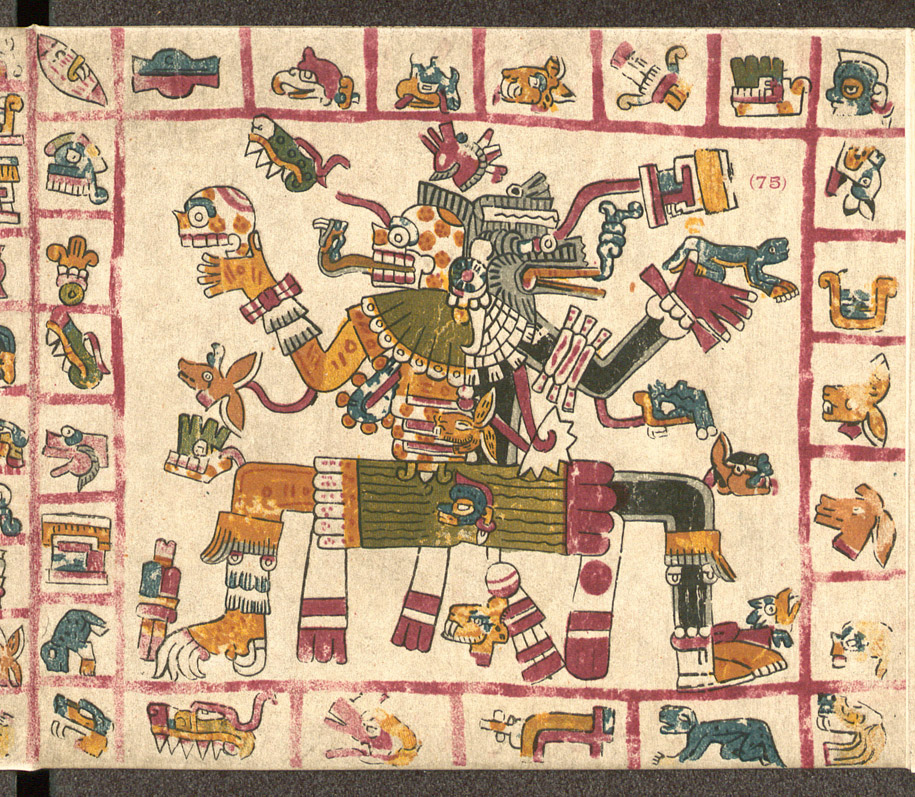
A page from the Codex Vaticanus B, showing Mictlantecuhtli and Quetzalcoatl back to back

a page from the Codex Borgia, showing Tlaloc, Xochiquetzal and Chalchiuhtlicue
Unfortunately, we have way fewer pre-Conquest codices than we do post-Conquest ones. The vast majority of them were destroyed during the invasion by Europeans who either didn't see them as having any value or were trying to make sure the natives stopped practicing their religion so they could be converted to Christianity as quickly as possible. That brings us up to the time of the post-Conquest codices, which were made after the Aztec empire had been conquered. Unlike the earlier codices, which are mostly concerned with recording history and mythology, telling ceremonial stories and lauding the deeds of particularly awesome kings, the post-Conquest codices are much more a portrait of a people under duress. They tend more toward attempting to record what was happening in the here-and-now and tying it to what the Aztecs knew of their own history, and while some do have great mythological value, many of them intentionally leave out religious imagery or euhemerize it down to the deeds of men or demons to avoid the authors getting into trouble with the Catholic Church. Some, like the Duran Codex, were actually overseen personally by Spanish priests and officials who commissioned the works as gifts for royalty back home or had an interest in preserving native history, which naturally led to them being even more skewed toward the authors' attempts to avoid ending up on trial for heresy and the overseers' own commentary and interpretations. The most famous works of this time period are the Florentine, Magliabecchi, Mendoza, Telleriano-Ramensis and Xolotl codices.
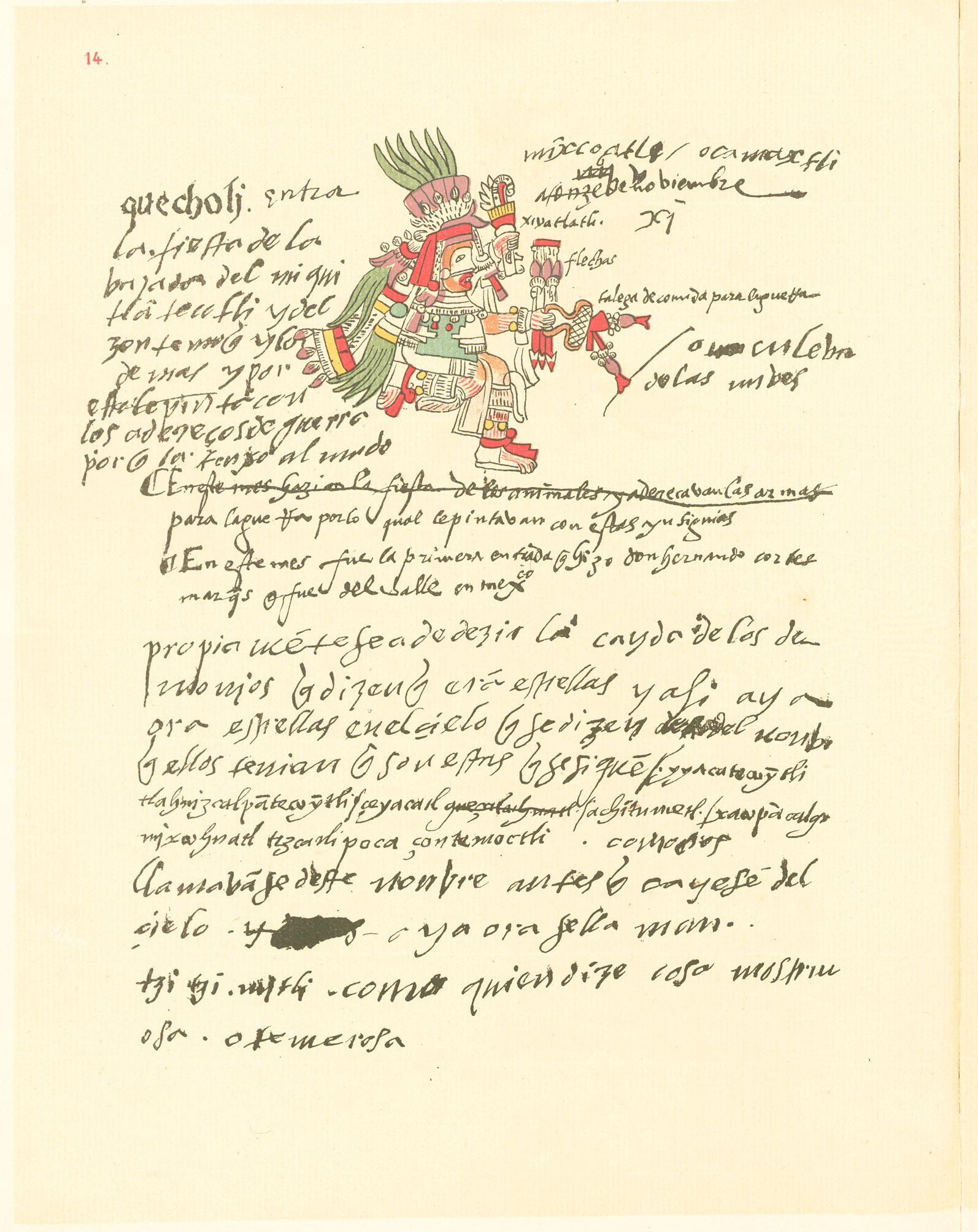
A page from the Codex Telleriano-Ramensis showing Mixcoatl with his hunting gear
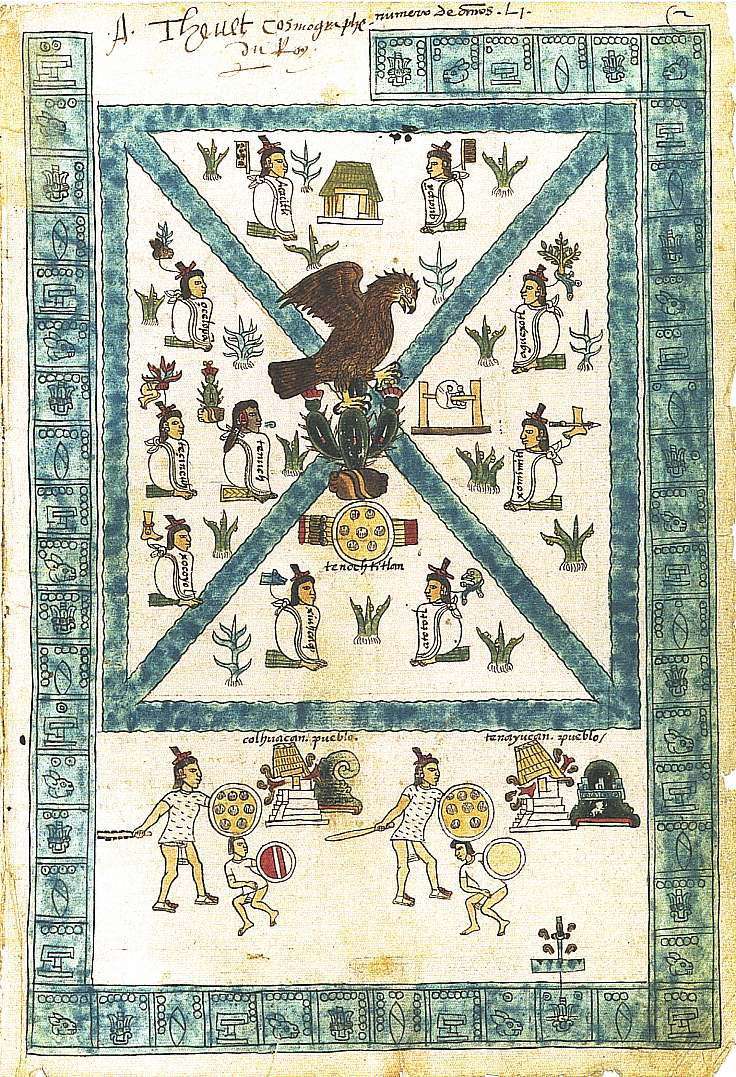
A page from the Codex Mendoza showing Huitzilopochtli in eagle form leading the Mexica to found Tenochtitlan

A page from the Florentine Codex depicting Aztec human sacrificial rites
As you can see, these are much more Spanish- and writing-heavy - closer to the European idea of books than the older Mexican codices, because they were being written by people now living under European rule and for a mostly European audience. They are still major primary sources for the study of Aztec religion and myth (because frankly, they are what we have and beggars can't be choosers), but they also inspire a lot more doubt and raise numerous questions about how accurate their version of stories might really be and how much European interference might be coloring what they contain.
Like most conquered mythologies, we have to do a lot of our learning about them from secondary sources - outside chroniclers like Duran, reproduced historical sources like the Codex Chimalpopoca, or mentions of the culture's practices in preserved resources from nearby peoples who interacted with them.
By the way, since you mentioned it, the Popol Vuh is indeed the major primary source for Maya mythology and is awesome, but it has its problems, too. The version of the Popol Vuh we have today was recorded by a Spanish priest named Francisco Ximenez at the beginning of the eighteenth century, most likely after having the story orally told to him by a K'iche Maya person in what is now Guatemala, and it's been through many transformations and probable changes from that original storyteller to us. The K'iche version may have differed substantially from the Mexican myths of the classical Maya period, to start with - a few hundred years and a lot of geography separate the two, and while they are definitely the same culture and obviously telling the same basic story based on their artwork, we'll never know what details might be different unless we find some new buried source somewhere. Then, the story was recorded after being orally told, making it almost certain that the recorder probably colored it with his own interpretations or changed or omitted some of it; then, there are several theories about who wrote it down first and in what form before Ximenez recopied it to make the first manuscript that was widely passed around, which no doubt included his biases and interpretations; and then various scholars in the eighteenth and nineteenth centuries played academic hockey with the manuscript, recopying and even stealing it, until it finally came into the form we have today.
This is a pretty common story when it comes to preservation of myth. We'd love to always have an accessible, well-preserved priamry source by unbiased natives to take a look at, but in reality that almost never happens. Mexico and its mythologies are prime examples of the infernal mess left behind by invading cultures with little interest in preservation of the peoples who came before them.
Subscribe to:
Posts (Atom)