Showing posts with label pantheons. Show all posts

Monday, May 5, 2014

Bees Coming Home to Roost

By now most of you have probably seen our video post, letting you all know what we're going to be bidding Scion a fond farewell and moving on to projects of our own soon. Your outpouring of support and kind words were much appreciated. You guys are awesome!

In among all the flailing, several people requested that, since we weren't going to be able to finish all the Scion projects we had begun, they would like to see whatever we did have completed, just in case it was usable. So, as we get a little time here and there, we're going to see if we can't give you guys what's left in our work file. All use at your own risk, of course, since none of it is what we'd normally call a "finished product", but hey, you can all houserule away, right? We know you're not afraid to!

So, to kick this off, here's my personal baby: a tiny little proto-supplement on the Hittite pantheon, the Siwannes. It contains a pantheon roster, complete with Virtues and associations, and a PSP based on the Hittite religious idea of the cyclically raging and calming gods.

This day is not without a pang for me. Those of you who have been around a while know that I have a ridiculous fixation on the Hittite pantheon; they're my favorite obscure gods to get excited and yell about, and I was genuinely touched and excited (like, unicorns flying over the moon outside my bedroom excited) when you guys banded together en masse to vote them in as the next project and let me get to finally work on them. It was their bad luck that they were halfway through processing when it came time to move on to other things, but I'm still glad I got to work on them at all.

So, take ye and enjoy in my name. The larger-than-life personalities of the gods of the ancient Anatolian empire are here to rampage across your games if you want them, with a PSP that pretty much looks exactly like this:


Also, shout-out from us to the awesome Stephen Oppelt, who has helped out with copy-editing and drawing the awesome logos for all our fan pantheons over the years. You rock!

Saturday, April 19, 2014

The Wide, Wonderful World

It's vlog time! Today's subject is general cosmological goodness, including questions about Titans, god interactions and the general rules of the universe.

Question: Do Scions identify cross pantheon by role? Do all the creator gods hang out and compare notes (or one up each other or just try and make the best bear, whatever)? Do all the fire gods get together and talk about who has the best volcanoes? Do all the psychopomps get together and complain about all the ungrateful mortals? Do the prophetic deities get together at the foretold times and talk about the subjects that they foresaw themselves talking about?

Question: How does each pantheon view masculinity and femininity? If that's a bit too much ground to cover, I'm particularly interested in how the Aesir, the Tuatha De Dannan and the Bogovi view masculinity and femininity.

Question: What gods (or kinds of gods) do you think would be most proud (if at all) of their children breaking off for a new pantheon? What gods would be least ok with it?

Question: Why is Apep in the Titanrealm of darkness? Is it not more closely associated with Chaos?

Question: Does a Justice God have to believe in Character his own laws or can he just ignore it when it is convenient?

Question: How do you handle the gods no longer being worshiped? Fate? The Titans, not caring, something else? Or do you run with the idea that the world of Scion has major cults today with large and active temples/shrines?

Question: What does the process of binding a Titan look like? The corebook provided a specific example in the sample chronicle, but failed to give more general information.

Question: In your game, Do mortals know if a god died or did something new to their legend? Like somehow a myth about the death or event of the god suddenly is found or they retroactively just know it? I was asking because of the fiction where Athena dies and I wondered about that.


And that's the end of that four-installment vlog-filming marathon. We're internet athletes!

Friday, February 28, 2014

The Hills of Sunny Tuscany

Question: Will you guys ever think of doing an Etruscan pantheon, or is it to much influenced by the Greeks?

Question: Do you ever just want to take a break from exploring distant frontiers of exotic ancient civilizations and write an Etruscan pantheon?


Pfft, like the Etruscans aren't exotic? Please. We live in North Carolina. Any religion that isn't Southern baptist is considered "exotic" around here.

Actually, I have to admit that I am totally a fan of Etruscan mythology. It is heavily Greek-influenced, but its unique aspects are incredibly interesting; there's a lot of crazy stuff, including rampant haruspexy, surprising incest themes, and fantastic new relations between different gods that make it a joy to read about. Any pantheon with a secret shadow council of unknowable gods in charge of whether or not the thunder-god is allowed to use the Super Nuke Death Lightning can't help but be interesting. If you're interested in the details of Etruscan myth, we'd totally suggest getting your hands on Etruscan Myth, Sacred History and Legend by Nancy Thomson de Grummond; it's a great resource with a ton of interesting information, comparison to Greco-Roman myth and excellent reproductions of Etruscan mythological art.

However, we're not sure whether or not an entire Etruscan pantheon supplement is a feasible option. The Etruscans certainly have unique deities and ideas, but they are a poorly-preserved religion before the beginning of Greek influence, and once that Greek influence began to be felt in the religion, things got massively syncretized. The same problems inherent in trying to write a separate Roman pantheon are present for the Etruscans; the majority of their major gods are obvious imports of the major gods of the Theoi, or at best native gods who were assigned all the stories and attributes of Theoi gods until their own individuality has been severely compromised and difficult to identify under all the layers of Greekness. Tinia, for example, almost certainly began as a purely Italiante thunder god with his own myths and local significance, but once Greek influence arrived on the scene, he became so strongly identified with Zeus that we have almost no remaining myths of him or images of him in art that are not obviously borrowed. We would have a few interesting tidbits to say about Tinia, like the aforementioned council control of his most powerful thunderbolts, but for the most part all his myths are just myths of Zeus.

There are purely Etruscan gods in the pantheon; Tiv, for example, is clearly the native moon-god and was more important in that role that Aritimi, the much later imported version of Artemis, and Thufltha (owner of the most fun name to say among his pantheon) is a purely Etruscan deity of fortune and good will. But while we could certainly scrape several of them together and talk about their neat attributes and whatnot, we have the same problem that we have trying to write a Roman pantheon: we'd have to ignore the most important major deities because they're basically identical to the Theoi, and that leaves us with a pantheon that doesn't really represent Etruscan religion at all. But we also can't just throw all the Theoi-analogues in there, because then we have two weirdly pseudo-identical pantheons.

So it's not on our short list; it has problems that we aren't sure how to address yet. We do think there are definitely Etruscan gods in Scion's world, just like there are Roman gods, and that they are not necessarily best handled as part of the Theoi, but for the moment it's something that various Storytellers will probably have to handle. Some will probably say that they want to consider all three pantheons under the Theoi umbrella, and that they represent Theoi influence in a few different cultures that worshiped the same gods in slightly different, culture-appropriate ways. Some will probably say that all three are different, and have to figure out how to split up the major Olympians among them. Some will do the sub-pantheon thing, and others will probably go for a mixture somewhere in between all these options. But until we figure out exactly what we want to do with this perennial issue, we probably wouldn't try to write up the Etruscans separately.

Monday, February 10, 2014

Cartography Special

Question: In your really awesome Religion World Map download, there were a couple of things that confused me that weren't covered by your readme! So I'm asking here. Why are there disconnected inland bits of Algonquin and Berber religious groups? I can understand breaks across shores, but that struck me a bit odd. Also, while I like the Diaspora, I was wondering if there were any pantheons not ignored, because A and B from the readme in that area! Otherwise South America seems surprisingly lacking! Thank you!

Well, first of all, just a quick reiteration to everyone using the map - it is way not perfectly accurate to the mile, or even ten miles, or even fifty miles. It's meant to give you a quick visual of the spreads of the largest pantheons in each area, mostly so you have an easy reference if you need to know whose territory your Scions are blithely wandering into or whose toes they might have stepped on if they blow up an important local landmark. I'm not a cartographer, and I would totally be lying if I said that things were exact, although we did do the best we could in terms of being mostly accurate.

But you guys know all of this, it was in the readme. So on to your questions!

For the Berbers, that's easy; their traditional territory is in the middle of the Sahara desert zone in northern Africa, and when you live in the Sahara, you live in whatever part of it is most hospitable to survival. The Berber people have also been nomadic for much of their history, especially those who live in the harshest desert conditions or who were trying to avoid the Muslim conquest going on nearby, meaning that the areas marked on the map show an approximation of their most common and populated territory, but that there may be Berbers in plenty of other nearby areas, just in fewer numbers or for less time. You see two different zones on the map because that was our best guess at traditional Berber stomping grounds, and most likely has to do with those areas being particularly good for life-sustaining oases and settlements and avoiding historical Arab incursions.

"Algonquin" is kind of an umbrella term for several different peoples (actually, "Berber" is, too!), from Ojibwa to Anishiinabe to Mahican and several others, but we're using it for the moment as a general label since they have a lot of mythological figures and beliefs in common and we haven't yet dived into that region of the world for a good thorough research visit. And because it's an umbrella term, that means they're not necessarily a contiguous people all the way through that territory; those disconnected spots are most likely places where a particular ethnic group within the Algonquin language family has a slightly separate territory from the next closest people. They're linguistically and culturally related, but not necessarily the same, so there's a wide range and no reason that they all have to have "borders" that rub right up on one another.

As for South America, the map is definitely very visually deceptive. Because we included only "pantheons" that had at least a handful of deities, for ease of integrating with Scion's classically-founded model, vast areas of South America look uninhabited, or at least areligious. This is totally not true. There is tons of mythology in South America, but most of it is isolated by the vast mess of the Amazon rainforest, which covers a huge part of the continent's interior and in ancient times was pretty much so massive and impenetrable that ethnic groups who lived comparatively near one another (close enough that European ethnic groups would have been fighting) might never bump into each other for long stretches of time. Various different peoples in central South America have their own mythologies, but have only one or two totem deities rather than a classic "pantheon", so they are not represented on the map. But they're there, and they're important, so if you want to explore South America's mythological map, you should totally do so. Things get crazy in the jungle.

Really, the map's a quick jumping-off point for games with globetrotting Scions and we've gotten a lot of use out of it, but you guys should not consider it authoritative or anything. It's just a game simplifier, and one that we may try to revisit and refine in the future. (But don't hold your breath - it's not super high on our priority list!)

Tuesday, January 28, 2014

Vestiges of a Distant Past

Question: With the Nemetondevos, how much information about them is still available in the world? Is your write-up about their temperament and powers backed up by actual facts? Or are you just kinda making things up for them?

Well, first of all, we are not making anything up. We try not to do that. But the Nemetondevos stuff on this site is under the “inactive pantheons” cut on its page for a reason, and that’s because the supplement detailing them is for the most part scraped together with a butter knife and filled in with cement.

There is information left about the Nemetondevos, but there isn’t very much. Several of them are clearly cognate deities with Irish or Welsh gods of other pantheons (especially the smith god Gobnhios, who is clearly borrowed from the Tuatha Goibhniu), while others gained Roman cults among the conquering armies of Caesar (the most famous of these is the horse goddess Epona, who became the patron of the Roman cavalry). But for those who are purely continental Celts, there is very little to go on; their peoples were pre-literate and therefore did not write down any stories, the majority of their worship centers were open-air and made from natural materials which means they fell apart over time, and the conquest of Rome replaced a great deal of indigenous belief with transplanted mythic ideas from the Roman pantheon. For many Gaulish gods, we know only vague associations, such as the fact that Belenos’ name comes from a root meaning “light” and therefore he’s probably a sun god, or the fact that Borvo’s shrines are almost always located near springs and therefore he’s probably a god of water. For others, we know only their names.

In Scion’s framework, the Nemetonevos are probably, as a majority, not Legend 12, and so while we have used them in our games occasionally, they are no longer on our major rosters and will probably be dispersed to appropriate places later on. A few of them do make the cut, with Cernunnos probably the most famous, but in general most of what you see on them came from the Biblioteque Interdite supplement and was invented for Scion, so it has only a little grounding in what the ancient Gauls themselves might have believed.

Monday, January 20, 2014

Not Exactly Santa's Workshop

It's not the fastest we've ever finished a pantheon - the Bogovi still hold that honor - but we're still feeling pretty proud of ourselves. Finished in almost exactly three months, the gods of the Inuit of the far frozen north are ready to join your games. Be careful when you call upon the Inue, because when they answer, they answer with mighty force.

It's been a while since we've been so jazzed about working on a pantheon, but these guys made it easy. For one thing, we finally have an official pantheon representing North America! It's not nearly the justice that continent deserves, but it's a start. For another, their unique worldview and status as gods of an area that few enter and even fewer understand made for some fascinating research and incredibly interesting deities (not to mention terrifying, in many cases). Like the Polynesians before them, the Inuit have a spread of different languages and regional variations in their pre-Christian religion, but we hope we've done a good job of being faithful to their shared concepts and presenting their most important mythological ideas.

Also, there are more gods in this supplement that will kill you for breathing near them than ever before. So that's a nice bonus for all you sadistic Storytellers out there.

As always, feel free to ask anything you like in the comments, and we'll be resetting the voting poll for new pantheon goodness momentarily. The Hittites won this round because all of you are awesome people who know a quality dead-cuneiform-preserved pantheon when you see one, so they will be next. (And I can't wait!)

If you're one of the lucky players in our games who have previously run into Sedna, Sila or Tornarssuk, now you can go read up on them and realize how very much worse things could have been. That's because we love you guys.

Edit: Now with 100% more Virtues and 100% less embarrassing cover typo. Sorry to those who already downloaded the first version of the PDF, but it's otherwise identical!

Sunday, January 19, 2014

They Have Opinions

Okay, you guys, today we're doing a vlog treat (one day late, but we needed to ambush the star-studded cast). Today's vlog is being performed totally unplanned and unscripted by three of our fabulous players, who took time out from their busy schedule of being screwed over by other king gods to answer some player-centric questions. In fact, they were so awesome at it that it was over an hour long when it was done, so we split it into two parts and you'll get to see the second half next week.

In the meantime, here are some questions!

Question: Does high positive/negative Appearance usually affect internal band interactions? Or is it often forgotten/shrugged off by players and their PCs? For instance, does Woody often find himself getting lost in Geoff's eyes, or is he just used to it?

Question: Have you used Gods in your games as NPCs, actually involved alongside the PCs, not just as observers/catalysts, and if so, which ones?

Question: Has your PCs been in a Avatar vs. Avatar fight?

Question: Sowiljr has a keycard for the handsome gods club. What is that? A cult for him or a mens' club for gods? Or what?

Question: Okay since every pantheon seems to be big messed up families I gotta ask: who is your "unfavorite" in each pantheon?


Awesome shout-out props to Alex Preston-Bosch for the fancy new opening credits - he is awesome!

Monday, January 6, 2014

I Sacrifice, Therefore I Am (Was)

Question: From what I understand, sacrifice to the Aztecs is an important part of maintaining and powering the universe. How do they react to pantheons like the Celtic ones, for whom sacrifice is a matter of simple veneration? Do they see it as needless luxury, or out-and-out blasphemy (since the other pantheons aren't actually being powered up by sacrifice)? A betrayal of their people? Or would they be fine with it?

A lot of this will probably depend on the specific Aztec god in question, so we're going to give you a few different approaches and let individual Storytellers figure out which one would make the most sense to any given god of the Teotl.

If you're talking about a Teotl god who isn't particularly bright, who hasn't had much interaction with other pantheons before, or who just has a poor grasp of the occult or a healthy opinion of how important and universal his own pantheon's practices are, there may be no conflict at all. Gods are, at their hearts, pretty much all egomaniacs, and those who are community-focused like the Teotl tend to extend that to their entire culture - i.e., Mexicans are best, everyone else probably does exactly what we do, because why would they ever do anything else? Under such an interpretatio mexicana, some Teotl may simply assume that other pantheons are getting power from their peoples' sacrifices. That would look normal to them, and if they're not particularly good at understanding how magic works, it may not occur to them that those other pantheons have different powers instead or that the entire universe doesn't run the same way that it does for them at home. Those gods probably totally approve of bog-body sacrifices or mummified mountain sacrifices; to them, those are the only other pantheons who are being even vaguely responsible. In fact, they probably severely dislike, or at least look down upon, pantheons who don't practice human sacrifice, because to them it looks like those jokers are just a bunch of gods being assholes and refusing to help prevent the entire universe from falling apart. What dicks.

On the other hand, those who have interacted with other pantheons a decent amount and understand that they don't get any power from their worshipers' sacrifices may have mixed feelings. Mortals giving up their very lives in sacrifice to their gods seems like it's right and familiar - after all, to the Aztecs, that's what they're supposed to be doing and it's hard to not automatically accept that. But at the same time, the Teotl are deeply invested in and loyal to their people, divine and mortal alike, and wouldn't dream of hurting them if they could help it (certain shining malcontents like Tezcatlipoca aside). It's the fact that the community of the Aztec world is so loyal to one another and the greater good of all that makes the deaths of its members a sacrifice at all. So from that perspective, some gods might see it as a rather unforgivable abuse of worshipers. Killing off some of one's worshipers to make sure everyone in the universe doesn't die is a noble sacrifice, putting the needs of the many before the needs of the few, but killing them off for no reason at all is being straight-up disloyal to the very people you're supposed to be taking care of. Gods coming from this point of view might be shocked, appalled or even furious with deities of other sacrificing pantheons, who they might see as being massively irresponsible or oppressive to their own people.

Of course, it's also a pretty entrenched idea among the Teotl (or at least the mortals that worshiped them) that the Aztecs are in fact the best humans in existence and every other people is lesser and therefore existing only to be conquered and/or sacrificed for the good of the world, so they may not be that upset about it. I mean, it's unfortunate that those other pantheons are jerks to their constituents, but their constituents are clearly not as important as the Teotl's constituents, so it can only be so much of a tragedy.

And finally, there may be some Aztec gods who simply don't care at all what other pantheons are doing. Especially if they realize that other pantheons can't get power out of sacrifices, they may just shrug and go on their way, probably with a side order of shaking their heads and talking among themselves about how only they are really doing anything to help the world not slide into destruction and it would be nice if those other, obviously lesser gods someday learned to do the same. They might see mortals practicing sacrifice anyway as being well-meaning but ultimately pointless and not really care about it much; it might also be a popular opinion that those other pantheons are obviously crippled or sub-powerful in some way, because their worshipers are doing it right but for some reason their gods just can't seem to benefit from it the way they're supposed to, which probably means something is wrong with them. Or, perhaps some might hold the theory that other races of mortals lack sufficient amounts of chalchiuatl, the precious water and source of energy carried in blood, and so killing them just isn't as helpful as killing an obviously much more important Aztec person would be (although this theory is probably held more by homebody gods, as any Teotl who go jaunting abroad will find it just as easy to murder and Australian or Tibetan person for Legend as they would performing a sacrifice at home; and ancient Aztecs definitely did sacrifice members of other ethnic groups they encountered, so maybe this is more of a people-who-aren't-Mesoamerican-are-inferior kind of thing instead of specifically Mexica-only). I mean, if you kill someone who isn't Aztec and therefore doesn't matter to your Loyalty- and Duty-bound view of the world at all, was it really a sacrifice?

The one thing in your question I would say probably nobody thinks is that those other pantheons are indulging in a "luxury". If the sacrifice literally doesn't do anything, it's not really a luxury at all - that would be like buying a box of literally nothing, and then claiming that this was a "luxury" that you kept in your house. One possible approach might be that other pantheons are just so powerful that they don't need sacrifice to keep the universe going and therefore sacrifice could be considered an unnecessary luxury... but I doubt very much you're going to find many Teotl who are all about deciding that everyone in the world is more powerful than they are. No pantheon is in ever in favor of that kind of interpretation.

So really, it depends on a particular god, how much your story has them gallivanting around the world and what sort of personality and idea of the powers of various pantheons they already have. Someone like Quetzalcoatl, who probably understands other pantheons' practices pretty well and doesn't like killing people to begin with, might be horrified by such blatant destruction of people for no reason at all; someone like Tezcatlipoca, who is completely happy with murdering people if he thinks it's funny, probably has no problem with it at all or is amused by how stupid those other pantheons and their inability to get power out of such actions are; and someone like Huitzilopochtli, who is likely none too bright and fully invested in how important and powerful he and his people are, probably assumes that everyone else also does it his way and would have no concept of gods who were receiving sacrifice without also receiving power. Mix and match as necessary.

Thursday, January 2, 2014

These People Are the Reason Sophia Archimedes Changed Her Name at God

Question: The Gnostic deity Sophia and others seem promising as possible deities for Scion. If you had Sophia, the Demiurge, and others as Gnostic deities to be Scions of, what kind of contribution do you think they could add to the Setting's plot/story/background?

Question: Is it actually possible to do a Gnostic pantheon? I mean, the Demiurge would sound like a really awesome Titan Avatar.


All right, folks - I hope you were ready for branch monotheism and medieval wackiness, because apparently that's where we're going today!

Gnosticism is one of the first really serious schools of Christianity to deviate substantially from mainstream belief, and is largely based on Platonic philosophy that was incorporated into fledgling Greek Christianity of the time. Like most religions, it's very complicated and has a lot of specific features gained or lost through different splinter sects and doctrinal additions, but the major features are these: that the world was created by the Demiurge (either God or a servant of God), that it is not truly reality but rather the poor material facsimile that is all most humans can comprehend, and that true salvation can only be achieved by seeing past the material to true enlightenment, a state called Gnosis that is achieved when one is aided by Sophia, the personification of wisdom. Some branches of Gnosticism recognize the existence of various lesser "deities", but always under the understanding that these are mere aspects or emanations of God rather than separate beings; others assign the creative Demiurge all kinds of bizarre alternate personas, ranging from viewing him as God to the Devil to an unrelated deity or demon to an interloper from another universe and everything in between.

Gnosticism, no lie, is bananas. Various branches of it, while holding onto the same basic ideas it started with from Christianity, have been influenced by a lot of other beliefs and cultures. Persian-flavored sects believed that the Demiurge was Ahura Mazda, creating the world, or alternately that it was Angra Mainyu, perpetrating the great lie by building the imperfect representation of the world on top of the real truth of enlightenment (and incidentally, doesn't that bring up some great Indo-Aryan conflux, too, with the idea of the physical world as created by Brahma not being real?). Egyptian-flavored sects believed that the Demiurge was Ra, or Ptah, or an unnamed son of one of them, or simply God as he was believed in by the Coptic Christians. Greek-flavored sects followed the common Greco-Roman practice of personifying abstract concepts and are responsible for most of the ideas of the Aeons (lesser "gods") and Sophia herself as living creatures of the cosmos, which were in turn passed to various other kinds of Gnosticism, and by the time the religion largely fell out of favor (around 300 C.E. or so), there were almost no parts of it that hadn't been influenced by one another in some way.

As you can imagine, scholars have had an absolute field day with Gnosticism, pretty much unceasingly from the nineteenth century (when study of it was resurrected by the Enlightenment) up until now. While various other religions' deities and ideas have clearly filtered into various sects of Gnosticism, the religion itself has its origins in Christianity; various branches claim they predate Christianity, but we have no records of its existence before the rise of the worship of Christ. The basic skeleton of Gnosticism is still largely Christian (and Judaic) as well, with a single distant God (who may or may not be the same as the creator figure, depending on the sect) in charge of all of humanity and lesser beings, even supernatural ones, subordinate to his will. The idea of achieving salvation through secret knowledge is explored further in the later medieval Christian branches of Mysticism, although seldom with as much craziness involved. The familiar figures of the Christian prophets are usually present as well, although whether they're messiahs or false prophets also depends on the particular flavor you're rocking.

If this looks crazy to try to fit into Scion's setting, that's because it is. We are probably never going to seriously approach the idea of trying to fold Gnosticism into Scion, for a few reasons. To begin with, its core ideas are Christian; especially in the older versions of Gnosticism, it comes across much more as a religion for people who are in the process of converting from polytheism to Christianity (which is, in all likelihood, what it mostly was, bringing holdovers from local polytheistic religions slowly in to be reinterpreted into the framework of monotheism). You can see a lot of Gnosticism still hanging on in modern forms of Christianity, in fact - for example, Sophia is still acknowledged in Catholicism, as a personification of the spiritual understanding of the Holy Trinity rather than an actual being. And that makes trying to adapt Gnosticism into a Scion pantheon subject to all the normal problems of working with Christianity and other monotheistic religions; at its heart, it's not a collection of equal deities, but rather a single God with various subordinate personas or servants, which doesn't play well with a polytheistic setting.

Another reason is that for many of the strongly polytheistic-flavored parts of Gnosticism, the polytheism in question is actually borrowed from various outside religions that already exist in Scion. The Netjer, Theoi and Yazata are already covering many of the most blatantly pantheonic aspects of Gnosticism, which should come as no surprise since those aspects are often directly acquired from them in the first place. Even Sophia exists already in ancient Greek religion as an abstract personification of wisdom, although she isn't particularly important and it's only once Socrates and Plato start involving her in their philosophic (literally philo-, "friend", and sophia, "knowledge", combined into one word) endeavors that the word/persona is given all that much importance.

And, finally, Sophia and the Aeons are personalities, but not true deities; they are not worshiped separately and do not have their own cults, and were always understood to be subordinate emanences of the original and ineffable God. Even the Demiurge, which depending on the strain of Gnosticism might be God himself or an intermediary creator made to take over the job, sometimes an agent of good who performs things that God is too large or important to manage and sometimes an agent of evil who by creating falsified realty keeps humanity from achieving true enlightenment, is really just a "part" of God, not a separate being. This wouldn't necessarily totally preclude them from being considered a pantheon - after all, Hinduism uses some of the same ideas - but there's too much monotheism going on here and precious little reason to try to split the whole mess off into something that fits into Scion's worldview.

But your question is really "Can I do this in Scion?" and the answer, of course, is yes. We wouldn't do it, but we're not the only game in town. Games that already roll with monotheism in some form or another should be able to fold Gnosticism into that with ease, and even those who don't are of course free to decide any darn thing is legitimate as a pantheon if they want to. You could decide that Sophia, Horon, Ecclesia and the other emanations of God are deities in their own right and stat them up, and since you're far away from us, we won't be around to frown and wag our fingers at you.

There are also plenty of ways to monkey around with Gnosticism without trying to invent a gnostic "pantheon", too; for example, you could claim that any one of the other religions that influenced Gnosticism is actually responsible for the movement's popularity, and that the gnostic sects were a result of the Theoi or Yazata or whomever trying to reclaim their worshipers from the new threat of Christianity. You could also decide that while Gnosticism itself is monotheistic, the emanations subordinate to God within it are actually aliases or alternative names for gods or Titans of other pantheons who used this opportunity to influence Christianity according to their own agenda. Or maybe those "gods" are in fact former Scions, who rose to godhood during the rise of Christianity and found a way to make their mark and be worshiped within it in a way that their firmly polytheistic parents were not flexible enough to do. It's a tricky idea to work in, but not really any more so than other brands of monotheism, so if you're game for anything like that, you should be able to give it a shot.

For our games, we're pretty certain that Gnosticism is at its root a variation on the usual Judeo-Christian monotheistic theme, so we're unlikely to add it to the overall polytheistic world of Scion. But of course, you're always free to pursue whatever you like in your own!


Thursday, December 26, 2013

The Wide, Wide World

Question: Odd question, but do you think the Sami gods will ever show up on your pantheon poll?

It's not odd at all. Fancy gods of various cultures are what we like to see here!

Sami deities are certainly a possibility for the poll someday! We try to keep the number of pantheons up for vote at any given time fairly small, since otherwise votes split all over the landscape and make a mess, so we normally keep it confined to either pantheons we know that lots of Storytellers and players have been hoping for, or pantheons we personally really want to work on. Of course, we want to work on everything, so you can guess how much that helps narrow it down.

The Sami definitely have their own unique culture and beliefs, including some very strong shamanistic traditions and deities that may have influenced or been influenced by several nearby pantheons so in our perfect Scion work of a million discrete pantheons, they would of course be included. I suspect that we'll probably have a long list of more prominent pantheons that various games could use to go through first, but we're always willing to hear suggestions for pantheons you guys need.

In fact, we can do that right now - what pantheons are you guys most interested in seeing? What would be most useful in your games? Where do you feel the most glaring holes in Scion's pantheon spread are? Lay it on us!

And speaking of pantheons, it's back to the salt mines for me!

Monday, December 23, 2013

On a Wing and a Prayer

Question: Would the Greek gods look down on a fellow Greek god with animal features even if they look great? (Like, say the new god had raven wings.)

You know, this is a really interesting question, with a few angles going on.

In general, the Greeks don't care if your animal parts look great, they still find them gauche. One of the major features of Greek aesthetic sensibility is the idea of absolute perfection of the human form, of which the gods are the most excellent example; no matter how bangin' awesome you look with your animal parts, they would always believe you'd look better without them. You're supposed to look like the pinnacle of the humanoid form, so even attractive animal parts still represent a deviation from perfection. An Ultimate Appearance god with a tail is always going to be considered doing it wrong, even if he's technically exactly as hot as an Ultimate Appearance god without one.

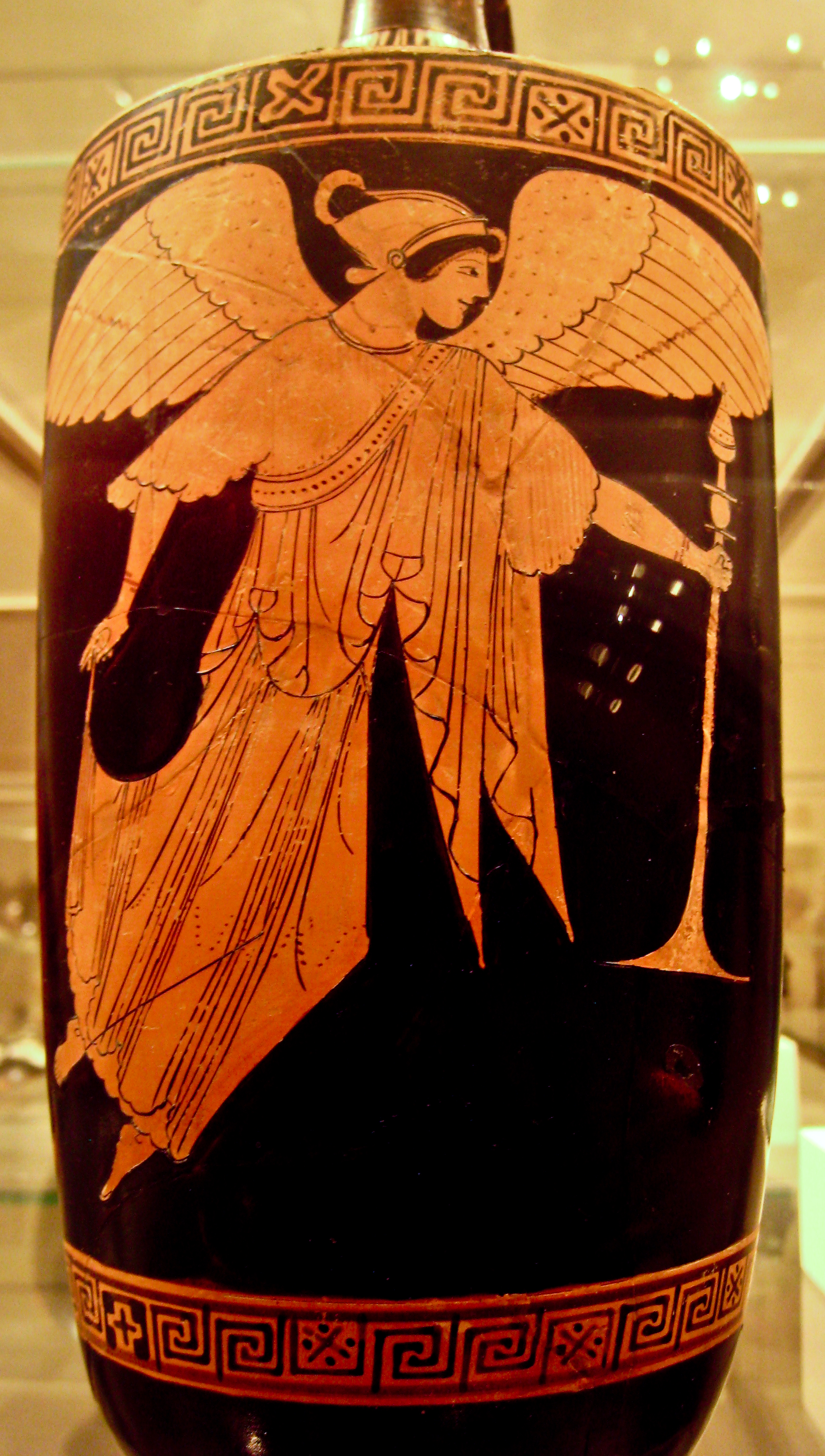
However, wings are specifically an exception in Greek mythology. Despite the general disdain for people who look inhuman (which, by the way, doesn't only include animal parts - dudes like Priapus are not winning any points, either), many gods do appear with wings on their shoulders without any apparent stigma.


Iris, the rainbow-goddess and messenger of the gods


Eros, god of love


Nike, goddess of victory in battle and competition


Various lesser gods are specifically said to be winged, and ancient writers seem perfectly happy to mention this without seeming to put any negative connotation on it.

The difference here between wings and other animal parts lies largely in their specific symbolism in Greek mythology. Where other animal parts usually represent bestiality, wildness and a lack of civilization and humanity, bird-like wings instead often represent swiftness and the ability to be ever-present, making them obvious choices for gods whose job it is to be everywhere all the time or to rush to and fro on their divine errands. Gods that travel constantly, like Iris, have wings to illustrate their fleetness, while gods that are capable of being present wherever needed, like Eros and Nike as the bringers of love and victory, have wings to show that they can instantly travel to anyone's side. Gods of swiftly-moving natural phenomena also often appear with wings, such as the gods of the four winds and their offspring, or Hypnos and Thanatos, lords of sleep and death, who must travel the world unceasingly to bestow their gifts on mankind.

Basically, in Greek iconography, wings are usually meant to suggest that the god that possesses them has Psychopomp or otherwise travels a lot, rather than meaning they necessarily have anything to do with birds or Animal. In fact, gods that do have to do with birds, like Aphrodite with swans, Hera with peacocks or Apollo with ravens, usually don't appear with bird parts in spite of their association.

So having wings might, depending on your Storyteller's interpretation, be the one permanent animal feature that a young god of the Theoi can get away with without courting social repercussions (the dreaded Greek God Snub). It really depends on whether your ST believes that those gods literally have wings - which they very well might - or prefers the interpretation that those wings are an affectation of Greek artists rather than a literal truth, in which case having actual wings might still be a problem for you. It's also worth noting that only lesser-Legend Greek gods usually rock the wings, which is most likely because grunt-work jobs like carrying messages or presiding tirelessly over human affairs are somewhat beneath the greater gods of Olympus, who are too important to be worrying about someone else's problems all the time. If you do choose to have permanent wings, it's likely that the other Theoi will automatically assume you're jockeying for one of these kinds of jobs, and to assign you to them even if that's not what you wanted; and if you do manage to get away from all of that, they're probably going to start questioning why you're being weird and wearing wings for no apparent reason.

Of course, you can always have animal parts regardless of what the Theoi think about it - it's not illegal to be creature-like, just considered in poor taste. As a new Scion trying to carve out a place for yourself, you can always decide to pal around with the other rustic gods and decide to ignore those stuffy old rules the geezers up on the mountain care about so much, or try to become a beloved figure among the Greek gods and start changing the status quo to become more accepting of alternative styles of beauty. But if you're looking to have a permanent animal feature (with Bestial Nature or relics or whatever else) and want to avoid the whole messy Mean Girls-esque political situation, wings are your best bet.

Wednesday, December 18, 2013

Highland Fling

Question: Were the Tuatha worshipped in Scotland as well as Ireland? I know that culturally Scotland and Ireland have a lot in common, but does that extend to their gods? (The question was brought on by watching Brave for like the 50th time and wondering who I’d make Merida a Scion of.)

Yep, they definitely were. Various Celtic gods are widespread across Scotland, and the Tuatha are the most major group of them, although their names are often slightly altered by the local dialects. Irish settlers crossed the water to Scotland around the second or third century and brought their deities with them, to mix with local figures as well as other imports from the Norse and even the Romans. Scotland's a giant melting pot that way, and is itself a mystical destination in several Irish legends, including the tale of Muireartach, the one-eyed goddess of the sea crossing between Ireland and Scotland who the Fianna claimed sometimes crossed the water to fight in their battles, or the story of Cu Chulainn traveling to Scotland to train under Scathach, the most demanding warrior woman known to the Irish.

Scotland does have a few figures that were probably deities of the local peoples, but for the most part their mythologies are imported from other nearby areas, and the Tuatha are the primary contenders when it comes to foreign gods with power in the area. If you're planning to mess around with the interplay between Scottish and Irish gods, you might be able to get some very interesting stories out of who came first, who took what territory from whom, and what kinds of political dynamics still remain in the area.

Personally, if I were statting Merida, I would probably set her up as a Scion of Scathach. I could see her running circles around Cu Chulainn at the same Legend level.

Sunday, December 8, 2013

Pleasing the Masses

Question: Well, it's apparently going to be the Inuit pantheon next, thanks to a [suspicious] last-minute surge in the voting. Can we at least ask that the Australians be put on the list for the NEXT pantheon to be covered, and vote on others for beyond that? Nothing against the Inuit - I just think the Australians would be of more use to me in an on-going game.

I apologize - we should have answered this closer to when the Atua were finished, but I lost it in the flood of questions that day. (Seriously, it was like thirty. You guys!)

I definitely feel you on wishing for a pantheon more useful for your own games, but unfortunately we can't cater directly to everybody's game. All kinds of different Scion games will get more use out of some pantheons than others; I know people on this site play in Celt-heavy games that need a Welsh pantheon more than anything else, others who want to explore the Americas who are starving for a Navajo or Algonquin pantheon, and still others who run heavy Shen and Kami and want to know why nobody else in eastern Asia is ready to play with them yet. One of the reasons we run a voting poll is so that we can get some majority help in deciding which pantheon to work with next; we can't please everybody, so we hope that the highest vote will represent pleasing the most people each time.

So while we understand your feelings, unfortunately we won't just schedule the Australian pantheon for next and skip voting. It wouldn't be fair to all the other Storytellers and players who really want something else and wouldn't find the Australians very useful, any more than it would be fair to you if we unilaterally decided to do Tibet next because it would be best for some other game you've never played in. If it makes you feel any better, only about half our custom pantheons are actually currently used in our games, either; the Anunna, Bogovi and Atua have been used in our chronicles, the first two heavily, but the others not so much right now.

As for your suspicions about the voting, that I can't help you with. One of the reasons we moved to the new polls was to cut down on the potential of cheating; the old Blogger-hosted ones allowed pretty rampant cheatery if you knew how, whereas the new ones prevent multiple votes from the same IP and force would-be vote-stackers to cruise around looking for separate internet connections and/or machines to try to get multiples off. I won't rule out the possibility of someone figuring out how to game the system (sadly, there's no such thing as a cheat-proof online poll), but hopefully it's a much reduced chance. There's often a last-minute voting surge when the previous pantheon is about to wrap up, as visitors to the site realize that the moment of truth is at hand, so that might also have contributed.

At any rate, voting is progressing right now and the Australians are one of the options - far from the frontrunner, it's true, but you can always try to rally your fellow players to the cause. As always, we pledge to get pantheons written as quickly as we can without sacrificing quality or our own sanity, in the hopes of being able to continue adding more and more to the Scion world and giving more and more games material they can use, but we can't do everything all at once.

Monday, December 2, 2013

Play Ball

Question: Okay, this one's for Anne - What can you tell us about those rivals to the Aztecs, the Tarascans? What were their gods/goddesses like?

Cue Mesoamerica again!

The people of the Tarascan empire are more properly the Purhepecha, people of Michoacan, the second-largest empire in Mexico at the time of the European invasion and the only real rival to the power of the Mexica-controlled Aztec empire, with which they maintained a sometimes-hot, sometimes-cold war for most of their existence. Michoacan fell only shortly after Tenochtitlan, ransacked by the Spanish as soon as they had finished allying with the Tarascans against the Aztecs, and the name today survives as one of the states of the modern country of Mexico.

We don't know as much about these guys' religion as some of the other peoples in the area, unfortunately; their records were preserved even less well than those of some of their neighbors, and our only really good remaining source of information about their ancient culture is the Chronicle of Michoacan, which was written by Spanish priests based on what the locals told them in order to be sent back to Europe as a curiosity. It's by far the closest to original we've got, with a section dedicated to describing the gods and festivals of the Tarascans, but it's also secondhand through a Christian writer, and in this case we lack any pre-Conquest documents to try to show where biases or editorializing might have occurred, so we pretty much have to take it on faith.

So we do know the names and even some of the customs (lots of blood sacrifice, as you do in Mexico) surrounding Tarascan gods, but don't have as firm a view of exactly what they were all about as we do for folks with better-preserved folklore like the Maya or Mexica. We know they had several major gods of their own, including the shapeshifting fertility goddess Xaratanga, who transformed into a serpent to hide from her enemies and a wizened old crone to trick her worshipers into revealing their ungenerous natures, Querenda Angapeti, an underworld-connected god who could be called upon to grant prophetic visions, Curicaueri, a culture-hero god who led the Tarascans to found their empire, and Hacuizecatapeme, the major ruling god of the pantheon to whom most sacrifices were dedicated.

Neat names for neat gods, or so we must assume despite not knowing a whole lot about them. There's definitely also some of the typical cultural borrowing in the area going on; the story of Curicaueri helping to found Michoacan is very similar in spirit to the tale of Huitzilopochtli helping to found Tenochtitlan, despite the general hostility between the two peoples, and indeed the Tarascans do mention a Zinzuviquixo as the god of the Mexica, probably referring to Huitzilopochtli by their own name for him (both mean "hummingbird" in their respective languages). The tale of the gods Cupanzieeri and Achuri Hirepe playing a ball game that ends in one of them losing and being sacrificed, after which his as-yet-unborn son Siratatapezi must discover his birthright with the help of friendly animals and defeat his father's murderer, is an obvious parallel to the Maya story of the Hero Twins, although in this case there is only one son to carry on his father's ball-playing legacy. And we have some great sculptures of a guy that looks suspiciously like Tlaloc, teeth and all, although of course the googly-eyed rain god is a pretty widespread phenomenon in Mesoamerica and needn't necessarily be referring to the same dude.

Unfortunately, almost all our Tarascan mythology is firmly post-Conquest, meaning we don't know how their stories might have played out before the intrusion of European influences. Some tales have had origin myths tacked onto them, such as the ball-playing myth now incorporating an explanation of where horses came from (the corpse of Cupanzieeri, once rescued by his son), while quite of few of the others are involved with explaining the Spanish invasion from the point of view of the Tarascans, who have a story somewhat akin to a council of their gods trying to explain what was going on and give them advice about how to deal with the newcomers. We really don't know a lot about what they were doing before then, though of course archaeological evidence is always fun to speculate over.

Unless we manage to unearth an awesome Tarascan codex or an unknown archaeological site full of relevant paintings soon, we'll probably remain on tenuous ground with this particular mythology. But, like all of Scion's gods, they're out there, and they definitely know the Teotl. Anything could happen.

Tuesday, November 19, 2013

PSA

Quick housekeeping post for a few questions that have already been answered!

Question: For those of us who are interested in creating our own custom pantheons (I'm personally considering making one for the Maidu Native American tribes), what's the process you use for creating your outstanding homebrew pantheons?

We've got an old post here about creating homebrew pantheons. We're pretty sure it's a different journey for everyone who does it, but it's a fun time no matter how you prefer to work!

Question: Hey guys! I was reading over the Atua and the K'uh and I had a thought. How does a fledging deity effectively combat the avatars of those places, since purviews like Psychopomp and (positive) Health don't really have anything offensive to use on those avatars?

This one is a little harder to find in the archives, but we've totally gone over it, too! Discussing how to use purviews without combat powers against Titans is covered in this vlog, starting at about fourteen minutes in.

Question: How would you deal with the Buddha in your games?

The quick answer is that we haven't because it hasn't come up, but we've got an old post with suggestions for the Buddha back here!

That's all for today, back to more questions tomorrow. :)

Sunday, November 17, 2013

Gods on the Sidelines

Question: What do you think about obscure pantheons like those in the Philippines, Burma or Melanesia? Are they great enough to be Scion pantheons or...?

Of course they are!

One of our absolute favorite things about Scion is the fact that it's completely global, and that any religions or mythologies that exist anywhere can and should be used in its gameworld whenever the Storyteller wishes. All myths are true in Scion, and that means all of them, not just the most widely known or popular or adapted-for-television. The mythologies of places like the Philippines were no less part of a vibrant ancient belief system, nor were their gods any less worshiped, feared or beloved, so why should they be automatically excluded from the game? Because they aren't very well-known outside their native land? Plenty of pantheons weren't once upon a time, and still aren't now, and for those intrepid Burmese players out there it would be super unfair for them not to be able to play games set among the gods of their own country just because people in other countries haven't heard of them.

However, that doesn't mean that every Storyteller is going to have the time or inclination to go out there and stat up every pantheon that has ever seen the light of day. Nobody's got the time - even we don't have the time, and we love doing that! - and if a particular game's stories don't involve those deities, it's not useful for the game anyway. Some games may have players or Storytellers who mostly want to interact with gods they already know and are interested in, and there's nothing wrong with that as long as everyone has fun. But if a given game's players or story do want to have Degei roll up and start dispensing some snaky Fijian god-justice, well, damn, they can do that exactly as much as they want to.

Of course, we can't expect the Scion universe to really be able to release all the gods everywhere, and there've been lots of in-game excuses for why that is - the lesser pantheons were destroyed by Titans, or conquered by other pantheons, or they don't have enough power to bother helping in the war, or they're just more famous gods slumming it in disguise, or whatever. We don't like those explanations and never have, but that doesn't mean your game can't use them if you need a plausible answer when your players go, "Hey, what are X pantheon that you weren't planning to get involved here doing right now?" We like to dream of the entire world's pantheons all being alive and ready to kick some ass in Scion, and we do our best to try to slowly but steadily write some of them up for use, but it's a long, long road and not one every game has the time or inclination to embark on.

But sure, never let anyone tell you that you can't have a certain pantheon in the game because they're "not important enough". Every pantheon is important to the people who believed in it, and can be important to your story if you want them to. The obscure ones just require a little more legwork when it comes to learning about their powers and stories, but they're out there waiting if you want them.

Saturday, November 16, 2013

Socializing in the Sky

Are you guys ready for another session of marathon vlogs? Here they come! Today's is about politics and insanity among the gods, who never seem to have getting along near the top of their to-do lists.


Question: From a social perspective, what does it mean to the gods when one god has more associated purviews and/or Epics than another god?

Question: Would it be possible for a god, through either Fate-dickery or Magic or just sheer force of will, to change their modus operandi? I have a game idea that partially revolves around the idea of Odin abandoning his normal methods to try the novel approach of honesty and good faith in order to avert Ragnarok. Is this plausible?

Question: Can you elaborate on the relationship between the Yazata and the Deva? Why do they see each other as enemies?

Question: You always talk about gods leaving the World because of Fatebonds. Why did they stay in the first place? They would have known about Fatebonds during that time. Was the risk just worth the reward?

Question: Would it be accurate to say that pantheons that have more Virtues in common (such as the Aesir and Nemetondevos) would be on better terms with each other than those that have few in common (like the Anunna and Theoi)?

Question: Every god has a rivals and enemies listing on their page, but what does that MEAN to them? To be specific, Odin has enemies - does he hate them, or are they merely names on his "to kill list"? When you say a god has enemies, does that mean hatred and active attempts at murder and sabotage, or something less intense and more passive?

Question: I've got a Scion game coming up where all the PCs are either Kami or Teotl. I was wondering if you had any ideas for ways in which those two pantheons would interact, as I'm currently drawing a blank.


Just be nice, everyone. Is that so hard?!

Sunday, November 10, 2013

Regrets

Okay, guys, John recorded this yesterday but couldn't figure out how to get it uploaded to YouTube, so instead of posting it here he threw a lot of furniture, drank some beers and stomped around until our cats had anxiety seizures. Now that it's finally up, we can bring you the belated vlog. He wants you to know he did it entirely by himself and it's awesome.

Hey, this isn't a question but more of a Request. Could we possibly get another John Only Vlog i love how he rages on questions when Anne isnt there to calm him down. Lie when the Vlog when he was in yall old house in the room talking bout Thor being a personification of Odin's strength. A blog like that where he answers questions and just lets us have it. In all his Johnny Goodness. Those are my favorites. PS i still love you anne just want to see some John Rage.


Question: Through EPIC COSMIC TRICKERY and MANIPULATION, a pantheon of gods sits down to all play D&D together. You are the DM, and they tell YOU to pick their char classes for them. What do you pick for them and why? Greeks (big 12), Norse, Aztec. GO! (pretty pretty please?)

Question: I know your views on made up stuff for Scion when there's worlds of material from real world mythologies, but I'm curious and cannot resist asking. If you guys had to take a pantheon from any fictional piece (other RPGs, Lovecraft, etc.) and create a Scion version for use as divine parents, which pantheon would it be?

Question: Can we get a hint on the secret project you're working now? Just a tiny one, I beg you!!

Question: You ever read any of Rick Riordan's Percy Jackson or Kane Chronicles books? And if so, what did you think of them?

Question: Regret guy here. What does Zeus regret. What does Eshu regret. What does Vishu and Braham regret. What does Sarsovitch regret. What does Perun regret. Choose any and all you feel like answering. Sorry about the spelling, pressed for time.

Question: Okay, i am not the original asker of this question: Power and responsibility go hand in hand. And with every great decision comes regret. Regret for what could have been, should have been, and what ultimately was. What do the gods regret? , but you talked about comming back with ONE god. Prove. What does the law regret? banishing his twin-son-bird-thing to the underworld for attacking Veles son? (who were dicks) or is there other things?

Question: Can you hide Epic Appearance (positive or negative) by wearing lots of clothes? I mean, bundled up like an eskimo without an inch of skin showing. Like Kenny from Southpark level bundled up. Sight? Clothes. Smell? Clothes. Touch? Clothes. Taste? ... ... stop licking my jacket!

Friday, November 1, 2013

Total War

Question: Say the Titans aren't an issue, and one of the pantheons decides "screw it, we're taking over." Which pantheon do you think is most likely to start a war to dominate the rest?

I don't know if there's a "most likely" in this scenario, but let's look at the possibilities!

First of all, I want to know: taking over what, and why? Are you talking about one pantheon trying to conquer the Overworlds of all the others? Trying to take over all the real estate on earth so only they are worshiped? Trying to assert their power to make all the other pantheons fiefdoms under them? Different kinds of power grabs come from different kinds of gods - for that matter, are all the members of this pantheon going to get power in some way or is it all going to funnel to their current king/queen, and if so, how does that change things? Also, why are they taking over? Conquering one other pantheon would make sense - maybe they hate them, or they have something they want to seize, or they're strategically located next to something important, whatever - but all of them at once is a lot harder to have a motive for. Is this hypothetical pantheon made up completely of crazy megalomaniacs who want ultimate power in the universe, or are they trying to take over to impose some kind of order or goodness in areas they think are broken, or do they think everyone else is about to gang up on them and they want to go on the offensive first, or do they have some kind of racial supremacy thing (more than the usual) going on? What is this war even about?

All of that stuff affects the answer to this question; any pantheon might decide to up and declare war if they thought they had to in order to get something they needed or kill a group of hated enemies. If the idea is that they just want to be In Charge of Everything, with no further explanation, that seems pretty unlikely but would lend itself best to the pantheons that come from conqueror nations whose social climate was based on warfare and annexation. In the Americas, the Teotl, K'uh and Apu all come from extremely war-oriented and expansionist cultures, while in Africa the Orisha spend half their existing myths conquering one anothers' kingdoms, in Polynesia the Atua oversaw crazy canoe-cavalry warfare between islands for centuries and up north the Tuatha, Aesir, Yazata and Theoi are famous for European and Asian warfare. And that's not even counting ridiculous people like the Elohim, who just really love war.

Actually, there are very few pantheons that have no warfare in the background of either their gods or the culture they were worshiped by, so there are few of them that probably just wouldn't go for it at all. The Bogovi are probably one; the Slavs were no slouches in the arena of war, but the Bogovi policy of not interfering with the World (or anything else outside their scope most of the time) would make it unlikely that they'd suddenly go on a conquering rampage. Gods of cultures like the Inuit, who did have conflicts occasionally but were usually way more concerned about surviving the coming week, are even less likely to have any reason to go out and start something.

But even they are still totally possible. The Inuit gods might decide they'd like some real estate that isn't a frozen hellscape; the Bogovi might decide that if they were in charge of the universe, they could stop everyone else from all this interference in the World they keep insisting on. No pantheon is off the table for a power bid, not really; gods are, after all, creatures of power and influence. They were designed to be in charge of things.

If you're thinking about making this a major plot in your games, we'd probably say to keep in mind that you can find a way to make the idea work for any pantheon, but that the actual success of such an endeavor is very, very unlikely. Even the largest pantheons are massively outnumbered when they decide to oppose all the other gods in existence, and gods vs. gods is a matter of equal powers clashing, without the Titans' ability to call on greater disasters and powers thanks to their link to the primordial. It could maybe still be done, but it would have to be planned incredibly carefully, get really lucky, and have some massive distractions or reasons other pantheons wouldn't just cut it short before the ball rolled too far. Remember, this pantheon is deciding to suddenly attack and conquer literally hundreds of other Legend 12 beings with purview Avatars and Ultimate Attributes. One god with an Avatar can fuck up any battlefield plan; imagine how many would be involved here.

What would probably happen is that one of those warlike pantheons would start hostilities, conquer a few other pantheons, and then the remaining ones would decide, "Okay, they're out of control," and become allies to shut them down. Even a massive pantheon will run out of steam eventually, especially if fighting a multi-front or serial war.

Also, don't attack Russia in the winter, kids. I know it always seems like a great idea, but while mortals can't get past the weather and the angry natives, the gods will probably have no better luck getting past the brick wall of eternally stubborn Bogovi opposition.

Saturday, October 26, 2013

South Pacific

This was one of the longest pantheon projects ever, but we hope you guys will think it was worth the wait. From the windswept tropical islands of the Polynesian triangle, we bring you the Atua, stormy gods of the natural elements and bringers of supernatural adventure on a cosmic scale. Brace yourselves, because they are out of control.

We've updated the master post for Atua-specific details, but if you have questions, by all means, hit us. We had a blast working with these guys, who are in the interesting position of being worshiped over a wide range of different islands but often in different ways, for different things or at differing degrees of importance, making them a jack-of-all-trades group of gods ready to leap into action in a dozen wildly varying ways.

I don't mind telling you guys that I'm going to take a little time off from pantheons (maybe a whole week!) to recuperate, but when we leap back into action it'll be with the Inuit gods of the far northern reaches of North America. We are way super excited to finally be adding a North American pantheon to our gameset, not to mention getting to flesh out several Inuit characters who have already made appearances in our games, and the unique (and scary, and awful) flavor of the arctic gods is going to be a whole new world of horrific fun.

Voting was really, really close this time; for a while there were three frontrunners that were neck and neck, and every week we wondered if the deciding factor was just going to be who was on top when we finally got the supplement out the door. If you were part of the very vocal factions who didn't quite come out ahead, don't despair; the next round of voting is up and both of the other heavyweight contenders from this time around are back again, as are some fresh new options for folks who have been looking for something different. As always, we're happy to talk about any of the pantheons up for voting if you have questions about them.

As always, thanks to all of you for reading and discussing and cheering us on. Go get yourselves some gods of the islands.