Question: This one might have been written in the comments instead, but I think it deserves an entire post (whenever it gets through The Questionado): What are nahualli?
You know, we talk about nahualli a whole bunch on this blog, because they're a concept that is very important for Aztec religion and spirituality and therefore very important to a lot of Teotl Scions and gods. But we've never outright laid out exactly what a nahualli is, which it now occurs to me has probably been confusing for folks who hadn't heard the term before. So let's fix that!
The word nahualli comes from the root nahua; it has a meaning something close to "wisdom" or "secret knowledge", with a secondary connotation of hiding or disguise, all of which concepts tie in with the idea of the nahualli. Often translated as "shadow self" or "second soul", a nahualli is a specific Aztec religious concept: basically, the idea is that all people are born with only half their soul in their human selves. The nahualli is the second half of a person's soul, which takes the form of an animal (either a real, physical animal somewhere in the world, or a spirit animal that only exists in the realms beyond normal human sight). What kind of animal depends upon the person; everyone might have a different one, often related to who they are as a person, what day of the sacred calendars they were born on, what patron god they might serve or what their name, specially given in order to attempt to describe their future life, means. For most people, that's the extent of the idea - the average person never meets or interacts with their nahualli, and lives an average life.
Those who are especially spiritually gifted, however - usually priests or magicians - might occasionally be able to find and encounter their nahualli. Usually it is assumed that they can do so because of their great magical powers; there's not a lot written about them from the time of the Aztecs' heyday, unfortunately, since European invaders were way not cool with the idea and didn't really understand it very well anyway, but some Spanish writers recorded that nahualli might reveal themselves to their other selves in dreams, and become joined to them in the course of sacred hunts where the human pursued his animal self. Others (usually casting the nahualli as a "devil") simply claimed that Aztec "sorcerers" could call them up in rituals. Naturally, having both parts of the soul together made those who could connect with their nahualli enormously powerful, magically and spiritually.
Various Aztec figures have famous nahualli, or employ nahualli in their stories. Tezcatlipoca's nahualli is the famous Tepeyollotl (meaning "heart of the mountain"), a massive jaguar that causes earthquakes and flees from the sun, and also possibly Chalchiuhtotolin ("jade turkey"), the turkey that symbolizes masculinity and diseases; both of them show different aspects of Tezcatlipoca himself, appropriate since they are, after all, him. Huitzilopochtli's nahualli are the hummingbird, symbol of virility, ferocity and resurrection, and the golden eagle, which led the Mexica people to their new home in Tenochtitlan to build their glorious empire. In fact, for most of the Aztec gods, their most closely associated totem animal - or animals, since as you can see in the previous examples gods sometimes have more than one - is likely to be their nahualli, as they are all deities and therefore by definition spiritually powerful enough to have contact with their shadow selves. Human priests and magicians also contact their nahualli in Aztec myth; in one story, a large contingent of Mexica magicians decide to undertake a journey to Aztlan to pay tribute to the earth goddess Coatlicue, and because they are passing from the world of humanity into the magical land where the goddess lives, they must transform into their nahualli in order to do so.
This idea of the nahualli is the root of the term nagual, a later version of the word now employed in modern Mexican spiritualism, witchcraft and folklore. The word nahualli is associated with not just the spirit animal but the person who was able to call it up - in modern times, that becomes its primary meaning with the animal a distant second, probably partly through a process of cultural evolution and partly because incoming Europeans were confused about the whole idea - and in the modern day, the word nagual usually refers to a sorcerer, one who is able to transform into an animal and perform spells and curses for others, both beneficial and malicious.
So, for the Teotl and their children in Scion, nahualli are obviously hella important! We represent them in games as a custom Birthright, one that Scions gain once they have become sufficiently powerful to find and harness their alternate self, and all of our Teotl Scions have gotten theirs at some point in their careers, although some sooner than others and some more successfully than others. Eztli, our Scion of Huitzilopochtli, is twin to Cuacitlali, an enormous vampire bat that mirrors her associations with blood and death, while Yoloxochitl is twin to an unnamed axolotl that mirrors her associations with immaturity, childhood and otherworldly beauty. No one has ever actually seen Maquicelotl's nahualli, but we all presume it's probably a jaguar, like his father's.
Details on exactly how we run a nahualli Birthright are in this old post here. And not only are we happy to talk about them, but I know a few Aztec enthusiasts who hang out in the comments who probably are, too! This was a pretty simplified overview of nahualli, so if you're interested in them, we encourage you to dig around for more.

Showing posts with label Mexico. Show all posts
Showing posts with label Mexico. Show all posts
Friday, March 7, 2014

Monday, February 24, 2014
The Blood is the Life
Question: I have a slight problem with the Aztecs. A little thing called "playing alongside a blood-crazed mass murderer". It's hard to play the goody two-shoes hero when my bandmate thrives upon the blood of virgins and the tears of children. I know that you can make an Aztec that's a pretty good guy, I just haven't seen it been proven. Aztecs are all crazy.
Hummm. Well, there's a lot going on here.
First of all, back your train up: Aztecs are not all crazy. You just got through saying you know that there can be Aztecs who are good people, so you clearly know this. Like everyone else on the planet, the Aztecs are a race of human beings, and they have all the good, bad and ugly in them that every other race has. It's no more fair to call them all crazy than to call all Chinese people crazy, or all French people, or all of any other race or nationality or ethnic group. Chill out with the name-calling of an entire civilization.
I know we've talked about the Aztec religion and the importance of blood sacrifice in it before, but our blog is a deep quagmire of many things, so we don't blame you for not digging through it all. We could write an entire book on what blood sacrifice is about and why it's centrally important to Aztec religion (in fact, other people have - if you have a chance, check out David Carrasco's City of Sacrifice for a very thorough look at the subject), and furthermore why this is not a moral question as much as a religious one, but the basics are these: the Aztecs believed, as the central conviction of their religion, that the gods lent all their power to making sure the world was maintained and supported so that it did not collapse. They believed that it had collapsed before, and would again if the gods didn't keep it running the way they were supposed to. And they believed that the power that the gods used - indeed, the most potent power in the universe - was chalchihuatl, "sacred water", which was contained only in the blood of living things. Blood was conceived of as literally being life and power, and therefore the sacrifice of blood to the gods was directly sending them the power needed to run the universe. Human sacrifice - which certainly could and did sometimes take the form of the murder of human beings, but was more often a semi-frequent ritual of letting a little of one's own blood, a practice called autosacrifice - was intended to lend the power of the blood spilled to the gods, who would then use it to keep the universe running. In effect, the religion was designed as a massive community works project, in which everyone did their part and shed their blood to ensure that the entire world continued on.
Of course, that doesn't mean people didn't abuse the system. There are sadists, opportunists and heartless bastards in every culture, and there were definitely priests who took advantage of the sacrifice system to extort goods and services from people, nobles who abused it to get rid of people they didn't like and people from every walk of life who tried to weasel out of it by getting someone else to go under the knife instead of themselves. But this isn't specific to the Aztecs; every other pantheon's religion has examples of behavior just as bad. And considering that the vast majority of them also practiced human sacrifice at some point in their history, they don't all have a lot of moral high ground to stand on for this one.
But, at any rate, the point here is that Aztec religion is not about murdering people for fun, or drinking the tears of babies, or bathing in blood just because they like blood. It is about doing what needs to be done, even when it's painful, for the good of the entire community and the entire world. The Teotl don't kill people because they're sociopaths; they kill people because they know if they don't, everyone's going to die anyway. In fact, murder for murder's sake is just plain wasteful, as far as they're concerned, and was illegal among the Aztecs.
It sounds to me like you're having a problem with a specific Aztec - your bandmate the blood-crazed mass-murderer. We don't know anything about him or her, but let's assume that they really are a crazed murderer who skins children for giggles. You know what? It is totally 100% okay for your character to hate, fear or despise them. That shit isn't okay. Your character doesn't necessarily know why they're doing those things, nor do they know if they have any reason beyond "I haven't seen blood in the last ten minutes". Your character is presumably a fairly normal person with a fairly normal moral compass (or so I assume from you saying you're playing "a pretty good guy"), so murder should bother him, and ritualized or fetishized murder probably even more so.
It is totally possible that your bandmate is a crazy person who should be put down for the good of everyone who encounters them. Like we said, we don't know who they are or what their motivations are, or even what exactly they do, so it could be anywhere along the spectrum from "I have to perform sacrifices or my parents are going to die and lose the Titan war" to "I just like torturing people with needles", or anywhere in between. It is totally possible to create and play characters who are evil serial killers - we've certainly had one or two - so that may be what you're dealing with here. If so, you're responding pretty much the way anyone could be expected to. I don't know what reasons you have for putting up with this person in character, but even if you have to be around them, nobody can make you approve of what they do or stop trying to prevent them from hurting the innocent.
However, it's also possible that you're approaching this from a position of ignorance when it comes to what Aztec sacrifice is about, and that you might want to take a closer look at this character and their behavior. Has your character ever asked them about what they do, what it means to them, or why they do it? Do you have enough Occult or Academics for your character to know what Aztec sacrifice is about and to be able to tell if that's what's going on here? Has your character ever encountered any other Aztecs, possibly NPCs, and did they seem to behave the same way? Have you spoken to your divine parent or other people in your pantheon and asked them why they would put you with this crazy-ass murderer, to see if they know something you don't? If you feel like you're stuck with this person, have you taken any steps to try to learn more about their motivations, and to see if there's any way you can try to lessen their violent tendencies or convince them to try something different?
And hey, maybe you have and it came up fruitless, and that's cool. Maybe you're just running in a band with someone who really does keep peoples' faces in a box under their bed, and there's just nothing you can do about it. But your question sounds a lot like you're blaming Aztec society and religion in general for the behavior of one individual, so it might be worth your time to investigate whether or not they're actually acting on behalf of their pantheon or just happen to be a crazy person. No society can be made up entirely of serial killers; it couldn't function. You may just be with a person who happens to be a psychopath, rather than a typical Aztec Scion.
As for our games, we have a wide variety of Aztec Scions, each with their own way of handling (and often struggling with) the problems and morality of their religion's need for human sacrifice. Sangria, the oldest of them, is in fact a psychopathic murderer who has no compassion or concern for the lives she takes whatsoever, but she's also only interested in killing people for sacrificial purposes, never for fun or because she doesn't like them; and the others run as much of a moral and emotional range as any other pantheon's Scions might, including Kettila, who kills only children because she was an abused child herself and wants to save them from anyone being able to hurt them anymore, Carlos, who kills only animals because he isn't willing to hurt other human beings, or Jay, who performs only autosacrifice and actively crusades to save people from harm and try to convince his pantheon to change their views on human sacrifice and outlaw the practice.
The bottom line is that Aztec Scions are no more automatically crazy or evil than any other pantheon's children. Their parents simply come from a different culture and religion, one that can seem very alien to European-oriented minds, and it is often difficult for Scions of other pantheons (and even the Aztec Scions themselves, who are often perfectly normal modern people) to understand and reconcile their radically different views on how the universe works and what their place in its support system needs to be.
Hummm. Well, there's a lot going on here.
First of all, back your train up: Aztecs are not all crazy. You just got through saying you know that there can be Aztecs who are good people, so you clearly know this. Like everyone else on the planet, the Aztecs are a race of human beings, and they have all the good, bad and ugly in them that every other race has. It's no more fair to call them all crazy than to call all Chinese people crazy, or all French people, or all of any other race or nationality or ethnic group. Chill out with the name-calling of an entire civilization.
I know we've talked about the Aztec religion and the importance of blood sacrifice in it before, but our blog is a deep quagmire of many things, so we don't blame you for not digging through it all. We could write an entire book on what blood sacrifice is about and why it's centrally important to Aztec religion (in fact, other people have - if you have a chance, check out David Carrasco's City of Sacrifice for a very thorough look at the subject), and furthermore why this is not a moral question as much as a religious one, but the basics are these: the Aztecs believed, as the central conviction of their religion, that the gods lent all their power to making sure the world was maintained and supported so that it did not collapse. They believed that it had collapsed before, and would again if the gods didn't keep it running the way they were supposed to. And they believed that the power that the gods used - indeed, the most potent power in the universe - was chalchihuatl, "sacred water", which was contained only in the blood of living things. Blood was conceived of as literally being life and power, and therefore the sacrifice of blood to the gods was directly sending them the power needed to run the universe. Human sacrifice - which certainly could and did sometimes take the form of the murder of human beings, but was more often a semi-frequent ritual of letting a little of one's own blood, a practice called autosacrifice - was intended to lend the power of the blood spilled to the gods, who would then use it to keep the universe running. In effect, the religion was designed as a massive community works project, in which everyone did their part and shed their blood to ensure that the entire world continued on.
Of course, that doesn't mean people didn't abuse the system. There are sadists, opportunists and heartless bastards in every culture, and there were definitely priests who took advantage of the sacrifice system to extort goods and services from people, nobles who abused it to get rid of people they didn't like and people from every walk of life who tried to weasel out of it by getting someone else to go under the knife instead of themselves. But this isn't specific to the Aztecs; every other pantheon's religion has examples of behavior just as bad. And considering that the vast majority of them also practiced human sacrifice at some point in their history, they don't all have a lot of moral high ground to stand on for this one.
But, at any rate, the point here is that Aztec religion is not about murdering people for fun, or drinking the tears of babies, or bathing in blood just because they like blood. It is about doing what needs to be done, even when it's painful, for the good of the entire community and the entire world. The Teotl don't kill people because they're sociopaths; they kill people because they know if they don't, everyone's going to die anyway. In fact, murder for murder's sake is just plain wasteful, as far as they're concerned, and was illegal among the Aztecs.
It sounds to me like you're having a problem with a specific Aztec - your bandmate the blood-crazed mass-murderer. We don't know anything about him or her, but let's assume that they really are a crazed murderer who skins children for giggles. You know what? It is totally 100% okay for your character to hate, fear or despise them. That shit isn't okay. Your character doesn't necessarily know why they're doing those things, nor do they know if they have any reason beyond "I haven't seen blood in the last ten minutes". Your character is presumably a fairly normal person with a fairly normal moral compass (or so I assume from you saying you're playing "a pretty good guy"), so murder should bother him, and ritualized or fetishized murder probably even more so.
It is totally possible that your bandmate is a crazy person who should be put down for the good of everyone who encounters them. Like we said, we don't know who they are or what their motivations are, or even what exactly they do, so it could be anywhere along the spectrum from "I have to perform sacrifices or my parents are going to die and lose the Titan war" to "I just like torturing people with needles", or anywhere in between. It is totally possible to create and play characters who are evil serial killers - we've certainly had one or two - so that may be what you're dealing with here. If so, you're responding pretty much the way anyone could be expected to. I don't know what reasons you have for putting up with this person in character, but even if you have to be around them, nobody can make you approve of what they do or stop trying to prevent them from hurting the innocent.
However, it's also possible that you're approaching this from a position of ignorance when it comes to what Aztec sacrifice is about, and that you might want to take a closer look at this character and their behavior. Has your character ever asked them about what they do, what it means to them, or why they do it? Do you have enough Occult or Academics for your character to know what Aztec sacrifice is about and to be able to tell if that's what's going on here? Has your character ever encountered any other Aztecs, possibly NPCs, and did they seem to behave the same way? Have you spoken to your divine parent or other people in your pantheon and asked them why they would put you with this crazy-ass murderer, to see if they know something you don't? If you feel like you're stuck with this person, have you taken any steps to try to learn more about their motivations, and to see if there's any way you can try to lessen their violent tendencies or convince them to try something different?
And hey, maybe you have and it came up fruitless, and that's cool. Maybe you're just running in a band with someone who really does keep peoples' faces in a box under their bed, and there's just nothing you can do about it. But your question sounds a lot like you're blaming Aztec society and religion in general for the behavior of one individual, so it might be worth your time to investigate whether or not they're actually acting on behalf of their pantheon or just happen to be a crazy person. No society can be made up entirely of serial killers; it couldn't function. You may just be with a person who happens to be a psychopath, rather than a typical Aztec Scion.
As for our games, we have a wide variety of Aztec Scions, each with their own way of handling (and often struggling with) the problems and morality of their religion's need for human sacrifice. Sangria, the oldest of them, is in fact a psychopathic murderer who has no compassion or concern for the lives she takes whatsoever, but she's also only interested in killing people for sacrificial purposes, never for fun or because she doesn't like them; and the others run as much of a moral and emotional range as any other pantheon's Scions might, including Kettila, who kills only children because she was an abused child herself and wants to save them from anyone being able to hurt them anymore, Carlos, who kills only animals because he isn't willing to hurt other human beings, or Jay, who performs only autosacrifice and actively crusades to save people from harm and try to convince his pantheon to change their views on human sacrifice and outlaw the practice.
The bottom line is that Aztec Scions are no more automatically crazy or evil than any other pantheon's children. Their parents simply come from a different culture and religion, one that can seem very alien to European-oriented minds, and it is often difficult for Scions of other pantheons (and even the Aztec Scions themselves, who are often perfectly normal modern people) to understand and reconcile their radically different views on how the universe works and what their place in its support system needs to be.
Thursday, January 16, 2014
Green and Wrinkly: The Sexiest Fruit
Question: Are there any gods, rituals, or anything else mythological associated with avocados, or more importantly, guacamole?
I hope you were ready to talk about how avocados are really testicles, because that's what's going to happen.
Avocados probably originated in Mexico, and most of their historic importance has been there; there is still some debate among horticultural scholars over whether the fruit started in Mexico and was later dispersed via seeds and trading to various other parts of Central and South America, or whether it started somewhere else and we just happen to have noticed it most prominently in Mexico, but our oldest evidence of consumption and cultivation of them comes from the central Mexican area. People chowing down on avocados is an old, old tradition, predating most of the familiar cultures of the area by a couple of millennia at least.
Our English word "avocado" is a slightly Spanish-transformed version of the original Nahuatl word for the fruit, which is ahuacatl (say it out loud, you can hear the resemblance). What's exciting about that is that ahuacatl is also the word for testicles, and there's a good reason for that.
Because they tend to grow like that. So you can see where people might have gotten the idea that they should name the fruit as if it were tree-junk, because that's pretty much what it is. Guacamole is just as excitingly dude-part-related; the word is another corrupted but still very close loan from Nahuatl, and in its original form was ahuacamolli (literally, "testicle sauce").
Now, I don't know of any avocado deities in particular; there are plenty of Central and South American fertility gods who probably include avocados in their general responsibilities (like Yum Caax, the Maya forest-god, for example), but none who just make the avocado and the avocado only their most important job. However, in several myths where a divine fruit is involved, especially in a fertility and birth context, scholars love to debate whether or not the fruit in question might be an avocado. In the Maya myth where Hun Hunaphu/Hun Nal grows into a tree from his severed head and impregnates the underworld goddess Xquic - depending on the version, by spitting into her hand or by getting her to eat a fruit from the tree - has been theorized to be perhaps suggesting that he grew into an avocado tree, thanks to the avocado's connection to fertility and male reproduction. The Inca myth of Coniraya impregnating Cavillaca by tricking her into eating a fruit full of his semen is also possibly an avocado, or in some versions a lucuma (which is a really similar fruit, in fact). There's no conclusive proof in either case, but when there's a fruit that is supposedly a testicle, and there are women getting pregnant from eating or looking at mysterious fruits, it's not a huge logical leap.
As for rituals, though, one of the oldest ones on the books: the avocado was considered an aphrodisiac by various Mesoamerican peoples, especially the Aztecs and Maya, so it would be consumed, as fruit or guacamole, by men who wanted to pep up their own testicles in preparation for a night of hot heir-siring. I've even seen a few books claim that the Aztecs prevented unmarried women from going outside during avocado harvest time in case all the sex in the air might accidentally cause them to start popping up pregnant, although I haven't been able to find a firm source on that one.
But, at any rate, avocados are all about dude fertility in Mesoamerica and South America, so if your Scion chronicle wants to use them, look out for dangerous levels of sexiness.
I hope you were ready to talk about how avocados are really testicles, because that's what's going to happen.
Avocados probably originated in Mexico, and most of their historic importance has been there; there is still some debate among horticultural scholars over whether the fruit started in Mexico and was later dispersed via seeds and trading to various other parts of Central and South America, or whether it started somewhere else and we just happen to have noticed it most prominently in Mexico, but our oldest evidence of consumption and cultivation of them comes from the central Mexican area. People chowing down on avocados is an old, old tradition, predating most of the familiar cultures of the area by a couple of millennia at least.
Our English word "avocado" is a slightly Spanish-transformed version of the original Nahuatl word for the fruit, which is ahuacatl (say it out loud, you can hear the resemblance). What's exciting about that is that ahuacatl is also the word for testicles, and there's a good reason for that.

Because they tend to grow like that. So you can see where people might have gotten the idea that they should name the fruit as if it were tree-junk, because that's pretty much what it is. Guacamole is just as excitingly dude-part-related; the word is another corrupted but still very close loan from Nahuatl, and in its original form was ahuacamolli (literally, "testicle sauce").
Now, I don't know of any avocado deities in particular; there are plenty of Central and South American fertility gods who probably include avocados in their general responsibilities (like Yum Caax, the Maya forest-god, for example), but none who just make the avocado and the avocado only their most important job. However, in several myths where a divine fruit is involved, especially in a fertility and birth context, scholars love to debate whether or not the fruit in question might be an avocado. In the Maya myth where Hun Hunaphu/Hun Nal grows into a tree from his severed head and impregnates the underworld goddess Xquic - depending on the version, by spitting into her hand or by getting her to eat a fruit from the tree - has been theorized to be perhaps suggesting that he grew into an avocado tree, thanks to the avocado's connection to fertility and male reproduction. The Inca myth of Coniraya impregnating Cavillaca by tricking her into eating a fruit full of his semen is also possibly an avocado, or in some versions a lucuma (which is a really similar fruit, in fact). There's no conclusive proof in either case, but when there's a fruit that is supposedly a testicle, and there are women getting pregnant from eating or looking at mysterious fruits, it's not a huge logical leap.

As for rituals, though, one of the oldest ones on the books: the avocado was considered an aphrodisiac by various Mesoamerican peoples, especially the Aztecs and Maya, so it would be consumed, as fruit or guacamole, by men who wanted to pep up their own testicles in preparation for a night of hot heir-siring. I've even seen a few books claim that the Aztecs prevented unmarried women from going outside during avocado harvest time in case all the sex in the air might accidentally cause them to start popping up pregnant, although I haven't been able to find a firm source on that one.
But, at any rate, avocados are all about dude fertility in Mesoamerica and South America, so if your Scion chronicle wants to use them, look out for dangerous levels of sexiness.
Monday, December 2, 2013
Play Ball
Question: Okay, this one's for Anne - What can you tell us about those rivals to the Aztecs, the Tarascans? What were their gods/goddesses like?
Cue Mesoamerica again!
The people of the Tarascan empire are more properly the Purhepecha, people of Michoacan, the second-largest empire in Mexico at the time of the European invasion and the only real rival to the power of the Mexica-controlled Aztec empire, with which they maintained a sometimes-hot, sometimes-cold war for most of their existence. Michoacan fell only shortly after Tenochtitlan, ransacked by the Spanish as soon as they had finished allying with the Tarascans against the Aztecs, and the name today survives as one of the states of the modern country of Mexico.
We don't know as much about these guys' religion as some of the other peoples in the area, unfortunately; their records were preserved even less well than those of some of their neighbors, and our only really good remaining source of information about their ancient culture is the Chronicle of Michoacan, which was written by Spanish priests based on what the locals told them in order to be sent back to Europe as a curiosity. It's by far the closest to original we've got, with a section dedicated to describing the gods and festivals of the Tarascans, but it's also secondhand through a Christian writer, and in this case we lack any pre-Conquest documents to try to show where biases or editorializing might have occurred, so we pretty much have to take it on faith.
So we do know the names and even some of the customs (lots of blood sacrifice, as you do in Mexico) surrounding Tarascan gods, but don't have as firm a view of exactly what they were all about as we do for folks with better-preserved folklore like the Maya or Mexica. We know they had several major gods of their own, including the shapeshifting fertility goddess Xaratanga, who transformed into a serpent to hide from her enemies and a wizened old crone to trick her worshipers into revealing their ungenerous natures, Querenda Angapeti, an underworld-connected god who could be called upon to grant prophetic visions, Curicaueri, a culture-hero god who led the Tarascans to found their empire, and Hacuizecatapeme, the major ruling god of the pantheon to whom most sacrifices were dedicated.
Neat names for neat gods, or so we must assume despite not knowing a whole lot about them. There's definitely also some of the typical cultural borrowing in the area going on; the story of Curicaueri helping to found Michoacan is very similar in spirit to the tale of Huitzilopochtli helping to found Tenochtitlan, despite the general hostility between the two peoples, and indeed the Tarascans do mention a Zinzuviquixo as the god of the Mexica, probably referring to Huitzilopochtli by their own name for him (both mean "hummingbird" in their respective languages). The tale of the gods Cupanzieeri and Achuri Hirepe playing a ball game that ends in one of them losing and being sacrificed, after which his as-yet-unborn son Siratatapezi must discover his birthright with the help of friendly animals and defeat his father's murderer, is an obvious parallel to the Maya story of the Hero Twins, although in this case there is only one son to carry on his father's ball-playing legacy. And we have some great sculptures of a guy that looks suspiciously like Tlaloc, teeth and all, although of course the googly-eyed rain god is a pretty widespread phenomenon in Mesoamerica and needn't necessarily be referring to the same dude.
Unfortunately, almost all our Tarascan mythology is firmly post-Conquest, meaning we don't know how their stories might have played out before the intrusion of European influences. Some tales have had origin myths tacked onto them, such as the ball-playing myth now incorporating an explanation of where horses came from (the corpse of Cupanzieeri, once rescued by his son), while quite of few of the others are involved with explaining the Spanish invasion from the point of view of the Tarascans, who have a story somewhat akin to a council of their gods trying to explain what was going on and give them advice about how to deal with the newcomers. We really don't know a lot about what they were doing before then, though of course archaeological evidence is always fun to speculate over.
Unless we manage to unearth an awesome Tarascan codex or an unknown archaeological site full of relevant paintings soon, we'll probably remain on tenuous ground with this particular mythology. But, like all of Scion's gods, they're out there, and they definitely know the Teotl. Anything could happen.
Cue Mesoamerica again!
The people of the Tarascan empire are more properly the Purhepecha, people of Michoacan, the second-largest empire in Mexico at the time of the European invasion and the only real rival to the power of the Mexica-controlled Aztec empire, with which they maintained a sometimes-hot, sometimes-cold war for most of their existence. Michoacan fell only shortly after Tenochtitlan, ransacked by the Spanish as soon as they had finished allying with the Tarascans against the Aztecs, and the name today survives as one of the states of the modern country of Mexico.
We don't know as much about these guys' religion as some of the other peoples in the area, unfortunately; their records were preserved even less well than those of some of their neighbors, and our only really good remaining source of information about their ancient culture is the Chronicle of Michoacan, which was written by Spanish priests based on what the locals told them in order to be sent back to Europe as a curiosity. It's by far the closest to original we've got, with a section dedicated to describing the gods and festivals of the Tarascans, but it's also secondhand through a Christian writer, and in this case we lack any pre-Conquest documents to try to show where biases or editorializing might have occurred, so we pretty much have to take it on faith.
So we do know the names and even some of the customs (lots of blood sacrifice, as you do in Mexico) surrounding Tarascan gods, but don't have as firm a view of exactly what they were all about as we do for folks with better-preserved folklore like the Maya or Mexica. We know they had several major gods of their own, including the shapeshifting fertility goddess Xaratanga, who transformed into a serpent to hide from her enemies and a wizened old crone to trick her worshipers into revealing their ungenerous natures, Querenda Angapeti, an underworld-connected god who could be called upon to grant prophetic visions, Curicaueri, a culture-hero god who led the Tarascans to found their empire, and Hacuizecatapeme, the major ruling god of the pantheon to whom most sacrifices were dedicated.
Neat names for neat gods, or so we must assume despite not knowing a whole lot about them. There's definitely also some of the typical cultural borrowing in the area going on; the story of Curicaueri helping to found Michoacan is very similar in spirit to the tale of Huitzilopochtli helping to found Tenochtitlan, despite the general hostility between the two peoples, and indeed the Tarascans do mention a Zinzuviquixo as the god of the Mexica, probably referring to Huitzilopochtli by their own name for him (both mean "hummingbird" in their respective languages). The tale of the gods Cupanzieeri and Achuri Hirepe playing a ball game that ends in one of them losing and being sacrificed, after which his as-yet-unborn son Siratatapezi must discover his birthright with the help of friendly animals and defeat his father's murderer, is an obvious parallel to the Maya story of the Hero Twins, although in this case there is only one son to carry on his father's ball-playing legacy. And we have some great sculptures of a guy that looks suspiciously like Tlaloc, teeth and all, although of course the googly-eyed rain god is a pretty widespread phenomenon in Mesoamerica and needn't necessarily be referring to the same dude.
Unfortunately, almost all our Tarascan mythology is firmly post-Conquest, meaning we don't know how their stories might have played out before the intrusion of European influences. Some tales have had origin myths tacked onto them, such as the ball-playing myth now incorporating an explanation of where horses came from (the corpse of Cupanzieeri, once rescued by his son), while quite of few of the others are involved with explaining the Spanish invasion from the point of view of the Tarascans, who have a story somewhat akin to a council of their gods trying to explain what was going on and give them advice about how to deal with the newcomers. We really don't know a lot about what they were doing before then, though of course archaeological evidence is always fun to speculate over.
Unless we manage to unearth an awesome Tarascan codex or an unknown archaeological site full of relevant paintings soon, we'll probably remain on tenuous ground with this particular mythology. But, like all of Scion's gods, they're out there, and they definitely know the Teotl. Anything could happen.
Sunday, December 1, 2013
End Times
Question: Are there any other cultures that have a divine end of days scenario aside from the Aesir and Ragnarok?
Oh, sure, tons of them. Eschatology, the study of the events of the end of the world, is not a purely European concept at all; many other cultures have their own ideas of what will happen at the death of the universe, some of them specifically marked and dated, others only implied.
The Norse stories of Ragnarok are very specific about times, places and people involved and so on, largely because they're predicated on prophecies. Details have been furnished by seers and soothsayers who have the ability to see into the future of Fate's weave; other cultures may not have as strong an emphasis on prophetic visions, and instead base their end-of-the-world scenarios on information gleaned from scripture or estimations based on their cosmological concepts of time and space.
One of the most famous, thanks to its religion still being a thriving and living one, is the end of the Kali Yuga in Hinduism. According to Hindu theology, every "day" - equivalent to literally millions of years, varying from four to several hundred depending on the scripture and sect - for Brahma, who experiences time much more slowly than mere humans, is equal to four ages in the world, roughly 24,000 years total. These four ages are the Satya Yuga (Age of Truth), in which religion, wisdom and prosperity are the rule of the universe; the Treta Yuga (Age of Three, referring to the number of pillars of Dharma remaining to support things at this time), in which evil begins to afflict the world but great heroes also arise to combat it; the Dvapara Yuga (Age of Two, referring to the now only at half-strength number of pillars), in which humanity is flawed but also kingly and learns to expiate their sins through study of the holy Vedas; and the Kali Yuga (Age of Kali, here referring to the asura Kali, not the goddess of the same name), during which humanity has degenerated into wanton sin and depravity and forgotten all but the most basic teachings of Hinduism.
We're currently in the Kali Yuga, which started at the moment that Vishnu left his last earthly incarnation, according to most interpretations of Hindu mythology (yes, just as in Greek mythology, we are the worst ever crop of humanity. Go us). Just as in the Norse myths of Ragnarok, the end of the Kali Yuga - and therefore the end of the world, when Brahma blinks and restarts the world once more at the beginning of the Satya Yuga - there are several prophesied events, culminating in a final showdown between the asura Kali, who is the one who has destroyed all righteousness on earth during the centuries of the Kali Yuga, and Kalki, the final avatar of Vishnu, who is destined to defeat him and in so doing end the world and make it ready for the beginning of the Satya Yuga again.
There's a ton of scripture out there on the Kali Yuga, not to mention reams of literature written by Hindu theologists and philosophers over the past thousand years or two, so if you want to really dig into it in detail, libraries and the internet are ready to help.
Of course, seldom in Scion do we discuss the problems of the Deva without also mentioning the Yazata, so a quick side trip into Zoroastrianism gets us another awesome end of the world scenario. The ancient Persian word for the event is Frashokereti, meaning "things become excellent", and as in Hindu tradition the world is broken up into ages, although in this case there are three instead of four (the first two were the Age of Creation and the Age of Pollution or Combination), and we're currently heading into the Age of Separation, when good and evil fight for supremacy.
According to Zoroastrian prophecy in the Avesta, the end of the world will be ushered in by the Saoshyant, a special hero and the son of the great Ahura Mazda himself (or in other traditions, Zarathustra), born from a virgin who bathes in a lake in which a trace of the supreme god's semen was left in order to impregnate her. The Saoshyant (who in Scion terms is definitely a kind of super specialized Scion, although in what terms totally depends on your take on Ahura Mazda) will wield the weapons of Vahram, resurrect the righteous dead to live again and lead the Yazata against the evil forces of the daeva, eventually defeating them. The gods will then melt the world into rivers of molten lava and metal, which will wash over all living things; the worthy and good will be able to wade through them to become one with heaven in bliss, but the evil will be utterly destroyed, along with Angra Mainyu and all his daeva minions.
Slightly north of Persia we run into the Slavs, who have their own eschatological forecast; according to Slavic tradition, Svarog lives for one million years, each day of which is the entire lifespan of the World (more than a little bit similar to Brahma, eh?). Each "day", he slumbers in the egg of the sun until he awakens in the evening, at which point he sweeps everything in the universe - all creation, living things, even the other gods - into one big pile and reconstitutes them into the pure stuff of creation, which he then fashions into the next world. This is called Sweeping Day and happens continually and regularly, like clockwork, and each time he recreates the Bogovi to take over their traditional foes, reborn with no memory of the last world. There's no specific time frame given for this, so we don't know how many years each world lasts; technically, Sweeping Day could be at any time, which is sobering. Someone with Prophecy should get on figuring that out.
We've also got the Mesopotamian religions; while they don't have any particular predictions for what will happen when the world ends, they do have an exact date. According to Babylonian texts, the world has a lifetime of "twelve times twelve sars", where one sar is equal to 36,000 years, so therefore the world is scheduled to last exactly 5,184,000 years. Furthermore, at the time of their civilization, they believed that there were only twelve sars - 432,000 years - left to go and that the vast majority of the world's lifespan was already over. So if we assume that's counting from the beginning of the major time of power for the Babylonian empire, around 1800 B.C.E., we're looking at a precise date for the end of the world in the year 430,200 C.E. In other words, too far away to care (which is probably what all that theoretical math was supposed to mean in Babylonian texts in the first place).
The two other major end-times scenarios that come to mind - those of the Aztec and Egyptian religions - are conditional, meaning that they aren't scheduled as an inevitability but will happen only if specific events occur first. For the Aztecs, we're currently living in the fifth world; the previous four worlds were each destroyed by large-scale disasters brought on by squabbles between the gods, in each case leading with the defection or destruction of the current sun deity. While there is no forecasted end of the world, it's understood that if the current sun - now embodied by Tonatiuh and protected by Huitzilopochtli - is destroyed or goes rogue, the fifth world will be destroyed as well. Depending on the tradition, some Mexican sources imply that a sixth world would then be created with a new god serving as the sun, while others - possibly more modern or influenced by Christianity - claim that the fifth world is the last one and that its destruction would spell the final and incontrovertible end.
Things are far more uncomfortable for the Egyptians; their cosmology is based on the idea that Ra, as the original creator of the universe, may at any time decide to become tired of it. If that occurs, he will decide to simply go to sleep, and as a result the world will be destroyed until such time as he decides to wake up and give remaking a new one a shot. While this hasn't happened yet, it's been a very near thing at least once; in one Egyptian story, Ra decides he's disenchanted with the whole affair and is about to pull the plug, and Hathor, goddess of beauty, joy and sexuality, narrowly averts disaster by lifting up her skirt and flashing him a full view of her incredibly attractive genitals. Ra is so amused he laughs uproariously, and then decides that he couldn't possibly destroy anything that awesome, so the world lives on another day. He could, however, decide to destroy the world at any moment; the only other end-of-the-world note is that Osiris is the only god expressly said to survive that apocalypse and be able to converse with Ra afterward, although he's not always very thrilled about the prospect.
With all this madness going on, there are plenty of doomsday possibilities to play with for Scion games. This is your hour to shine, oracles and prophets!
Oh, sure, tons of them. Eschatology, the study of the events of the end of the world, is not a purely European concept at all; many other cultures have their own ideas of what will happen at the death of the universe, some of them specifically marked and dated, others only implied.
The Norse stories of Ragnarok are very specific about times, places and people involved and so on, largely because they're predicated on prophecies. Details have been furnished by seers and soothsayers who have the ability to see into the future of Fate's weave; other cultures may not have as strong an emphasis on prophetic visions, and instead base their end-of-the-world scenarios on information gleaned from scripture or estimations based on their cosmological concepts of time and space.
One of the most famous, thanks to its religion still being a thriving and living one, is the end of the Kali Yuga in Hinduism. According to Hindu theology, every "day" - equivalent to literally millions of years, varying from four to several hundred depending on the scripture and sect - for Brahma, who experiences time much more slowly than mere humans, is equal to four ages in the world, roughly 24,000 years total. These four ages are the Satya Yuga (Age of Truth), in which religion, wisdom and prosperity are the rule of the universe; the Treta Yuga (Age of Three, referring to the number of pillars of Dharma remaining to support things at this time), in which evil begins to afflict the world but great heroes also arise to combat it; the Dvapara Yuga (Age of Two, referring to the now only at half-strength number of pillars), in which humanity is flawed but also kingly and learns to expiate their sins through study of the holy Vedas; and the Kali Yuga (Age of Kali, here referring to the asura Kali, not the goddess of the same name), during which humanity has degenerated into wanton sin and depravity and forgotten all but the most basic teachings of Hinduism.
We're currently in the Kali Yuga, which started at the moment that Vishnu left his last earthly incarnation, according to most interpretations of Hindu mythology (yes, just as in Greek mythology, we are the worst ever crop of humanity. Go us). Just as in the Norse myths of Ragnarok, the end of the Kali Yuga - and therefore the end of the world, when Brahma blinks and restarts the world once more at the beginning of the Satya Yuga - there are several prophesied events, culminating in a final showdown between the asura Kali, who is the one who has destroyed all righteousness on earth during the centuries of the Kali Yuga, and Kalki, the final avatar of Vishnu, who is destined to defeat him and in so doing end the world and make it ready for the beginning of the Satya Yuga again.
There's a ton of scripture out there on the Kali Yuga, not to mention reams of literature written by Hindu theologists and philosophers over the past thousand years or two, so if you want to really dig into it in detail, libraries and the internet are ready to help.
Of course, seldom in Scion do we discuss the problems of the Deva without also mentioning the Yazata, so a quick side trip into Zoroastrianism gets us another awesome end of the world scenario. The ancient Persian word for the event is Frashokereti, meaning "things become excellent", and as in Hindu tradition the world is broken up into ages, although in this case there are three instead of four (the first two were the Age of Creation and the Age of Pollution or Combination), and we're currently heading into the Age of Separation, when good and evil fight for supremacy.
According to Zoroastrian prophecy in the Avesta, the end of the world will be ushered in by the Saoshyant, a special hero and the son of the great Ahura Mazda himself (or in other traditions, Zarathustra), born from a virgin who bathes in a lake in which a trace of the supreme god's semen was left in order to impregnate her. The Saoshyant (who in Scion terms is definitely a kind of super specialized Scion, although in what terms totally depends on your take on Ahura Mazda) will wield the weapons of Vahram, resurrect the righteous dead to live again and lead the Yazata against the evil forces of the daeva, eventually defeating them. The gods will then melt the world into rivers of molten lava and metal, which will wash over all living things; the worthy and good will be able to wade through them to become one with heaven in bliss, but the evil will be utterly destroyed, along with Angra Mainyu and all his daeva minions.
Slightly north of Persia we run into the Slavs, who have their own eschatological forecast; according to Slavic tradition, Svarog lives for one million years, each day of which is the entire lifespan of the World (more than a little bit similar to Brahma, eh?). Each "day", he slumbers in the egg of the sun until he awakens in the evening, at which point he sweeps everything in the universe - all creation, living things, even the other gods - into one big pile and reconstitutes them into the pure stuff of creation, which he then fashions into the next world. This is called Sweeping Day and happens continually and regularly, like clockwork, and each time he recreates the Bogovi to take over their traditional foes, reborn with no memory of the last world. There's no specific time frame given for this, so we don't know how many years each world lasts; technically, Sweeping Day could be at any time, which is sobering. Someone with Prophecy should get on figuring that out.
We've also got the Mesopotamian religions; while they don't have any particular predictions for what will happen when the world ends, they do have an exact date. According to Babylonian texts, the world has a lifetime of "twelve times twelve sars", where one sar is equal to 36,000 years, so therefore the world is scheduled to last exactly 5,184,000 years. Furthermore, at the time of their civilization, they believed that there were only twelve sars - 432,000 years - left to go and that the vast majority of the world's lifespan was already over. So if we assume that's counting from the beginning of the major time of power for the Babylonian empire, around 1800 B.C.E., we're looking at a precise date for the end of the world in the year 430,200 C.E. In other words, too far away to care (which is probably what all that theoretical math was supposed to mean in Babylonian texts in the first place).
The two other major end-times scenarios that come to mind - those of the Aztec and Egyptian religions - are conditional, meaning that they aren't scheduled as an inevitability but will happen only if specific events occur first. For the Aztecs, we're currently living in the fifth world; the previous four worlds were each destroyed by large-scale disasters brought on by squabbles between the gods, in each case leading with the defection or destruction of the current sun deity. While there is no forecasted end of the world, it's understood that if the current sun - now embodied by Tonatiuh and protected by Huitzilopochtli - is destroyed or goes rogue, the fifth world will be destroyed as well. Depending on the tradition, some Mexican sources imply that a sixth world would then be created with a new god serving as the sun, while others - possibly more modern or influenced by Christianity - claim that the fifth world is the last one and that its destruction would spell the final and incontrovertible end.
Things are far more uncomfortable for the Egyptians; their cosmology is based on the idea that Ra, as the original creator of the universe, may at any time decide to become tired of it. If that occurs, he will decide to simply go to sleep, and as a result the world will be destroyed until such time as he decides to wake up and give remaking a new one a shot. While this hasn't happened yet, it's been a very near thing at least once; in one Egyptian story, Ra decides he's disenchanted with the whole affair and is about to pull the plug, and Hathor, goddess of beauty, joy and sexuality, narrowly averts disaster by lifting up her skirt and flashing him a full view of her incredibly attractive genitals. Ra is so amused he laughs uproariously, and then decides that he couldn't possibly destroy anything that awesome, so the world lives on another day. He could, however, decide to destroy the world at any moment; the only other end-of-the-world note is that Osiris is the only god expressly said to survive that apocalypse and be able to converse with Ra afterward, although he's not always very thrilled about the prospect.
With all this madness going on, there are plenty of doomsday possibilities to play with for Scion games. This is your hour to shine, oracles and prophets!
Monday, October 7, 2013
Source of All Knowledge
Question: What are the main primary sources for Aztec mythology? Ideally something written by Aztecs themselves? Is there an Aztec equivalent to the Popol Vuh?
The main primary sources for Aztec mythology are the codices, which I'm sure you guys have heard me yell about until you're tired of me (did you know I have reproductions of some in my house, because I do!). Codices fall into two major groups: pre-Conquest, which were created by the Aztecs before any Europeans arrived to blow things up, and post-conquest, which were created by Aztec scribes who continued to write after the arrival of the Spanish and colonization of Mexico.
Pre-Conquest codices are, of course, the objectively "best" primary sources we have for Aztec mythology; because they were made before any European interference arrived, they give a clearer picture of the religion and history of the Aztec people. These include the Borbonicus, Borgia, Fejervary-Mayer and Vaticanus B codices, all of which are now preserved in museums and many of which are sadly fragmentary and incomplete. (That list is only Aztec/Mexica codices, by the way, but we also have a few pre-Conquest codices from other Mesoamerican peoples, including the Mixtec Nuttall and Selden codices, the Tlaxcallan Cospi codex, and the Mayan Dresden, Madrid and Paris codices. They're beautiful, but also difficult to read, since they're from the time period that priest-assisted codex performance would have been common and have little writing to go along with their symbolic and pictorial contents (although some Latinized writing in both Spanish and Nahuatl was added to a few of them after the conquest, especially the Borbonicus). They're lovely artifacts of history that some scholars have been studying their entire lives and still not fully explained every bit of iconography and myth, although many of them have certainly tried.
Unfortunately, we have way fewer pre-Conquest codices than we do post-Conquest ones. The vast majority of them were destroyed during the invasion by Europeans who either didn't see them as having any value or were trying to make sure the natives stopped practicing their religion so they could be converted to Christianity as quickly as possible. That brings us up to the time of the post-Conquest codices, which were made after the Aztec empire had been conquered. Unlike the earlier codices, which are mostly concerned with recording history and mythology, telling ceremonial stories and lauding the deeds of particularly awesome kings, the post-Conquest codices are much more a portrait of a people under duress. They tend more toward attempting to record what was happening in the here-and-now and tying it to what the Aztecs knew of their own history, and while some do have great mythological value, many of them intentionally leave out religious imagery or euhemerize it down to the deeds of men or demons to avoid the authors getting into trouble with the Catholic Church. Some, like the Duran Codex, were actually overseen personally by Spanish priests and officials who commissioned the works as gifts for royalty back home or had an interest in preserving native history, which naturally led to them being even more skewed toward the authors' attempts to avoid ending up on trial for heresy and the overseers' own commentary and interpretations. The most famous works of this time period are the Florentine, Magliabecchi, Mendoza, Telleriano-Ramensis and Xolotl codices.
As you can see, these are much more Spanish- and writing-heavy - closer to the European idea of books than the older Mexican codices, because they were being written by people now living under European rule and for a mostly European audience. They are still major primary sources for the study of Aztec religion and myth (because frankly, they are what we have and beggars can't be choosers), but they also inspire a lot more doubt and raise numerous questions about how accurate their version of stories might really be and how much European interference might be coloring what they contain.
Like most conquered mythologies, we have to do a lot of our learning about them from secondary sources - outside chroniclers like Duran, reproduced historical sources like the Codex Chimalpopoca, or mentions of the culture's practices in preserved resources from nearby peoples who interacted with them.
By the way, since you mentioned it, the Popol Vuh is indeed the major primary source for Maya mythology and is awesome, but it has its problems, too. The version of the Popol Vuh we have today was recorded by a Spanish priest named Francisco Ximenez at the beginning of the eighteenth century, most likely after having the story orally told to him by a K'iche Maya person in what is now Guatemala, and it's been through many transformations and probable changes from that original storyteller to us. The K'iche version may have differed substantially from the Mexican myths of the classical Maya period, to start with - a few hundred years and a lot of geography separate the two, and while they are definitely the same culture and obviously telling the same basic story based on their artwork, we'll never know what details might be different unless we find some new buried source somewhere. Then, the story was recorded after being orally told, making it almost certain that the recorder probably colored it with his own interpretations or changed or omitted some of it; then, there are several theories about who wrote it down first and in what form before Ximenez recopied it to make the first manuscript that was widely passed around, which no doubt included his biases and interpretations; and then various scholars in the eighteenth and nineteenth centuries played academic hockey with the manuscript, recopying and even stealing it, until it finally came into the form we have today.
This is a pretty common story when it comes to preservation of myth. We'd love to always have an accessible, well-preserved priamry source by unbiased natives to take a look at, but in reality that almost never happens. Mexico and its mythologies are prime examples of the infernal mess left behind by invading cultures with little interest in preservation of the peoples who came before them.
The main primary sources for Aztec mythology are the codices, which I'm sure you guys have heard me yell about until you're tired of me (did you know I have reproductions of some in my house, because I do!). Codices fall into two major groups: pre-Conquest, which were created by the Aztecs before any Europeans arrived to blow things up, and post-conquest, which were created by Aztec scribes who continued to write after the arrival of the Spanish and colonization of Mexico.
Pre-Conquest codices are, of course, the objectively "best" primary sources we have for Aztec mythology; because they were made before any European interference arrived, they give a clearer picture of the religion and history of the Aztec people. These include the Borbonicus, Borgia, Fejervary-Mayer and Vaticanus B codices, all of which are now preserved in museums and many of which are sadly fragmentary and incomplete. (That list is only Aztec/Mexica codices, by the way, but we also have a few pre-Conquest codices from other Mesoamerican peoples, including the Mixtec Nuttall and Selden codices, the Tlaxcallan Cospi codex, and the Mayan Dresden, Madrid and Paris codices. They're beautiful, but also difficult to read, since they're from the time period that priest-assisted codex performance would have been common and have little writing to go along with their symbolic and pictorial contents (although some Latinized writing in both Spanish and Nahuatl was added to a few of them after the conquest, especially the Borbonicus). They're lovely artifacts of history that some scholars have been studying their entire lives and still not fully explained every bit of iconography and myth, although many of them have certainly tried.

A page from the Codex Borbonicus, depicting Itzlacoliuhqui with the barb of Tonatiuh through his skull
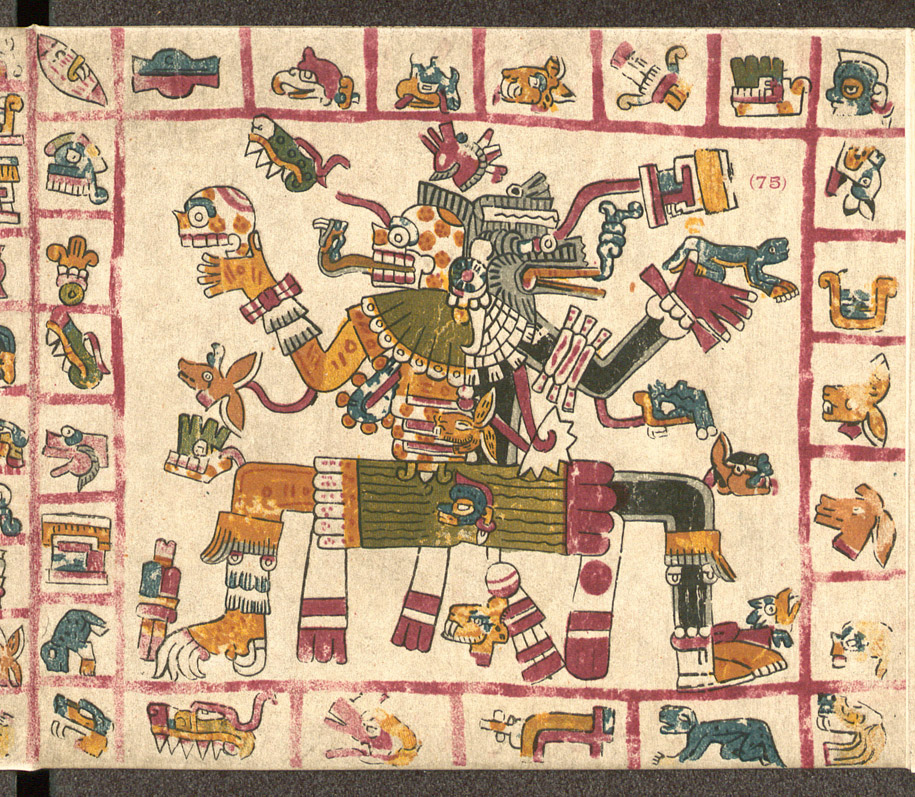
A page from the Codex Vaticanus B, showing Mictlantecuhtli and Quetzalcoatl back to back

a page from the Codex Borgia, showing Tlaloc, Xochiquetzal and Chalchiuhtlicue
Unfortunately, we have way fewer pre-Conquest codices than we do post-Conquest ones. The vast majority of them were destroyed during the invasion by Europeans who either didn't see them as having any value or were trying to make sure the natives stopped practicing their religion so they could be converted to Christianity as quickly as possible. That brings us up to the time of the post-Conquest codices, which were made after the Aztec empire had been conquered. Unlike the earlier codices, which are mostly concerned with recording history and mythology, telling ceremonial stories and lauding the deeds of particularly awesome kings, the post-Conquest codices are much more a portrait of a people under duress. They tend more toward attempting to record what was happening in the here-and-now and tying it to what the Aztecs knew of their own history, and while some do have great mythological value, many of them intentionally leave out religious imagery or euhemerize it down to the deeds of men or demons to avoid the authors getting into trouble with the Catholic Church. Some, like the Duran Codex, were actually overseen personally by Spanish priests and officials who commissioned the works as gifts for royalty back home or had an interest in preserving native history, which naturally led to them being even more skewed toward the authors' attempts to avoid ending up on trial for heresy and the overseers' own commentary and interpretations. The most famous works of this time period are the Florentine, Magliabecchi, Mendoza, Telleriano-Ramensis and Xolotl codices.
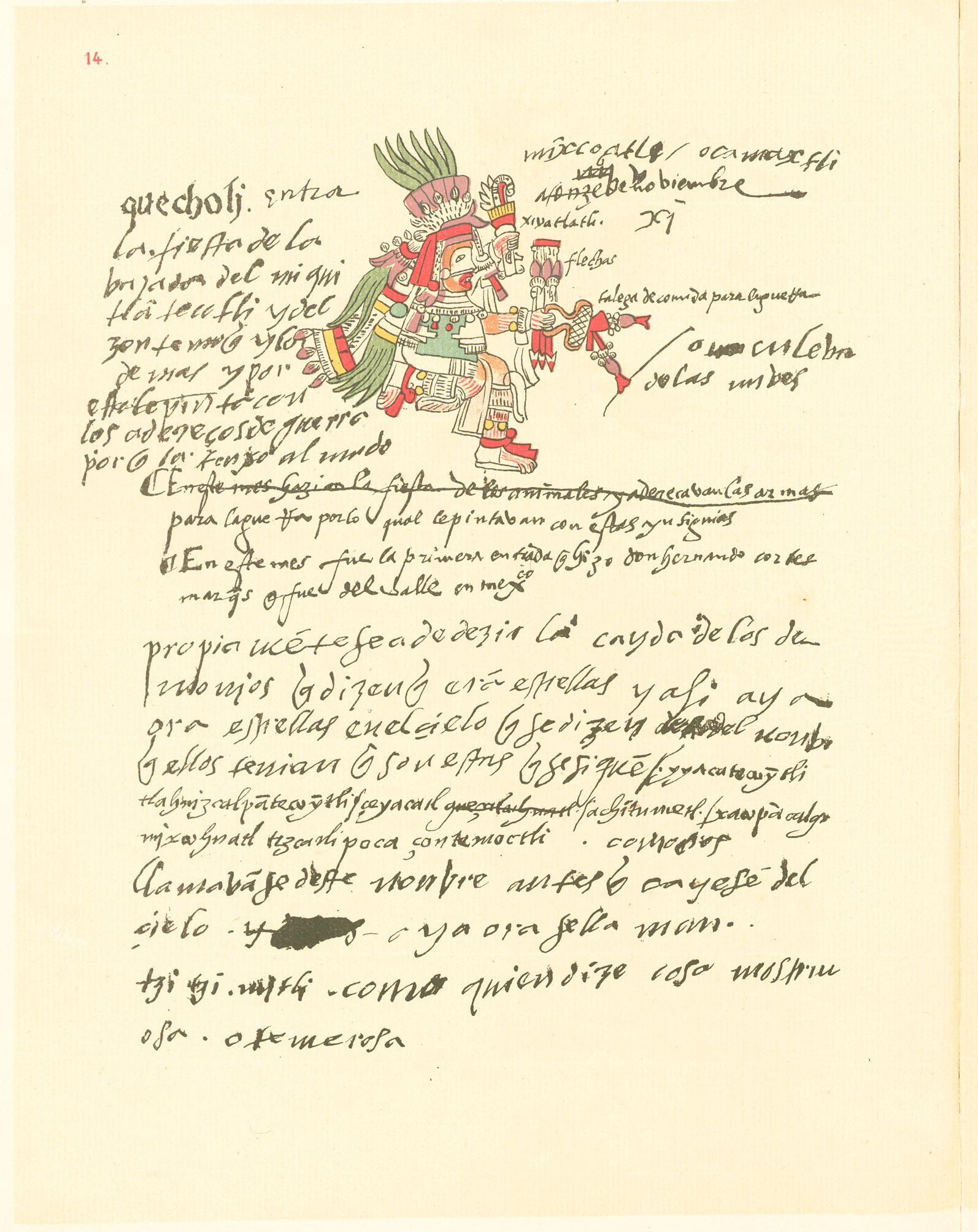
A page from the Codex Telleriano-Ramensis showing Mixcoatl with his hunting gear
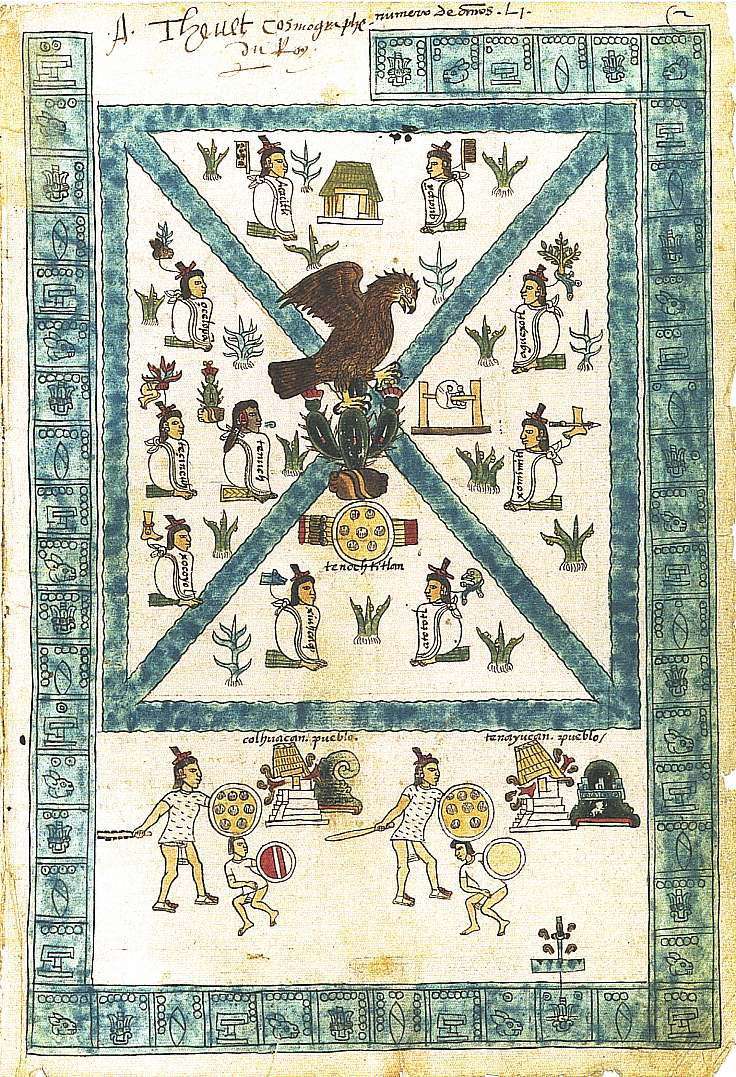
A page from the Codex Mendoza showing Huitzilopochtli in eagle form leading the Mexica to found Tenochtitlan

A page from the Florentine Codex depicting Aztec human sacrificial rites
As you can see, these are much more Spanish- and writing-heavy - closer to the European idea of books than the older Mexican codices, because they were being written by people now living under European rule and for a mostly European audience. They are still major primary sources for the study of Aztec religion and myth (because frankly, they are what we have and beggars can't be choosers), but they also inspire a lot more doubt and raise numerous questions about how accurate their version of stories might really be and how much European interference might be coloring what they contain.
Like most conquered mythologies, we have to do a lot of our learning about them from secondary sources - outside chroniclers like Duran, reproduced historical sources like the Codex Chimalpopoca, or mentions of the culture's practices in preserved resources from nearby peoples who interacted with them.
By the way, since you mentioned it, the Popol Vuh is indeed the major primary source for Maya mythology and is awesome, but it has its problems, too. The version of the Popol Vuh we have today was recorded by a Spanish priest named Francisco Ximenez at the beginning of the eighteenth century, most likely after having the story orally told to him by a K'iche Maya person in what is now Guatemala, and it's been through many transformations and probable changes from that original storyteller to us. The K'iche version may have differed substantially from the Mexican myths of the classical Maya period, to start with - a few hundred years and a lot of geography separate the two, and while they are definitely the same culture and obviously telling the same basic story based on their artwork, we'll never know what details might be different unless we find some new buried source somewhere. Then, the story was recorded after being orally told, making it almost certain that the recorder probably colored it with his own interpretations or changed or omitted some of it; then, there are several theories about who wrote it down first and in what form before Ximenez recopied it to make the first manuscript that was widely passed around, which no doubt included his biases and interpretations; and then various scholars in the eighteenth and nineteenth centuries played academic hockey with the manuscript, recopying and even stealing it, until it finally came into the form we have today.
This is a pretty common story when it comes to preservation of myth. We'd love to always have an accessible, well-preserved priamry source by unbiased natives to take a look at, but in reality that almost never happens. Mexico and its mythologies are prime examples of the infernal mess left behind by invading cultures with little interest in preservation of the peoples who came before them.
Friday, August 23, 2013
Tlilli Tlapalli
Question: So I learned in school that the Aztecs didn't have writing and couldn't write down any of their stories until the Spanish came. But you mentioned something called the "codices" a few times with myths in them - are those some kind of books? Is my teacher just wrong?
People were endangered by the reckless speed with which I shot across the planet to answer this question. Sonic booms disordered friendly airspace; trails of flying debris ended up haphazardly beside roads; John and the cats are in hiding. I'm a mythology enthusiast and a librarian and a Mexican-flag-wavin' fan of the Aztecs in Scion, and you have basically just asked me a jackpot question.
The pre-conquest Mexicans did not have writing in the same sense that Europeans at the time did; that is, there was no widely-used alphabet that represented specific sounds, and their written records often didn't look very much like those of the Spanish. Instead, they wrote pictographically, which means all of their words were in fact symbols and pictures that represented concepts instead of noises. There were symbols for specific noises, but they would never use them to write unless they were trying to describe something totally foreign to their language - why use three symbols to write B-OO-K when they could just use one symbol that meant "book", right? Why use a couple of different symbols that made up the sounds of "rabbit", when they could just draw a picture of a rabbit and be done with it?
The Spanish - and other European nations, when they eventually paid attention to what was going on in the southern New World - looked at these weird symbols and drawings and believed that the Aztecs must not be capable of reading or writing, and were instead relying on crude artwork to communicate because of this deficiency. In fact, the idea that they were a sub-literate people was one of the chief arguments in claiming that the giant urban civilization was in fact composed of savages, and that the influence of the Europeans was a benevolent thing that helped drag them up to the level of civilized culture. The fact that those self-same Europeans also burned the vast majority of Aztec codices they found, in order to prevent the natives from clinging to any pesky culture or religion they hadn't approved, resulted in very few of them surviving, which only fueled the idea back in Europe that the Aztecs couldn't write at all, poor dears.
There's another layer of philological difficulty in play here as well, in that the surviving Aztec codices don't always have very much writing in them, either.
Well... shit. That looks bananas even to us, who are now used to different kinds of written communication, so imagine what it looked like to the conquistadors. There are clearly some symbols here, as well as some in medias res action scenes, but how the hell are you supposed to read that and come up with an actual story?
The answer is that you aren't, because the Aztecs didn't conceive of their codices the same way we do the printed word today. Books weren't something that you created and then anyone could just pick up and immediately get all the information out of (in fact, for most of the history of the written word across most of the world, books were considered something only the very wealthy or the priesthood was going to be able to read anyway); rather, many of them - especially those created for the clergy or religious rites - were actually intended to be performed instead of simply read. Instead of writing down as many words as possible to get the idea across to a reader, codices of this sort were filled with triggering symbols and relevant images, which were meant to be seen by a specially trained person (usually a priest) who had memorized the story that they were retelling. In essence, the codex was a compendium of mnemonic devices, designed to trigger a particular history, religious tale or edict in the mind of a person who had already memorized it, and then he would go ahead and verbally tell the story while referring to the codex for reminders and pictorial illustration.
This is one of my favorite incredibly neat things about the Aztec codices - that they're not just books, but actually performances, and that you need both the codex and the person who was trained to read it in order to get the full, beautiful impact of the story. It was both an artform and a complex way of storing important information - a synthesis of the more common methods in other cultures of either writing things down or passing them down orally with no written component.
Unfortunately, that system was almost totally destroyed with the coming of the Spanish. Not only did they have no interest in Aztec religious or historical book-performance (in fact, they severely discouraged it, since they wanted everyone to convert to European religion and law as quickly as possible), but they destroyed most of the codices, which in turn removed those all-important compendiums of story-triggers from play. Add in the fact that many Aztecs perished in the struggle over the empire, and you ended up with some ex-scribes or ex-priests who could have read the codices but never would again since they were now destroyed, trying to remember what they could without the compendiums they'd been taught to work with, or a few remaining codices that nobody could read, having lost whomever was trained to do so. Some histories written by Europeans who tried to ask Aztec people about reading them record that they actually refused to do so after a while - which was not surprising, considering that reciting forgotten lore about their native gods or sacred histories could get a native Mexican a one-way ticket to the Inquisition with blistering speed.
So the Spanish shrugged, said that the Aztecs obviously couldn't read or write, and sent a few of their pretty picture-books back to Europe as curiosities, and there the matter laid until a few centuries later, when scholars realized that there was actually a whole lot going on in the codices and that the idea that the Aztecs weren't literate because they used symbols instead of letters was about as ridiculous as saying that people from China couldn't read for the same reason.
Of course, just like we have in our society, the Aztecs had a lot of different forms of written communication, and the codices were only one of them. They also kept royal records and tax accounts, created elaborate maps and banners to mark places and people, and generally went about labeling things where useful about the way you'd expect. They just did so with colorful pictures instead of representative letters, leading to a sort of renaissance for modern archaeologists when they realized that they were actually looking at words and sentences, not just interesting artwork. Some codices do have phonetic writing in them, in both Spanish and Nahuatl, because they were written after the coming of the Europeans by Aztecs who had been partially assimilated into the new culture, while others are entirely composed of the combined-symbol glyphs of the pre-conquest artistic writing system.
By the way, the Mexica/Aztecs weren't the only ones to use codices this way; it was common in ancient Mesoamerica and the Mixtec and Zapotec also used the same style, which probably influenced the Aztecs into following suit. The Maya do have their own writing system, which is also glyph-based but a lot more elaborate and complicated (often compared to Mandarin Chinese), but it's an entirely different kettle of fish, one that has parts that are still being translated and puzzled out by scholars and archaeologists even today.
If you view writing as only words on a page, then it's possible you could say that the Aztecs didn't have it, but to do so would be to ignore their unique cultural advancements and methods of preserving their histories and beliefs, which were exciting and interactive in their own way. As a person who deals professionally in different ways of recording and sharing information, I never cease to be fascinated by the codices, or how much they can still tell us even centuries later and without their human half.
People were endangered by the reckless speed with which I shot across the planet to answer this question. Sonic booms disordered friendly airspace; trails of flying debris ended up haphazardly beside roads; John and the cats are in hiding. I'm a mythology enthusiast and a librarian and a Mexican-flag-wavin' fan of the Aztecs in Scion, and you have basically just asked me a jackpot question.
The pre-conquest Mexicans did not have writing in the same sense that Europeans at the time did; that is, there was no widely-used alphabet that represented specific sounds, and their written records often didn't look very much like those of the Spanish. Instead, they wrote pictographically, which means all of their words were in fact symbols and pictures that represented concepts instead of noises. There were symbols for specific noises, but they would never use them to write unless they were trying to describe something totally foreign to their language - why use three symbols to write B-OO-K when they could just use one symbol that meant "book", right? Why use a couple of different symbols that made up the sounds of "rabbit", when they could just draw a picture of a rabbit and be done with it?
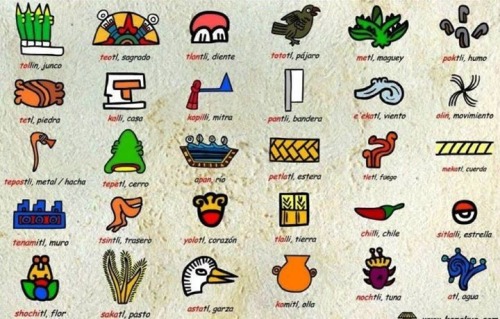
The Spanish - and other European nations, when they eventually paid attention to what was going on in the southern New World - looked at these weird symbols and drawings and believed that the Aztecs must not be capable of reading or writing, and were instead relying on crude artwork to communicate because of this deficiency. In fact, the idea that they were a sub-literate people was one of the chief arguments in claiming that the giant urban civilization was in fact composed of savages, and that the influence of the Europeans was a benevolent thing that helped drag them up to the level of civilized culture. The fact that those self-same Europeans also burned the vast majority of Aztec codices they found, in order to prevent the natives from clinging to any pesky culture or religion they hadn't approved, resulted in very few of them surviving, which only fueled the idea back in Europe that the Aztecs couldn't write at all, poor dears.
There's another layer of philological difficulty in play here as well, in that the surviving Aztec codices don't always have very much writing in them, either.
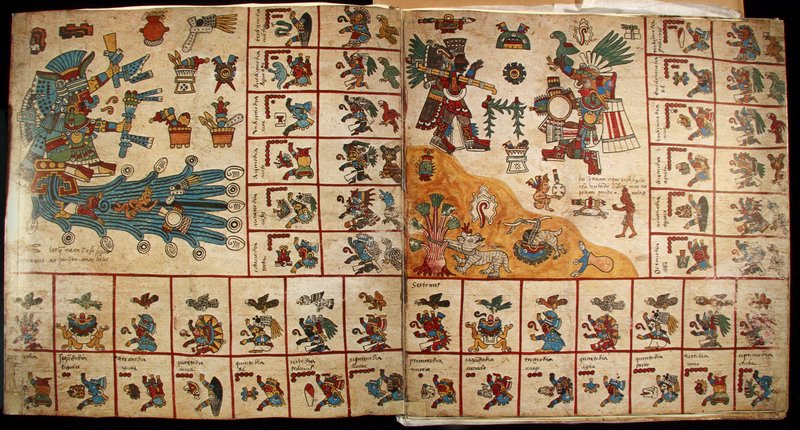
Well... shit. That looks bananas even to us, who are now used to different kinds of written communication, so imagine what it looked like to the conquistadors. There are clearly some symbols here, as well as some in medias res action scenes, but how the hell are you supposed to read that and come up with an actual story?
The answer is that you aren't, because the Aztecs didn't conceive of their codices the same way we do the printed word today. Books weren't something that you created and then anyone could just pick up and immediately get all the information out of (in fact, for most of the history of the written word across most of the world, books were considered something only the very wealthy or the priesthood was going to be able to read anyway); rather, many of them - especially those created for the clergy or religious rites - were actually intended to be performed instead of simply read. Instead of writing down as many words as possible to get the idea across to a reader, codices of this sort were filled with triggering symbols and relevant images, which were meant to be seen by a specially trained person (usually a priest) who had memorized the story that they were retelling. In essence, the codex was a compendium of mnemonic devices, designed to trigger a particular history, religious tale or edict in the mind of a person who had already memorized it, and then he would go ahead and verbally tell the story while referring to the codex for reminders and pictorial illustration.
This is one of my favorite incredibly neat things about the Aztec codices - that they're not just books, but actually performances, and that you need both the codex and the person who was trained to read it in order to get the full, beautiful impact of the story. It was both an artform and a complex way of storing important information - a synthesis of the more common methods in other cultures of either writing things down or passing them down orally with no written component.
Unfortunately, that system was almost totally destroyed with the coming of the Spanish. Not only did they have no interest in Aztec religious or historical book-performance (in fact, they severely discouraged it, since they wanted everyone to convert to European religion and law as quickly as possible), but they destroyed most of the codices, which in turn removed those all-important compendiums of story-triggers from play. Add in the fact that many Aztecs perished in the struggle over the empire, and you ended up with some ex-scribes or ex-priests who could have read the codices but never would again since they were now destroyed, trying to remember what they could without the compendiums they'd been taught to work with, or a few remaining codices that nobody could read, having lost whomever was trained to do so. Some histories written by Europeans who tried to ask Aztec people about reading them record that they actually refused to do so after a while - which was not surprising, considering that reciting forgotten lore about their native gods or sacred histories could get a native Mexican a one-way ticket to the Inquisition with blistering speed.
So the Spanish shrugged, said that the Aztecs obviously couldn't read or write, and sent a few of their pretty picture-books back to Europe as curiosities, and there the matter laid until a few centuries later, when scholars realized that there was actually a whole lot going on in the codices and that the idea that the Aztecs weren't literate because they used symbols instead of letters was about as ridiculous as saying that people from China couldn't read for the same reason.
Of course, just like we have in our society, the Aztecs had a lot of different forms of written communication, and the codices were only one of them. They also kept royal records and tax accounts, created elaborate maps and banners to mark places and people, and generally went about labeling things where useful about the way you'd expect. They just did so with colorful pictures instead of representative letters, leading to a sort of renaissance for modern archaeologists when they realized that they were actually looking at words and sentences, not just interesting artwork. Some codices do have phonetic writing in them, in both Spanish and Nahuatl, because they were written after the coming of the Europeans by Aztecs who had been partially assimilated into the new culture, while others are entirely composed of the combined-symbol glyphs of the pre-conquest artistic writing system.
By the way, the Mexica/Aztecs weren't the only ones to use codices this way; it was common in ancient Mesoamerica and the Mixtec and Zapotec also used the same style, which probably influenced the Aztecs into following suit. The Maya do have their own writing system, which is also glyph-based but a lot more elaborate and complicated (often compared to Mandarin Chinese), but it's an entirely different kettle of fish, one that has parts that are still being translated and puzzled out by scholars and archaeologists even today.
If you view writing as only words on a page, then it's possible you could say that the Aztecs didn't have it, but to do so would be to ignore their unique cultural advancements and methods of preserving their histories and beliefs, which were exciting and interactive in their own way. As a person who deals professionally in different ways of recording and sharing information, I never cease to be fascinated by the codices, or how much they can still tell us even centuries later and without their human half.
Tuesday, May 21, 2013
Anne Screams and Screams
Question: Why would people continue to use the Atzlanti when you created two good replacements, the K'uh and the Apu? I mean, they fill the same Mesoamerican niche. Both pantheons seem to mirror some aspects of the Aztec gods without being the Itztli conveyor belt the Aztec Scions become for their divine parents. Plus the Maya twins sound completely awesome.
Okay. Hi. Question-asker, I'm sure you're not really an evil troll and you're not trying to make me cross-eyed with rage, so please don't take my passionate cascade of fury too personally here. It's not you, it's Europe.
There are three exceptionally good reasons to keep using the Aztlanti, even if you are also using and enjoying the K'uh and Apu. I will list them for you.
1) The Aztlanti are not the same as the K'uh or the Apu.
2) The Aztlanti are not the same as the K'uh or the Apu.
3) THE AZTLANTI ARE NOT THE SAME AS THE K'UH OR THE APU.
This question... just... there are so many things wrong with it that I'm losing my mind trying to decide where to start. All this energy going into staying civil about it isn't making it any easier, either.
First of all, probably well-intentioned person who I'm sorry I'm yelling at right now, the Apu do not fill a Mesoamerican niche. At all. In any way. The Inca people who worshiped them lived in Peru and the surrounding territories of South America; they were nowhere near Mesoamerica and, as far as we know, never had any contact with the religions farther north. The religion that worshiped the Apu was not even slightly close to the religions that worshiped the Aztlanti and the K'uh - not conceptually, not in ritual, not even geographically. It is as far from the territory of the Aztlanti to the territory of the Apu as it is from China to Australia, you guys. And yet nobody comes over here and asks why the hell we would want to write an Australian pantheon when there's a perfectly good Chinese pantheon already in the game, because that would be FUCKING RIDICULOUS.
You're not the first person to look me dead in the eye and say that the Apu are unnecessary because they take up the same cultural "slot" as the Aztlanti/part of the Mesoamerican world/basically worshiping the same gods, right? You probably won't be the last. But these are gods who are no closer to one another than the Irish gods are to the Hittites, so why the fuck does everyone keep deciding that they must be the same people?
I will tell you why: because Europe. We have an awesomely global audience on this website and we love hearing from Scion players around the world, but the fact is that the vast bulk of Scion players are in the United States, Canada or western Europe. That means they've all grown up learning history from the point of view of European colonialism and conquest, and holy shit does that mean people are misinformed like whoa. The European invaders who discovered and subsequently conquered the ass off of the Americas did not bother to differentiate much between different cultures that they encountered; they were there to get natural resources, keep rival European kingdoms from gaining territory on them and stop all the heathen devilry that they saw going on everywhere. Who cares whether this flavor of brown people is slightly different than that one, when they're all going to be learning Christianity, dying of smallpox or working in the same fields for us anyway? Not only did they not care about the differences between cultures in the New World, they actively pretended that there wasn't one, leading to a perception of all the indigenous peoples of the Americas as an undifferentiated soup of "savages".
Of course, that was centuries ago, right? Yes, it was, but the hell of it is that it still strongly and violently colors our perceptions of the people who inhabited the Americas before the Europeans arrived. All of our historical and religious records were written by those Europeans, designed for consumption by those Europeans and disseminated by those Europeans, and they have carried that prejudicial lack of differentiation through for hundreds of motherfucking years. American history textbooks offer a quick sketch of life before Europeans in a few pages and then dedicate the entire book to what happened once the white people showed up. American religion textbooks talk about vast swaths of land covering totally disparate peoples as if they were exactly the same. The state of most historical texts when it comes to discussing the pre-European-invasion Americas is deplorable on a nuclear level, and that affects everyone who grows up with them.
And that's why this question is happening today, because four hundred goddamned years ago the Europeans couldn't be assed to tell the difference between different races in the Americas and, after destroying most of those cultures anyway, never had the inclination or the ability to correct the issue. Those Europeans who were interested in the cultures of the natives did not do a great job of finding out much about them, usually because 99.9999999999999999993% of them were Christian missionaries trying to convert them and stamp out their indigenous beliefs anyway, and the information they sent back to Europe (where it turned into our heinous conception of the pre-conquest Americas) was piecemeal, patched, incorrect and sometimes directly made up. That's where the trend of thinking of the Incas as the same people as the Maya and the Maya as the same people as the Aztecs began, because well-meaning cultural assassins sent back most of our information from that time period in the form of "A Treatise on the Superstitions of the Brown Peoples" or "Folk Beliefs of the Dirty Natives: A Treasury for Children."
It's odd that we tend to notice this a lot more with the North American native cultures than the ones south of Texas. Oh, the vast majority of us still don't actually know the difference between Lakota and Blackfoot and Navajo, not in any meaningful way, but we at least know they are different. This is probably a combination of the North American native presence having survived on reservations and as resisting nations for much longer, and of them being an important force in US history, which naturally makes more people in the US (i.e., most Scion players) pay attention to them. But, bizarrely, as soon as you cross the line into Chihuahua, suddenly everybody thinks that there's no real difference between various groups of people down there.
But my friends, I am here to tell you that there is a difference. There's a difference between cultures in Mexico itself, and there is A MASSIVE FUCKING DIFFERENCE between people in Mexio and people in PERU. Have you looked at a map? Do you know where Peru is? IT IS NOT CLOSE TO MEXICO. The fact that both cultures were conquered by the Spanish does not magically make them twins. At the moment, the Apu are the only fully-written pantheon on THE ENTIRE CONTINENT OF SOUTH AMERICA, and you want them to be the same as the people of Mesoamerica? What, do you think there's nothing else in South America except for monkeys and trees? That it's inexplicably the only continent in the world where religion never existed before Christianity? What is the logic here?
So: no. The Apu are not part of the Mesoamerican niche. They never were and they never will be.
More importantly, NEITHER IS ANYONE ELSE. Do you know why? Because there's no such thing as "the Mesoamerican niche". Holy shit. We are not talking about the earwax-flavored Bertie Bott's Every-Flavor Bean. We are talking about religions, cultures, entire societies of people, and furthermore we're talking about a large area of the world with uniqe history and ideas. Here, let me go ahead and find a quick map transposition for you. I'ma put Mexico over in Europe, and we'll see what happens.
Do you see what I'm getting at? Mexico could swallow Italy, Greece, France, Germany and several of the smaller Slavic countries and still have room for dessert. Why on earth do people insist on believing that there are ninety bajillion different ethnic groups in Europe, but only one in all of freaking Mexico? And, you guys, you guys, that's just MEXICO. Contrary to popular belief, THERE ARE MORE PLACES IN MESOAMERICA THAN MEXICO, and that means that it's even closer to being nearly the same size as Europe, and holy BALLS, do you understand why it is bananas to call it a niche?
Albanian mythology is a niche. The pre-Japanese mythology of Okinawa is a niche. The non-deitied spiritual shamanism of Lappish tribes is a niche. Mesoamerica is not a niche. It is a MAJORLY IMPORTANT AREA OF THE WORLD.
We didn't write the K'uh because we wanted to replace the Aztlanti; that is about the worst description of what we were trying to do ever. We wrote the K'uh to complement and accompany the Aztlanti, the same way we wrote the Bogovi to complement and accompany the rest of the European pantheons. They are not the same. They are not redundant. If anything, the fact that there are still only two pantheons in Mesoamerica is pretty shitty when there are definitely more than that in real life (no, I'm serious, there are, these are not the only two religions in Central America). What the living fuck.
And no, the K'uh and Apu do not "mirror aspects of the Aztec gods". I am stabbing that notion in the face, right here, right now. The Aztec religion was certainly influenced by material from the Maya, among others, but so was every other goddamned religion in existence. Cultures influence each other! That's normal! That's what happens when two ethnic groups meet and shake hands! It doesn't make them the same, and it also doesn't mean that they don't have a discrete, concrete, real and important religion of their own! It does not mean their gods are not their gods! I CANNOT YELL ABOUT THIS ENOUGH.
Here, we'll do the European comparison again. The Greek pantheon is big on burned sacrifices, right? Oh, look, so is the Hindu pantheon. The Slavic pantheon has gods dedicated to truth and justice? Oh, look, so does the Persian pantheon. The Canaanite pantheon has a triad of sky/water/death gods who rule it? Oh, look, so does the Greek pantheon. The Chinese pantheon maintains an important religion observation of honoring one's ancestors? Oh, look, so do several of the Australian pantheons. Are you going to suggest we should just ditch one of each of these comparisons because the other is already "covering" that? NO. BECAUSE THAT WOULD BE FUCKING INSANE.
Yes, the Aztlanti, Apu and K'uh all practice blood sacrifice, and yes, they all believe in some variation on the idea of the gods maintaining the cosmic power of the universe. But that doesn't make them the same any more than the Dodekatheon, Pesedjet and Orisha all practicing slavery makes them the same, or the Devas, Amatsukami and Yazata practicing purifiying fire rituals makes them the same, or the Tuatha, Aesir and Nemetondevos all believing in courageous acts of warfare makes them the same. Religions with common themes are found all over the world, usually right next to each other. Of course nearby religions sometimes influence one another with religious practices, but when you move on to saying, "so probably they're the same", you're wrong and you have to leave now and go live in Wrongville. For most religions, even the things they have in common are expressed, experienced and worshiped differently, because that's what different cultures do. I just talked about how Aztec blood sacrifice and Maya blood sacrifice are different in a lot of important ways on the vlog a little while ago, but I think you sent this question in before then, so consider it a get out of jail free card to escape my volcano of rage.
That's not to say that there aren't crossover moments here between the Aztlanti and the K'uh (not the Apu, because they are South American and have nothing to do with anything here); they do obviously share a god or two and have clearly waved as they passed one another in the hall now and then. But that's no more damning than the fact that the Aesir appear in Slavic myth now and then, or that Lugh is a god in good standing in three different pantheons' rosters, or that Guanyin is so Chinese it hurts and yet was originally a Hindu deity. The K'uh are the K'uh, and the Aztlanti are the Aztlanti, and to say that their gods or their religion are similar enough to ditch one and run with the other is to be tragically, epically, head-smashingly incorrect.
Also, I am about to perform Itztli myself on the next person who complains to me that the Aztlanti are evil monsters who just want to have children so they can later murder them for blood sacrifice goodies. That attitude betrays such a fundamental lack of understanding of what the Aztlanti are all about that I can't even do anything with it. I know that's what the Scion books are selling, but please, everyone, stop buying it; those books are possibly more shit-faced drunk in their portrayal of the Aztlanti than any other pantheon, and that's saying something. If you have the time and the interest, read up on Aztec blood sacrifice, why it was practiced, and what it means to the gods; I recommend David Carrasco's City of Sacrifice, but any halfway decent book on the subject should do. It has nothing to do with greedy gods who want to devour their offspring, and everything to do with the entire world and all living things in it doing their part to keep the universe from collapsing.
Look, the point of all this yelling is not to tell you that you can't stop running the Aztlanti. If you don't like them, don't run them. You should never run any pantheon - from the RAW, from our PDFs, or from anywhere else - if you're not interested in them or you don't feel like they're adding to your stories. If you love the K'uh and the Apu and don't want to deal with the Aztlanti, then you should open the field for Scions of the K'uh and the Apu and leave the Aztec gods to sit at home and tell each other stories about the good old days. Lots of Storytellers only use a few pantheons in their games, and there is nothing at all wrong with that.
But don't remove them from the game because they've been "replaced" by the K'uh and Apu. They haven't; they couldn't be. All three are highly different pantheons of highly different cultures with their own unique importance and mythological symbolism attached. None of them render one another redundant any more than the Aesir render the Tuatha redundant; they enhance one another by fleshing out their part of the world that much more. If you don't want 'em, you don't need to play with 'em, but don't pretend they're somehow unworthy of inclusion.
And yes, the Hero Twins are total ballers.
Okay. Hi. Question-asker, I'm sure you're not really an evil troll and you're not trying to make me cross-eyed with rage, so please don't take my passionate cascade of fury too personally here. It's not you, it's Europe.
There are three exceptionally good reasons to keep using the Aztlanti, even if you are also using and enjoying the K'uh and Apu. I will list them for you.
1) The Aztlanti are not the same as the K'uh or the Apu.
2) The Aztlanti are not the same as the K'uh or the Apu.
3) THE AZTLANTI ARE NOT THE SAME AS THE K'UH OR THE APU.
This question... just... there are so many things wrong with it that I'm losing my mind trying to decide where to start. All this energy going into staying civil about it isn't making it any easier, either.
First of all, probably well-intentioned person who I'm sorry I'm yelling at right now, the Apu do not fill a Mesoamerican niche. At all. In any way. The Inca people who worshiped them lived in Peru and the surrounding territories of South America; they were nowhere near Mesoamerica and, as far as we know, never had any contact with the religions farther north. The religion that worshiped the Apu was not even slightly close to the religions that worshiped the Aztlanti and the K'uh - not conceptually, not in ritual, not even geographically. It is as far from the territory of the Aztlanti to the territory of the Apu as it is from China to Australia, you guys. And yet nobody comes over here and asks why the hell we would want to write an Australian pantheon when there's a perfectly good Chinese pantheon already in the game, because that would be FUCKING RIDICULOUS.
You're not the first person to look me dead in the eye and say that the Apu are unnecessary because they take up the same cultural "slot" as the Aztlanti/part of the Mesoamerican world/basically worshiping the same gods, right? You probably won't be the last. But these are gods who are no closer to one another than the Irish gods are to the Hittites, so why the fuck does everyone keep deciding that they must be the same people?
I will tell you why: because Europe. We have an awesomely global audience on this website and we love hearing from Scion players around the world, but the fact is that the vast bulk of Scion players are in the United States, Canada or western Europe. That means they've all grown up learning history from the point of view of European colonialism and conquest, and holy shit does that mean people are misinformed like whoa. The European invaders who discovered and subsequently conquered the ass off of the Americas did not bother to differentiate much between different cultures that they encountered; they were there to get natural resources, keep rival European kingdoms from gaining territory on them and stop all the heathen devilry that they saw going on everywhere. Who cares whether this flavor of brown people is slightly different than that one, when they're all going to be learning Christianity, dying of smallpox or working in the same fields for us anyway? Not only did they not care about the differences between cultures in the New World, they actively pretended that there wasn't one, leading to a perception of all the indigenous peoples of the Americas as an undifferentiated soup of "savages".
Of course, that was centuries ago, right? Yes, it was, but the hell of it is that it still strongly and violently colors our perceptions of the people who inhabited the Americas before the Europeans arrived. All of our historical and religious records were written by those Europeans, designed for consumption by those Europeans and disseminated by those Europeans, and they have carried that prejudicial lack of differentiation through for hundreds of motherfucking years. American history textbooks offer a quick sketch of life before Europeans in a few pages and then dedicate the entire book to what happened once the white people showed up. American religion textbooks talk about vast swaths of land covering totally disparate peoples as if they were exactly the same. The state of most historical texts when it comes to discussing the pre-European-invasion Americas is deplorable on a nuclear level, and that affects everyone who grows up with them.
And that's why this question is happening today, because four hundred goddamned years ago the Europeans couldn't be assed to tell the difference between different races in the Americas and, after destroying most of those cultures anyway, never had the inclination or the ability to correct the issue. Those Europeans who were interested in the cultures of the natives did not do a great job of finding out much about them, usually because 99.9999999999999999993% of them were Christian missionaries trying to convert them and stamp out their indigenous beliefs anyway, and the information they sent back to Europe (where it turned into our heinous conception of the pre-conquest Americas) was piecemeal, patched, incorrect and sometimes directly made up. That's where the trend of thinking of the Incas as the same people as the Maya and the Maya as the same people as the Aztecs began, because well-meaning cultural assassins sent back most of our information from that time period in the form of "A Treatise on the Superstitions of the Brown Peoples" or "Folk Beliefs of the Dirty Natives: A Treasury for Children."
It's odd that we tend to notice this a lot more with the North American native cultures than the ones south of Texas. Oh, the vast majority of us still don't actually know the difference between Lakota and Blackfoot and Navajo, not in any meaningful way, but we at least know they are different. This is probably a combination of the North American native presence having survived on reservations and as resisting nations for much longer, and of them being an important force in US history, which naturally makes more people in the US (i.e., most Scion players) pay attention to them. But, bizarrely, as soon as you cross the line into Chihuahua, suddenly everybody thinks that there's no real difference between various groups of people down there.
But my friends, I am here to tell you that there is a difference. There's a difference between cultures in Mexico itself, and there is A MASSIVE FUCKING DIFFERENCE between people in Mexio and people in PERU. Have you looked at a map? Do you know where Peru is? IT IS NOT CLOSE TO MEXICO. The fact that both cultures were conquered by the Spanish does not magically make them twins. At the moment, the Apu are the only fully-written pantheon on THE ENTIRE CONTINENT OF SOUTH AMERICA, and you want them to be the same as the people of Mesoamerica? What, do you think there's nothing else in South America except for monkeys and trees? That it's inexplicably the only continent in the world where religion never existed before Christianity? What is the logic here?
So: no. The Apu are not part of the Mesoamerican niche. They never were and they never will be.
More importantly, NEITHER IS ANYONE ELSE. Do you know why? Because there's no such thing as "the Mesoamerican niche". Holy shit. We are not talking about the earwax-flavored Bertie Bott's Every-Flavor Bean. We are talking about religions, cultures, entire societies of people, and furthermore we're talking about a large area of the world with uniqe history and ideas. Here, let me go ahead and find a quick map transposition for you. I'ma put Mexico over in Europe, and we'll see what happens.

Do you see what I'm getting at? Mexico could swallow Italy, Greece, France, Germany and several of the smaller Slavic countries and still have room for dessert. Why on earth do people insist on believing that there are ninety bajillion different ethnic groups in Europe, but only one in all of freaking Mexico? And, you guys, you guys, that's just MEXICO. Contrary to popular belief, THERE ARE MORE PLACES IN MESOAMERICA THAN MEXICO, and that means that it's even closer to being nearly the same size as Europe, and holy BALLS, do you understand why it is bananas to call it a niche?
Albanian mythology is a niche. The pre-Japanese mythology of Okinawa is a niche. The non-deitied spiritual shamanism of Lappish tribes is a niche. Mesoamerica is not a niche. It is a MAJORLY IMPORTANT AREA OF THE WORLD.
We didn't write the K'uh because we wanted to replace the Aztlanti; that is about the worst description of what we were trying to do ever. We wrote the K'uh to complement and accompany the Aztlanti, the same way we wrote the Bogovi to complement and accompany the rest of the European pantheons. They are not the same. They are not redundant. If anything, the fact that there are still only two pantheons in Mesoamerica is pretty shitty when there are definitely more than that in real life (no, I'm serious, there are, these are not the only two religions in Central America). What the living fuck.
And no, the K'uh and Apu do not "mirror aspects of the Aztec gods". I am stabbing that notion in the face, right here, right now. The Aztec religion was certainly influenced by material from the Maya, among others, but so was every other goddamned religion in existence. Cultures influence each other! That's normal! That's what happens when two ethnic groups meet and shake hands! It doesn't make them the same, and it also doesn't mean that they don't have a discrete, concrete, real and important religion of their own! It does not mean their gods are not their gods! I CANNOT YELL ABOUT THIS ENOUGH.
Here, we'll do the European comparison again. The Greek pantheon is big on burned sacrifices, right? Oh, look, so is the Hindu pantheon. The Slavic pantheon has gods dedicated to truth and justice? Oh, look, so does the Persian pantheon. The Canaanite pantheon has a triad of sky/water/death gods who rule it? Oh, look, so does the Greek pantheon. The Chinese pantheon maintains an important religion observation of honoring one's ancestors? Oh, look, so do several of the Australian pantheons. Are you going to suggest we should just ditch one of each of these comparisons because the other is already "covering" that? NO. BECAUSE THAT WOULD BE FUCKING INSANE.
Yes, the Aztlanti, Apu and K'uh all practice blood sacrifice, and yes, they all believe in some variation on the idea of the gods maintaining the cosmic power of the universe. But that doesn't make them the same any more than the Dodekatheon, Pesedjet and Orisha all practicing slavery makes them the same, or the Devas, Amatsukami and Yazata practicing purifiying fire rituals makes them the same, or the Tuatha, Aesir and Nemetondevos all believing in courageous acts of warfare makes them the same. Religions with common themes are found all over the world, usually right next to each other. Of course nearby religions sometimes influence one another with religious practices, but when you move on to saying, "so probably they're the same", you're wrong and you have to leave now and go live in Wrongville. For most religions, even the things they have in common are expressed, experienced and worshiped differently, because that's what different cultures do. I just talked about how Aztec blood sacrifice and Maya blood sacrifice are different in a lot of important ways on the vlog a little while ago, but I think you sent this question in before then, so consider it a get out of jail free card to escape my volcano of rage.
That's not to say that there aren't crossover moments here between the Aztlanti and the K'uh (not the Apu, because they are South American and have nothing to do with anything here); they do obviously share a god or two and have clearly waved as they passed one another in the hall now and then. But that's no more damning than the fact that the Aesir appear in Slavic myth now and then, or that Lugh is a god in good standing in three different pantheons' rosters, or that Guanyin is so Chinese it hurts and yet was originally a Hindu deity. The K'uh are the K'uh, and the Aztlanti are the Aztlanti, and to say that their gods or their religion are similar enough to ditch one and run with the other is to be tragically, epically, head-smashingly incorrect.
Also, I am about to perform Itztli myself on the next person who complains to me that the Aztlanti are evil monsters who just want to have children so they can later murder them for blood sacrifice goodies. That attitude betrays such a fundamental lack of understanding of what the Aztlanti are all about that I can't even do anything with it. I know that's what the Scion books are selling, but please, everyone, stop buying it; those books are possibly more shit-faced drunk in their portrayal of the Aztlanti than any other pantheon, and that's saying something. If you have the time and the interest, read up on Aztec blood sacrifice, why it was practiced, and what it means to the gods; I recommend David Carrasco's City of Sacrifice, but any halfway decent book on the subject should do. It has nothing to do with greedy gods who want to devour their offspring, and everything to do with the entire world and all living things in it doing their part to keep the universe from collapsing.
Look, the point of all this yelling is not to tell you that you can't stop running the Aztlanti. If you don't like them, don't run them. You should never run any pantheon - from the RAW, from our PDFs, or from anywhere else - if you're not interested in them or you don't feel like they're adding to your stories. If you love the K'uh and the Apu and don't want to deal with the Aztlanti, then you should open the field for Scions of the K'uh and the Apu and leave the Aztec gods to sit at home and tell each other stories about the good old days. Lots of Storytellers only use a few pantheons in their games, and there is nothing at all wrong with that.
But don't remove them from the game because they've been "replaced" by the K'uh and Apu. They haven't; they couldn't be. All three are highly different pantheons of highly different cultures with their own unique importance and mythological symbolism attached. None of them render one another redundant any more than the Aesir render the Tuatha redundant; they enhance one another by fleshing out their part of the world that much more. If you don't want 'em, you don't need to play with 'em, but don't pretend they're somehow unworthy of inclusion.
And yes, the Hero Twins are total ballers.
Saturday, May 4, 2013
Bloodrush
It's another solo vlog, but don't despair. We'll get back together someday.
This week, because I'm on my own, I'll be talking about Mesoamerican stuff. Because that's what I do when left alone without supervision!
Question: Why did you strip Fertility, Sky, Water and Epic Intelligence from Quetzalcoatl when his description says he is a god of those things? Should the unspoken understanding that he is those things outweigh tthe fact that there are no stories expressly describing him doing said things?
Question: In comparison between Maya and Aztec culture and myth, which one was more prolific with human sacrifice?
Question: First, I just wanted to say that I love your Maya writeup. Kudos to you guys for your awesome work. I have a question, however, concerning the PSP. For the Unici Chupla, Utzil Keban, Caan Cab and Sucun Palil boons, what are the options for characters who want to embody a "between" state, instead of one or the other (say, a hermaphroditic god, or a character who wants to appear as middle-aged, or a "wise child", etc.)? It sems like those boons don't allow for an in-between.
Question: I have a question regarding the sun and moon among the Maya. Who ultimately controls the sun and moon amongst them: K'inich Ahau and Awilix or the Hero Twins? Both pairs seem to have power over the celestial objects, so I was curious.
By the way, for those who wanted some unnecessarily graphic pictures of Maya autosacrifice, I'm here for you. If you didn't want that, I'm here for you anyway. Sorry.
These people are serious about getting serious.
This week, because I'm on my own, I'll be talking about Mesoamerican stuff. Because that's what I do when left alone without supervision!
Question: Why did you strip Fertility, Sky, Water and Epic Intelligence from Quetzalcoatl when his description says he is a god of those things? Should the unspoken understanding that he is those things outweigh tthe fact that there are no stories expressly describing him doing said things?
Question: In comparison between Maya and Aztec culture and myth, which one was more prolific with human sacrifice?
Question: First, I just wanted to say that I love your Maya writeup. Kudos to you guys for your awesome work. I have a question, however, concerning the PSP. For the Unici Chupla, Utzil Keban, Caan Cab and Sucun Palil boons, what are the options for characters who want to embody a "between" state, instead of one or the other (say, a hermaphroditic god, or a character who wants to appear as middle-aged, or a "wise child", etc.)? It sems like those boons don't allow for an in-between.
Question: I have a question regarding the sun and moon among the Maya. Who ultimately controls the sun and moon amongst them: K'inich Ahau and Awilix or the Hero Twins? Both pairs seem to have power over the celestial objects, so I was curious.
By the way, for those who wanted some unnecessarily graphic pictures of Maya autosacrifice, I'm here for you. If you didn't want that, I'm here for you anyway. Sorry.
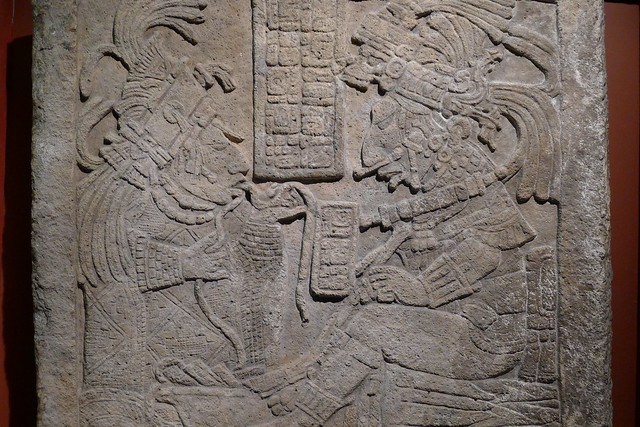

These people are serious about getting serious.
Monday, March 18, 2013
Fauna Mexica
Question: Since I am a fan of using the research you did, do you have a good list of animals important to Aztec mythology? Want to find something fitting for my Animal-purview wielding Aztec.
Well, that depends a lot on what kind of Animal-wielding Aztec your Scion is! Different animals represent different things for the Aztecs, just as they do for other cultures around the world, so which one you want to pick up probably depends a lot on your Scion's character, associations and future plans.
First of all, the most common ones are those that the gods already have associated with them, which stands to reason - those gods have animal associations because of those animals' symbolism, and those animals' symbolism is strong because they're among the most culturally important animals to the ancient Aztecs. The solitary and predatory jaguar, totem of Tezcatlipoca, represents soverignty, power and kingship, while the hummingbird, Huitzilopochtli's symbol, representa virility, strength and energy with the wild beating of its wings. Eagles, another of Huitzilopochtli's favored symbols, represent strength and warlike victory as well as being solar symbols, and chroniclers recorded them being fed human hearts to carry the blood back to their master the sun. Tezcatlipoca is also associated with the turkey, which sounds ridiculous to us but is in fact because the Aztecs associated the turkey's bright colors and strutting male behavior with masculinity and pride.
Then there are also the animals that have nasty connotations. Owls, bats and spiders all represented death, decay and the terrible world of the afterlife, which is why they're so often seen hanging out with Mictlantecuhtli and other death gods. Dogs (usually hairless, and the forerunners of the famous Mexican Hairless Dog) were also related to death and night since they were considered the guides that helped human souls find their way to the Underworld.
Finally, there are the domestic plenty and fun times animals. Rabbits are strongly connected to fertility, both plant-wise and baby-wise, and being fertile and somewhat round they also have strong links to the moon, which governs fertility in women; deer have many of the same associations, as their hoofprints were said to mimic both the spots on the moon and the shape of the vulva. Reptiles and amphibians - including crocodiles, snakes, frogs and turtles - are almost universally associated with water and fertility in Mesoamerica, which in turn sees them frequently associated with Tlaloc and his wife Chalchiuhtlicue. Frogs, thanks to their enthusiastic leaping, are also used to symbolize joy, while butterflies represent happiness, beauty and spiritual freedom.
This is all a very quick, very rough list of animals known to the Aztecs and what they associated them with, so feel free to branch out and look up other animals from that part of the world. There are a lot of animals endemic to Mexico and the surrounding areas that aren't specifically mentioned in a lot of Aztec lore but which are still awesome options for a Scion looking for a fancy new Animal totem - the coati, for example, or the axolotl, armadillo, coyote or howler monkey. You could even get fancy with extinct animals that the Aztecs knew but that are now gone from Mexico, like the Mexican wolf or bear, or even the ancient mammoths whose remains are sometimes found buried beneath Mesoamerican ritual centers.
Pretty much any animal in Mexico (or outside it, if your Scion wants to be non-traditional!) is fair game. As always, our advice is to choose one that suits you, and then find the symbolism attached to it - or, if it doesn't have any, make it yourself and introduce it into Aztec mythology as its new patron god.
Well, that depends a lot on what kind of Animal-wielding Aztec your Scion is! Different animals represent different things for the Aztecs, just as they do for other cultures around the world, so which one you want to pick up probably depends a lot on your Scion's character, associations and future plans.
First of all, the most common ones are those that the gods already have associated with them, which stands to reason - those gods have animal associations because of those animals' symbolism, and those animals' symbolism is strong because they're among the most culturally important animals to the ancient Aztecs. The solitary and predatory jaguar, totem of Tezcatlipoca, represents soverignty, power and kingship, while the hummingbird, Huitzilopochtli's symbol, representa virility, strength and energy with the wild beating of its wings. Eagles, another of Huitzilopochtli's favored symbols, represent strength and warlike victory as well as being solar symbols, and chroniclers recorded them being fed human hearts to carry the blood back to their master the sun. Tezcatlipoca is also associated with the turkey, which sounds ridiculous to us but is in fact because the Aztecs associated the turkey's bright colors and strutting male behavior with masculinity and pride.
Then there are also the animals that have nasty connotations. Owls, bats and spiders all represented death, decay and the terrible world of the afterlife, which is why they're so often seen hanging out with Mictlantecuhtli and other death gods. Dogs (usually hairless, and the forerunners of the famous Mexican Hairless Dog) were also related to death and night since they were considered the guides that helped human souls find their way to the Underworld.

Finally, there are the domestic plenty and fun times animals. Rabbits are strongly connected to fertility, both plant-wise and baby-wise, and being fertile and somewhat round they also have strong links to the moon, which governs fertility in women; deer have many of the same associations, as their hoofprints were said to mimic both the spots on the moon and the shape of the vulva. Reptiles and amphibians - including crocodiles, snakes, frogs and turtles - are almost universally associated with water and fertility in Mesoamerica, which in turn sees them frequently associated with Tlaloc and his wife Chalchiuhtlicue. Frogs, thanks to their enthusiastic leaping, are also used to symbolize joy, while butterflies represent happiness, beauty and spiritual freedom.
This is all a very quick, very rough list of animals known to the Aztecs and what they associated them with, so feel free to branch out and look up other animals from that part of the world. There are a lot of animals endemic to Mexico and the surrounding areas that aren't specifically mentioned in a lot of Aztec lore but which are still awesome options for a Scion looking for a fancy new Animal totem - the coati, for example, or the axolotl, armadillo, coyote or howler monkey. You could even get fancy with extinct animals that the Aztecs knew but that are now gone from Mexico, like the Mexican wolf or bear, or even the ancient mammoths whose remains are sometimes found buried beneath Mesoamerican ritual centers.
Pretty much any animal in Mexico (or outside it, if your Scion wants to be non-traditional!) is fair game. As always, our advice is to choose one that suits you, and then find the symbolism attached to it - or, if it doesn't have any, make it yourself and introduce it into Aztec mythology as its new patron god.
Tuesday, March 5, 2013
Aztecs: Still Sexist
Question: So Itzpapalotl helped create humanity but now apparently just wants to destroy. Does she just wanna watch the world burn, or does she have a motive for wreaking havoc?
Itzpapalotl (and Cihuacoatl, her other face) is a complicated creature. Like many Aztec gods, she encompasses both helpful functions that are essential to the universe and horrible cruelties that everyone else just has to deal with.
She has positive aspects, it's true! She aided Quetzalcoatl in creating humanity from the bones of the dead people of the Fourth World, and she takes care of the souls of dead infants and newborns as her especial responsibility, keeping them in the paradisaical fields of Tamoanchan. Yet she is also terrible and destructive, destroying and devouring the Centzonmimixcoa (her own children possibly, depending on the geneaology!) and leading the horrible hordes of the maleficent cihuateteo and the terrifying tzitzimime. And sometimes she hovers somewhere in between, such as when she abandons her son Mixcoatl at birth but then spends the rest of her life looking for him, consumed by remorse, or when we learn that she's a warlike goddess of destruction because she herself was the first victim killed in a war. She's a nurturing mother figure who tends to infants and symbolizes the symbiotic relationship of butterfly and flower, and she's an evil baby-eating warrior who takes no prisoners. There's really never been a time that she's been an all positive or all negative figure; at best, she's an unpredictable creature who occasionally helps the gods out on her own agenda, at worst a malevolent monster bent on destroying them.
A lot of this oddly dual Aztec attitude toward their goddess is due to sex symbolism; Itzpapalotl is, like all goddesses, a powerful and dangerous figure, but she crosses the line from the areas that are appropriate for women to be powerful in and into those that are not (Coatlicue has this problem, too). As the patron of babies, pregnant women and childbirth in general she must be a mighty warrior figure because childbirth is a bloody battle as far as the Aztecs are concerned, but when she extends that to actually marching into war the way a man would, she leaves the rightful place of a woman and starts behaving like a man, something that always pushes all the Aztec sociological buttons. She must have control over blood, death, sacrifice and war, because childbirth is part of those things; but that also means she's a dangerous being that is straddling the worlds of both sexes in a frankly threatening manner. The Aztecs couldn't justify her not being a badass because she's directly the goddess of one form of that bloody and violent power, but they were also made intensely uncomfortable by her when she took on other aspects of that role.
Which is actually a very handy way of separating when Itzpapalotl's "good" and when she's "bad". When she's being a mother and fulfilling a traditionally female role - giving birth to and searching for her baby, helping Quetzalcoatl give birth to a whole new race of humanity - she's good. When she's being a warrior and doing things that the Aztecs would have considered masculine - battling and devouring the Centzonmimixcoa, invading and waylaying people with the tzitzimime - she's bad. When she's doing those first "good" things, the gods are her friends and nobody bothers her, and when she's doing the "bad" things, she gets murdered (and, depending on the translation and interpretation, possibly sexually dominated first) to stop her.
So the Aztecs were kind of ambivalent about her, because she was obviously necessary and fulfilled a super important function that the universe needs, but was also evil and terrifying and they wished someone would put a stop to her. Her myths and representations are accordingly more than a little bipolar, depending on where she's appearing and what she symbolizes when she does. Pregnant women tried to emulate her strength and courage when they went into labor, while men were more concerned with the story of Mixcoatl putting her down when she struck against him in war. Necessary but dangerous: the story of Aztec religion.
For Scion, this makes Itzpapalotl one of those multi-layered, complicated antagonists that you can't really just pigeonhole and forget. We're very certain she's a Titan - she's one of the oldest beings in the Aztec universe, is in charge of not one but two separate groups of malevolent creatures that want to harass and destroy humanity, is aligned with the hated stars and has a death-story that rings pretty perfectly as an imprisonment in Tartarus. But she's also probably got more motivations than just "I have Stars and Stars hate the Aztlanti" to go on. A great part of it probably is that she wants to watch the world burn - or, more accurately, that as a primal being concerned with war and blood, she needs to be out making those things happen all the time and isn't overly concerned with who she's murdering or why. As with most previously imprisoned Titans, there's probably also a heavy element of hatred for the gods who locked her up, and ironically also for fellow Titan Mixcoatl, with whom she has a very nasty, very unlikely-to-get-better relationship.
Of course, as a patron of childbirth, she probably also wants to run around causing pregnancies and bloody deliveries all the time, too. But the gods probably accurately assessed that she'd be doing more harm than good, and put her away lest she keep murdering all the adults until there was nobody left but hordes of bloodstained infants, forming Lord of the Flies-style societies in her honor and slowly being picked off by hungry tzitzimime. The fact that women who can beat them in a fight upset Aztec gods is probably just a helpful additional motive to their desire to get her out of play.
Itzpapalotl (and Cihuacoatl, her other face) is a complicated creature. Like many Aztec gods, she encompasses both helpful functions that are essential to the universe and horrible cruelties that everyone else just has to deal with.
She has positive aspects, it's true! She aided Quetzalcoatl in creating humanity from the bones of the dead people of the Fourth World, and she takes care of the souls of dead infants and newborns as her especial responsibility, keeping them in the paradisaical fields of Tamoanchan. Yet she is also terrible and destructive, destroying and devouring the Centzonmimixcoa (her own children possibly, depending on the geneaology!) and leading the horrible hordes of the maleficent cihuateteo and the terrifying tzitzimime. And sometimes she hovers somewhere in between, such as when she abandons her son Mixcoatl at birth but then spends the rest of her life looking for him, consumed by remorse, or when we learn that she's a warlike goddess of destruction because she herself was the first victim killed in a war. She's a nurturing mother figure who tends to infants and symbolizes the symbiotic relationship of butterfly and flower, and she's an evil baby-eating warrior who takes no prisoners. There's really never been a time that she's been an all positive or all negative figure; at best, she's an unpredictable creature who occasionally helps the gods out on her own agenda, at worst a malevolent monster bent on destroying them.
A lot of this oddly dual Aztec attitude toward their goddess is due to sex symbolism; Itzpapalotl is, like all goddesses, a powerful and dangerous figure, but she crosses the line from the areas that are appropriate for women to be powerful in and into those that are not (Coatlicue has this problem, too). As the patron of babies, pregnant women and childbirth in general she must be a mighty warrior figure because childbirth is a bloody battle as far as the Aztecs are concerned, but when she extends that to actually marching into war the way a man would, she leaves the rightful place of a woman and starts behaving like a man, something that always pushes all the Aztec sociological buttons. She must have control over blood, death, sacrifice and war, because childbirth is part of those things; but that also means she's a dangerous being that is straddling the worlds of both sexes in a frankly threatening manner. The Aztecs couldn't justify her not being a badass because she's directly the goddess of one form of that bloody and violent power, but they were also made intensely uncomfortable by her when she took on other aspects of that role.
Which is actually a very handy way of separating when Itzpapalotl's "good" and when she's "bad". When she's being a mother and fulfilling a traditionally female role - giving birth to and searching for her baby, helping Quetzalcoatl give birth to a whole new race of humanity - she's good. When she's being a warrior and doing things that the Aztecs would have considered masculine - battling and devouring the Centzonmimixcoa, invading and waylaying people with the tzitzimime - she's bad. When she's doing those first "good" things, the gods are her friends and nobody bothers her, and when she's doing the "bad" things, she gets murdered (and, depending on the translation and interpretation, possibly sexually dominated first) to stop her.
So the Aztecs were kind of ambivalent about her, because she was obviously necessary and fulfilled a super important function that the universe needs, but was also evil and terrifying and they wished someone would put a stop to her. Her myths and representations are accordingly more than a little bipolar, depending on where she's appearing and what she symbolizes when she does. Pregnant women tried to emulate her strength and courage when they went into labor, while men were more concerned with the story of Mixcoatl putting her down when she struck against him in war. Necessary but dangerous: the story of Aztec religion.
For Scion, this makes Itzpapalotl one of those multi-layered, complicated antagonists that you can't really just pigeonhole and forget. We're very certain she's a Titan - she's one of the oldest beings in the Aztec universe, is in charge of not one but two separate groups of malevolent creatures that want to harass and destroy humanity, is aligned with the hated stars and has a death-story that rings pretty perfectly as an imprisonment in Tartarus. But she's also probably got more motivations than just "I have Stars and Stars hate the Aztlanti" to go on. A great part of it probably is that she wants to watch the world burn - or, more accurately, that as a primal being concerned with war and blood, she needs to be out making those things happen all the time and isn't overly concerned with who she's murdering or why. As with most previously imprisoned Titans, there's probably also a heavy element of hatred for the gods who locked her up, and ironically also for fellow Titan Mixcoatl, with whom she has a very nasty, very unlikely-to-get-better relationship.
Of course, as a patron of childbirth, she probably also wants to run around causing pregnancies and bloody deliveries all the time, too. But the gods probably accurately assessed that she'd be doing more harm than good, and put her away lest she keep murdering all the adults until there was nobody left but hordes of bloodstained infants, forming Lord of the Flies-style societies in her honor and slowly being picked off by hungry tzitzimime. The fact that women who can beat them in a fight upset Aztec gods is probably just a helpful additional motive to their desire to get her out of play.
Subscribe to:
Posts (Atom)