It's another vlog day, and this week, it's all about the Norse. Let's hit it!
Question: How much bigger, physically, are the Aesir Gods than the non-Aesir Gods? How much bigger physically are non-Aesir Gods than normal humans? How much bigger physically CAN the non-Aesir gods get than normal humans?
Question: Is Odin as colossal of a jerk to his brothers as he is to... everyone who does not meet the criteria 'NOT being a dick to this person will help prevent Ragnarok'?
Question: Is it ever explained what happened to Vili and Ve? After the creation myth, they seem to disappear.
Question: Why will Baldur go to Hel when he dies? Shouldn't he end up in Valhalla (or at least in Folkvangr)? Isn't he everyone's favorite person ever?
Question: After looking up seidr & learning men were considered effeminate if they used it, I'm curious about how the Aesir view the three fate purviews and male scions who use them. I'd imagine Magic has a bit of a stigma but what about Mystery & Prophecy?
Question: What is the difference between Helheim and Niflheim. I have seen both being used as Hel's house.
Question: What happens when a Titan with Ultimate Stamina dies and comes back? Does the concept they represent return to normal?
Question: How do you handle the Norse goddess Idun? She's technically not either Aesir, Vanir or giant but as the daughter of Ivaldi, a dwarf or svartalfar. My personal take on it is that she short and childlike looking. Half because she's a dwarf and half because she's the goddess of youth.
Next time, we're going to talk about characters and PCs and fun stuff related to playing and running them. See you then!

Showing posts with label Hel. Show all posts
Showing posts with label Hel. Show all posts
Saturday, April 5, 2014

Thursday, March 20, 2014
Do What You Do
Since we've gotten a bunch of these lately, here's a quick big-bang-style post with several questions about associations. Let's go at it!
Question: Why does Hera have Health associated?
Hera is strongly associated with childbirth and the health of children and pregnant women alike, which is covered by the Health purview. Not only is she one of the few gods to create children completely parthenogenically with no males involved (both Hephaestus and Typhon are said to be her children alone, although both also have alternative genealogies), but she was called upon to protect mothers and infants during pregnancy and birth and to prevent complications and diseases that might harm them, especially in her Roman guise as Juno. This is one of those places where an association comes more from cult associations than from a specific myth in which the association is demonstrated.
John would like to note that we're considering lately whether issues of childbirth and human fertility should contribute toward a Health association and how strongly, so if you have opinions, lay them on us.
Question: Does Epic Appearance really suit Tlaloc?
Have you seen him?
And many more. Some scholars think that these might be supposed to be geese instead of swans, in which case you could alternatively give her Animal (Goose), but we figured Swan fit with her aesthetic more. While we don't always give everyone an Animal association just because they appear with an animal in art a lot - sometimes the animal is just symbolic, or they have a myth that suggests it's not a good idea - Aphrodite is slim on associations like most Greek deities, and we figured she could use the help.
As for Fertility vs. Health, we're totally with you on the weirdness of that, but after doing as thorough a run through ancient Greek stories and descriptions of Aphrodite, that's where we ended up. Aphrodite is indeed associated with sex, but while Health does affect baby-making, it doesn't have a lot to do with the sex act itself beyond that, and so Aphrodite's strong connections to bangin' didn't really give her much of a connection there (although her Roman persona, Venus, is a little bit more linkable to Health as a concept). But the ancient Greeks connected human fertility and the fertility of the earth symbolically and even literally in many of their writings, so that Aphrodite is often praised as a bringer of earthly fertility despite not being a more classical plant-shaper. From Stasinus describing Aphrodite as eternally clothed in "crocus and hyacinth and flourishing violet and the rose's lovely bloom, so sweet and delicious, and heavenly buds, the flowers of the narcissus and lily; in such perfumed garments is Aphrodite clothed at all seasons," to the Homeric hymns stating that flowers spring up beneath her feet wherever she walks, plants turn up surprisingly frequently with Aphrodite. The reason is probably best summed up in Aeschylus' Danaides, in which Aphrodite herself describes the births of all the plants and trees and flowers of the world, and then claims, "Of all these things I am the cause," suggesting that because she is the motivator for sex which causes procreation, she is the root cause of all procreation of all life, even though she does not participate in the actual childbearing or mothering process.
Question: Shouldn't Hermes have Epic Dexterity and Illusion? Apologies if this has been answered already.
While Hermes certainly has decent amounts of both, neither was strong enough for us to want to give him the Ultimate expression of it. He does use Illusion occasionally, most notably in the tale where he makes himself a doppelgaenger of a man in order to drive him insane, but he doesn't do it all that often or all that impressively, so for the most part his trickery is probably the result of awesome Manipulation and Wits, and some low- to mid-level Illusion boons now and then. Dexterity doesn't really fit him, either; he does have the epithet "quick-footed", which helps, but for the most part the modern idea of him as super-fast comes from his role as messenger of the gods rather than any actual mythological association with speed of travel.
Question: Why does Njord have Fire associated?
Because of this passage in the Prose Edda:
The third among the Aesir is he that is called Njörd: he dwells in heaven, in the abode called Nóatún. He rules the course of the wind, and stills sea and fire; on him shall men call for voyages and for hunting.
Even more than Hel above, Njord suffers from the dearth of mythological information on the Aesir and Vanir. While his Water association as the god of the ocean is pretty solid, everything else tends to be like that - single statements that are clear, but don't have any other examples to back them up. Njord is supposed to be one of the most important and powerful of the Vanir, which is why he was traded to the Aesir in the first place, so we decided to give him Sky and Fire in spite of the lack of extra stories attached to them... but we feel like it's likely he may get demoted to a lot fewer associations in the future workup of lower-Legend gods. The Edda's very clear that he does those things, so we like them, but we also usually want more than one example, so thus is our quandary.
That's all our association questions for today - phew!
Question: Why does Hera have Health associated?
Hera is strongly associated with childbirth and the health of children and pregnant women alike, which is covered by the Health purview. Not only is she one of the few gods to create children completely parthenogenically with no males involved (both Hephaestus and Typhon are said to be her children alone, although both also have alternative genealogies), but she was called upon to protect mothers and infants during pregnancy and birth and to prevent complications and diseases that might harm them, especially in her Roman guise as Juno. This is one of those places where an association comes more from cult associations than from a specific myth in which the association is demonstrated.
John would like to note that we're considering lately whether issues of childbirth and human fertility should contribute toward a Health association and how strongly, so if you have opinions, lay them on us.
Question: Does Epic Appearance really suit Tlaloc?
Have you seen him?

Tlaloc is famously crazy-looking, even among the Mexican gods, where curlicue-faces and bizarre giant clothing styles are a way of life. He combines parts of a bunch of animals related to his elements, especially the crocodile teeth and giant frog eyes, and is so visually striking that he's one of the few gods we can pick out across various different levels of Mesoamerican myth in different cultures and time periods. The Googly-Eyed Rain Monster - that's a real term, I didn't make it up! - is a mainstay of wacky Mesoamerican religious art, and Tlaloc, representative of both the devouring earth that must be fed blood to be appeased and the terrible storm that devastates the landscape and brings disease and damage, is pretty clearly intended to be terrifying in a way that many others among the Teotl are not.
Question: why does Hel have Epic Stamina associated?
We'll admit to this one being more of a stretch. Hel lives in an area that is famously inhospitable, so much so that even the gods avoid it - freezing cold and filled with debilitating disease - seemingly without any problems, and also survived being "cast" or "thrown" from Yggdrasil into Helheim by Odin (it went better for her than the similar fall did for Hephaestus, at least!). We were at the time trying to make sure all Legend 12 deities had at least four associations, which we later relaxed to three, so this one is by far her least solid.
Question: Why does Hermes have Magic associated?
Because, as Hermes Trismegistus ("thrice-great Hermes" or "thrice-wise Hermes"), he is the inventer of sorcery and patron of the Hermetic order of magaicians, who of course named their organization after him. Hilariously, Hermes T is probably a combination of Hermes and Thoth, but at this point they're almost inseparable in that role, so we found that it made more sense to extend the association to both of them than to try to split them into separate parts. It's likely that Hermes/Mercury's association with magic originally comes from his association with luck, a necessary part of his function as god of shenanigans, thievery and other things you need good fortune to pull off, but it eventually evolved into a full-blown magic association that survives to this day. Not every branch of Greek or Roman religion accepted Hermes T as being the same as Hermes, so you could set him up as a completely different god if you wanted to, but we figured in this case simplicity was better.
Question: Where do you guys get Animal (Swan) and Fertility for Aphrodite? I mean, I know it's hard to figure out powers that she might have other than "being really hot" but I can't recall a single myth of her doing anything with swans or plant life. I could see the Health Purview, since it has powers that affect sex and HUMAN fertility, not to mention Human Clay would be a useful power for the Goddess of Beauty (she can give you beauty or take it away) but Fertility and Animal don't make much sense.
Aphrodite is actually associated with the swan all the time! The bird represented light and beauty to the ancient Greeks, which made it an easy one to associate with her. Take a gander (ha!) at all these ancient images of Aphrodite hanging out with swans:


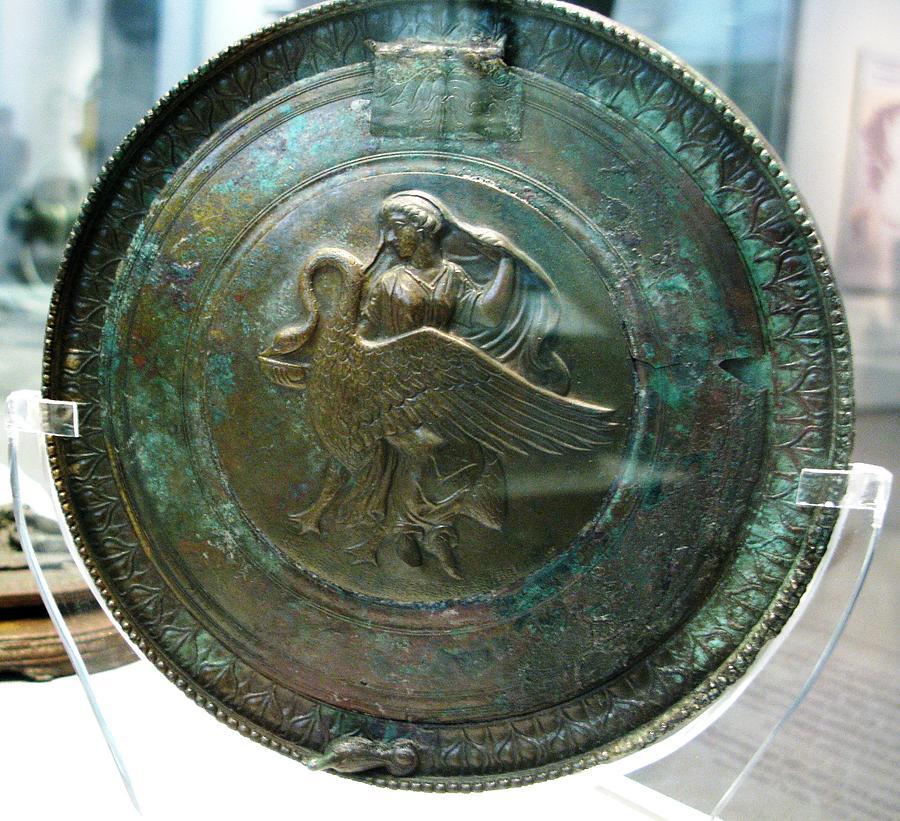
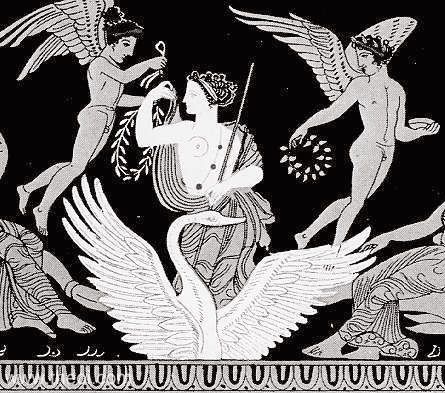
And many more. Some scholars think that these might be supposed to be geese instead of swans, in which case you could alternatively give her Animal (Goose), but we figured Swan fit with her aesthetic more. While we don't always give everyone an Animal association just because they appear with an animal in art a lot - sometimes the animal is just symbolic, or they have a myth that suggests it's not a good idea - Aphrodite is slim on associations like most Greek deities, and we figured she could use the help.
As for Fertility vs. Health, we're totally with you on the weirdness of that, but after doing as thorough a run through ancient Greek stories and descriptions of Aphrodite, that's where we ended up. Aphrodite is indeed associated with sex, but while Health does affect baby-making, it doesn't have a lot to do with the sex act itself beyond that, and so Aphrodite's strong connections to bangin' didn't really give her much of a connection there (although her Roman persona, Venus, is a little bit more linkable to Health as a concept). But the ancient Greeks connected human fertility and the fertility of the earth symbolically and even literally in many of their writings, so that Aphrodite is often praised as a bringer of earthly fertility despite not being a more classical plant-shaper. From Stasinus describing Aphrodite as eternally clothed in "crocus and hyacinth and flourishing violet and the rose's lovely bloom, so sweet and delicious, and heavenly buds, the flowers of the narcissus and lily; in such perfumed garments is Aphrodite clothed at all seasons," to the Homeric hymns stating that flowers spring up beneath her feet wherever she walks, plants turn up surprisingly frequently with Aphrodite. The reason is probably best summed up in Aeschylus' Danaides, in which Aphrodite herself describes the births of all the plants and trees and flowers of the world, and then claims, "Of all these things I am the cause," suggesting that because she is the motivator for sex which causes procreation, she is the root cause of all procreation of all life, even though she does not participate in the actual childbearing or mothering process.
Question: Shouldn't Hermes have Epic Dexterity and Illusion? Apologies if this has been answered already.
While Hermes certainly has decent amounts of both, neither was strong enough for us to want to give him the Ultimate expression of it. He does use Illusion occasionally, most notably in the tale where he makes himself a doppelgaenger of a man in order to drive him insane, but he doesn't do it all that often or all that impressively, so for the most part his trickery is probably the result of awesome Manipulation and Wits, and some low- to mid-level Illusion boons now and then. Dexterity doesn't really fit him, either; he does have the epithet "quick-footed", which helps, but for the most part the modern idea of him as super-fast comes from his role as messenger of the gods rather than any actual mythological association with speed of travel.
Question: Why does Njord have Fire associated?
Because of this passage in the Prose Edda:
The third among the Aesir is he that is called Njörd: he dwells in heaven, in the abode called Nóatún. He rules the course of the wind, and stills sea and fire; on him shall men call for voyages and for hunting.
Even more than Hel above, Njord suffers from the dearth of mythological information on the Aesir and Vanir. While his Water association as the god of the ocean is pretty solid, everything else tends to be like that - single statements that are clear, but don't have any other examples to back them up. Njord is supposed to be one of the most important and powerful of the Vanir, which is why he was traded to the Aesir in the first place, so we decided to give him Sky and Fire in spite of the lack of extra stories attached to them... but we feel like it's likely he may get demoted to a lot fewer associations in the future workup of lower-Legend gods. The Edda's very clear that he does those things, so we like them, but we also usually want more than one example, so thus is our quandary.
That's all our association questions for today - phew!
Saturday, December 28, 2013
All Abilities, All the Time
Okay, so this is last week's vlog, finally freed from the prison of John's video processing software. Please ignore all the business about the Secret Scion gift exchange, because obviously that was meant to mostly remind people to send us pictures last week. Also please ignore all the empty space above our heads in this video - I don't know what's up lately with all our vlogs being just the tops of our heads, but we promise we'll fix it.
As promised, this vlog is about abilities in a bunch of dimensions - so here we go!
Question: So, Arete. Massive lifting, dodge DV...you'd figure a hellacious Arete: Athletics would help these derived stats, but as written, seems not?
Question: So we know you'd pick Epic Strength and MAYBE Mystery as associated for Herakles. What would you choose for his six associated abilities?
Question: Could you explain the uses of Politics and Integrity (aside from your resistance roll)? I've always had trouble defining those.
Question: Scion is the only WW system not to have Subterfuge. Does this bug y'all? Do you use Empathy for lying to people? I hate that so.
Question: Would art restoration fall under Art, Craft or Science?
Question: Why does Hel have Medicine?
Question: I'm making an NPC scion who as a mortal practiced the martial art capoeira. In this instance, is it justifiable to use either Art (Dancing) or Brawl when making an attack? Or even combining them?
The other post about the Politics ability can be found here!
Apparently, a weird video cut (John was in charge of editing this, I would like to note) accidentally cut off our discussion of how Hel is not actually one of the Aesir and there are a lot of questions about who she is and what she represents, since she's both classified with the monsters but also treated as a goddess or at least an equal to the gods of Asgard, as well as being Loki's daughter. We're sorry about that, but it can always be a topic for another day!
As promised, this vlog is about abilities in a bunch of dimensions - so here we go!
Question: So, Arete. Massive lifting, dodge DV...you'd figure a hellacious Arete: Athletics would help these derived stats, but as written, seems not?
Question: So we know you'd pick Epic Strength and MAYBE Mystery as associated for Herakles. What would you choose for his six associated abilities?
Question: Could you explain the uses of Politics and Integrity (aside from your resistance roll)? I've always had trouble defining those.
Question: Scion is the only WW system not to have Subterfuge. Does this bug y'all? Do you use Empathy for lying to people? I hate that so.
Question: Would art restoration fall under Art, Craft or Science?
Question: Why does Hel have Medicine?
Question: I'm making an NPC scion who as a mortal practiced the martial art capoeira. In this instance, is it justifiable to use either Art (Dancing) or Brawl when making an attack? Or even combining them?
The other post about the Politics ability can be found here!
Apparently, a weird video cut (John was in charge of editing this, I would like to note) accidentally cut off our discussion of how Hel is not actually one of the Aesir and there are a lot of questions about who she is and what she represents, since she's both classified with the monsters but also treated as a goddess or at least an equal to the gods of Asgard, as well as being Loki's daughter. We're sorry about that, but it can always be a topic for another day!
Tuesday, September 10, 2013
A Wild Wind
Question: I'd like to know some more about the Wild Hunt. I know that each culture has its own version of it. In Scion, how do you handled it?
Well, rolling in first of all with the fact that each culture actually doesn't have a version of the Wild Hunt - far from it, really. The concept is a very northern European one, and you won't find it in the same form in the rest of the world. But there are several possibilities for handing the Hunt within the lands of the European gods, so let's check them out!
First of all, there are basically just buckets of different interpretations of the Hunt, who's on it, who's leading it, who it's chasing, and what it means all over the place, so Storytellers have a veritable smorgasbord of folklore to choose from. In Germany and the Celtic lands surrounding it as well as the British Isles, the Hunt was thought of as made up of the spirits of the dead and the demons that attended them, frightful and dangerous to an living soul unlucky enough to be caught out at night while they were riding; they chase the living in order to add them to their number, and are especially fond of prideful young men and beautiful young women, who should always be cautious to make it indoors before sunset. In other Celtic areas, however, particularly England and Ireland, the Hunt is instead made up for fairy riders who ride with wild and ecstatic abandon, hunting magical animals, mortals who will be taken back to Faerie with them or even unlucky members of their own kind; whether they're dangerous to people or merely frightening and supernatural depends on the area and how comfortable a particular village or shire is with their relationship with the faeries. Sometimes, helping the fairy Wild Hunt can gain you magical prizes or favors (although, as with all things that come from fairies, they are often double-edged swords), but in other areas in any way interacting with them dooms you to share their Hunt, either for the single night or for eternity, and hindering them in any way (even accidental) will surely bring down their supernatural wrath on your head. Some parts of Wales split the difference and claim that the hunt is the hounds and gods of the underworld, chasing down ghosts or spirits that have escaped their final destination, and in areas where Christianity has strongly colored the folklore this is often transformed into a tale of the hounds of Hell chasing down the souls of sinners.
The biggest question, though, is always this: who is the leader of the Wild Hunt? There we have many options as well, all of them interesting and rife with possible plot hooks. Odin himself is one of the most popular options, and indeed the idea of the Wild Hunt in Scandinavia was almost exclusively associated with him, a legend that set him as the wild-eyed leader of a hunt of belling supernatural hounds and the dead warriors of the einherjar; remote areas even today still retain folksayings surrounding Odin being out on particularly stormy or ominously silent nights. On the continent around Denmark and Germany, the Hunt is often said to be helmed by a woman, however - the goddess Holle, who might be either Hel or Freya, leading her own horde of the dead for her dark amusement. In Britain, the figure of Herne the Hunter is often said to be the leader of the Wild Hunt, comprised of both the dead and the beasts of the deep woods, and more than a few scholars have pointed out that his name is etymologically very similar to that of Cernunnos, not to mention that both figures are often represented as horned or antlered. In Wales, the terrifying god Gwyn ap Nudd (literally "Gwyn, son of Nudd", who is the Welsh version of Nuada) leads the hunt from the Underworld flanked by the demons of death, the better to catch the fleeing souls of those who have just died and take them home with him again; Nuada himself isn't associated with the hunt over in Ireland, but Manannan mac Lir, god of the galloping waves which are his horses, has been theorized by scholars to perhaps do the same, possibly in search of the souls of heroes who have died in the crossing to Mag Mell. In areas where the Wild Hunt is a fairy event, it is often said to be led by Auberon or whomever the local king or queen of the fairies is considered to be. And, one of the youngest but most interesting versions, it's also a matter of myth in some parts of Britain that the Wild Hunt is led by King Arthur himself, still searching for the Questing Beast with the shades of his loyal knights, spending the ages searching for it until, on the day he succeeds, he returns to lead England to glory again.
As for us, our games have actually seen the Skeins of Fate group participate in the Wild Hunt, which was held by the fairies of the Autumn Court with a hapless Gaulish Scion as their quarry. It was led by the Autumn King, who was a creature of indistinct nightmare that no one got a very good look at; it's still unsure if he's simply a fairy they had an encounter with, or if he might have been a god in disguise that they didn't recognize. Certainly, Aurora pulled off some very ballsy maneuvers there and largely got away with it, so one has to wonder whether or not there were two eyes under that dark crown. One of the Eastern Promises groups also heard tell of the Wild Hunt beginning soon somewhere nearby, but they ended up going somewhere else to solve their problems, and consequently still have not encountered whomever or whatever hunts at midnight.
We like to keep the Hunt ambiguous - who knows if they players will ever investigate enough to learn the real truth? But there are myriad possibilities for anyone who wants to use them in a game, and the plots practically write themselves.
P.S.: Do you guys know this song? It's on our playlist for the Strawberry Fields game thanks to Seamus, our Scion of Manannan mac Lir, and although not strictly about the Hunt, you can almost feel the hoofbeats shaking the ground as they go.
Well, rolling in first of all with the fact that each culture actually doesn't have a version of the Wild Hunt - far from it, really. The concept is a very northern European one, and you won't find it in the same form in the rest of the world. But there are several possibilities for handing the Hunt within the lands of the European gods, so let's check them out!
First of all, there are basically just buckets of different interpretations of the Hunt, who's on it, who's leading it, who it's chasing, and what it means all over the place, so Storytellers have a veritable smorgasbord of folklore to choose from. In Germany and the Celtic lands surrounding it as well as the British Isles, the Hunt was thought of as made up of the spirits of the dead and the demons that attended them, frightful and dangerous to an living soul unlucky enough to be caught out at night while they were riding; they chase the living in order to add them to their number, and are especially fond of prideful young men and beautiful young women, who should always be cautious to make it indoors before sunset. In other Celtic areas, however, particularly England and Ireland, the Hunt is instead made up for fairy riders who ride with wild and ecstatic abandon, hunting magical animals, mortals who will be taken back to Faerie with them or even unlucky members of their own kind; whether they're dangerous to people or merely frightening and supernatural depends on the area and how comfortable a particular village or shire is with their relationship with the faeries. Sometimes, helping the fairy Wild Hunt can gain you magical prizes or favors (although, as with all things that come from fairies, they are often double-edged swords), but in other areas in any way interacting with them dooms you to share their Hunt, either for the single night or for eternity, and hindering them in any way (even accidental) will surely bring down their supernatural wrath on your head. Some parts of Wales split the difference and claim that the hunt is the hounds and gods of the underworld, chasing down ghosts or spirits that have escaped their final destination, and in areas where Christianity has strongly colored the folklore this is often transformed into a tale of the hounds of Hell chasing down the souls of sinners.
The biggest question, though, is always this: who is the leader of the Wild Hunt? There we have many options as well, all of them interesting and rife with possible plot hooks. Odin himself is one of the most popular options, and indeed the idea of the Wild Hunt in Scandinavia was almost exclusively associated with him, a legend that set him as the wild-eyed leader of a hunt of belling supernatural hounds and the dead warriors of the einherjar; remote areas even today still retain folksayings surrounding Odin being out on particularly stormy or ominously silent nights. On the continent around Denmark and Germany, the Hunt is often said to be helmed by a woman, however - the goddess Holle, who might be either Hel or Freya, leading her own horde of the dead for her dark amusement. In Britain, the figure of Herne the Hunter is often said to be the leader of the Wild Hunt, comprised of both the dead and the beasts of the deep woods, and more than a few scholars have pointed out that his name is etymologically very similar to that of Cernunnos, not to mention that both figures are often represented as horned or antlered. In Wales, the terrifying god Gwyn ap Nudd (literally "Gwyn, son of Nudd", who is the Welsh version of Nuada) leads the hunt from the Underworld flanked by the demons of death, the better to catch the fleeing souls of those who have just died and take them home with him again; Nuada himself isn't associated with the hunt over in Ireland, but Manannan mac Lir, god of the galloping waves which are his horses, has been theorized by scholars to perhaps do the same, possibly in search of the souls of heroes who have died in the crossing to Mag Mell. In areas where the Wild Hunt is a fairy event, it is often said to be led by Auberon or whomever the local king or queen of the fairies is considered to be. And, one of the youngest but most interesting versions, it's also a matter of myth in some parts of Britain that the Wild Hunt is led by King Arthur himself, still searching for the Questing Beast with the shades of his loyal knights, spending the ages searching for it until, on the day he succeeds, he returns to lead England to glory again.
As for us, our games have actually seen the Skeins of Fate group participate in the Wild Hunt, which was held by the fairies of the Autumn Court with a hapless Gaulish Scion as their quarry. It was led by the Autumn King, who was a creature of indistinct nightmare that no one got a very good look at; it's still unsure if he's simply a fairy they had an encounter with, or if he might have been a god in disguise that they didn't recognize. Certainly, Aurora pulled off some very ballsy maneuvers there and largely got away with it, so one has to wonder whether or not there were two eyes under that dark crown. One of the Eastern Promises groups also heard tell of the Wild Hunt beginning soon somewhere nearby, but they ended up going somewhere else to solve their problems, and consequently still have not encountered whomever or whatever hunts at midnight.
We like to keep the Hunt ambiguous - who knows if they players will ever investigate enough to learn the real truth? But there are myriad possibilities for anyone who wants to use them in a game, and the plots practically write themselves.
P.S.: Do you guys know this song? It's on our playlist for the Strawberry Fields game thanks to Seamus, our Scion of Manannan mac Lir, and although not strictly about the Hunt, you can almost feel the hoofbeats shaking the ground as they go.
Friday, February 3, 2012
Hel is Where the Heart is
Question: Of Loki's three children, why is Hel the only one granted "god" status, albeit goddess of death with a realm that is as much prison as kingdom? Is it because she is more "human" than her brothers? Also, can she leave Helheim at all, but chooses not to, or is she truly sealed there as much as the souls she oversees?
Poor Hel gets such a raw deal (but then, I guess she gets hers back by getting to hang onto Baldur for a while and thumbing her nose at Odin).
Hel is most often mentioned in the same breath with her monstrous brothers, which definitely suggests that she was considered scary on a similar level; since most of history features mankind being scared to death of death, that stands to reason. I agree, however, that there is a real sense of Hel as a more "human" or at least accessible figure; she is invoked a few times in sagas by people who are dying or declaring that they're going to die, turns up in Christianized texts as having spats with the Devil, and has semi-cordial conversations and dealings with the gods. The most notable clues that Hel is considered on a somewhat even footing with the gods of Asgard are the fact that the gods send tribute down to her with Hermod, paying her their respects, and that Odin himself actively gives her sovereignty over the realm of the dead, effectively endorsing her as necessary. Add those to the fact that Scion pantheons tend to function best with a death-god, and it's not hard to see why she makes the cut while her brothers, who are merely monsters rather than creatures playing specific roles in the divine community, do not.
As far as leaving Helheim/Niflheim goes, though, that's a thornier question. The fact that Odin tosses her down there in order to keep her the hell away from Asgard implies strongly that she can't get out; the underworld is her "prison" just as much as the ribbon and oceans act as jails for her brothers. She never leaves in the Norse sagas, not even at Ragnarok when her father is running around blowing everything up; from a purely mythological point of view, I'd say that she can't.
But for Scion's premise to work for her, she actually has to be able to leave Helheim; if she can't go to the World, she can't have Scions, pretty short and simple (in fact, Hero discusses what she looks like and does when she's in the World, so clearly the original writers assumed that she could go there). If you want to stick with the idea that Hel can't leave, however, there are a few clever workarounds you could try; the easiest is just that she chooses a likely mortal who enters her domain and resurrects him for what are probably some cold and terrifying sexytimes (which might lead to interesting questions regarding what happens to those poor guys afterward; does she kill them again? Keep them somewhere in her house?). You could also rule that she can only leave in Avatar form (which is how most gods visit the World anyway), or that Odin has granted her special dispensation to visit Midgard only in order to help create Scions for the pantheon. Maybe she never gives birth her own Scions, and only adopts the children of other gods.
I'd keep her in Hel and let her get creative about how to have children as a result; Scions of Hel are most likely rare creatures no matter how you slice it.
Poor Hel gets such a raw deal (but then, I guess she gets hers back by getting to hang onto Baldur for a while and thumbing her nose at Odin).
Hel is most often mentioned in the same breath with her monstrous brothers, which definitely suggests that she was considered scary on a similar level; since most of history features mankind being scared to death of death, that stands to reason. I agree, however, that there is a real sense of Hel as a more "human" or at least accessible figure; she is invoked a few times in sagas by people who are dying or declaring that they're going to die, turns up in Christianized texts as having spats with the Devil, and has semi-cordial conversations and dealings with the gods. The most notable clues that Hel is considered on a somewhat even footing with the gods of Asgard are the fact that the gods send tribute down to her with Hermod, paying her their respects, and that Odin himself actively gives her sovereignty over the realm of the dead, effectively endorsing her as necessary. Add those to the fact that Scion pantheons tend to function best with a death-god, and it's not hard to see why she makes the cut while her brothers, who are merely monsters rather than creatures playing specific roles in the divine community, do not.
As far as leaving Helheim/Niflheim goes, though, that's a thornier question. The fact that Odin tosses her down there in order to keep her the hell away from Asgard implies strongly that she can't get out; the underworld is her "prison" just as much as the ribbon and oceans act as jails for her brothers. She never leaves in the Norse sagas, not even at Ragnarok when her father is running around blowing everything up; from a purely mythological point of view, I'd say that she can't.
But for Scion's premise to work for her, she actually has to be able to leave Helheim; if she can't go to the World, she can't have Scions, pretty short and simple (in fact, Hero discusses what she looks like and does when she's in the World, so clearly the original writers assumed that she could go there). If you want to stick with the idea that Hel can't leave, however, there are a few clever workarounds you could try; the easiest is just that she chooses a likely mortal who enters her domain and resurrects him for what are probably some cold and terrifying sexytimes (which might lead to interesting questions regarding what happens to those poor guys afterward; does she kill them again? Keep them somewhere in her house?). You could also rule that she can only leave in Avatar form (which is how most gods visit the World anyway), or that Odin has granted her special dispensation to visit Midgard only in order to help create Scions for the pantheon. Maybe she never gives birth her own Scions, and only adopts the children of other gods.
I'd keep her in Hel and let her get creative about how to have children as a result; Scions of Hel are most likely rare creatures no matter how you slice it.
Tuesday, January 31, 2012
Oh, What a Tangled Web
Question: I know it's just a myth, but is Odin arrogant, stupid, or both? He is called all wise and all knowing but the whole Norse cycle seems to be him constantly shooting himself in the foot, especially when it comes to the children of Loki, Hel especially, putting her in a place where she will be able to keep Baldur for herself and keep Ragnarok on track. Also, does Hel truly love Baldur, or is she just being mean and spiteful?
Arrogant? Probably. Stupid? No. What Odin mostly is is desperate.
The children of Loki can look like a huge blind spot for Odin; imprisoning them instead of destroying them ensures that all three will get a chance to play a role in Ragnarok, Hel by keeping Baldur, Jormungandr by killing Thor and Fenrir by killing Odin himself. Certainly the fact that they're alive and well and just waiting for their chance to demolish him and everything he owns is probably not helping him sleep nights.
But a major problem for Odin at the time that he binds the three children is that he doesn't know any of that yet. Binding them at all is in reaction to a prophecy, but it's not that prophecy; all the Aesir manage to come up with is that the three are going to be incredibly dangerous and destructive if they're allowed to continue roaming free. Add this to the gods already being very uncomfortable about things like the volume of flesh Fenrir is consuming per day, and Odin has very compelling reasons to get rid of them; but he doesn't know, at this time, that they're slated to be part of the final destruction. That information comes from the dead voelva that he visits after Baldur's dream, and it probably comes as a huge blow; learning that the creatures you just imprisoned instead of killing are going to one day break free and wreak havoc on your person has to be one of the worst things to discover via any means, let alone incontrovertible prophecy.
But why not just kill them anyway? "Going to be horribly dangerous and cause lots of trouble" seems like a good justification, right? Unfortunately for Odin, he pretty much can't. Hel, Jormungandr and Fenrir are the children of Loki, and Loki is Odin's best buddy and blood-brother; not only is killing your best friend's children kind of the king of all dick moves, but thanks to the blood-brother tag it's almost tantamount to kin-slaying, something the Norse are not okay with at all (see: Hod, Baldur, Vali). Odin can't just walk up to Loki over a pint of mead and be like, "Hey, my wife had a vision that your daughter's going to be problematic if she lives here, so I'm going to murder her." It's really not an option, especially since none of Loki's children have actually done anything yet other than make people uncomfortable.
So imprisonment is really the only safe middle ground he can go to for the three of them; Hel goes to the Underworld, Jormungandr to the bottom of the ocean and Fenrir to the depths of his cave. The later discovery that they're going to be his doom is probably horrible, but it's too late to go kill them now (especially since they still haven't done anything other than Fenrir biting Tyr's arm off, and nobody really blames him for that under the circumstances, not even Tyr, who kind of knew that was coming). For an extra dollop of fist-shaking at the sky, the whole situation is very much a self-fulfilling prophecy; had he not tossed all three of them into eternal jail, they might not be so eager to wreck his shit when released, but it's too late for that now, too. In addition, by Scion's rules, he can't kill Jormungandr and Fenrir anyway; both are Titans (albeit without ever being mentioned as belonging to a specific Titanrealm), and killing Titans, as Odin knows from firsthand experience, is a terrible, terrible idea.
As in many other dimensions, it sucks to be Odin sometimes.
As for Hel, well, there really isn't much to go on in the Eddas to tell us what her real feelings are about Baldur; she might love him, might be enforcing the laws of death, or might just be hanging on to him out of spite at the Aesir who dumped her in Helheim in the first place. There's no evidence to say that she ever met him when she was briefly in Asgard or had any kind of pre-existing relationship with him; as far as we know, she has no idea he exists except by hearsay until he ends up in her hall.
But then again, this is Baldur we're talking about; is it even possible for a lady to see Baldur and not immediately fall head-over-heels? Being loved is what Baldur is good at, and there's no reason to suppose that Hel is any less likely to cherish him than everybody back at home in Asgard. If she wasn't in love with him before he shows up, she almost certainly is afterward, and while there may be spite or adherence to rules also involved in her refusal to part with him, I'd assume some of it is a genuine desire to keep him with her. When a dude with Ultimate Charisma and Appearance waltzes into your house, of course you want him to live with you forever.
If you want to get extremely romantic about the whole situation, I've even seen some scholars theorize that Loki's slaying of Baldur (which appears otherwise unmotivated and is strangely out of place in his normally non-lethal prank repertoire) and refusal to help resurrect him later is directly intended to give him to Hel as a companion, sort of a father providing for his daughter in defiance of Odin's rulings.
It's an area with no clear answer in myth, so individual games of Scion may take many different directions when approaching it, all depending on how you want Odin, Loki, Hel and Baldur to come off as individuals.
Arrogant? Probably. Stupid? No. What Odin mostly is is desperate.
The children of Loki can look like a huge blind spot for Odin; imprisoning them instead of destroying them ensures that all three will get a chance to play a role in Ragnarok, Hel by keeping Baldur, Jormungandr by killing Thor and Fenrir by killing Odin himself. Certainly the fact that they're alive and well and just waiting for their chance to demolish him and everything he owns is probably not helping him sleep nights.
But a major problem for Odin at the time that he binds the three children is that he doesn't know any of that yet. Binding them at all is in reaction to a prophecy, but it's not that prophecy; all the Aesir manage to come up with is that the three are going to be incredibly dangerous and destructive if they're allowed to continue roaming free. Add this to the gods already being very uncomfortable about things like the volume of flesh Fenrir is consuming per day, and Odin has very compelling reasons to get rid of them; but he doesn't know, at this time, that they're slated to be part of the final destruction. That information comes from the dead voelva that he visits after Baldur's dream, and it probably comes as a huge blow; learning that the creatures you just imprisoned instead of killing are going to one day break free and wreak havoc on your person has to be one of the worst things to discover via any means, let alone incontrovertible prophecy.
But why not just kill them anyway? "Going to be horribly dangerous and cause lots of trouble" seems like a good justification, right? Unfortunately for Odin, he pretty much can't. Hel, Jormungandr and Fenrir are the children of Loki, and Loki is Odin's best buddy and blood-brother; not only is killing your best friend's children kind of the king of all dick moves, but thanks to the blood-brother tag it's almost tantamount to kin-slaying, something the Norse are not okay with at all (see: Hod, Baldur, Vali). Odin can't just walk up to Loki over a pint of mead and be like, "Hey, my wife had a vision that your daughter's going to be problematic if she lives here, so I'm going to murder her." It's really not an option, especially since none of Loki's children have actually done anything yet other than make people uncomfortable.
So imprisonment is really the only safe middle ground he can go to for the three of them; Hel goes to the Underworld, Jormungandr to the bottom of the ocean and Fenrir to the depths of his cave. The later discovery that they're going to be his doom is probably horrible, but it's too late to go kill them now (especially since they still haven't done anything other than Fenrir biting Tyr's arm off, and nobody really blames him for that under the circumstances, not even Tyr, who kind of knew that was coming). For an extra dollop of fist-shaking at the sky, the whole situation is very much a self-fulfilling prophecy; had he not tossed all three of them into eternal jail, they might not be so eager to wreck his shit when released, but it's too late for that now, too. In addition, by Scion's rules, he can't kill Jormungandr and Fenrir anyway; both are Titans (albeit without ever being mentioned as belonging to a specific Titanrealm), and killing Titans, as Odin knows from firsthand experience, is a terrible, terrible idea.
As in many other dimensions, it sucks to be Odin sometimes.
As for Hel, well, there really isn't much to go on in the Eddas to tell us what her real feelings are about Baldur; she might love him, might be enforcing the laws of death, or might just be hanging on to him out of spite at the Aesir who dumped her in Helheim in the first place. There's no evidence to say that she ever met him when she was briefly in Asgard or had any kind of pre-existing relationship with him; as far as we know, she has no idea he exists except by hearsay until he ends up in her hall.
But then again, this is Baldur we're talking about; is it even possible for a lady to see Baldur and not immediately fall head-over-heels? Being loved is what Baldur is good at, and there's no reason to suppose that Hel is any less likely to cherish him than everybody back at home in Asgard. If she wasn't in love with him before he shows up, she almost certainly is afterward, and while there may be spite or adherence to rules also involved in her refusal to part with him, I'd assume some of it is a genuine desire to keep him with her. When a dude with Ultimate Charisma and Appearance waltzes into your house, of course you want him to live with you forever.
If you want to get extremely romantic about the whole situation, I've even seen some scholars theorize that Loki's slaying of Baldur (which appears otherwise unmotivated and is strangely out of place in his normally non-lethal prank repertoire) and refusal to help resurrect him later is directly intended to give him to Hel as a companion, sort of a father providing for his daughter in defiance of Odin's rulings.
It's an area with no clear answer in myth, so individual games of Scion may take many different directions when approaching it, all depending on how you want Odin, Loki, Hel and Baldur to come off as individuals.
Subscribe to:
Posts (Atom)