Showing posts with label Tlaloc. Show all posts

Thursday, March 20, 2014

Do What You Do

Since we've gotten a bunch of these lately, here's a quick big-bang-style post with several questions about associations. Let's go at it!

Question: Why does Hera have Health associated?

Hera is strongly associated with childbirth and the health of children and pregnant women alike, which is covered by the Health purview. Not only is she one of the few gods to create children completely parthenogenically with no males involved (both Hephaestus and Typhon are said to be her children alone, although both also have alternative genealogies), but she was called upon to protect mothers and infants during pregnancy and birth and to prevent complications and diseases that might harm them, especially in her Roman guise as Juno. This is one of those places where an association comes more from cult associations than from a specific myth in which the association is demonstrated.

John would like to note that we're considering lately whether issues of childbirth and human fertility should contribute toward a Health association and how strongly, so if you have opinions, lay them on us.

Question: Does Epic Appearance really suit Tlaloc?

Have you seen him?


Tlaloc is famously crazy-looking, even among the Mexican gods, where curlicue-faces and bizarre giant clothing styles are a way of life. He combines parts of a bunch of animals related to his elements, especially the crocodile teeth and giant frog eyes, and is so visually striking that he's one of the few gods we can pick out across various different levels of Mesoamerican myth in different cultures and time periods. The Googly-Eyed Rain Monster - that's a real term, I didn't make it up! - is a mainstay of wacky Mesoamerican religious art, and Tlaloc, representative of both the devouring earth that must be fed blood to be appeased and the terrible storm that devastates the landscape and brings disease and damage, is pretty clearly intended to be terrifying in a way that many others among the Teotl are not.

Question: why does Hel have Epic Stamina associated?

We'll admit to this one being more of a stretch. Hel lives in an area that is famously inhospitable, so much so that even the gods avoid it - freezing cold and filled with debilitating disease - seemingly without any problems, and also survived being "cast" or "thrown" from Yggdrasil into Helheim by Odin (it went better for her than the similar fall did for Hephaestus, at least!). We were at the time trying to make sure all Legend 12 deities had at least four associations, which we later relaxed to three, so this one is by far her least solid.

Question: Why does Hermes have Magic associated?

Because, as Hermes Trismegistus ("thrice-great Hermes" or "thrice-wise Hermes"), he is the inventer of sorcery and patron of the Hermetic order of magaicians, who of course named their organization after him. Hilariously, Hermes T is probably a combination of Hermes and Thoth, but at this point they're almost inseparable in that role, so we found that it made more sense to extend the association to both of them than to try to split them into separate parts. It's likely that Hermes/Mercury's association with magic originally comes from his association with luck, a necessary part of his function as god of shenanigans, thievery and other things you need good fortune to pull off, but it eventually evolved into a full-blown magic association that survives to this day. Not every branch of Greek or Roman religion accepted Hermes T as being the same as Hermes, so you could set him up as a completely different god if you wanted to, but we figured in this case simplicity was better.

Question: Where do you guys get Animal (Swan) and Fertility for Aphrodite? I mean, I know it's hard to figure out powers that she might have other than "being really hot" but I can't recall a single myth of her doing anything with swans or plant life. I could see the Health Purview, since it has powers that affect sex and HUMAN fertility, not to mention Human Clay would be a useful power for the Goddess of Beauty (she can give you beauty or take it away) but Fertility and Animal don't make much sense.

Aphrodite is actually associated with the swan all the time! The bird represented light and beauty to the ancient Greeks, which made it an easy one to associate with her. Take a gander (ha!) at all these ancient images of Aphrodite hanging out with swans:


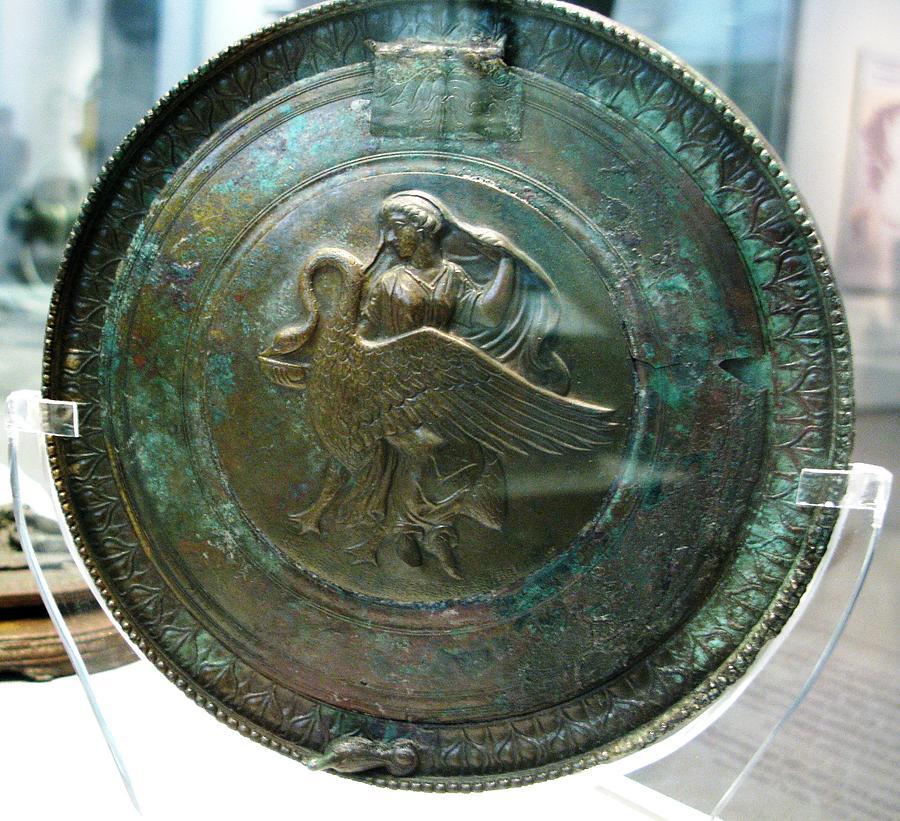
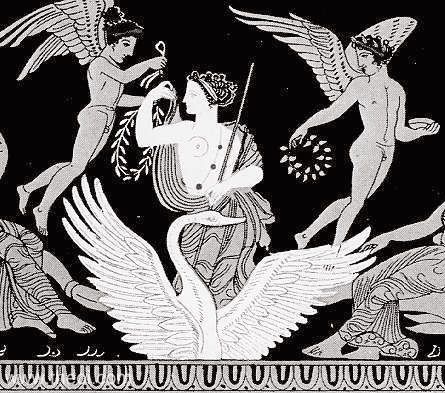


And many more. Some scholars think that these might be supposed to be geese instead of swans, in which case you could alternatively give her Animal (Goose), but we figured Swan fit with her aesthetic more. While we don't always give everyone an Animal association just because they appear with an animal in art a lot - sometimes the animal is just symbolic, or they have a myth that suggests it's not a good idea - Aphrodite is slim on associations like most Greek deities, and we figured she could use the help.

As for Fertility vs. Health, we're totally with you on the weirdness of that, but after doing as thorough a run through ancient Greek stories and descriptions of Aphrodite, that's where we ended up. Aphrodite is indeed associated with sex, but while Health does affect baby-making, it doesn't have a lot to do with the sex act itself beyond that, and so Aphrodite's strong connections to bangin' didn't really give her much of a connection there (although her Roman persona, Venus, is a little bit more linkable to Health as a concept). But the ancient Greeks connected human fertility and the fertility of the earth symbolically and even literally in many of their writings, so that Aphrodite is often praised as a bringer of earthly fertility despite not being a more classical plant-shaper. From Stasinus describing Aphrodite as eternally clothed in "crocus and hyacinth and flourishing violet and the rose's lovely bloom, so sweet and delicious, and heavenly buds, the flowers of the narcissus and lily; in such perfumed garments is Aphrodite clothed at all seasons," to the Homeric hymns stating that flowers spring up beneath her feet wherever she walks, plants turn up surprisingly frequently with Aphrodite. The reason is probably best summed up in Aeschylus' Danaides, in which Aphrodite herself describes the births of all the plants and trees and flowers of the world, and then claims, "Of all these things I am the cause," suggesting that because she is the motivator for sex which causes procreation, she is the root cause of all procreation of all life, even though she does not participate in the actual childbearing or mothering process.

Question: Shouldn't Hermes have Epic Dexterity and Illusion? Apologies if this has been answered already.

While Hermes certainly has decent amounts of both, neither was strong enough for us to want to give him the Ultimate expression of it. He does use Illusion occasionally, most notably in the tale where he makes himself a doppelgaenger of a man in order to drive him insane, but he doesn't do it all that often or all that impressively, so for the most part his trickery is probably the result of awesome Manipulation and Wits, and some low- to mid-level Illusion boons now and then. Dexterity doesn't really fit him, either; he does have the epithet "quick-footed", which helps, but for the most part the modern idea of him as super-fast comes from his role as messenger of the gods rather than any actual mythological association with speed of travel.

Question: Why does Njord have Fire associated?

Because of this passage in the Prose Edda:

The third among the Aesir is he that is called Njörd: he dwells in heaven, in the abode called Nóatún. He rules the course of the wind, and stills sea and fire; on him shall men call for voyages and for hunting.

Even more than Hel above, Njord suffers from the dearth of mythological information on the Aesir and Vanir. While his Water association as the god of the ocean is pretty solid, everything else tends to be like that - single statements that are clear, but don't have any other examples to back them up. Njord is supposed to be one of the most important and powerful of the Vanir, which is why he was traded to the Aesir in the first place, so we decided to give him Sky and Fire in spite of the lack of extra stories attached to them... but we feel like it's likely he may get demoted to a lot fewer associations in the future workup of lower-Legend gods. The Edda's very clear that he does those things, so we like them, but we also usually want more than one example, so thus is our quandary.

That's all our association questions for today - phew!

Friday, August 30, 2013

Broken Homes

Question: So, what's the relationship between Xochiquetzal and Tezcatlipoca nowadays? I've heard some claims that she's the Smoking Mirror's wife now (one of four), but not all sources seem to agree.

Not good, in our opinion. There's room to go either way, though.

For those unaware of their sordid past, Xochiquetzal was once seduced by Tezcatlipoca, god of masculinity and seduction among his many other talents (and since she's also the goddess of love and sex, sparks were bound to fly). It depends on the teller of the tale whether this was a mutual affair, she was blandished into it or he even physically kidnapped her. Even if it was voluntary, the problem with this was that she was also married at the time, to Tlaloc, who happened to be serving as the third sun; her disloyalty so upset him that he caused the rain of fire that destroyed the Third World, and forced everyone to restart creation and elect a new sun again. It was a pretty big debacle, and Xochiquetzal summarily ceased being associated much with Tlaloc, who gained a new wife in the water goddess Chalchiuhtlicue.

However, Xochiquetzal also ceases being associated with Tezcatlipoca in any meaningful way as well. The god is said to have wives, but those wives' identities are hard to pin down, given as various different names in different sources or not elaborated on at all, often left as identifiers of his association with wealth and masculinity rather than characters themselves. The idea of four wives comes from the ixiptla cult, in which a Tezcatlipoca impersonator was assigned four "wives" who were impersonators of four goddesses including Xochiquetzal, but it's hard to be certain whether they meant that Tezcatlipoca literally had four wives or whether that was just the convenient number for the ritual (after all, four is the magic number in Mesoamerican religion; if you asked them how many there were of anything sacred but undefined, they'd probably say four). It's also very possible that he wasn't necessarily believed to be married to those particular goddesses, but that they were there as representatives of concepts associated with the ixiptla's death and offering to Tezcatlipoca; under this theory, the women represent life-giving forces (sex, crafts, salt and fertility of the earth) and the ixiptla represents humanity making use of them, and the Xochiquetzal impersonator is there as a representative of sex propagating humanity rather than a wife in the human sense.

At any rate, Xochiquetzal certainly has an affair with Tezcatlipoca, but thereafter they split so thoroughly that they might as well not even be in the same pantheon anymore. Xochiquetzal's stories never mention even a whisper of Tezcatlipoca; she acts as a free agent, seducing mortals, producing flowers and generally acting like an unattached, swinging single lady. She's much more often associated with her brother Xochipilli when with anyone, since they share a lot of real estate as gods of fertility and fun. Tezcatlipoca, similarly, never has another myth in which the flower goddess is mentioned, and goes about his business being a solo giant pain in everyone's ass.

This doesn't necessarily mean they aren't married; after all, married couples in Aztec myth generally don't do a whole lot together, and their marriages were probably conceived of as partnerships between deities of related concepts (Tlaloc as rain and Chalchiuhtlicue as water, for example) rather than relationships that made much of a narrative difference to the exploits of the gods. But it also leaves us with seriously no way of knowing whether the Aztecs considered Xochiquetzal to have remained with her illicit lover or stayed single after her spectacular divorce, so either option is available.

In our games, we assume the flower goddess is unattached, the better to ply her trade as goddess of sexy lovefests without anything getting in the way too much, and that there's a lot of simmering uncomfortable sentiment still breweing between her, Tlaloc and Tezcatlipoca, none of whom are happy with one another (well, except Tezcatlipoca, he probably gives no fucks). Sowiljr is currently trying to get her betrothed to Tonatiuh in the hopes of settling the godrealm down and replacing some of the gods lost in the great Norse debacle of several years ago, although how successful he's going to be will depend on his resistance rolls, her willingness to settle for a god she didn't choose for herself and Eztli's hold on her temper.

Tuesday, November 13, 2012

Frogs and Snakes and Crocodiles, Oh My!

Question: How would you deal with Chaac, whom many consider the Maya version of Tlaloc? Even though Tlaloc doesn't have Water associated, the concept of the Great Water Cycle makes a strong point for associating Chaac with Water.

I suspect we will be dealing with Chaac sooner rather than later, if the Maya gods continue their commanding lead on the poll.

We're keeping our minds open until we have a chance to do some really thorough Chaac research, but at the moment we're leaning toward keeping him (and Quetzalcoatl/Kulkulkan, while we're at it) on the Aztec rosters and focusing on the more uniquely Maya gods for their lineup instead. While there are some places where it's sort of ambiguous which gods might match up with which others, Tlaloc and Chaac share a lot of pretty clear similarities that make it difficult to break them apart as well as differences that give us pause - a lot like the Ares/Mars conundrum over in classical myth, really. On the one hand, Chaac does things Tlaloc doesn't; on the other hand, the two have so much overlap that we're not sure how useful it would be to break them down.

It'll really come down to whether or not, after sitting down and doing a really and truly thorough look at the Maya Chaac versus the Aztec Tlaloc, we end up feeling like they have enough differences to stand on their own feet instead of being the same deity interpreted by two different cultures. If they do, we'll happily separate them; if they don't, Tlaloc will keep on keepin' on and it'll be understood (the way it is for now, since we don't have the Maya gods in play yet) that he's the same person as Chaac.

As for Water, Chaac does have more water connotations than Tlaloc - but only by a little bit, honestly. The Great Water Cycle, in spite of its name, features Chaac mostly being a Sky god as usual, raining ceaselessly down on the landscape for half the year before withering during the dry season until he can return. Rain is indeed made up of water, which is why the name fits so well, but Scion makes a solid distinction between rain falling under Sky and other kinds of water falling under Water, and the vast majority of Chaac's functions are clearly those of a sky god.

As with other gods who show some signs of possessing a purview but aren't strongly associated enough with it to be gods of it, it may just be that Chaac (and/or Tlaloc) has some Water boons, illustrating that he does have some sway in the realm of water, but doesn't have the Avatar of it, making it clear that he isn't as powerful in that area as a true god of the waters would be.

Monday, October 29, 2012

Vlog Grab Bag!

Welcome to the crazy grab-bag vlog, in which we answer ten thousand (or six) questions in one flurry of manic activity!

Question: Why doesn’t Tlaloc have Animal (Crocodile), Animal (Turtle) or Water?

Question: How do you feel about a deity having multiple active Scions at any given time?

Question: How do you deal with public revelation? What if they drop Canopus into traffic, or throw lightning on the evening news?

Question: Who are the gods of Scotland?

Question: How would you handle a player wanting to father a new race of vampires? What kind of powers do you think they'd need? What about spawning other races of creatures?

Question: Who is the top magician out of every magic god/goddess of every pantheon? I'm pulling for Odin!


Today's installment features an outdoor adventure with loose wild animals. Because that's how we vlog.

Tuesday, September 25, 2012

Gods of Sun and Sacrifice

Question: Could you please go over the Aztec associated powers overhaul? Some of them make sense (Quetzalcoatl gaining Stars or Tezcatlipoca gaining Chaos), but others really, really don't (Tezcatlipoca gaining Health... and Xipe Totec losing it).

Oh, my friends, you know I'm always ready to talk about Aztecs. Let's do this!

...and because I love to talk about Aztecs, I now realize after finishing this post that it's way too long for common consumption. Follow me behind the jump if you dare.