Question: Many months ago I asked about Xipe Totec being the odd man out in the Teotl, that he was the only member of the pantheon not family to any of the others; but the death god, Mich-can't spell the rest, is ALSO unrelated to the rest of the pantheon. Does the gods of death being separate from the other gods have some special cosmic significance to the Aztecs, or is he unrelated to the rest of the pantheon for a different reason, like it shows that the other gods just don't like him or hes different?
Mictlantecuhtli is the guy you're looking for. If it would help to break it down, the word "Mictlan" means literally "place of death" and is the underworld (from mict-, to die, and -lan, a place suffix), and "Tecuhtli" means literally "lord" or "noble" (from tec-, a stem used for words such as "grandfather" indicating respect). So his name is really just literally "Lord of the Underworld", which makes sense because being boss of Mictlan is what he's all about.
But it is still a handful to spell for non-Nahuatl-speakers, so don't sweat it too much. It'll come with practice!
Mictlantecuhtli is definitely treated somewhat differently in Aztec mythology, you're right; he has a few myths, but generally even in those he is the figure someone else comes to or interacts with, and seldom goes out to do so on his own for any reason. He spends the entirety of his time in Mictlan, lording over the dead in their silent hall with his similarly depressing wife, and does not go on adventures with his people like Huitzilopochtli, get involved in other gods' business like Tezcatlipoca or make sweeping changes to the Aztec cosmology like Tlaloc or Chalchiuhtlicue.
The reason for this is actually far-reaching across a lot of Mesoamerican civilizations, not just the Aztecs: Mictlantecuhtli is about death, and death has a special place in both the cosmology and outlook of many ancient Mesoamerican cultures. Death, as a general concept, was an idea of especial fear and loathing, containing all the terrible ideas of fear, decay and opposition to life itself, which should not be surprising for a culture that believed that the divine power for anyone to do anything was contained in their living blood and therefore lost irrevocably upon death. This is why death gods among the Aztecs (and the Maya, who are even more violently opposed to it and therefore fear the massive terror of an entire realm dedicated to it, Xibalba) are almost always extremely horrifying to look at and be around. Skeletons, rotting flesh, scary teeth and so on are visual markers that clue us in that death gods are not only associated with the hereafter, but also that that is a terrible and distressing place, one that the living should avoid at all costs for as long as possible.
Mictlantecuhtli isn't related to the other gods primarily because he is Of Death, and the other gods are Of Life; the two things don't go together, and when they interact it's usually with disgusting or tragic consequences, such as Quetzalcoatl almost dying in the attempt to retrieve the bones of humanity from the underworld or Xochiquetzal being injured and disfigured by the bat stealing parts of her very body to deliver to the dead king. This is probably also why he needed to have a wife essentially made for him rather than chosen from among the other gods, none of whom would be in any way up for that kind of horror becoming their everyday existence. The worlds of the living and the dead are not supposed to interact in Aztec myth, and that means that despite his obvious existence and importance, Mictlantecuhtli himself doesn't interact with the other gods much, either. He's not supposed to; he's supposed to stay in the underworld and handle all the dead stuff so everyone else doesn't have to.
This doesn't mean that Mictlantecuhtli is necessarily bad or evil. On the contrary, he performs a vital function: keeping the underworld separate and inviolate, so that the dead can never escape from it and threaten the world of the living. He is in a sense the defender of humanity, in that without his stewardship it is possible that the horrifying creatures of the great below would leak out and threaten all life on earth. Like many death gods in cultures that have a healthy fear of the dead, he has to exist in order to make sure that life is separated from death and thus protected. It's a dirty job, but someone has to do it (and summarily be deeply, deeply disliked and avoided by everyone else).
He's still terrifying, however, and horrible, and no one living wants to be around him, and everyone is generally hoping to die in some way that doesn't involve ending up in Mictlan with him if at all possible. But, to paraphrase what someone else once said... sometimes it's better to reign in the underworld than to be a nobody among the other gods.

Showing posts with label Teotl. Show all posts
Showing posts with label Teotl. Show all posts
Friday, April 4, 2014

Thursday, March 20, 2014
Do What You Do
Since we've gotten a bunch of these lately, here's a quick big-bang-style post with several questions about associations. Let's go at it!
Question: Why does Hera have Health associated?
Hera is strongly associated with childbirth and the health of children and pregnant women alike, which is covered by the Health purview. Not only is she one of the few gods to create children completely parthenogenically with no males involved (both Hephaestus and Typhon are said to be her children alone, although both also have alternative genealogies), but she was called upon to protect mothers and infants during pregnancy and birth and to prevent complications and diseases that might harm them, especially in her Roman guise as Juno. This is one of those places where an association comes more from cult associations than from a specific myth in which the association is demonstrated.
John would like to note that we're considering lately whether issues of childbirth and human fertility should contribute toward a Health association and how strongly, so if you have opinions, lay them on us.
Question: Does Epic Appearance really suit Tlaloc?
Have you seen him?
And many more. Some scholars think that these might be supposed to be geese instead of swans, in which case you could alternatively give her Animal (Goose), but we figured Swan fit with her aesthetic more. While we don't always give everyone an Animal association just because they appear with an animal in art a lot - sometimes the animal is just symbolic, or they have a myth that suggests it's not a good idea - Aphrodite is slim on associations like most Greek deities, and we figured she could use the help.
As for Fertility vs. Health, we're totally with you on the weirdness of that, but after doing as thorough a run through ancient Greek stories and descriptions of Aphrodite, that's where we ended up. Aphrodite is indeed associated with sex, but while Health does affect baby-making, it doesn't have a lot to do with the sex act itself beyond that, and so Aphrodite's strong connections to bangin' didn't really give her much of a connection there (although her Roman persona, Venus, is a little bit more linkable to Health as a concept). But the ancient Greeks connected human fertility and the fertility of the earth symbolically and even literally in many of their writings, so that Aphrodite is often praised as a bringer of earthly fertility despite not being a more classical plant-shaper. From Stasinus describing Aphrodite as eternally clothed in "crocus and hyacinth and flourishing violet and the rose's lovely bloom, so sweet and delicious, and heavenly buds, the flowers of the narcissus and lily; in such perfumed garments is Aphrodite clothed at all seasons," to the Homeric hymns stating that flowers spring up beneath her feet wherever she walks, plants turn up surprisingly frequently with Aphrodite. The reason is probably best summed up in Aeschylus' Danaides, in which Aphrodite herself describes the births of all the plants and trees and flowers of the world, and then claims, "Of all these things I am the cause," suggesting that because she is the motivator for sex which causes procreation, she is the root cause of all procreation of all life, even though she does not participate in the actual childbearing or mothering process.
Question: Shouldn't Hermes have Epic Dexterity and Illusion? Apologies if this has been answered already.
While Hermes certainly has decent amounts of both, neither was strong enough for us to want to give him the Ultimate expression of it. He does use Illusion occasionally, most notably in the tale where he makes himself a doppelgaenger of a man in order to drive him insane, but he doesn't do it all that often or all that impressively, so for the most part his trickery is probably the result of awesome Manipulation and Wits, and some low- to mid-level Illusion boons now and then. Dexterity doesn't really fit him, either; he does have the epithet "quick-footed", which helps, but for the most part the modern idea of him as super-fast comes from his role as messenger of the gods rather than any actual mythological association with speed of travel.
Question: Why does Njord have Fire associated?
Because of this passage in the Prose Edda:
The third among the Aesir is he that is called Njörd: he dwells in heaven, in the abode called Nóatún. He rules the course of the wind, and stills sea and fire; on him shall men call for voyages and for hunting.
Even more than Hel above, Njord suffers from the dearth of mythological information on the Aesir and Vanir. While his Water association as the god of the ocean is pretty solid, everything else tends to be like that - single statements that are clear, but don't have any other examples to back them up. Njord is supposed to be one of the most important and powerful of the Vanir, which is why he was traded to the Aesir in the first place, so we decided to give him Sky and Fire in spite of the lack of extra stories attached to them... but we feel like it's likely he may get demoted to a lot fewer associations in the future workup of lower-Legend gods. The Edda's very clear that he does those things, so we like them, but we also usually want more than one example, so thus is our quandary.
That's all our association questions for today - phew!
Question: Why does Hera have Health associated?
Hera is strongly associated with childbirth and the health of children and pregnant women alike, which is covered by the Health purview. Not only is she one of the few gods to create children completely parthenogenically with no males involved (both Hephaestus and Typhon are said to be her children alone, although both also have alternative genealogies), but she was called upon to protect mothers and infants during pregnancy and birth and to prevent complications and diseases that might harm them, especially in her Roman guise as Juno. This is one of those places where an association comes more from cult associations than from a specific myth in which the association is demonstrated.
John would like to note that we're considering lately whether issues of childbirth and human fertility should contribute toward a Health association and how strongly, so if you have opinions, lay them on us.
Question: Does Epic Appearance really suit Tlaloc?
Have you seen him?

Tlaloc is famously crazy-looking, even among the Mexican gods, where curlicue-faces and bizarre giant clothing styles are a way of life. He combines parts of a bunch of animals related to his elements, especially the crocodile teeth and giant frog eyes, and is so visually striking that he's one of the few gods we can pick out across various different levels of Mesoamerican myth in different cultures and time periods. The Googly-Eyed Rain Monster - that's a real term, I didn't make it up! - is a mainstay of wacky Mesoamerican religious art, and Tlaloc, representative of both the devouring earth that must be fed blood to be appeased and the terrible storm that devastates the landscape and brings disease and damage, is pretty clearly intended to be terrifying in a way that many others among the Teotl are not.
Question: why does Hel have Epic Stamina associated?
We'll admit to this one being more of a stretch. Hel lives in an area that is famously inhospitable, so much so that even the gods avoid it - freezing cold and filled with debilitating disease - seemingly without any problems, and also survived being "cast" or "thrown" from Yggdrasil into Helheim by Odin (it went better for her than the similar fall did for Hephaestus, at least!). We were at the time trying to make sure all Legend 12 deities had at least four associations, which we later relaxed to three, so this one is by far her least solid.
Question: Why does Hermes have Magic associated?
Because, as Hermes Trismegistus ("thrice-great Hermes" or "thrice-wise Hermes"), he is the inventer of sorcery and patron of the Hermetic order of magaicians, who of course named their organization after him. Hilariously, Hermes T is probably a combination of Hermes and Thoth, but at this point they're almost inseparable in that role, so we found that it made more sense to extend the association to both of them than to try to split them into separate parts. It's likely that Hermes/Mercury's association with magic originally comes from his association with luck, a necessary part of his function as god of shenanigans, thievery and other things you need good fortune to pull off, but it eventually evolved into a full-blown magic association that survives to this day. Not every branch of Greek or Roman religion accepted Hermes T as being the same as Hermes, so you could set him up as a completely different god if you wanted to, but we figured in this case simplicity was better.
Question: Where do you guys get Animal (Swan) and Fertility for Aphrodite? I mean, I know it's hard to figure out powers that she might have other than "being really hot" but I can't recall a single myth of her doing anything with swans or plant life. I could see the Health Purview, since it has powers that affect sex and HUMAN fertility, not to mention Human Clay would be a useful power for the Goddess of Beauty (she can give you beauty or take it away) but Fertility and Animal don't make much sense.
Aphrodite is actually associated with the swan all the time! The bird represented light and beauty to the ancient Greeks, which made it an easy one to associate with her. Take a gander (ha!) at all these ancient images of Aphrodite hanging out with swans:


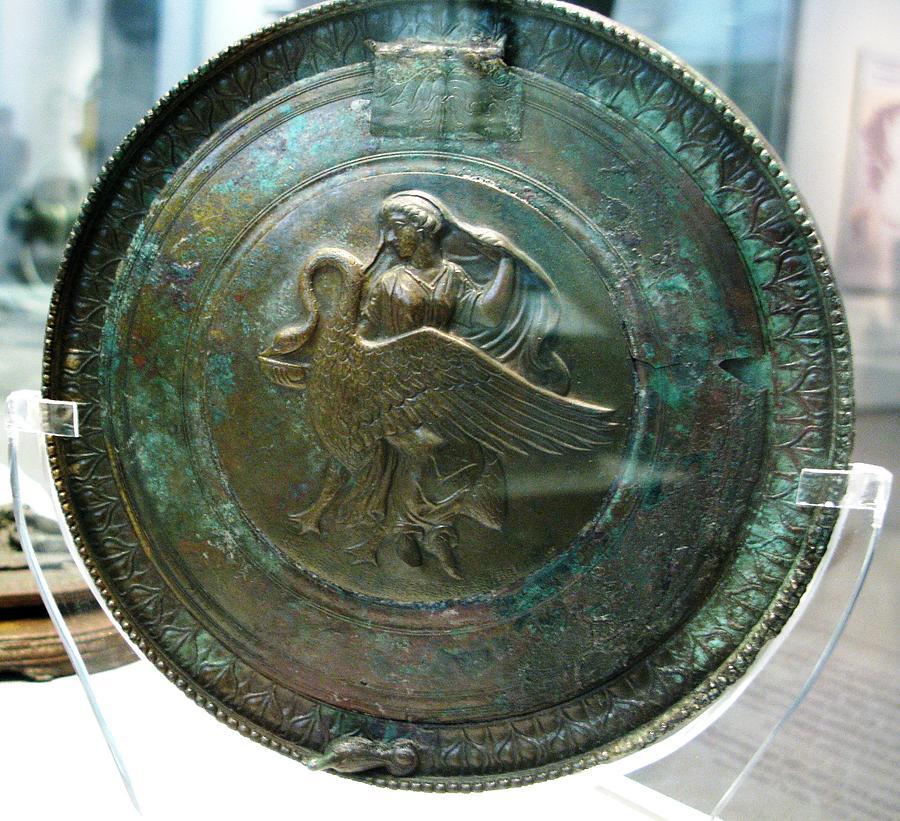
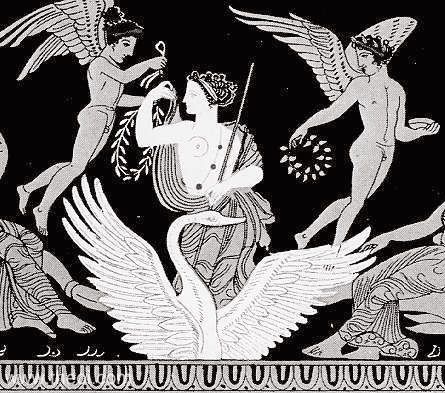
And many more. Some scholars think that these might be supposed to be geese instead of swans, in which case you could alternatively give her Animal (Goose), but we figured Swan fit with her aesthetic more. While we don't always give everyone an Animal association just because they appear with an animal in art a lot - sometimes the animal is just symbolic, or they have a myth that suggests it's not a good idea - Aphrodite is slim on associations like most Greek deities, and we figured she could use the help.
As for Fertility vs. Health, we're totally with you on the weirdness of that, but after doing as thorough a run through ancient Greek stories and descriptions of Aphrodite, that's where we ended up. Aphrodite is indeed associated with sex, but while Health does affect baby-making, it doesn't have a lot to do with the sex act itself beyond that, and so Aphrodite's strong connections to bangin' didn't really give her much of a connection there (although her Roman persona, Venus, is a little bit more linkable to Health as a concept). But the ancient Greeks connected human fertility and the fertility of the earth symbolically and even literally in many of their writings, so that Aphrodite is often praised as a bringer of earthly fertility despite not being a more classical plant-shaper. From Stasinus describing Aphrodite as eternally clothed in "crocus and hyacinth and flourishing violet and the rose's lovely bloom, so sweet and delicious, and heavenly buds, the flowers of the narcissus and lily; in such perfumed garments is Aphrodite clothed at all seasons," to the Homeric hymns stating that flowers spring up beneath her feet wherever she walks, plants turn up surprisingly frequently with Aphrodite. The reason is probably best summed up in Aeschylus' Danaides, in which Aphrodite herself describes the births of all the plants and trees and flowers of the world, and then claims, "Of all these things I am the cause," suggesting that because she is the motivator for sex which causes procreation, she is the root cause of all procreation of all life, even though she does not participate in the actual childbearing or mothering process.
Question: Shouldn't Hermes have Epic Dexterity and Illusion? Apologies if this has been answered already.
While Hermes certainly has decent amounts of both, neither was strong enough for us to want to give him the Ultimate expression of it. He does use Illusion occasionally, most notably in the tale where he makes himself a doppelgaenger of a man in order to drive him insane, but he doesn't do it all that often or all that impressively, so for the most part his trickery is probably the result of awesome Manipulation and Wits, and some low- to mid-level Illusion boons now and then. Dexterity doesn't really fit him, either; he does have the epithet "quick-footed", which helps, but for the most part the modern idea of him as super-fast comes from his role as messenger of the gods rather than any actual mythological association with speed of travel.
Question: Why does Njord have Fire associated?
Because of this passage in the Prose Edda:
The third among the Aesir is he that is called Njörd: he dwells in heaven, in the abode called Nóatún. He rules the course of the wind, and stills sea and fire; on him shall men call for voyages and for hunting.
Even more than Hel above, Njord suffers from the dearth of mythological information on the Aesir and Vanir. While his Water association as the god of the ocean is pretty solid, everything else tends to be like that - single statements that are clear, but don't have any other examples to back them up. Njord is supposed to be one of the most important and powerful of the Vanir, which is why he was traded to the Aesir in the first place, so we decided to give him Sky and Fire in spite of the lack of extra stories attached to them... but we feel like it's likely he may get demoted to a lot fewer associations in the future workup of lower-Legend gods. The Edda's very clear that he does those things, so we like them, but we also usually want more than one example, so thus is our quandary.
That's all our association questions for today - phew!
Friday, March 7, 2014
The Shadow Self
Question: This one might have been written in the comments instead, but I think it deserves an entire post (whenever it gets through The Questionado): What are nahualli?
You know, we talk about nahualli a whole bunch on this blog, because they're a concept that is very important for Aztec religion and spirituality and therefore very important to a lot of Teotl Scions and gods. But we've never outright laid out exactly what a nahualli is, which it now occurs to me has probably been confusing for folks who hadn't heard the term before. So let's fix that!
The word nahualli comes from the root nahua; it has a meaning something close to "wisdom" or "secret knowledge", with a secondary connotation of hiding or disguise, all of which concepts tie in with the idea of the nahualli. Often translated as "shadow self" or "second soul", a nahualli is a specific Aztec religious concept: basically, the idea is that all people are born with only half their soul in their human selves. The nahualli is the second half of a person's soul, which takes the form of an animal (either a real, physical animal somewhere in the world, or a spirit animal that only exists in the realms beyond normal human sight). What kind of animal depends upon the person; everyone might have a different one, often related to who they are as a person, what day of the sacred calendars they were born on, what patron god they might serve or what their name, specially given in order to attempt to describe their future life, means. For most people, that's the extent of the idea - the average person never meets or interacts with their nahualli, and lives an average life.
Those who are especially spiritually gifted, however - usually priests or magicians - might occasionally be able to find and encounter their nahualli. Usually it is assumed that they can do so because of their great magical powers; there's not a lot written about them from the time of the Aztecs' heyday, unfortunately, since European invaders were way not cool with the idea and didn't really understand it very well anyway, but some Spanish writers recorded that nahualli might reveal themselves to their other selves in dreams, and become joined to them in the course of sacred hunts where the human pursued his animal self. Others (usually casting the nahualli as a "devil") simply claimed that Aztec "sorcerers" could call them up in rituals. Naturally, having both parts of the soul together made those who could connect with their nahualli enormously powerful, magically and spiritually.
Various Aztec figures have famous nahualli, or employ nahualli in their stories. Tezcatlipoca's nahualli is the famous Tepeyollotl (meaning "heart of the mountain"), a massive jaguar that causes earthquakes and flees from the sun, and also possibly Chalchiuhtotolin ("jade turkey"), the turkey that symbolizes masculinity and diseases; both of them show different aspects of Tezcatlipoca himself, appropriate since they are, after all, him. Huitzilopochtli's nahualli are the hummingbird, symbol of virility, ferocity and resurrection, and the golden eagle, which led the Mexica people to their new home in Tenochtitlan to build their glorious empire. In fact, for most of the Aztec gods, their most closely associated totem animal - or animals, since as you can see in the previous examples gods sometimes have more than one - is likely to be their nahualli, as they are all deities and therefore by definition spiritually powerful enough to have contact with their shadow selves. Human priests and magicians also contact their nahualli in Aztec myth; in one story, a large contingent of Mexica magicians decide to undertake a journey to Aztlan to pay tribute to the earth goddess Coatlicue, and because they are passing from the world of humanity into the magical land where the goddess lives, they must transform into their nahualli in order to do so.
This idea of the nahualli is the root of the term nagual, a later version of the word now employed in modern Mexican spiritualism, witchcraft and folklore. The word nahualli is associated with not just the spirit animal but the person who was able to call it up - in modern times, that becomes its primary meaning with the animal a distant second, probably partly through a process of cultural evolution and partly because incoming Europeans were confused about the whole idea - and in the modern day, the word nagual usually refers to a sorcerer, one who is able to transform into an animal and perform spells and curses for others, both beneficial and malicious.
So, for the Teotl and their children in Scion, nahualli are obviously hella important! We represent them in games as a custom Birthright, one that Scions gain once they have become sufficiently powerful to find and harness their alternate self, and all of our Teotl Scions have gotten theirs at some point in their careers, although some sooner than others and some more successfully than others. Eztli, our Scion of Huitzilopochtli, is twin to Cuacitlali, an enormous vampire bat that mirrors her associations with blood and death, while Yoloxochitl is twin to an unnamed axolotl that mirrors her associations with immaturity, childhood and otherworldly beauty. No one has ever actually seen Maquicelotl's nahualli, but we all presume it's probably a jaguar, like his father's.
Details on exactly how we run a nahualli Birthright are in this old post here. And not only are we happy to talk about them, but I know a few Aztec enthusiasts who hang out in the comments who probably are, too! This was a pretty simplified overview of nahualli, so if you're interested in them, we encourage you to dig around for more.
You know, we talk about nahualli a whole bunch on this blog, because they're a concept that is very important for Aztec religion and spirituality and therefore very important to a lot of Teotl Scions and gods. But we've never outright laid out exactly what a nahualli is, which it now occurs to me has probably been confusing for folks who hadn't heard the term before. So let's fix that!
The word nahualli comes from the root nahua; it has a meaning something close to "wisdom" or "secret knowledge", with a secondary connotation of hiding or disguise, all of which concepts tie in with the idea of the nahualli. Often translated as "shadow self" or "second soul", a nahualli is a specific Aztec religious concept: basically, the idea is that all people are born with only half their soul in their human selves. The nahualli is the second half of a person's soul, which takes the form of an animal (either a real, physical animal somewhere in the world, or a spirit animal that only exists in the realms beyond normal human sight). What kind of animal depends upon the person; everyone might have a different one, often related to who they are as a person, what day of the sacred calendars they were born on, what patron god they might serve or what their name, specially given in order to attempt to describe their future life, means. For most people, that's the extent of the idea - the average person never meets or interacts with their nahualli, and lives an average life.
Those who are especially spiritually gifted, however - usually priests or magicians - might occasionally be able to find and encounter their nahualli. Usually it is assumed that they can do so because of their great magical powers; there's not a lot written about them from the time of the Aztecs' heyday, unfortunately, since European invaders were way not cool with the idea and didn't really understand it very well anyway, but some Spanish writers recorded that nahualli might reveal themselves to their other selves in dreams, and become joined to them in the course of sacred hunts where the human pursued his animal self. Others (usually casting the nahualli as a "devil") simply claimed that Aztec "sorcerers" could call them up in rituals. Naturally, having both parts of the soul together made those who could connect with their nahualli enormously powerful, magically and spiritually.
Various Aztec figures have famous nahualli, or employ nahualli in their stories. Tezcatlipoca's nahualli is the famous Tepeyollotl (meaning "heart of the mountain"), a massive jaguar that causes earthquakes and flees from the sun, and also possibly Chalchiuhtotolin ("jade turkey"), the turkey that symbolizes masculinity and diseases; both of them show different aspects of Tezcatlipoca himself, appropriate since they are, after all, him. Huitzilopochtli's nahualli are the hummingbird, symbol of virility, ferocity and resurrection, and the golden eagle, which led the Mexica people to their new home in Tenochtitlan to build their glorious empire. In fact, for most of the Aztec gods, their most closely associated totem animal - or animals, since as you can see in the previous examples gods sometimes have more than one - is likely to be their nahualli, as they are all deities and therefore by definition spiritually powerful enough to have contact with their shadow selves. Human priests and magicians also contact their nahualli in Aztec myth; in one story, a large contingent of Mexica magicians decide to undertake a journey to Aztlan to pay tribute to the earth goddess Coatlicue, and because they are passing from the world of humanity into the magical land where the goddess lives, they must transform into their nahualli in order to do so.
This idea of the nahualli is the root of the term nagual, a later version of the word now employed in modern Mexican spiritualism, witchcraft and folklore. The word nahualli is associated with not just the spirit animal but the person who was able to call it up - in modern times, that becomes its primary meaning with the animal a distant second, probably partly through a process of cultural evolution and partly because incoming Europeans were confused about the whole idea - and in the modern day, the word nagual usually refers to a sorcerer, one who is able to transform into an animal and perform spells and curses for others, both beneficial and malicious.
So, for the Teotl and their children in Scion, nahualli are obviously hella important! We represent them in games as a custom Birthright, one that Scions gain once they have become sufficiently powerful to find and harness their alternate self, and all of our Teotl Scions have gotten theirs at some point in their careers, although some sooner than others and some more successfully than others. Eztli, our Scion of Huitzilopochtli, is twin to Cuacitlali, an enormous vampire bat that mirrors her associations with blood and death, while Yoloxochitl is twin to an unnamed axolotl that mirrors her associations with immaturity, childhood and otherworldly beauty. No one has ever actually seen Maquicelotl's nahualli, but we all presume it's probably a jaguar, like his father's.
Details on exactly how we run a nahualli Birthright are in this old post here. And not only are we happy to talk about them, but I know a few Aztec enthusiasts who hang out in the comments who probably are, too! This was a pretty simplified overview of nahualli, so if you're interested in them, we encourage you to dig around for more.
Monday, February 24, 2014
The Blood is the Life
Question: I have a slight problem with the Aztecs. A little thing called "playing alongside a blood-crazed mass murderer". It's hard to play the goody two-shoes hero when my bandmate thrives upon the blood of virgins and the tears of children. I know that you can make an Aztec that's a pretty good guy, I just haven't seen it been proven. Aztecs are all crazy.
Hummm. Well, there's a lot going on here.
First of all, back your train up: Aztecs are not all crazy. You just got through saying you know that there can be Aztecs who are good people, so you clearly know this. Like everyone else on the planet, the Aztecs are a race of human beings, and they have all the good, bad and ugly in them that every other race has. It's no more fair to call them all crazy than to call all Chinese people crazy, or all French people, or all of any other race or nationality or ethnic group. Chill out with the name-calling of an entire civilization.
I know we've talked about the Aztec religion and the importance of blood sacrifice in it before, but our blog is a deep quagmire of many things, so we don't blame you for not digging through it all. We could write an entire book on what blood sacrifice is about and why it's centrally important to Aztec religion (in fact, other people have - if you have a chance, check out David Carrasco's City of Sacrifice for a very thorough look at the subject), and furthermore why this is not a moral question as much as a religious one, but the basics are these: the Aztecs believed, as the central conviction of their religion, that the gods lent all their power to making sure the world was maintained and supported so that it did not collapse. They believed that it had collapsed before, and would again if the gods didn't keep it running the way they were supposed to. And they believed that the power that the gods used - indeed, the most potent power in the universe - was chalchihuatl, "sacred water", which was contained only in the blood of living things. Blood was conceived of as literally being life and power, and therefore the sacrifice of blood to the gods was directly sending them the power needed to run the universe. Human sacrifice - which certainly could and did sometimes take the form of the murder of human beings, but was more often a semi-frequent ritual of letting a little of one's own blood, a practice called autosacrifice - was intended to lend the power of the blood spilled to the gods, who would then use it to keep the universe running. In effect, the religion was designed as a massive community works project, in which everyone did their part and shed their blood to ensure that the entire world continued on.
Of course, that doesn't mean people didn't abuse the system. There are sadists, opportunists and heartless bastards in every culture, and there were definitely priests who took advantage of the sacrifice system to extort goods and services from people, nobles who abused it to get rid of people they didn't like and people from every walk of life who tried to weasel out of it by getting someone else to go under the knife instead of themselves. But this isn't specific to the Aztecs; every other pantheon's religion has examples of behavior just as bad. And considering that the vast majority of them also practiced human sacrifice at some point in their history, they don't all have a lot of moral high ground to stand on for this one.
But, at any rate, the point here is that Aztec religion is not about murdering people for fun, or drinking the tears of babies, or bathing in blood just because they like blood. It is about doing what needs to be done, even when it's painful, for the good of the entire community and the entire world. The Teotl don't kill people because they're sociopaths; they kill people because they know if they don't, everyone's going to die anyway. In fact, murder for murder's sake is just plain wasteful, as far as they're concerned, and was illegal among the Aztecs.
It sounds to me like you're having a problem with a specific Aztec - your bandmate the blood-crazed mass-murderer. We don't know anything about him or her, but let's assume that they really are a crazed murderer who skins children for giggles. You know what? It is totally 100% okay for your character to hate, fear or despise them. That shit isn't okay. Your character doesn't necessarily know why they're doing those things, nor do they know if they have any reason beyond "I haven't seen blood in the last ten minutes". Your character is presumably a fairly normal person with a fairly normal moral compass (or so I assume from you saying you're playing "a pretty good guy"), so murder should bother him, and ritualized or fetishized murder probably even more so.
It is totally possible that your bandmate is a crazy person who should be put down for the good of everyone who encounters them. Like we said, we don't know who they are or what their motivations are, or even what exactly they do, so it could be anywhere along the spectrum from "I have to perform sacrifices or my parents are going to die and lose the Titan war" to "I just like torturing people with needles", or anywhere in between. It is totally possible to create and play characters who are evil serial killers - we've certainly had one or two - so that may be what you're dealing with here. If so, you're responding pretty much the way anyone could be expected to. I don't know what reasons you have for putting up with this person in character, but even if you have to be around them, nobody can make you approve of what they do or stop trying to prevent them from hurting the innocent.
However, it's also possible that you're approaching this from a position of ignorance when it comes to what Aztec sacrifice is about, and that you might want to take a closer look at this character and their behavior. Has your character ever asked them about what they do, what it means to them, or why they do it? Do you have enough Occult or Academics for your character to know what Aztec sacrifice is about and to be able to tell if that's what's going on here? Has your character ever encountered any other Aztecs, possibly NPCs, and did they seem to behave the same way? Have you spoken to your divine parent or other people in your pantheon and asked them why they would put you with this crazy-ass murderer, to see if they know something you don't? If you feel like you're stuck with this person, have you taken any steps to try to learn more about their motivations, and to see if there's any way you can try to lessen their violent tendencies or convince them to try something different?
And hey, maybe you have and it came up fruitless, and that's cool. Maybe you're just running in a band with someone who really does keep peoples' faces in a box under their bed, and there's just nothing you can do about it. But your question sounds a lot like you're blaming Aztec society and religion in general for the behavior of one individual, so it might be worth your time to investigate whether or not they're actually acting on behalf of their pantheon or just happen to be a crazy person. No society can be made up entirely of serial killers; it couldn't function. You may just be with a person who happens to be a psychopath, rather than a typical Aztec Scion.
As for our games, we have a wide variety of Aztec Scions, each with their own way of handling (and often struggling with) the problems and morality of their religion's need for human sacrifice. Sangria, the oldest of them, is in fact a psychopathic murderer who has no compassion or concern for the lives she takes whatsoever, but she's also only interested in killing people for sacrificial purposes, never for fun or because she doesn't like them; and the others run as much of a moral and emotional range as any other pantheon's Scions might, including Kettila, who kills only children because she was an abused child herself and wants to save them from anyone being able to hurt them anymore, Carlos, who kills only animals because he isn't willing to hurt other human beings, or Jay, who performs only autosacrifice and actively crusades to save people from harm and try to convince his pantheon to change their views on human sacrifice and outlaw the practice.
The bottom line is that Aztec Scions are no more automatically crazy or evil than any other pantheon's children. Their parents simply come from a different culture and religion, one that can seem very alien to European-oriented minds, and it is often difficult for Scions of other pantheons (and even the Aztec Scions themselves, who are often perfectly normal modern people) to understand and reconcile their radically different views on how the universe works and what their place in its support system needs to be.
Hummm. Well, there's a lot going on here.
First of all, back your train up: Aztecs are not all crazy. You just got through saying you know that there can be Aztecs who are good people, so you clearly know this. Like everyone else on the planet, the Aztecs are a race of human beings, and they have all the good, bad and ugly in them that every other race has. It's no more fair to call them all crazy than to call all Chinese people crazy, or all French people, or all of any other race or nationality or ethnic group. Chill out with the name-calling of an entire civilization.
I know we've talked about the Aztec religion and the importance of blood sacrifice in it before, but our blog is a deep quagmire of many things, so we don't blame you for not digging through it all. We could write an entire book on what blood sacrifice is about and why it's centrally important to Aztec religion (in fact, other people have - if you have a chance, check out David Carrasco's City of Sacrifice for a very thorough look at the subject), and furthermore why this is not a moral question as much as a religious one, but the basics are these: the Aztecs believed, as the central conviction of their religion, that the gods lent all their power to making sure the world was maintained and supported so that it did not collapse. They believed that it had collapsed before, and would again if the gods didn't keep it running the way they were supposed to. And they believed that the power that the gods used - indeed, the most potent power in the universe - was chalchihuatl, "sacred water", which was contained only in the blood of living things. Blood was conceived of as literally being life and power, and therefore the sacrifice of blood to the gods was directly sending them the power needed to run the universe. Human sacrifice - which certainly could and did sometimes take the form of the murder of human beings, but was more often a semi-frequent ritual of letting a little of one's own blood, a practice called autosacrifice - was intended to lend the power of the blood spilled to the gods, who would then use it to keep the universe running. In effect, the religion was designed as a massive community works project, in which everyone did their part and shed their blood to ensure that the entire world continued on.
Of course, that doesn't mean people didn't abuse the system. There are sadists, opportunists and heartless bastards in every culture, and there were definitely priests who took advantage of the sacrifice system to extort goods and services from people, nobles who abused it to get rid of people they didn't like and people from every walk of life who tried to weasel out of it by getting someone else to go under the knife instead of themselves. But this isn't specific to the Aztecs; every other pantheon's religion has examples of behavior just as bad. And considering that the vast majority of them also practiced human sacrifice at some point in their history, they don't all have a lot of moral high ground to stand on for this one.
But, at any rate, the point here is that Aztec religion is not about murdering people for fun, or drinking the tears of babies, or bathing in blood just because they like blood. It is about doing what needs to be done, even when it's painful, for the good of the entire community and the entire world. The Teotl don't kill people because they're sociopaths; they kill people because they know if they don't, everyone's going to die anyway. In fact, murder for murder's sake is just plain wasteful, as far as they're concerned, and was illegal among the Aztecs.
It sounds to me like you're having a problem with a specific Aztec - your bandmate the blood-crazed mass-murderer. We don't know anything about him or her, but let's assume that they really are a crazed murderer who skins children for giggles. You know what? It is totally 100% okay for your character to hate, fear or despise them. That shit isn't okay. Your character doesn't necessarily know why they're doing those things, nor do they know if they have any reason beyond "I haven't seen blood in the last ten minutes". Your character is presumably a fairly normal person with a fairly normal moral compass (or so I assume from you saying you're playing "a pretty good guy"), so murder should bother him, and ritualized or fetishized murder probably even more so.
It is totally possible that your bandmate is a crazy person who should be put down for the good of everyone who encounters them. Like we said, we don't know who they are or what their motivations are, or even what exactly they do, so it could be anywhere along the spectrum from "I have to perform sacrifices or my parents are going to die and lose the Titan war" to "I just like torturing people with needles", or anywhere in between. It is totally possible to create and play characters who are evil serial killers - we've certainly had one or two - so that may be what you're dealing with here. If so, you're responding pretty much the way anyone could be expected to. I don't know what reasons you have for putting up with this person in character, but even if you have to be around them, nobody can make you approve of what they do or stop trying to prevent them from hurting the innocent.
However, it's also possible that you're approaching this from a position of ignorance when it comes to what Aztec sacrifice is about, and that you might want to take a closer look at this character and their behavior. Has your character ever asked them about what they do, what it means to them, or why they do it? Do you have enough Occult or Academics for your character to know what Aztec sacrifice is about and to be able to tell if that's what's going on here? Has your character ever encountered any other Aztecs, possibly NPCs, and did they seem to behave the same way? Have you spoken to your divine parent or other people in your pantheon and asked them why they would put you with this crazy-ass murderer, to see if they know something you don't? If you feel like you're stuck with this person, have you taken any steps to try to learn more about their motivations, and to see if there's any way you can try to lessen their violent tendencies or convince them to try something different?
And hey, maybe you have and it came up fruitless, and that's cool. Maybe you're just running in a band with someone who really does keep peoples' faces in a box under their bed, and there's just nothing you can do about it. But your question sounds a lot like you're blaming Aztec society and religion in general for the behavior of one individual, so it might be worth your time to investigate whether or not they're actually acting on behalf of their pantheon or just happen to be a crazy person. No society can be made up entirely of serial killers; it couldn't function. You may just be with a person who happens to be a psychopath, rather than a typical Aztec Scion.
As for our games, we have a wide variety of Aztec Scions, each with their own way of handling (and often struggling with) the problems and morality of their religion's need for human sacrifice. Sangria, the oldest of them, is in fact a psychopathic murderer who has no compassion or concern for the lives she takes whatsoever, but she's also only interested in killing people for sacrificial purposes, never for fun or because she doesn't like them; and the others run as much of a moral and emotional range as any other pantheon's Scions might, including Kettila, who kills only children because she was an abused child herself and wants to save them from anyone being able to hurt them anymore, Carlos, who kills only animals because he isn't willing to hurt other human beings, or Jay, who performs only autosacrifice and actively crusades to save people from harm and try to convince his pantheon to change their views on human sacrifice and outlaw the practice.
The bottom line is that Aztec Scions are no more automatically crazy or evil than any other pantheon's children. Their parents simply come from a different culture and religion, one that can seem very alien to European-oriented minds, and it is often difficult for Scions of other pantheons (and even the Aztec Scions themselves, who are often perfectly normal modern people) to understand and reconcile their radically different views on how the universe works and what their place in its support system needs to be.
Sunday, February 9, 2014
Dereliction of Duty
Question: Is Duty really a valid Virtue for most pantheons, particularly the Aztecs? I've done a little research into them, and it seems as if worlds 1 through 4 were destroyed more from the gods being petty and spiteful and neglecting their duties than anything else.
Well, in answer to your first question, yes, Duty is hella a valid Virtue for some pantheons to have. It represents a cultural drive to put the needs of the culture itself – its people, values, customs, and your job within it – above your own selfish needs, and to support the whole because you know that your value comes from being part of it. Not every culture espouses Duty, but when they do, they do it hardcore: it’s where things like the samurai code of honor in Japan come from, or the Polynesian insistence on incredibly complex social and aristocratic roles. And the Aztecs, who embody Duty like it’s motherfucking going out of style.
You’re right; the destruction of the first four worlds represents four different failures of Duty. But that’s important and intentional. These are cases of a myth that proves the rule by showing its exceptions: when people do not do their Duty, everything is horrible and awful, forever, it’s the worst. A culture that did not give a shit about duty would not write a story about how people failing at duty equals the literal failure of the universe. That’s something you’re only going to get with people who want you to know that duty is so important that if you break it everyone might die and you’re the worst person who ever lived.
The thing about the Teotl is that they embody Duty, constantly, their entire lives, all the time. They are gods who literally have to hold up the universe all the time, or it’ll break – they have to make sure the rain falls, the sun rises, the earth stays solid, the crops grow, and the second one of them drops a ball or gets distracted or just isn’t up to it that day, there are disastrous consequences in the world. The Aztec gods were conceived of by their people as being ceaselessly dedicated to maintaining the world, very literally performing that awe-inspiring Duty every minute of every day, and if they ever stopped or thought their Duty wasn’t important, the world would collapse and everyone would die. And that leads to the Aztec culture itself, which decided that they also had a duty to support and uphold the universe for everyone’s sake, and therefore offered regular blood sacrifices to their gods. They made it their duty to empower the gods to keep doing their duty – in essence, a massive chain of Duty all the way from mortal to god, with anyone who proved to be a weak link severely looked down upon or even punished.
The myth of the four suns illustrates this in a big way. Just like the World now, those Worlds were doing fine – until one god failed in his Duty. In the first and second, it was because someone attacked him; in the third, because he went into a jealous rage; and in the fourth, because she became hysterical and couldn’t keep it together. And each time that Duty was failed, the world literally ended. That’s how important duty is to these guys; if you don’t do it, you failed the entire universe.
Of course, that doesn’t mean that they don’t fail at their Duty once in a while – every god and Scion does, at some point. And they also have other Virtues that may sometimes conflict with Duty, and if Duty loses out, that’s a problem for everyone. But on the whole, their entire religion is built around the idea of the gods dutifully supporting and protecting the universe, humanity dutifully supporting and appreciating them, and everything continuing to exist only because they do that. They are massively Dutiful. Duty is everybody’s cosmic job.
We are fans of you asking questions about Virtue appropriateness, by the way, because there are definitely some in the game right now that we think bear consideration, or maybe don’t fit as well as another one would. But this is definitely not one of them.
Well, in answer to your first question, yes, Duty is hella a valid Virtue for some pantheons to have. It represents a cultural drive to put the needs of the culture itself – its people, values, customs, and your job within it – above your own selfish needs, and to support the whole because you know that your value comes from being part of it. Not every culture espouses Duty, but when they do, they do it hardcore: it’s where things like the samurai code of honor in Japan come from, or the Polynesian insistence on incredibly complex social and aristocratic roles. And the Aztecs, who embody Duty like it’s motherfucking going out of style.
You’re right; the destruction of the first four worlds represents four different failures of Duty. But that’s important and intentional. These are cases of a myth that proves the rule by showing its exceptions: when people do not do their Duty, everything is horrible and awful, forever, it’s the worst. A culture that did not give a shit about duty would not write a story about how people failing at duty equals the literal failure of the universe. That’s something you’re only going to get with people who want you to know that duty is so important that if you break it everyone might die and you’re the worst person who ever lived.
The thing about the Teotl is that they embody Duty, constantly, their entire lives, all the time. They are gods who literally have to hold up the universe all the time, or it’ll break – they have to make sure the rain falls, the sun rises, the earth stays solid, the crops grow, and the second one of them drops a ball or gets distracted or just isn’t up to it that day, there are disastrous consequences in the world. The Aztec gods were conceived of by their people as being ceaselessly dedicated to maintaining the world, very literally performing that awe-inspiring Duty every minute of every day, and if they ever stopped or thought their Duty wasn’t important, the world would collapse and everyone would die. And that leads to the Aztec culture itself, which decided that they also had a duty to support and uphold the universe for everyone’s sake, and therefore offered regular blood sacrifices to their gods. They made it their duty to empower the gods to keep doing their duty – in essence, a massive chain of Duty all the way from mortal to god, with anyone who proved to be a weak link severely looked down upon or even punished.
The myth of the four suns illustrates this in a big way. Just like the World now, those Worlds were doing fine – until one god failed in his Duty. In the first and second, it was because someone attacked him; in the third, because he went into a jealous rage; and in the fourth, because she became hysterical and couldn’t keep it together. And each time that Duty was failed, the world literally ended. That’s how important duty is to these guys; if you don’t do it, you failed the entire universe.
Of course, that doesn’t mean that they don’t fail at their Duty once in a while – every god and Scion does, at some point. And they also have other Virtues that may sometimes conflict with Duty, and if Duty loses out, that’s a problem for everyone. But on the whole, their entire religion is built around the idea of the gods dutifully supporting and protecting the universe, humanity dutifully supporting and appreciating them, and everything continuing to exist only because they do that. They are massively Dutiful. Duty is everybody’s cosmic job.
We are fans of you asking questions about Virtue appropriateness, by the way, because there are definitely some in the game right now that we think bear consideration, or maybe don’t fit as well as another one would. But this is definitely not one of them.
Thursday, January 9, 2014
Brothers in Battle
Question: You've discussed before that, in general, having disparate pantheons together in a campaign can be problematic. What generally are the guidelines you use for determining if pantheons play nice with each other, if only in terms of their Scions fitting well? If you could give specific examples (say, with the Teotl, not that I plan on running a game where they're prevalent wink wink) of what pantheons work with another one and why, that would also be awesome. Thanks!
There are two important guidelines that can help you plan for future band harmoniousness, and those are the Virtues of the Scions in question and the historical interaction between their pantheons/cultures.
Virtues are the easiest go-to place to compare; as a general rule, the more Virtues a pantheon has in common with another, the less likely their Scions (and gods) are to get upset with one another. Virtues in alignment means that those Scions will agree with one another a lot more about what needs to be done, understand where their bandmates are coming from a lot more of the time, and spend much less time and effort grappling with intra-band conflicts of morality and theology. For example, the Teotl and K'uh are likely to get along very well, since they have the shared morals of Conviction, Courage and Loyalty in common; they'll respect one anothers' bravery, be able to count on one anothers' loyalty, and even when they disagree they'll at least respect the integrity of the other person's refusal to compromise. Another good example would be the Bogovi and Netjer, who despite not having much in common in terms of culture or history can still be down with each others' religious dedication, determination to preserve the World's balance and adherence to the rule of law.
That doesn't mean that bands with different Virtues can't get along, but it does mean that it's much more difficult and will require a lot more compromise, conflict and personal growth on the parts of the characters, something that not every player wants, needs or enjoys doing in their games. We love our god-level PCs, but when their group started and it included one Scion (Sangria) with Conviction, Courage, Duty and Loyalty and two others (Goze and Sophia) with Expression, Intellect, Valor and Vengeance, can you guess how well they got along? The answer was not at all. They hated each other. Sangria didn't understand (or care about trying to understand) the Greeks' abstract ideas about the importance of art and culture, and they went stark bananas from not being able to handle her murdering innocent people for power and doing what she thought was her job no matter how evil or destructive they perceived it to be. Their Virtues were opposed about 75% of the time, with the result being that they had to learn to adapt or die (luckily, the former). They survived it and it added a lot to their characters and development arcs, but it also generated a lot of conflict and heartbreak along the way, probably more than the game strictly needed.
Opposed Virtues don't just not get each other - in many cases, they actively hate each other. If one Scion has Expression and a mighty need to create magical artwork all over the world and the other has Harmony and a stringent code that prohibits putting magical shit anywhere in human territory, those two Scions are going to end up throwing down (or worse, trying not to and then going into Virtue Extremity). If one Scion has Courage and leaps into action to destroy every enemy in his path no matter whether they're already injured and the other has Valor and can't stand to see the helpless be harmed, those two Scions are going to end up punching each other in the face on the battlefield instead of their enemies. The Scion with Vengeance fucking hates the Scion with Order, who refuses to let her visit sweet revenge on those who have wronged her, and the Scion with Order is just as upset in return with his bandmate who sees nothing wrong with committing every felony on the books as long as she gets to destroy someone she hates.
Now, there will always be opposed Virtues in your Scion band - always, always, always. You can't avoid them. Scions' own Virtues sometimes oppose one another (I hate this guy with a Vengeance, but he's a wuss and my Valor says I can't hit him! Argh!), and even if you get Scions of the closest possible Virtue sets together, they'll always have one or two Virtues that don't match and that get in the way once in a while (I'm a Netjer Scion and my Conviction makes me accept that sometimes you just gotta do what you gotta do, but my Bogovi buddy I normally agree with keeps saying he can't shirk his Duty even if it's clearly the best course of action! Argh!). And some Scions will come in as a normally closely-aligned pantheon but take a different Virtue at character creation, which you may not know ahead of time as the Storyteller (unless you ban them from doing that, I guess). This is normal and will make for good play; if nobody's Virtues ever clashed, they wouldn't be able to develop as characters nearly as much, so don't panic or give up if your carefully-crafted group of all normally-compatible Anunna and Elohim suddenly explodes into a screaming match of Conviction vs. Vengeance. Characters will disagree, sometimes heatedly and with gusto, from time to time over the course of the game. As long as it's not so much that the group can't function (which is what this question is trying to help you set up to avoid from the get-go!), that's perfectly all right.
Virtues are only half the equation, however. They're great measures of how much ideological common ground a pantheon might have with another, but they don't necessarily have a strong bearing on how those ideas are interpreted in the real world or what might have happened between them in the past. That's where historical interaction between the pantheons comes into play.
The Kami and the Shen have very similar Virtues - with Duty, Harmony and Valor in common, the only place they differ is that the Kami prefer Endurance and the Shen prefer Intellect. (Yes, I know we talk about changing these a lot, just follow me for the explanation for now.) Does that make them automatically prone to being best friends? Not necessarily, because the history of interaction between Japan and China, both mythologically and in the World, has not always been a very cordial one. The Kami, as the deities of Shinto, might be nursing a grudge thanks to the invasion of the foreign gods of Chinese Buddhism onto their turf centuries ago, leading the fall of Shinto as the only state-approved religion and the introduction of all kinds of new practices and deities that didn't follow the old ways. The Shen may not have forgiven the Kami for their continual wars on the mainland over the past few centuries, both in mythology and among mortals, especially the very fresh tragedy of the massacres committed by Japanese attackers during the Sino-Japanese wars of the last two hundred years, which might or might not have involved divine interference. Scions, as modern people from either of those cultures, may bring their own baggage along with their parents' - a Scion of the Shen whose grandparents died during the Japanese war crimes of the 1930s might have no tolerance whatsoever for agents of the Japanese gods, regardless of how much they have in common philosophically, and a Scion of the Kami who sees herself as the representative of a religion dying out because of Chinese influence might hate her opposite number on principle thanks to his pantheon's campaign against hers. Gods on either side can also easily influence their childrens' perceptions; even if the Kami weren't necessarily involved in the Sino-Japanese wars, for example, it really only takes a single comment from one of the Shen that they were behind it/didn't bother to stop it/benefited from it, and their children will act accordingly.
This works in reverse as well. You might think that the Theoi and Netjer would absolutely hate one another, since they don't have even one measly Virtue in common between them, but while there have definitely been vicious conflicts between them in the past, there have also been long periods of historical cooperation and cultural trade. They're not in love or anything, but they often can and do get along much better than their Virtues would suggest, especially when they have a common goal. The Yazata and Bogovi only share Order and are otherwise wildly different in Virtue setup, which might suggest that they would have nowhere to begin getting along with one another, but their history suggests otherwise, with the two religions often influencing and borrowing from one another, to such an extent that there are even a few crossover deities between them.
It looks kind of like we're saying, "Who knows, apparently Virtues don't mean anything," but that's not what we're trying to do. Rather, we're saying that Virtues are almost always a great starting yardstick for whether or not Scions will get along within a band; but, other factors, such as history, religious affiliation and previous experience may affect that, so make sure you know the interactions of the pantheons you're thinking of combining instead of just their four Virtues and how those stack up to everyone else's. And - and this is probably the most important thing you can do as a Storyteller to make people suck it up and get along in a band even when they don't want to - make sure you always give the Scions who work together some common goals. Even if they're not getting along right now, even if they really think things the other people do are fundamentally wrong, even if they despise one anothers' guts, they'll still usually pull it together when they know they have to all work together to achieve something that's important to each of them. It might be because their parents told them to, it might be because the specific situation requires other people with skills they just don't have, or anything else, but common goals will always go a long way toward making sure people put in the effort to deal with one another instead of just stomping off home or taking a pike to their bandmates' faces.
Oh, by the way: Teotl Scions will probably get along best with Scions of the K'uh, with whom they share most of their Virtues and with whom they have a history of cultural interaction and exchange, several crossover deities, and an understanding of some religious concepts that other pantheons don't always get (blood sacrifice being the main one). There may be some bad blood between them from the K'uh side thanks to later Maya communities being conquered by the suddenly expansionist Aztecs near the end of Mesoamerican civilization and the general Aztec attitude that they are the best and everyone else in Mesoamerica had better recognize it, but nothing that would cause too much of a conflict between them. Runners-up (each with two Virtues in common) would be the Aesir (probably respectable as fellow warriors but also deeply irresponsible by Aztec standards), the Apu (with no cultural context but similar ideals of courageous battle and duty to the community giving them some common ground) or the Orisha (equally badass and passionate and with a close connection to their people, but maybe a little too hung up on things like their personal problems to be as effective as deities as they should be).
In closing, we'd just like to point out that while these things all help intra-band harmony, they don't guarantee it; and further that we don't know if you need to try that hard to make sure everything is as close to the same for everyone as possible. Often, we set up possible pantheons for a new game based on them all having only a single Virtue in common, or being in a particular cultural group in spite of their Virtue spreads, and those approaches can and have worked, too.
Edit: In case it might be helpful for some, here's a quick chart of who's got Virtues in common.
There are two important guidelines that can help you plan for future band harmoniousness, and those are the Virtues of the Scions in question and the historical interaction between their pantheons/cultures.
Virtues are the easiest go-to place to compare; as a general rule, the more Virtues a pantheon has in common with another, the less likely their Scions (and gods) are to get upset with one another. Virtues in alignment means that those Scions will agree with one another a lot more about what needs to be done, understand where their bandmates are coming from a lot more of the time, and spend much less time and effort grappling with intra-band conflicts of morality and theology. For example, the Teotl and K'uh are likely to get along very well, since they have the shared morals of Conviction, Courage and Loyalty in common; they'll respect one anothers' bravery, be able to count on one anothers' loyalty, and even when they disagree they'll at least respect the integrity of the other person's refusal to compromise. Another good example would be the Bogovi and Netjer, who despite not having much in common in terms of culture or history can still be down with each others' religious dedication, determination to preserve the World's balance and adherence to the rule of law.
That doesn't mean that bands with different Virtues can't get along, but it does mean that it's much more difficult and will require a lot more compromise, conflict and personal growth on the parts of the characters, something that not every player wants, needs or enjoys doing in their games. We love our god-level PCs, but when their group started and it included one Scion (Sangria) with Conviction, Courage, Duty and Loyalty and two others (Goze and Sophia) with Expression, Intellect, Valor and Vengeance, can you guess how well they got along? The answer was not at all. They hated each other. Sangria didn't understand (or care about trying to understand) the Greeks' abstract ideas about the importance of art and culture, and they went stark bananas from not being able to handle her murdering innocent people for power and doing what she thought was her job no matter how evil or destructive they perceived it to be. Their Virtues were opposed about 75% of the time, with the result being that they had to learn to adapt or die (luckily, the former). They survived it and it added a lot to their characters and development arcs, but it also generated a lot of conflict and heartbreak along the way, probably more than the game strictly needed.
Opposed Virtues don't just not get each other - in many cases, they actively hate each other. If one Scion has Expression and a mighty need to create magical artwork all over the world and the other has Harmony and a stringent code that prohibits putting magical shit anywhere in human territory, those two Scions are going to end up throwing down (or worse, trying not to and then going into Virtue Extremity). If one Scion has Courage and leaps into action to destroy every enemy in his path no matter whether they're already injured and the other has Valor and can't stand to see the helpless be harmed, those two Scions are going to end up punching each other in the face on the battlefield instead of their enemies. The Scion with Vengeance fucking hates the Scion with Order, who refuses to let her visit sweet revenge on those who have wronged her, and the Scion with Order is just as upset in return with his bandmate who sees nothing wrong with committing every felony on the books as long as she gets to destroy someone she hates.
Now, there will always be opposed Virtues in your Scion band - always, always, always. You can't avoid them. Scions' own Virtues sometimes oppose one another (I hate this guy with a Vengeance, but he's a wuss and my Valor says I can't hit him! Argh!), and even if you get Scions of the closest possible Virtue sets together, they'll always have one or two Virtues that don't match and that get in the way once in a while (I'm a Netjer Scion and my Conviction makes me accept that sometimes you just gotta do what you gotta do, but my Bogovi buddy I normally agree with keeps saying he can't shirk his Duty even if it's clearly the best course of action! Argh!). And some Scions will come in as a normally closely-aligned pantheon but take a different Virtue at character creation, which you may not know ahead of time as the Storyteller (unless you ban them from doing that, I guess). This is normal and will make for good play; if nobody's Virtues ever clashed, they wouldn't be able to develop as characters nearly as much, so don't panic or give up if your carefully-crafted group of all normally-compatible Anunna and Elohim suddenly explodes into a screaming match of Conviction vs. Vengeance. Characters will disagree, sometimes heatedly and with gusto, from time to time over the course of the game. As long as it's not so much that the group can't function (which is what this question is trying to help you set up to avoid from the get-go!), that's perfectly all right.
Virtues are only half the equation, however. They're great measures of how much ideological common ground a pantheon might have with another, but they don't necessarily have a strong bearing on how those ideas are interpreted in the real world or what might have happened between them in the past. That's where historical interaction between the pantheons comes into play.
The Kami and the Shen have very similar Virtues - with Duty, Harmony and Valor in common, the only place they differ is that the Kami prefer Endurance and the Shen prefer Intellect. (Yes, I know we talk about changing these a lot, just follow me for the explanation for now.) Does that make them automatically prone to being best friends? Not necessarily, because the history of interaction between Japan and China, both mythologically and in the World, has not always been a very cordial one. The Kami, as the deities of Shinto, might be nursing a grudge thanks to the invasion of the foreign gods of Chinese Buddhism onto their turf centuries ago, leading the fall of Shinto as the only state-approved religion and the introduction of all kinds of new practices and deities that didn't follow the old ways. The Shen may not have forgiven the Kami for their continual wars on the mainland over the past few centuries, both in mythology and among mortals, especially the very fresh tragedy of the massacres committed by Japanese attackers during the Sino-Japanese wars of the last two hundred years, which might or might not have involved divine interference. Scions, as modern people from either of those cultures, may bring their own baggage along with their parents' - a Scion of the Shen whose grandparents died during the Japanese war crimes of the 1930s might have no tolerance whatsoever for agents of the Japanese gods, regardless of how much they have in common philosophically, and a Scion of the Kami who sees herself as the representative of a religion dying out because of Chinese influence might hate her opposite number on principle thanks to his pantheon's campaign against hers. Gods on either side can also easily influence their childrens' perceptions; even if the Kami weren't necessarily involved in the Sino-Japanese wars, for example, it really only takes a single comment from one of the Shen that they were behind it/didn't bother to stop it/benefited from it, and their children will act accordingly.
This works in reverse as well. You might think that the Theoi and Netjer would absolutely hate one another, since they don't have even one measly Virtue in common between them, but while there have definitely been vicious conflicts between them in the past, there have also been long periods of historical cooperation and cultural trade. They're not in love or anything, but they often can and do get along much better than their Virtues would suggest, especially when they have a common goal. The Yazata and Bogovi only share Order and are otherwise wildly different in Virtue setup, which might suggest that they would have nowhere to begin getting along with one another, but their history suggests otherwise, with the two religions often influencing and borrowing from one another, to such an extent that there are even a few crossover deities between them.
It looks kind of like we're saying, "Who knows, apparently Virtues don't mean anything," but that's not what we're trying to do. Rather, we're saying that Virtues are almost always a great starting yardstick for whether or not Scions will get along within a band; but, other factors, such as history, religious affiliation and previous experience may affect that, so make sure you know the interactions of the pantheons you're thinking of combining instead of just their four Virtues and how those stack up to everyone else's. And - and this is probably the most important thing you can do as a Storyteller to make people suck it up and get along in a band even when they don't want to - make sure you always give the Scions who work together some common goals. Even if they're not getting along right now, even if they really think things the other people do are fundamentally wrong, even if they despise one anothers' guts, they'll still usually pull it together when they know they have to all work together to achieve something that's important to each of them. It might be because their parents told them to, it might be because the specific situation requires other people with skills they just don't have, or anything else, but common goals will always go a long way toward making sure people put in the effort to deal with one another instead of just stomping off home or taking a pike to their bandmates' faces.
Oh, by the way: Teotl Scions will probably get along best with Scions of the K'uh, with whom they share most of their Virtues and with whom they have a history of cultural interaction and exchange, several crossover deities, and an understanding of some religious concepts that other pantheons don't always get (blood sacrifice being the main one). There may be some bad blood between them from the K'uh side thanks to later Maya communities being conquered by the suddenly expansionist Aztecs near the end of Mesoamerican civilization and the general Aztec attitude that they are the best and everyone else in Mesoamerica had better recognize it, but nothing that would cause too much of a conflict between them. Runners-up (each with two Virtues in common) would be the Aesir (probably respectable as fellow warriors but also deeply irresponsible by Aztec standards), the Apu (with no cultural context but similar ideals of courageous battle and duty to the community giving them some common ground) or the Orisha (equally badass and passionate and with a close connection to their people, but maybe a little too hung up on things like their personal problems to be as effective as deities as they should be).
In closing, we'd just like to point out that while these things all help intra-band harmony, they don't guarantee it; and further that we don't know if you need to try that hard to make sure everything is as close to the same for everyone as possible. Often, we set up possible pantheons for a new game based on them all having only a single Virtue in common, or being in a particular cultural group in spite of their Virtue spreads, and those approaches can and have worked, too.
Edit: In case it might be helpful for some, here's a quick chart of who's got Virtues in common.
| Pantheon | Three Virtues in Common | Two Virtues in Common | One Virtue in Common | No Virtues in Common |
| Aesir | Nemetondevos | Alihah, K'uh, Orisha, Teotl, Tuatha | Anunna, Apu, Atua, Deva, Elohim, Kami, Theoi, Yazata | Bogovi, Netjer, Shen |
| Alihah | None | Aesir, Atua, Elohim, Orisha, Theoi, Tuatha | Anunna, Apu, Bogovi, Deva, Kami, Nemetondevos, Netjer, Yazata | K'uh, Shen, Teotl |
| Anunna | Elohim, Netjer | Apu, Bogovi, K'uh, Orisha, Teotl, Tuatha, Yazata | Aesir, Alihah, Apu, Nemetondevos | Deva, Kami, Shen, Theoi |
| Apu | None | Bogovi, Deva, Kami, K'uh, Netjer, Shen, Teotl | Aesir, Alihah, Anunna, Atua, Nemetondevos, Orisha, Yazata | Elohim, Theoi, Tuatha |
| Atua | Elohim | Anunna, Bogovi, Orisha, Teotl, Tuatha | Aesir, Alihah, Apu, Kami, K'uh, Nemetondevos, Shen, Theoi | Deva, Yazata |
| Bogovi | Netjer | Apu, Atua, Deva, Elohim | Alihah, Anunna, Kami, K'uh, Shen, Teotl, Tuatha, Yazata | Aesir, Nemetondevos, Orisha, Theoi |
| Deva | None | Bogovi, Kami, Netjer, Shen | Aesir, Alihah, Anunna, Apu, Elohim, K'uh, Theoi, Tuatha, Yazata | Atua, Nemetondevos, Orisha, Teotl |
| Elohim | Anunna, Atua | Alihah, Netjer, Orisha, Tuatha | Aesir, Bogovi, Deva, K'uh, Nemetondevos, Teotl, Theoi | Apu, Kami, Shen, Yazata |
| Kami | Shen | Apu, Deva, Nemetondevos, Theoi | Aesir, Alihah, Atua, Bogovi, Teotl, Tuatha, Yazata | Anunna, Elohim, K'uh, Netjer, Orisha |
| K'uh | Teotl | Aesir, Anunna, Apu, Bogovi, Nemetondevos, Netjer, Orisha | Atua, Deva, Elohim, Shen, Tuatha, Yazata | Alihah, Kami, Theoi |
| Nemetondevos | Aesir | Kami, K'uh, Teotl | Alihah, Anunna, Apu, Atua, Orisha, Shen, Theoi, Tuatha, Yazata | Bogovi, Deva, Netjer |
| Netjer | Anunna, Bogovi | Apu, Deva, Elohim, Yazata | Alihah, Atua, Kami, K'uh, Orisha, Shen, Teotl, Tuatha | Aesir, Nemetondevos, Theoi |
| Orisha | None | Aesir, Alihah, Anunna, Atua, Elohim, K'uh, Teotl, Theoi, Tuatha, Yazata | Apu, Nemetondevos, Netjer | Bogovi, Deva, Kami, Shen |
| Shen | Kami | Apu, Bogovi, Deva, Theoi | Atua, K'uh, Nemetondevos, Netjer, Teotl, Tuatha, Yazata | Aesir, Alihah, Anunna, Orisha |
| Teotl | K'uh | Aesir, Anunna, Apu, Atua, Nemetondevos, Orisha | Bogovi, Elohim, Kami, Netjer, Shen, Tuatha, Yazata | Alihah, Deva, Theoi |
| Theoi | None | Alihah, Kami, Orisha, Shen, Tuatha, Yazata | Aesir, Atua, Deva, Elohim, Nemetondevos | Anunna, Apu, Bogovi, K'uh, Netjer, Teotl |
| Tuatha | None | Aesir, Alihah, Anunna, Atua, Orisha, Theoi | Bogovi, Deva, Elohim, Kami, K'uh, Nemetondevos, Netjer, Shen, Teotl, Yazata | Apu |
| Yazata | None | Anunna, Netjer, Orisha, Theoi | Aesir, Alihah, Apu, Bogovi, Deva, Elohim, Kami, K'uh, Nemetondevos, Shen, Teotl, Tuatha | Atua |
Monday, January 6, 2014
I Sacrifice, Therefore I Am (Was)
Question: From what I understand, sacrifice to the Aztecs is an important part of maintaining and powering the universe. How do they react to pantheons like the Celtic ones, for whom sacrifice is a matter of simple veneration? Do they see it as needless luxury, or out-and-out blasphemy (since the other pantheons aren't actually being powered up by sacrifice)? A betrayal of their people? Or would they be fine with it?
A lot of this will probably depend on the specific Aztec god in question, so we're going to give you a few different approaches and let individual Storytellers figure out which one would make the most sense to any given god of the Teotl.
If you're talking about a Teotl god who isn't particularly bright, who hasn't had much interaction with other pantheons before, or who just has a poor grasp of the occult or a healthy opinion of how important and universal his own pantheon's practices are, there may be no conflict at all. Gods are, at their hearts, pretty much all egomaniacs, and those who are community-focused like the Teotl tend to extend that to their entire culture - i.e., Mexicans are best, everyone else probably does exactly what we do, because why would they ever do anything else? Under such an interpretatio mexicana, some Teotl may simply assume that other pantheons are getting power from their peoples' sacrifices. That would look normal to them, and if they're not particularly good at understanding how magic works, it may not occur to them that those other pantheons have different powers instead or that the entire universe doesn't run the same way that it does for them at home. Those gods probably totally approve of bog-body sacrifices or mummified mountain sacrifices; to them, those are the only other pantheons who are being even vaguely responsible. In fact, they probably severely dislike, or at least look down upon, pantheons who don't practice human sacrifice, because to them it looks like those jokers are just a bunch of gods being assholes and refusing to help prevent the entire universe from falling apart. What dicks.
On the other hand, those who have interacted with other pantheons a decent amount and understand that they don't get any power from their worshipers' sacrifices may have mixed feelings. Mortals giving up their very lives in sacrifice to their gods seems like it's right and familiar - after all, to the Aztecs, that's what they're supposed to be doing and it's hard to not automatically accept that. But at the same time, the Teotl are deeply invested in and loyal to their people, divine and mortal alike, and wouldn't dream of hurting them if they could help it (certain shining malcontents like Tezcatlipoca aside). It's the fact that the community of the Aztec world is so loyal to one another and the greater good of all that makes the deaths of its members a sacrifice at all. So from that perspective, some gods might see it as a rather unforgivable abuse of worshipers. Killing off some of one's worshipers to make sure everyone in the universe doesn't die is a noble sacrifice, putting the needs of the many before the needs of the few, but killing them off for no reason at all is being straight-up disloyal to the very people you're supposed to be taking care of. Gods coming from this point of view might be shocked, appalled or even furious with deities of other sacrificing pantheons, who they might see as being massively irresponsible or oppressive to their own people.
Of course, it's also a pretty entrenched idea among the Teotl (or at least the mortals that worshiped them) that the Aztecs are in fact the best humans in existence and every other people is lesser and therefore existing only to be conquered and/or sacrificed for the good of the world, so they may not be that upset about it. I mean, it's unfortunate that those other pantheons are jerks to their constituents, but their constituents are clearly not as important as the Teotl's constituents, so it can only be so much of a tragedy.
And finally, there may be some Aztec gods who simply don't care at all what other pantheons are doing. Especially if they realize that other pantheons can't get power out of sacrifices, they may just shrug and go on their way, probably with a side order of shaking their heads and talking among themselves about how only they are really doing anything to help the world not slide into destruction and it would be nice if those other, obviously lesser gods someday learned to do the same. They might see mortals practicing sacrifice anyway as being well-meaning but ultimately pointless and not really care about it much; it might also be a popular opinion that those other pantheons are obviously crippled or sub-powerful in some way, because their worshipers are doing it right but for some reason their gods just can't seem to benefit from it the way they're supposed to, which probably means something is wrong with them. Or, perhaps some might hold the theory that other races of mortals lack sufficient amounts of chalchiuatl, the precious water and source of energy carried in blood, and so killing them just isn't as helpful as killing an obviously much more important Aztec person would be (although this theory is probably held more by homebody gods, as any Teotl who go jaunting abroad will find it just as easy to murder and Australian or Tibetan person for Legend as they would performing a sacrifice at home; and ancient Aztecs definitely did sacrifice members of other ethnic groups they encountered, so maybe this is more of a people-who-aren't-Mesoamerican-are-inferior kind of thing instead of specifically Mexica-only). I mean, if you kill someone who isn't Aztec and therefore doesn't matter to your Loyalty- and Duty-bound view of the world at all, was it really a sacrifice?
The one thing in your question I would say probably nobody thinks is that those other pantheons are indulging in a "luxury". If the sacrifice literally doesn't do anything, it's not really a luxury at all - that would be like buying a box of literally nothing, and then claiming that this was a "luxury" that you kept in your house. One possible approach might be that other pantheons are just so powerful that they don't need sacrifice to keep the universe going and therefore sacrifice could be considered an unnecessary luxury... but I doubt very much you're going to find many Teotl who are all about deciding that everyone in the world is more powerful than they are. No pantheon is in ever in favor of that kind of interpretation.
So really, it depends on a particular god, how much your story has them gallivanting around the world and what sort of personality and idea of the powers of various pantheons they already have. Someone like Quetzalcoatl, who probably understands other pantheons' practices pretty well and doesn't like killing people to begin with, might be horrified by such blatant destruction of people for no reason at all; someone like Tezcatlipoca, who is completely happy with murdering people if he thinks it's funny, probably has no problem with it at all or is amused by how stupid those other pantheons and their inability to get power out of such actions are; and someone like Huitzilopochtli, who is likely none too bright and fully invested in how important and powerful he and his people are, probably assumes that everyone else also does it his way and would have no concept of gods who were receiving sacrifice without also receiving power. Mix and match as necessary.
A lot of this will probably depend on the specific Aztec god in question, so we're going to give you a few different approaches and let individual Storytellers figure out which one would make the most sense to any given god of the Teotl.
If you're talking about a Teotl god who isn't particularly bright, who hasn't had much interaction with other pantheons before, or who just has a poor grasp of the occult or a healthy opinion of how important and universal his own pantheon's practices are, there may be no conflict at all. Gods are, at their hearts, pretty much all egomaniacs, and those who are community-focused like the Teotl tend to extend that to their entire culture - i.e., Mexicans are best, everyone else probably does exactly what we do, because why would they ever do anything else? Under such an interpretatio mexicana, some Teotl may simply assume that other pantheons are getting power from their peoples' sacrifices. That would look normal to them, and if they're not particularly good at understanding how magic works, it may not occur to them that those other pantheons have different powers instead or that the entire universe doesn't run the same way that it does for them at home. Those gods probably totally approve of bog-body sacrifices or mummified mountain sacrifices; to them, those are the only other pantheons who are being even vaguely responsible. In fact, they probably severely dislike, or at least look down upon, pantheons who don't practice human sacrifice, because to them it looks like those jokers are just a bunch of gods being assholes and refusing to help prevent the entire universe from falling apart. What dicks.
On the other hand, those who have interacted with other pantheons a decent amount and understand that they don't get any power from their worshipers' sacrifices may have mixed feelings. Mortals giving up their very lives in sacrifice to their gods seems like it's right and familiar - after all, to the Aztecs, that's what they're supposed to be doing and it's hard to not automatically accept that. But at the same time, the Teotl are deeply invested in and loyal to their people, divine and mortal alike, and wouldn't dream of hurting them if they could help it (certain shining malcontents like Tezcatlipoca aside). It's the fact that the community of the Aztec world is so loyal to one another and the greater good of all that makes the deaths of its members a sacrifice at all. So from that perspective, some gods might see it as a rather unforgivable abuse of worshipers. Killing off some of one's worshipers to make sure everyone in the universe doesn't die is a noble sacrifice, putting the needs of the many before the needs of the few, but killing them off for no reason at all is being straight-up disloyal to the very people you're supposed to be taking care of. Gods coming from this point of view might be shocked, appalled or even furious with deities of other sacrificing pantheons, who they might see as being massively irresponsible or oppressive to their own people.
Of course, it's also a pretty entrenched idea among the Teotl (or at least the mortals that worshiped them) that the Aztecs are in fact the best humans in existence and every other people is lesser and therefore existing only to be conquered and/or sacrificed for the good of the world, so they may not be that upset about it. I mean, it's unfortunate that those other pantheons are jerks to their constituents, but their constituents are clearly not as important as the Teotl's constituents, so it can only be so much of a tragedy.
And finally, there may be some Aztec gods who simply don't care at all what other pantheons are doing. Especially if they realize that other pantheons can't get power out of sacrifices, they may just shrug and go on their way, probably with a side order of shaking their heads and talking among themselves about how only they are really doing anything to help the world not slide into destruction and it would be nice if those other, obviously lesser gods someday learned to do the same. They might see mortals practicing sacrifice anyway as being well-meaning but ultimately pointless and not really care about it much; it might also be a popular opinion that those other pantheons are obviously crippled or sub-powerful in some way, because their worshipers are doing it right but for some reason their gods just can't seem to benefit from it the way they're supposed to, which probably means something is wrong with them. Or, perhaps some might hold the theory that other races of mortals lack sufficient amounts of chalchiuatl, the precious water and source of energy carried in blood, and so killing them just isn't as helpful as killing an obviously much more important Aztec person would be (although this theory is probably held more by homebody gods, as any Teotl who go jaunting abroad will find it just as easy to murder and Australian or Tibetan person for Legend as they would performing a sacrifice at home; and ancient Aztecs definitely did sacrifice members of other ethnic groups they encountered, so maybe this is more of a people-who-aren't-Mesoamerican-are-inferior kind of thing instead of specifically Mexica-only). I mean, if you kill someone who isn't Aztec and therefore doesn't matter to your Loyalty- and Duty-bound view of the world at all, was it really a sacrifice?
The one thing in your question I would say probably nobody thinks is that those other pantheons are indulging in a "luxury". If the sacrifice literally doesn't do anything, it's not really a luxury at all - that would be like buying a box of literally nothing, and then claiming that this was a "luxury" that you kept in your house. One possible approach might be that other pantheons are just so powerful that they don't need sacrifice to keep the universe going and therefore sacrifice could be considered an unnecessary luxury... but I doubt very much you're going to find many Teotl who are all about deciding that everyone in the world is more powerful than they are. No pantheon is in ever in favor of that kind of interpretation.
So really, it depends on a particular god, how much your story has them gallivanting around the world and what sort of personality and idea of the powers of various pantheons they already have. Someone like Quetzalcoatl, who probably understands other pantheons' practices pretty well and doesn't like killing people to begin with, might be horrified by such blatant destruction of people for no reason at all; someone like Tezcatlipoca, who is completely happy with murdering people if he thinks it's funny, probably has no problem with it at all or is amused by how stupid those other pantheons and their inability to get power out of such actions are; and someone like Huitzilopochtli, who is likely none too bright and fully invested in how important and powerful he and his people are, probably assumes that everyone else also does it his way and would have no concept of gods who were receiving sacrifice without also receiving power. Mix and match as necessary.
Sunday, December 8, 2013
Lady Death
Question: In my current game, there is a Scion of Mictlantecuhtli who's become a bit of a mummy-in-law's-boy after Mictecacihuatl was the one to visit him. I was wondering how you guys portray her in your games? Is she a major power in her own right (what with that whole Santa Muerte business), or is she always in her husband's terrifyingly gribbly shadow?
Currently in our games, she's busy being very irritated that Geoff's and Sangria's son won't stop trying to hit on her. Get off her lawn, Cuatecuani!
Mictecacihuatl is a neat figure; while we're pretty sure she's lower in Legend than Mictlantecuhtli, having fewer myths and records of worship than he does and generally filling a sort of complementary consort role instead of having a separate schtick of her own, she's still got some very cool stuff going on that games should feel free to explore.
To start with, she's one of only two Aztec deities (Tlazolteotl is the other one) directly said to have originally been human, and to have been "transformed" into a goddess by the intervention of the gods. In Scion terms, this might mean that she was actually a Scion herself (which of course begs the question: of whom?) who ascended to rather sudden apotheosis, but since her transformation involved her death and mortal soul's removal to the underworld, perhaps there's something weirder going on involving Mictlantecuhtli's powers over the dead. Unlike other underworld deities like Persephone or Adonis who lived to adulthood before being forced to attend deathly underworld lovers, Mictecacihuatl hardly ever had a "life" at all; she was sacrificed to Mictlantecuhtli as a baby, and raised to adulthood - whatever that means for a ghost - exclusively under his care. As a result, she probably has a pretty abnormal attitude toward life and the living, which she never really knew and may not properly understand or appreciate. She might be thoroughly wrapped up in the affairs of Mictlan, never having known or cared about anything else; or, on the flip side, she might be very curious about the world above, which it's likely she has no memory of ever experiencing.
The Santa Muerte cult is a whole can of crazy worms for trying to determine who's related to what and which things influenced which others, but we do in fact consider it a modern-day cult dedicated to Mictecacihuatl in our games. While it's likely that the roots of the saint lie at least partially with her husband Mictlantecuhtli, the preeminent underworld power, the transformation of the figure over time into a female one gives us a perfect opportunity to let the lady of Mictlan have some influence in the World. Even if she left as a baby, she was still once at least partly human and is a natural choice if one of the powers of death is establishing a modern cult among humanity. Certainly, the image of Santa Muerte as a skeletal woman beckoning the living to join her in death is a dead ringer for Mictecacihuatl.
We'd probably put her at Legend 10 for a default, rocking Death and Appearance as her associations, and we love all the possibilities to play with when it comes to setting her up as Santa Muerte. It's a neat switcheroo to see her become more popular in the modern day than her formerly most-important husband, and the change probably has a lot to do with the influence of Christianity (especially the figure of the Virgin Mary), the formation of various underground societies in Latin America and the shift away from the pre-Conquest idea of afterlife determined by the manner of death toward one that incorporates Heaven and Hell as determined by manner of life. Those are all awesome themes to explore in a game that involves Mexico, other parts of Mesoamerica or peoples from there no matter where they live, and is a good linchpin for plots exploring how the gods remain relevant and active in the modern day.
So, yeah. Mictecacihuatl is an awesome Aztec goddess lady and we can always use more love for those!
Currently in our games, she's busy being very irritated that Geoff's and Sangria's son won't stop trying to hit on her. Get off her lawn, Cuatecuani!
Mictecacihuatl is a neat figure; while we're pretty sure she's lower in Legend than Mictlantecuhtli, having fewer myths and records of worship than he does and generally filling a sort of complementary consort role instead of having a separate schtick of her own, she's still got some very cool stuff going on that games should feel free to explore.
To start with, she's one of only two Aztec deities (Tlazolteotl is the other one) directly said to have originally been human, and to have been "transformed" into a goddess by the intervention of the gods. In Scion terms, this might mean that she was actually a Scion herself (which of course begs the question: of whom?) who ascended to rather sudden apotheosis, but since her transformation involved her death and mortal soul's removal to the underworld, perhaps there's something weirder going on involving Mictlantecuhtli's powers over the dead. Unlike other underworld deities like Persephone or Adonis who lived to adulthood before being forced to attend deathly underworld lovers, Mictecacihuatl hardly ever had a "life" at all; she was sacrificed to Mictlantecuhtli as a baby, and raised to adulthood - whatever that means for a ghost - exclusively under his care. As a result, she probably has a pretty abnormal attitude toward life and the living, which she never really knew and may not properly understand or appreciate. She might be thoroughly wrapped up in the affairs of Mictlan, never having known or cared about anything else; or, on the flip side, she might be very curious about the world above, which it's likely she has no memory of ever experiencing.
The Santa Muerte cult is a whole can of crazy worms for trying to determine who's related to what and which things influenced which others, but we do in fact consider it a modern-day cult dedicated to Mictecacihuatl in our games. While it's likely that the roots of the saint lie at least partially with her husband Mictlantecuhtli, the preeminent underworld power, the transformation of the figure over time into a female one gives us a perfect opportunity to let the lady of Mictlan have some influence in the World. Even if she left as a baby, she was still once at least partly human and is a natural choice if one of the powers of death is establishing a modern cult among humanity. Certainly, the image of Santa Muerte as a skeletal woman beckoning the living to join her in death is a dead ringer for Mictecacihuatl.
We'd probably put her at Legend 10 for a default, rocking Death and Appearance as her associations, and we love all the possibilities to play with when it comes to setting her up as Santa Muerte. It's a neat switcheroo to see her become more popular in the modern day than her formerly most-important husband, and the change probably has a lot to do with the influence of Christianity (especially the figure of the Virgin Mary), the formation of various underground societies in Latin America and the shift away from the pre-Conquest idea of afterlife determined by the manner of death toward one that incorporates Heaven and Hell as determined by manner of life. Those are all awesome themes to explore in a game that involves Mexico, other parts of Mesoamerica or peoples from there no matter where they live, and is a good linchpin for plots exploring how the gods remain relevant and active in the modern day.
So, yeah. Mictecacihuatl is an awesome Aztec goddess lady and we can always use more love for those!
Monday, December 2, 2013
Play Ball
Question: Okay, this one's for Anne - What can you tell us about those rivals to the Aztecs, the Tarascans? What were their gods/goddesses like?
Cue Mesoamerica again!
The people of the Tarascan empire are more properly the Purhepecha, people of Michoacan, the second-largest empire in Mexico at the time of the European invasion and the only real rival to the power of the Mexica-controlled Aztec empire, with which they maintained a sometimes-hot, sometimes-cold war for most of their existence. Michoacan fell only shortly after Tenochtitlan, ransacked by the Spanish as soon as they had finished allying with the Tarascans against the Aztecs, and the name today survives as one of the states of the modern country of Mexico.
We don't know as much about these guys' religion as some of the other peoples in the area, unfortunately; their records were preserved even less well than those of some of their neighbors, and our only really good remaining source of information about their ancient culture is the Chronicle of Michoacan, which was written by Spanish priests based on what the locals told them in order to be sent back to Europe as a curiosity. It's by far the closest to original we've got, with a section dedicated to describing the gods and festivals of the Tarascans, but it's also secondhand through a Christian writer, and in this case we lack any pre-Conquest documents to try to show where biases or editorializing might have occurred, so we pretty much have to take it on faith.
So we do know the names and even some of the customs (lots of blood sacrifice, as you do in Mexico) surrounding Tarascan gods, but don't have as firm a view of exactly what they were all about as we do for folks with better-preserved folklore like the Maya or Mexica. We know they had several major gods of their own, including the shapeshifting fertility goddess Xaratanga, who transformed into a serpent to hide from her enemies and a wizened old crone to trick her worshipers into revealing their ungenerous natures, Querenda Angapeti, an underworld-connected god who could be called upon to grant prophetic visions, Curicaueri, a culture-hero god who led the Tarascans to found their empire, and Hacuizecatapeme, the major ruling god of the pantheon to whom most sacrifices were dedicated.
Neat names for neat gods, or so we must assume despite not knowing a whole lot about them. There's definitely also some of the typical cultural borrowing in the area going on; the story of Curicaueri helping to found Michoacan is very similar in spirit to the tale of Huitzilopochtli helping to found Tenochtitlan, despite the general hostility between the two peoples, and indeed the Tarascans do mention a Zinzuviquixo as the god of the Mexica, probably referring to Huitzilopochtli by their own name for him (both mean "hummingbird" in their respective languages). The tale of the gods Cupanzieeri and Achuri Hirepe playing a ball game that ends in one of them losing and being sacrificed, after which his as-yet-unborn son Siratatapezi must discover his birthright with the help of friendly animals and defeat his father's murderer, is an obvious parallel to the Maya story of the Hero Twins, although in this case there is only one son to carry on his father's ball-playing legacy. And we have some great sculptures of a guy that looks suspiciously like Tlaloc, teeth and all, although of course the googly-eyed rain god is a pretty widespread phenomenon in Mesoamerica and needn't necessarily be referring to the same dude.
Unfortunately, almost all our Tarascan mythology is firmly post-Conquest, meaning we don't know how their stories might have played out before the intrusion of European influences. Some tales have had origin myths tacked onto them, such as the ball-playing myth now incorporating an explanation of where horses came from (the corpse of Cupanzieeri, once rescued by his son), while quite of few of the others are involved with explaining the Spanish invasion from the point of view of the Tarascans, who have a story somewhat akin to a council of their gods trying to explain what was going on and give them advice about how to deal with the newcomers. We really don't know a lot about what they were doing before then, though of course archaeological evidence is always fun to speculate over.
Unless we manage to unearth an awesome Tarascan codex or an unknown archaeological site full of relevant paintings soon, we'll probably remain on tenuous ground with this particular mythology. But, like all of Scion's gods, they're out there, and they definitely know the Teotl. Anything could happen.
Cue Mesoamerica again!
The people of the Tarascan empire are more properly the Purhepecha, people of Michoacan, the second-largest empire in Mexico at the time of the European invasion and the only real rival to the power of the Mexica-controlled Aztec empire, with which they maintained a sometimes-hot, sometimes-cold war for most of their existence. Michoacan fell only shortly after Tenochtitlan, ransacked by the Spanish as soon as they had finished allying with the Tarascans against the Aztecs, and the name today survives as one of the states of the modern country of Mexico.
We don't know as much about these guys' religion as some of the other peoples in the area, unfortunately; their records were preserved even less well than those of some of their neighbors, and our only really good remaining source of information about their ancient culture is the Chronicle of Michoacan, which was written by Spanish priests based on what the locals told them in order to be sent back to Europe as a curiosity. It's by far the closest to original we've got, with a section dedicated to describing the gods and festivals of the Tarascans, but it's also secondhand through a Christian writer, and in this case we lack any pre-Conquest documents to try to show where biases or editorializing might have occurred, so we pretty much have to take it on faith.
So we do know the names and even some of the customs (lots of blood sacrifice, as you do in Mexico) surrounding Tarascan gods, but don't have as firm a view of exactly what they were all about as we do for folks with better-preserved folklore like the Maya or Mexica. We know they had several major gods of their own, including the shapeshifting fertility goddess Xaratanga, who transformed into a serpent to hide from her enemies and a wizened old crone to trick her worshipers into revealing their ungenerous natures, Querenda Angapeti, an underworld-connected god who could be called upon to grant prophetic visions, Curicaueri, a culture-hero god who led the Tarascans to found their empire, and Hacuizecatapeme, the major ruling god of the pantheon to whom most sacrifices were dedicated.
Neat names for neat gods, or so we must assume despite not knowing a whole lot about them. There's definitely also some of the typical cultural borrowing in the area going on; the story of Curicaueri helping to found Michoacan is very similar in spirit to the tale of Huitzilopochtli helping to found Tenochtitlan, despite the general hostility between the two peoples, and indeed the Tarascans do mention a Zinzuviquixo as the god of the Mexica, probably referring to Huitzilopochtli by their own name for him (both mean "hummingbird" in their respective languages). The tale of the gods Cupanzieeri and Achuri Hirepe playing a ball game that ends in one of them losing and being sacrificed, after which his as-yet-unborn son Siratatapezi must discover his birthright with the help of friendly animals and defeat his father's murderer, is an obvious parallel to the Maya story of the Hero Twins, although in this case there is only one son to carry on his father's ball-playing legacy. And we have some great sculptures of a guy that looks suspiciously like Tlaloc, teeth and all, although of course the googly-eyed rain god is a pretty widespread phenomenon in Mesoamerica and needn't necessarily be referring to the same dude.
Unfortunately, almost all our Tarascan mythology is firmly post-Conquest, meaning we don't know how their stories might have played out before the intrusion of European influences. Some tales have had origin myths tacked onto them, such as the ball-playing myth now incorporating an explanation of where horses came from (the corpse of Cupanzieeri, once rescued by his son), while quite of few of the others are involved with explaining the Spanish invasion from the point of view of the Tarascans, who have a story somewhat akin to a council of their gods trying to explain what was going on and give them advice about how to deal with the newcomers. We really don't know a lot about what they were doing before then, though of course archaeological evidence is always fun to speculate over.
Unless we manage to unearth an awesome Tarascan codex or an unknown archaeological site full of relevant paintings soon, we'll probably remain on tenuous ground with this particular mythology. But, like all of Scion's gods, they're out there, and they definitely know the Teotl. Anything could happen.
Wednesday, November 20, 2013
Lord of the Left
Question: What are some of Huitzilopochtli's other names/titles?
The Aztec god of the sun isn't an Odin, saddled with a thousand titles and epithets, but his people nevertheless knew him by a few different names. His most common name, Huitzilopochtli, is usually translated as "hummingbird on the left-hand side", from huitzilin, meaning hummingbird, and opochtli, meaning left-hand. An alternative translation is "hummingbird of the south", which might refer to his place as the one of the four Tezcatlipocas who presides over that quarter of the world.
Other names include:
Inaquizcaotl - While this is given as a name of Huitzilopochtli in a few old Spanish sources, its etymology is unknown and no one is quite sure what it's supposed to mean. "Quiz" usually means some form of "outward", as in coming out, going out or emerging; "caotl" isn't a common word in Nahuatl and may be a mistransliteration of the more common "coatl", meaning snake. That would give us a tenuous translation of "the arriving serpent" or "emerging serpent", maybe referring to his use of Xiuhcoatl as a weapon.
Mexi - Although this one is debated, at least a few sources relate that Huitzilopochtli gave his name as Mexi to his people when he first led them from the wilderness. The name of their people, Mexica, would therefore literally mean children or followers of Mexi, and the name of the country, Mexico, would mean place or city of Mexi. Mexi is most likely a shortened form of mexitli, which refers to a hare, although why he would have that title we don't know. It may refer to a myth that hasn't survived to the modern day.
Paynal/Paynalton - This is actually technically the name of Huitzilopochtli's earthly avatar, who arrives on earth to interact with mortals so that the god's full glory doesn't blast unsuspecting humans. A neat example of a god in mythology actually using the Avatar Birthright.
Teoyaotlatohuehuitzilopochtli - The most formal of the sun god's titles, this mess means "Huitzilopochtli the Divine Lord of Warfare". Just think, his normal five-syllable name is the abbreviated short form.
Tetzahuitl - This title means "terror" and is generally used to refer to him when he's busting it up on the battlefield
Tetzateotl - Similarly, "terrifying divinity", making it clear that we're talking about a god. Who is also scary as shit.
Tlaxotecatl - One of the most famous of Huitzilopochtli's epithets, the "divine hurler" or "divine thrower", referring to his insane throwing prowess that allowed him to hurl his defeated siblings into the sky to become stars and hurl the fire of the sun from Xiuhtecuhtli.
Xoxohuic Tlacochtli - Literally, "the blue javelin", which probably refers to both the god's brilliant blue coloring as a hummingbird and his association with airborne weapons and attacks.
Yaotecuhtli - Literally "lord of war". Because that's what he does.
Yaotzin - This one just means "enemy" and is another war epithet of Huitzilopochtli's, referring to his tendency to trash opposing armies. It's also occasionally used to refer to Tezcatlipoca, although the inscrutable jaguar-god is as often his own family's enemy as anyone else's.
There are probably a few more floating around - shout them out if you got them! - but those are the ones I know off the top of my head. Ain't nobody got as many syllables in their titles as the Teotl.
The Aztec god of the sun isn't an Odin, saddled with a thousand titles and epithets, but his people nevertheless knew him by a few different names. His most common name, Huitzilopochtli, is usually translated as "hummingbird on the left-hand side", from huitzilin, meaning hummingbird, and opochtli, meaning left-hand. An alternative translation is "hummingbird of the south", which might refer to his place as the one of the four Tezcatlipocas who presides over that quarter of the world.
Other names include:
Inaquizcaotl - While this is given as a name of Huitzilopochtli in a few old Spanish sources, its etymology is unknown and no one is quite sure what it's supposed to mean. "Quiz" usually means some form of "outward", as in coming out, going out or emerging; "caotl" isn't a common word in Nahuatl and may be a mistransliteration of the more common "coatl", meaning snake. That would give us a tenuous translation of "the arriving serpent" or "emerging serpent", maybe referring to his use of Xiuhcoatl as a weapon.
Mexi - Although this one is debated, at least a few sources relate that Huitzilopochtli gave his name as Mexi to his people when he first led them from the wilderness. The name of their people, Mexica, would therefore literally mean children or followers of Mexi, and the name of the country, Mexico, would mean place or city of Mexi. Mexi is most likely a shortened form of mexitli, which refers to a hare, although why he would have that title we don't know. It may refer to a myth that hasn't survived to the modern day.
Paynal/Paynalton - This is actually technically the name of Huitzilopochtli's earthly avatar, who arrives on earth to interact with mortals so that the god's full glory doesn't blast unsuspecting humans. A neat example of a god in mythology actually using the Avatar Birthright.
Teoyaotlatohuehuitzilopochtli - The most formal of the sun god's titles, this mess means "Huitzilopochtli the Divine Lord of Warfare". Just think, his normal five-syllable name is the abbreviated short form.
Tetzahuitl - This title means "terror" and is generally used to refer to him when he's busting it up on the battlefield
Tetzateotl - Similarly, "terrifying divinity", making it clear that we're talking about a god. Who is also scary as shit.
Tlaxotecatl - One of the most famous of Huitzilopochtli's epithets, the "divine hurler" or "divine thrower", referring to his insane throwing prowess that allowed him to hurl his defeated siblings into the sky to become stars and hurl the fire of the sun from Xiuhtecuhtli.
Xoxohuic Tlacochtli - Literally, "the blue javelin", which probably refers to both the god's brilliant blue coloring as a hummingbird and his association with airborne weapons and attacks.
Yaotecuhtli - Literally "lord of war". Because that's what he does.
Yaotzin - This one just means "enemy" and is another war epithet of Huitzilopochtli's, referring to his tendency to trash opposing armies. It's also occasionally used to refer to Tezcatlipoca, although the inscrutable jaguar-god is as often his own family's enemy as anyone else's.
There are probably a few more floating around - shout them out if you got them! - but those are the ones I know off the top of my head. Ain't nobody got as many syllables in their titles as the Teotl.
Monday, November 18, 2013
J'accuse
Question: What pantheon was primarily responsible for the Spanish coming over and conquering the Mexica?
Well, now, that's a question with a lot of potential answers.
The official answer from the Scion books is that the conquest of Mexico was in fact the doing of the Teotl themselves; it sets the cataclysmic culture clash as the latest sally in the endless rivalry between Quetzalcoatl and Tezcatlipoca, and claims that it was Quetzalcoatl's turn to end the world and restart the whole mess again (something our players refer to as "flipping over the chessboard"). According to Scion: God, he therefore created Hernan Cortes as his own Scion, and visited the Aztec ruler Moctezuma in prophetic dreams in order to inform him that the invader was his son and instruct him to surrender to the Spanish. The Aztec civilization was curbstomped in the ensuing chaos, and Cortes supposedly had a breakdown over realizing that he was part of the very culture he had destroyed and went off to join the Keepers of the World rather than be part of any organized group of gods.
We've got a lot of problems with that particular story (indeed, with the entire Keepers of the World chapter, honestly), and while Quetzalcoatl blowing shit up is not by any means a stretch of the imagination, we would not have ever suggested that he or any of the other Teotl were behind the Spanish invasion. Teotl Virtues, as a generality, can handle a single act of treason but not a prolonged one, and we're not big fans of the original books' tendency to always set the Aztec gods as bloodthirsty bad guys and therefore suggest that it's their own fault their civilization collapsed. That's just a little too much "don't blame the white guys for conquering the natives, blame the natives for letting them!" for our taste.
So if we ignore that particular story from the books (and we do, believe me), then what pantheon did provide the driving force behind the invasion and destruction of Mesoamerica? Well, the major people involved here are indeed the Spanish, so it would make sense to look toward the Spanish gods to see if they were involved, but in this case that strategy probably won't bear much fruit. Spain has no unified "mythology", but is rather filled with a crazy potpurri of different beliefs from the various ethnic groups that lived there across the ages; Celts and Greeks are particularly prominent, along with a dash of Berber folklore brought up from Morocco and other parts of northern Africa. There is an indigenous pantheon in Spain: those would be the Basque gods, led by the primal earth goddess Mari, but it's unlikely that they had much to do with the activities of the Spanish people at that time, having become largely ignored after the influx of Christianity wiped them out except for a few lingering traces of folklore.
In fact, the only god really active in Spain at the time of the Mexican invasion was the God of Catholicism, and indeed much of the conquest of the Americas was, at least officially, carried out in his name. The Spaniards claimed that God was with them and supported their cause, that if they were successful it was because God willed it so, and that wiping out any trace of the native religions and more uncomfortable customs was, of course, clearly the will of God and therefore utterly sanctioned. If you happen to use God in some form - as a face of Aten or El or Yahweh, as a conglomerate god made of Fatebonds, as a Titan who has gone off the rails, or whatever other wacky thing people do in their games - then this is a great place to blame him for the catastrophe that befell the Mexica. In fact, if you have God as a present force, he can be blamed for a great deal of destruction of indigenous religions, especially in the Americas and Africa, as missionaries and crusaders cut an impressive historical swath through local beliefs wherever they saw them.
But if you're not down with bringing in God and all the headaches trying to fit him into Scion's cosmology brings with him, then what other pantheon can we point the finger at? The Spanish weren't the only Europeans setting out to conquer slices of the New World, and the pantheons behind other areas of Europe might have had a hand in encouraging colonization; the Tuatha de Danann and Nemetondevos are the closest possibilities, although the Gaulish gods would be more likely to be involved in the French colonizations of places like Canada and Florida/Louisiana and the Irish people were far from at the forefront of the conquest efforts in North America. And, depending on what the politics of the divine looked like at that point in history, it could have been any pantheon's idea, for whatever twisted, labyrinthine plot they might have been cooking up. Or, it could have been a collaborative effort by several pantheons, who wanted to prevent the Teotl from continuing to reap power from Itztli while chilling in their Overworld safely avoiding Fatebonds.
But you know, it's also possible - in fact, even probable - that no pantheon at all is "responsible" for the Spanish conquest of Mesoamerica. That invasion happened relatively recently in world history, and extremely recently as the gods reckon time; Buddhism, Christanity and Islam had been established all over the Old World for many centuries by this point, and it's very likely that it was already well past the time when most of the polytheistic pantheons had withdrawn from the World to escape the dangers of Fatebonds and overwhelming the mortal populace. Tempting as it is to have a group of gods to blame for the kind of cultural destruction the European invaders brought to Mexico, it might just have been something done by humans: planned by humans for profit, executed by them with the normal tools at their disposal. After all, that's what actually happened in real world history, so it's not much of a stretch to think it also happened that way in Scion, right? Mortals are easily influenced and controlled by gods, but they are also quite capable of doing things - even gigantic, world-affecting things - all by themselves.
Personally, I'm actually most in favor of the European invasion of the Americas being mostly carried out by the humans themselves, rather than puppet-mastered by pantheons, especially since there are no gods that really jump out at me as having a great reason to want to do that. Like many other invasions, upsets and replacements from one culture or religion to the next, it might very well just have been one of those things mortals started doing once the gods stopped running their lives directly, leaving them to figure out their destinies on their own. We often forget in Scion that humans can (and do) do important things and make important decisions, and historical events that aren't overtly magical are one of my favorite places to establish that.
But, of course, if you have some plot in which Pantheon A totally masterminded the downfall of the Aztec civilization because of Motivation B, then there's no reason not to run with that. We probably wouldn't set it up as the default history in our games, but as always every game has the opportunity to do it differently if it wants to.
Well, now, that's a question with a lot of potential answers.
The official answer from the Scion books is that the conquest of Mexico was in fact the doing of the Teotl themselves; it sets the cataclysmic culture clash as the latest sally in the endless rivalry between Quetzalcoatl and Tezcatlipoca, and claims that it was Quetzalcoatl's turn to end the world and restart the whole mess again (something our players refer to as "flipping over the chessboard"). According to Scion: God, he therefore created Hernan Cortes as his own Scion, and visited the Aztec ruler Moctezuma in prophetic dreams in order to inform him that the invader was his son and instruct him to surrender to the Spanish. The Aztec civilization was curbstomped in the ensuing chaos, and Cortes supposedly had a breakdown over realizing that he was part of the very culture he had destroyed and went off to join the Keepers of the World rather than be part of any organized group of gods.
We've got a lot of problems with that particular story (indeed, with the entire Keepers of the World chapter, honestly), and while Quetzalcoatl blowing shit up is not by any means a stretch of the imagination, we would not have ever suggested that he or any of the other Teotl were behind the Spanish invasion. Teotl Virtues, as a generality, can handle a single act of treason but not a prolonged one, and we're not big fans of the original books' tendency to always set the Aztec gods as bloodthirsty bad guys and therefore suggest that it's their own fault their civilization collapsed. That's just a little too much "don't blame the white guys for conquering the natives, blame the natives for letting them!" for our taste.
So if we ignore that particular story from the books (and we do, believe me), then what pantheon did provide the driving force behind the invasion and destruction of Mesoamerica? Well, the major people involved here are indeed the Spanish, so it would make sense to look toward the Spanish gods to see if they were involved, but in this case that strategy probably won't bear much fruit. Spain has no unified "mythology", but is rather filled with a crazy potpurri of different beliefs from the various ethnic groups that lived there across the ages; Celts and Greeks are particularly prominent, along with a dash of Berber folklore brought up from Morocco and other parts of northern Africa. There is an indigenous pantheon in Spain: those would be the Basque gods, led by the primal earth goddess Mari, but it's unlikely that they had much to do with the activities of the Spanish people at that time, having become largely ignored after the influx of Christianity wiped them out except for a few lingering traces of folklore.
In fact, the only god really active in Spain at the time of the Mexican invasion was the God of Catholicism, and indeed much of the conquest of the Americas was, at least officially, carried out in his name. The Spaniards claimed that God was with them and supported their cause, that if they were successful it was because God willed it so, and that wiping out any trace of the native religions and more uncomfortable customs was, of course, clearly the will of God and therefore utterly sanctioned. If you happen to use God in some form - as a face of Aten or El or Yahweh, as a conglomerate god made of Fatebonds, as a Titan who has gone off the rails, or whatever other wacky thing people do in their games - then this is a great place to blame him for the catastrophe that befell the Mexica. In fact, if you have God as a present force, he can be blamed for a great deal of destruction of indigenous religions, especially in the Americas and Africa, as missionaries and crusaders cut an impressive historical swath through local beliefs wherever they saw them.
But if you're not down with bringing in God and all the headaches trying to fit him into Scion's cosmology brings with him, then what other pantheon can we point the finger at? The Spanish weren't the only Europeans setting out to conquer slices of the New World, and the pantheons behind other areas of Europe might have had a hand in encouraging colonization; the Tuatha de Danann and Nemetondevos are the closest possibilities, although the Gaulish gods would be more likely to be involved in the French colonizations of places like Canada and Florida/Louisiana and the Irish people were far from at the forefront of the conquest efforts in North America. And, depending on what the politics of the divine looked like at that point in history, it could have been any pantheon's idea, for whatever twisted, labyrinthine plot they might have been cooking up. Or, it could have been a collaborative effort by several pantheons, who wanted to prevent the Teotl from continuing to reap power from Itztli while chilling in their Overworld safely avoiding Fatebonds.
But you know, it's also possible - in fact, even probable - that no pantheon at all is "responsible" for the Spanish conquest of Mesoamerica. That invasion happened relatively recently in world history, and extremely recently as the gods reckon time; Buddhism, Christanity and Islam had been established all over the Old World for many centuries by this point, and it's very likely that it was already well past the time when most of the polytheistic pantheons had withdrawn from the World to escape the dangers of Fatebonds and overwhelming the mortal populace. Tempting as it is to have a group of gods to blame for the kind of cultural destruction the European invaders brought to Mexico, it might just have been something done by humans: planned by humans for profit, executed by them with the normal tools at their disposal. After all, that's what actually happened in real world history, so it's not much of a stretch to think it also happened that way in Scion, right? Mortals are easily influenced and controlled by gods, but they are also quite capable of doing things - even gigantic, world-affecting things - all by themselves.
Personally, I'm actually most in favor of the European invasion of the Americas being mostly carried out by the humans themselves, rather than puppet-mastered by pantheons, especially since there are no gods that really jump out at me as having a great reason to want to do that. Like many other invasions, upsets and replacements from one culture or religion to the next, it might very well just have been one of those things mortals started doing once the gods stopped running their lives directly, leaving them to figure out their destinies on their own. We often forget in Scion that humans can (and do) do important things and make important decisions, and historical events that aren't overtly magical are one of my favorite places to establish that.
But, of course, if you have some plot in which Pantheon A totally masterminded the downfall of the Aztec civilization because of Motivation B, then there's no reason not to run with that. We probably wouldn't set it up as the default history in our games, but as always every game has the opportunity to do it differently if it wants to.
Saturday, November 16, 2013
Socializing in the Sky
Are you guys ready for another session of marathon vlogs? Here they come! Today's is about politics and insanity among the gods, who never seem to have getting along near the top of their to-do lists.
Question: From a social perspective, what does it mean to the gods when one god has more associated purviews and/or Epics than another god?
Question: Would it be possible for a god, through either Fate-dickery or Magic or just sheer force of will, to change their modus operandi? I have a game idea that partially revolves around the idea of Odin abandoning his normal methods to try the novel approach of honesty and good faith in order to avert Ragnarok. Is this plausible?
Question: Can you elaborate on the relationship between the Yazata and the Deva? Why do they see each other as enemies?
Question: You always talk about gods leaving the World because of Fatebonds. Why did they stay in the first place? They would have known about Fatebonds during that time. Was the risk just worth the reward?
Question: Would it be accurate to say that pantheons that have more Virtues in common (such as the Aesir and Nemetondevos) would be on better terms with each other than those that have few in common (like the Anunna and Theoi)?
Question: Every god has a rivals and enemies listing on their page, but what does that MEAN to them? To be specific, Odin has enemies - does he hate them, or are they merely names on his "to kill list"? When you say a god has enemies, does that mean hatred and active attempts at murder and sabotage, or something less intense and more passive?
Question: I've got a Scion game coming up where all the PCs are either Kami or Teotl. I was wondering if you had any ideas for ways in which those two pantheons would interact, as I'm currently drawing a blank.
Just be nice, everyone. Is that so hard?!
Question: From a social perspective, what does it mean to the gods when one god has more associated purviews and/or Epics than another god?
Question: Would it be possible for a god, through either Fate-dickery or Magic or just sheer force of will, to change their modus operandi? I have a game idea that partially revolves around the idea of Odin abandoning his normal methods to try the novel approach of honesty and good faith in order to avert Ragnarok. Is this plausible?
Question: Can you elaborate on the relationship between the Yazata and the Deva? Why do they see each other as enemies?
Question: You always talk about gods leaving the World because of Fatebonds. Why did they stay in the first place? They would have known about Fatebonds during that time. Was the risk just worth the reward?
Question: Would it be accurate to say that pantheons that have more Virtues in common (such as the Aesir and Nemetondevos) would be on better terms with each other than those that have few in common (like the Anunna and Theoi)?
Question: Every god has a rivals and enemies listing on their page, but what does that MEAN to them? To be specific, Odin has enemies - does he hate them, or are they merely names on his "to kill list"? When you say a god has enemies, does that mean hatred and active attempts at murder and sabotage, or something less intense and more passive?
Question: I've got a Scion game coming up where all the PCs are either Kami or Teotl. I was wondering if you had any ideas for ways in which those two pantheons would interact, as I'm currently drawing a blank.
Just be nice, everyone. Is that so hard?!
Wednesday, November 13, 2013
Animalia
Question: Scion treats all myths as real, right? So then, how does it treat animism? In some cases it is obvious, like how the Aztec gods have the nahualli animal forms, or how certain gods occasionally take on the form or aspects of animal (Zeus as a cow, Ganesha and his elephant head). But what about before them, when people revered certain animals? Does every pantheon have a couple of animals among their number?
This question is a giant complicated ball of wax that is trying to ask about a bunch of different stuff at once. I'm going to try to untangle it - stay with me, folks!
To begin with, I'm not sure if animism means what you think it means; I might be wrong, but the question makes it sound like you're implying that animism refers to the reverence of animal spirits and/or the belief that animals themselves are religious figures. Those ideas are bound up in animism, but the term actually means much more than that. It comes from the Latin word animus, which means spirit or breath, and refers to the much broader religious concept espoused by some cultures that all things have religiously significant spirits. That includes not just animals but also plants, natural features of the landscape, inanimate objects such as rocks, or even the abandoned bodies of the dead. Native American religions are most often cited as the best examples of animist belief systems, since many of them believe in the spiritual essence of the animals and landscape around them, and the Shinto religion of Japan also has more than a touch of that idea of spirits-in-all. When Disney's Pocahontas sings "Colors of the Wind", she's trying to describe to John Smith the animist religion of her people.
So while animism includes the idea of animal spirits, it is actually a much larger concept. This question seems to be more about the animals only, though, so we'll skip all that spirits-of-trees-and-wind stuff for now.
As you note, most religions have some kind of concept of animals and their place in the general spiritual hierarchy of things. Some consider the animals themselves to be magical or spiritually powerful in a way that humans generally are not; American religions, in particular, often do this. Sometimes it's because they believe in a spirit world, as the Inuit do, into which animals are naturally more able to enter and understand than humans, or sometimes it's because animals are more beloved by the gods, such as in some Middle Eastern cultures, and were therefore created with more powers than humans. In a few cases, especially in Africa and North America, myths will outright say that animals were given such spiritual powers as compensation for the fact that people hunt and kill them for food.
However, as with all mythologies, the religions they came from are vastly different in character, so even when animals are important, that doesn't necessarily mean that the ways in which they are important are comparable. Most pantheons have at least a god or two who have animal totems in some way, but the Teotl, who acknowledge animals as the second half of themselves, are very different from the Netjer, who use animal imagery to represent abstract concepts about themselves, who are in turn very different again from the Aesir, who only command beasts but do not embody them themselves.
What's important to remember about the All Myths Are Real model - which we've talked about in depth before, if you missed it - is that all things are true, but that truth isn't necessarily universal, and it may be true in a variety of ways without cheapening the authenticity of the game's treatment. If the Japanese believe that there are little kami inhabiting many inanimate objects, well, that's true, then; but it might be true only in Japan, or only when interacting with certain Japanese elements, or correlate to some concept in another culture that is fundamentally similar but that they experience in a different way. Often this is done through PSPs, as is the case in our Japanese example here; theoretically, the game says that there are kami everywhere, but since nobody who doesn't have Tsukumo-gami can interact with them in any way, they might as well not exist except for the gods of the Shinto religion. It's a little bit like the way light doesn't "exist" for people who have been blind since birth; you can tell them about it, but since they can never experience it in any way, it's both true for you and not true for them.
I think the ultimate place this question is going (see? it's all over the map!) is toward the idea of animal totems as the original deities or spirits worshiped by ancient societies, and whether or not they count as "gods" in Scion's framework. It's a concept visited by both Joseph Campbell in his Primitive Mythologies and Neil Gaiman in his excellent novel American Gods, and definitely one that's food for thought, especially when we think about the commonly-held theory that the earliest religions of humanity probably involved worship of important animal totems rather than anthropomorphic figures. If, in the ancient pre-recorded times of man's history, we worshiped the bear or the deer or the eagle as themselves, then where are those gods now?
Part of the answer lies in the fact that religions, even ones with strong structure and hierarchy, are living and changing institutions and they have all evolved and adapted over time. Many of those ancient animal gods actually are still around, right under your nose, because they've evolved into the familiar forms of the gods of Scion's current pantheons. The Netjer are a great example of this; many of them were originally zoomorphic in form, and the Old Kingdom artwork of them shows them simply as animals, worshiped without any humanoid form whatsoever. Sobek was originally just a crocodile, Hathor just a cow, and Sekhmet just a lion, and they only became human-like and gained human-like stories later in the religion's evolution. Figures like the Coyote deities of North America are still animal in shape most of the time, but they have gained human-like myths of their exploits and may even take on human form sometimes, placing them perhaps a little earlier on this evolutionary continuum than the older Netjer.
So, for some pantheons, those gods didn't go anywhere; they just changed. Some of them still run around in their animal forms, like Tezcatlipoca rolling up as Tepeyollotl when he doesn't feel like being humanoid, while others, like Baal, have translated from embodying their totem animal to becoming its master instead. This process also works in reverse, by the way, with some animals that were once worshiped as deities being demoted to merely monsters or magical talking animals in half-forgotten folklore; and even more rarely the god and the animal may split entirely, as in the spectacular case of Ninurta in Mesopotamian mythology, who sheds his animalistic form which becomes the Anzu bird, and he the god who controls it.
Another option is indeed that those animal-level gods are still around, but are just lower Legend than most of the heavy hitters of the current pantheons. They don't have much in the way of surviving mythology or stories, after all, and long ago lost their worshipers; in some cases, even the people who used to worship them are gone, moved away, become part of new ethnic groups or even gone extinct. They may still linger on alone, pantheonless if they were not part of a larger group, or perhaps they died in the first Titanomachy, when they had no fellow gods to take care of them and not enough power to defend themselves. If they were part of a pantheon that still exists, they may roam the Overworld, Legend 9 and all but forgotten by humanity and even their fellow gods. Some of them might now be minions of the Titans, absorbed easily into the greater realms of the ideas they once represented.
But if such prehistoric animal totem gods do exist, we know nothing about them, and anything we tried to do with them for Scion would be invented; by definition, they predate recorded history and we therefore know only what we theorize about them. We can look at cave paintings or make guesses about what might have come before those animal beliefs we did have the opportunity to write down or preserve orally, but they're just guesses.
It would be over-simplistic to say that every pantheon has some of these animal gods; not every ancient culture assigned the same importance to animals or, if they did find them important, thought of that importance in the same way. Many cultures, for example, had a concept of a "master animal" - usually the most important animal in the local ecosystem, which was revered above the others and believed to be able to spiritually interact with humans, but was not actually deified and instead conceived of as a race comparable to humans that existed alongside them. And even the master animal concept wasn't always thought of the same way by every culture; some western African cultures thought of the antelope as the master animal because it was their most important food creature and they needed its permission to catch and eat it, but some of the Brazilian rainforest cultures thought of the jaguar as the master animal because it was the most powerful predator of the area and could therefore be considered its "ruling race".
But it's definitely possible for many pantheons to have such gods, and if you want to do something in a story with them, they certainly might be out there. The animal kingdom - everything living, in fact - has been thought of as a power in its own right by most peoples throughout history, and Scion has many, many ways of illustrating that power. As many as there are different treatments of animals across world myths, in fact.
This question is a giant complicated ball of wax that is trying to ask about a bunch of different stuff at once. I'm going to try to untangle it - stay with me, folks!
To begin with, I'm not sure if animism means what you think it means; I might be wrong, but the question makes it sound like you're implying that animism refers to the reverence of animal spirits and/or the belief that animals themselves are religious figures. Those ideas are bound up in animism, but the term actually means much more than that. It comes from the Latin word animus, which means spirit or breath, and refers to the much broader religious concept espoused by some cultures that all things have religiously significant spirits. That includes not just animals but also plants, natural features of the landscape, inanimate objects such as rocks, or even the abandoned bodies of the dead. Native American religions are most often cited as the best examples of animist belief systems, since many of them believe in the spiritual essence of the animals and landscape around them, and the Shinto religion of Japan also has more than a touch of that idea of spirits-in-all. When Disney's Pocahontas sings "Colors of the Wind", she's trying to describe to John Smith the animist religion of her people.
So while animism includes the idea of animal spirits, it is actually a much larger concept. This question seems to be more about the animals only, though, so we'll skip all that spirits-of-trees-and-wind stuff for now.
As you note, most religions have some kind of concept of animals and their place in the general spiritual hierarchy of things. Some consider the animals themselves to be magical or spiritually powerful in a way that humans generally are not; American religions, in particular, often do this. Sometimes it's because they believe in a spirit world, as the Inuit do, into which animals are naturally more able to enter and understand than humans, or sometimes it's because animals are more beloved by the gods, such as in some Middle Eastern cultures, and were therefore created with more powers than humans. In a few cases, especially in Africa and North America, myths will outright say that animals were given such spiritual powers as compensation for the fact that people hunt and kill them for food.
However, as with all mythologies, the religions they came from are vastly different in character, so even when animals are important, that doesn't necessarily mean that the ways in which they are important are comparable. Most pantheons have at least a god or two who have animal totems in some way, but the Teotl, who acknowledge animals as the second half of themselves, are very different from the Netjer, who use animal imagery to represent abstract concepts about themselves, who are in turn very different again from the Aesir, who only command beasts but do not embody them themselves.
What's important to remember about the All Myths Are Real model - which we've talked about in depth before, if you missed it - is that all things are true, but that truth isn't necessarily universal, and it may be true in a variety of ways without cheapening the authenticity of the game's treatment. If the Japanese believe that there are little kami inhabiting many inanimate objects, well, that's true, then; but it might be true only in Japan, or only when interacting with certain Japanese elements, or correlate to some concept in another culture that is fundamentally similar but that they experience in a different way. Often this is done through PSPs, as is the case in our Japanese example here; theoretically, the game says that there are kami everywhere, but since nobody who doesn't have Tsukumo-gami can interact with them in any way, they might as well not exist except for the gods of the Shinto religion. It's a little bit like the way light doesn't "exist" for people who have been blind since birth; you can tell them about it, but since they can never experience it in any way, it's both true for you and not true for them.
I think the ultimate place this question is going (see? it's all over the map!) is toward the idea of animal totems as the original deities or spirits worshiped by ancient societies, and whether or not they count as "gods" in Scion's framework. It's a concept visited by both Joseph Campbell in his Primitive Mythologies and Neil Gaiman in his excellent novel American Gods, and definitely one that's food for thought, especially when we think about the commonly-held theory that the earliest religions of humanity probably involved worship of important animal totems rather than anthropomorphic figures. If, in the ancient pre-recorded times of man's history, we worshiped the bear or the deer or the eagle as themselves, then where are those gods now?
Part of the answer lies in the fact that religions, even ones with strong structure and hierarchy, are living and changing institutions and they have all evolved and adapted over time. Many of those ancient animal gods actually are still around, right under your nose, because they've evolved into the familiar forms of the gods of Scion's current pantheons. The Netjer are a great example of this; many of them were originally zoomorphic in form, and the Old Kingdom artwork of them shows them simply as animals, worshiped without any humanoid form whatsoever. Sobek was originally just a crocodile, Hathor just a cow, and Sekhmet just a lion, and they only became human-like and gained human-like stories later in the religion's evolution. Figures like the Coyote deities of North America are still animal in shape most of the time, but they have gained human-like myths of their exploits and may even take on human form sometimes, placing them perhaps a little earlier on this evolutionary continuum than the older Netjer.
So, for some pantheons, those gods didn't go anywhere; they just changed. Some of them still run around in their animal forms, like Tezcatlipoca rolling up as Tepeyollotl when he doesn't feel like being humanoid, while others, like Baal, have translated from embodying their totem animal to becoming its master instead. This process also works in reverse, by the way, with some animals that were once worshiped as deities being demoted to merely monsters or magical talking animals in half-forgotten folklore; and even more rarely the god and the animal may split entirely, as in the spectacular case of Ninurta in Mesopotamian mythology, who sheds his animalistic form which becomes the Anzu bird, and he the god who controls it.
Another option is indeed that those animal-level gods are still around, but are just lower Legend than most of the heavy hitters of the current pantheons. They don't have much in the way of surviving mythology or stories, after all, and long ago lost their worshipers; in some cases, even the people who used to worship them are gone, moved away, become part of new ethnic groups or even gone extinct. They may still linger on alone, pantheonless if they were not part of a larger group, or perhaps they died in the first Titanomachy, when they had no fellow gods to take care of them and not enough power to defend themselves. If they were part of a pantheon that still exists, they may roam the Overworld, Legend 9 and all but forgotten by humanity and even their fellow gods. Some of them might now be minions of the Titans, absorbed easily into the greater realms of the ideas they once represented.
But if such prehistoric animal totem gods do exist, we know nothing about them, and anything we tried to do with them for Scion would be invented; by definition, they predate recorded history and we therefore know only what we theorize about them. We can look at cave paintings or make guesses about what might have come before those animal beliefs we did have the opportunity to write down or preserve orally, but they're just guesses.
It would be over-simplistic to say that every pantheon has some of these animal gods; not every ancient culture assigned the same importance to animals or, if they did find them important, thought of that importance in the same way. Many cultures, for example, had a concept of a "master animal" - usually the most important animal in the local ecosystem, which was revered above the others and believed to be able to spiritually interact with humans, but was not actually deified and instead conceived of as a race comparable to humans that existed alongside them. And even the master animal concept wasn't always thought of the same way by every culture; some western African cultures thought of the antelope as the master animal because it was their most important food creature and they needed its permission to catch and eat it, but some of the Brazilian rainforest cultures thought of the jaguar as the master animal because it was the most powerful predator of the area and could therefore be considered its "ruling race".
But it's definitely possible for many pantheons to have such gods, and if you want to do something in a story with them, they certainly might be out there. The animal kingdom - everything living, in fact - has been thought of as a power in its own right by most peoples throughout history, and Scion has many, many ways of illustrating that power. As many as there are different treatments of animals across world myths, in fact.
Sunday, November 10, 2013
Beloved Bear
Question: I saw that Geoff has a different name (Tlazohtlaloni) on the Teotl family tree. What does the name mean and how did he earn it?
Tlazohtlaloni means literally "beloved one", with the masculine ending so you know it's a dude who is being beloved here. It was given to him by the Teotl to describe his place in the pantheon as Eztli's consort; as far as they're concerned, his job is literally just to be her beloved. That's what he's allowed into Acopa for.
Geoff's in a strange situation on Acopa thanks to that really awful thing his pantheon did; they have to tolerate him because he's legally married to Eztli and she's important to them, but he doesn't really have a place among them and is always treated as something of a potentially disruptive outsider. From an Aztec point of view, he also fills all the traditionally "feminine" roles in his marriage to Eztli, including taking care of the children, making food, taking care of her day-to-day needs and being protected by her, while Eztli does most of the traditionally "masculine" things like going to war and ensuring the family's safety, all of which means that even when he's not doing anything, he doesn't look quite right to them.
He's working on trying to gain more acceptance in his adopted pantheon, ingratiating himself with the Tezcatlipocas and even trying to find a way to make contact with a nahualli of his own, but it's slow going since the Aztec gods are unwilling to change and unlikely to forget the tragic events of the recent past. So, until then, he's Eztli's "beloved one" to them, and will be until they decide he's distinguished himself in some other way.
(It's a pretty good name for a god of marriage, though, and they've been starting to let him kind of take that role on, so progress is being made!)
Tlazohtlaloni means literally "beloved one", with the masculine ending so you know it's a dude who is being beloved here. It was given to him by the Teotl to describe his place in the pantheon as Eztli's consort; as far as they're concerned, his job is literally just to be her beloved. That's what he's allowed into Acopa for.
Geoff's in a strange situation on Acopa thanks to that really awful thing his pantheon did; they have to tolerate him because he's legally married to Eztli and she's important to them, but he doesn't really have a place among them and is always treated as something of a potentially disruptive outsider. From an Aztec point of view, he also fills all the traditionally "feminine" roles in his marriage to Eztli, including taking care of the children, making food, taking care of her day-to-day needs and being protected by her, while Eztli does most of the traditionally "masculine" things like going to war and ensuring the family's safety, all of which means that even when he's not doing anything, he doesn't look quite right to them.
He's working on trying to gain more acceptance in his adopted pantheon, ingratiating himself with the Tezcatlipocas and even trying to find a way to make contact with a nahualli of his own, but it's slow going since the Aztec gods are unwilling to change and unlikely to forget the tragic events of the recent past. So, until then, he's Eztli's "beloved one" to them, and will be until they decide he's distinguished himself in some other way.
(It's a pretty good name for a god of marriage, though, and they've been starting to let him kind of take that role on, so progress is being made!)
Monday, October 7, 2013
Source of All Knowledge
Question: What are the main primary sources for Aztec mythology? Ideally something written by Aztecs themselves? Is there an Aztec equivalent to the Popol Vuh?
The main primary sources for Aztec mythology are the codices, which I'm sure you guys have heard me yell about until you're tired of me (did you know I have reproductions of some in my house, because I do!). Codices fall into two major groups: pre-Conquest, which were created by the Aztecs before any Europeans arrived to blow things up, and post-conquest, which were created by Aztec scribes who continued to write after the arrival of the Spanish and colonization of Mexico.
Pre-Conquest codices are, of course, the objectively "best" primary sources we have for Aztec mythology; because they were made before any European interference arrived, they give a clearer picture of the religion and history of the Aztec people. These include the Borbonicus, Borgia, Fejervary-Mayer and Vaticanus B codices, all of which are now preserved in museums and many of which are sadly fragmentary and incomplete. (That list is only Aztec/Mexica codices, by the way, but we also have a few pre-Conquest codices from other Mesoamerican peoples, including the Mixtec Nuttall and Selden codices, the Tlaxcallan Cospi codex, and the Mayan Dresden, Madrid and Paris codices. They're beautiful, but also difficult to read, since they're from the time period that priest-assisted codex performance would have been common and have little writing to go along with their symbolic and pictorial contents (although some Latinized writing in both Spanish and Nahuatl was added to a few of them after the conquest, especially the Borbonicus). They're lovely artifacts of history that some scholars have been studying their entire lives and still not fully explained every bit of iconography and myth, although many of them have certainly tried.
Unfortunately, we have way fewer pre-Conquest codices than we do post-Conquest ones. The vast majority of them were destroyed during the invasion by Europeans who either didn't see them as having any value or were trying to make sure the natives stopped practicing their religion so they could be converted to Christianity as quickly as possible. That brings us up to the time of the post-Conquest codices, which were made after the Aztec empire had been conquered. Unlike the earlier codices, which are mostly concerned with recording history and mythology, telling ceremonial stories and lauding the deeds of particularly awesome kings, the post-Conquest codices are much more a portrait of a people under duress. They tend more toward attempting to record what was happening in the here-and-now and tying it to what the Aztecs knew of their own history, and while some do have great mythological value, many of them intentionally leave out religious imagery or euhemerize it down to the deeds of men or demons to avoid the authors getting into trouble with the Catholic Church. Some, like the Duran Codex, were actually overseen personally by Spanish priests and officials who commissioned the works as gifts for royalty back home or had an interest in preserving native history, which naturally led to them being even more skewed toward the authors' attempts to avoid ending up on trial for heresy and the overseers' own commentary and interpretations. The most famous works of this time period are the Florentine, Magliabecchi, Mendoza, Telleriano-Ramensis and Xolotl codices.
As you can see, these are much more Spanish- and writing-heavy - closer to the European idea of books than the older Mexican codices, because they were being written by people now living under European rule and for a mostly European audience. They are still major primary sources for the study of Aztec religion and myth (because frankly, they are what we have and beggars can't be choosers), but they also inspire a lot more doubt and raise numerous questions about how accurate their version of stories might really be and how much European interference might be coloring what they contain.
Like most conquered mythologies, we have to do a lot of our learning about them from secondary sources - outside chroniclers like Duran, reproduced historical sources like the Codex Chimalpopoca, or mentions of the culture's practices in preserved resources from nearby peoples who interacted with them.
By the way, since you mentioned it, the Popol Vuh is indeed the major primary source for Maya mythology and is awesome, but it has its problems, too. The version of the Popol Vuh we have today was recorded by a Spanish priest named Francisco Ximenez at the beginning of the eighteenth century, most likely after having the story orally told to him by a K'iche Maya person in what is now Guatemala, and it's been through many transformations and probable changes from that original storyteller to us. The K'iche version may have differed substantially from the Mexican myths of the classical Maya period, to start with - a few hundred years and a lot of geography separate the two, and while they are definitely the same culture and obviously telling the same basic story based on their artwork, we'll never know what details might be different unless we find some new buried source somewhere. Then, the story was recorded after being orally told, making it almost certain that the recorder probably colored it with his own interpretations or changed or omitted some of it; then, there are several theories about who wrote it down first and in what form before Ximenez recopied it to make the first manuscript that was widely passed around, which no doubt included his biases and interpretations; and then various scholars in the eighteenth and nineteenth centuries played academic hockey with the manuscript, recopying and even stealing it, until it finally came into the form we have today.
This is a pretty common story when it comes to preservation of myth. We'd love to always have an accessible, well-preserved priamry source by unbiased natives to take a look at, but in reality that almost never happens. Mexico and its mythologies are prime examples of the infernal mess left behind by invading cultures with little interest in preservation of the peoples who came before them.
The main primary sources for Aztec mythology are the codices, which I'm sure you guys have heard me yell about until you're tired of me (did you know I have reproductions of some in my house, because I do!). Codices fall into two major groups: pre-Conquest, which were created by the Aztecs before any Europeans arrived to blow things up, and post-conquest, which were created by Aztec scribes who continued to write after the arrival of the Spanish and colonization of Mexico.
Pre-Conquest codices are, of course, the objectively "best" primary sources we have for Aztec mythology; because they were made before any European interference arrived, they give a clearer picture of the religion and history of the Aztec people. These include the Borbonicus, Borgia, Fejervary-Mayer and Vaticanus B codices, all of which are now preserved in museums and many of which are sadly fragmentary and incomplete. (That list is only Aztec/Mexica codices, by the way, but we also have a few pre-Conquest codices from other Mesoamerican peoples, including the Mixtec Nuttall and Selden codices, the Tlaxcallan Cospi codex, and the Mayan Dresden, Madrid and Paris codices. They're beautiful, but also difficult to read, since they're from the time period that priest-assisted codex performance would have been common and have little writing to go along with their symbolic and pictorial contents (although some Latinized writing in both Spanish and Nahuatl was added to a few of them after the conquest, especially the Borbonicus). They're lovely artifacts of history that some scholars have been studying their entire lives and still not fully explained every bit of iconography and myth, although many of them have certainly tried.

A page from the Codex Borbonicus, depicting Itzlacoliuhqui with the barb of Tonatiuh through his skull
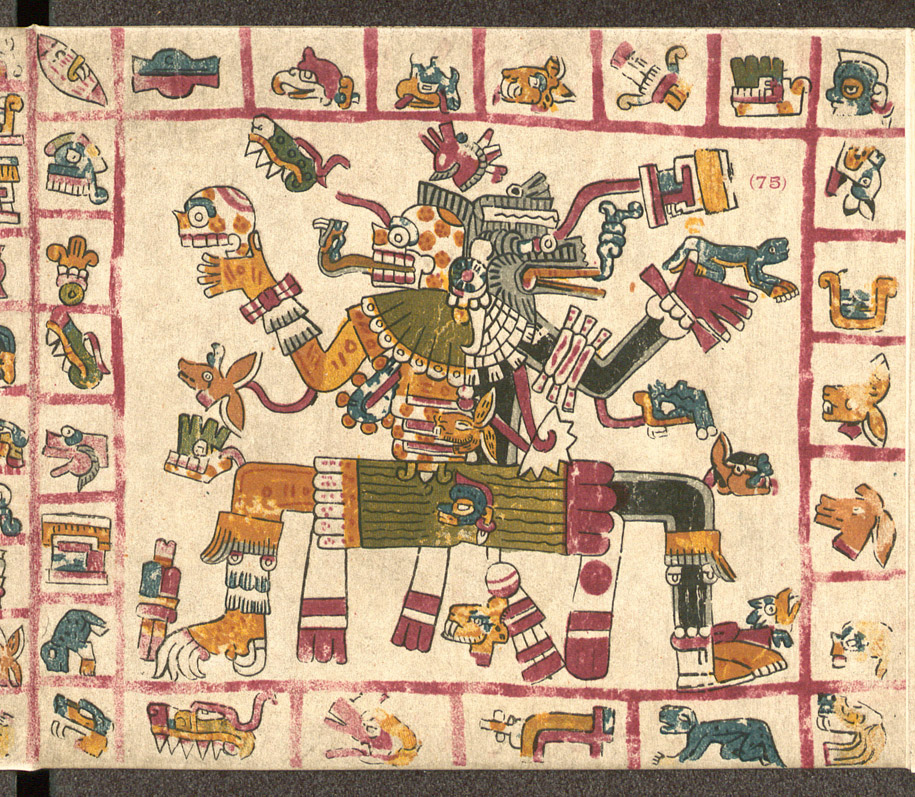
A page from the Codex Vaticanus B, showing Mictlantecuhtli and Quetzalcoatl back to back

a page from the Codex Borgia, showing Tlaloc, Xochiquetzal and Chalchiuhtlicue
Unfortunately, we have way fewer pre-Conquest codices than we do post-Conquest ones. The vast majority of them were destroyed during the invasion by Europeans who either didn't see them as having any value or were trying to make sure the natives stopped practicing their religion so they could be converted to Christianity as quickly as possible. That brings us up to the time of the post-Conquest codices, which were made after the Aztec empire had been conquered. Unlike the earlier codices, which are mostly concerned with recording history and mythology, telling ceremonial stories and lauding the deeds of particularly awesome kings, the post-Conquest codices are much more a portrait of a people under duress. They tend more toward attempting to record what was happening in the here-and-now and tying it to what the Aztecs knew of their own history, and while some do have great mythological value, many of them intentionally leave out religious imagery or euhemerize it down to the deeds of men or demons to avoid the authors getting into trouble with the Catholic Church. Some, like the Duran Codex, were actually overseen personally by Spanish priests and officials who commissioned the works as gifts for royalty back home or had an interest in preserving native history, which naturally led to them being even more skewed toward the authors' attempts to avoid ending up on trial for heresy and the overseers' own commentary and interpretations. The most famous works of this time period are the Florentine, Magliabecchi, Mendoza, Telleriano-Ramensis and Xolotl codices.
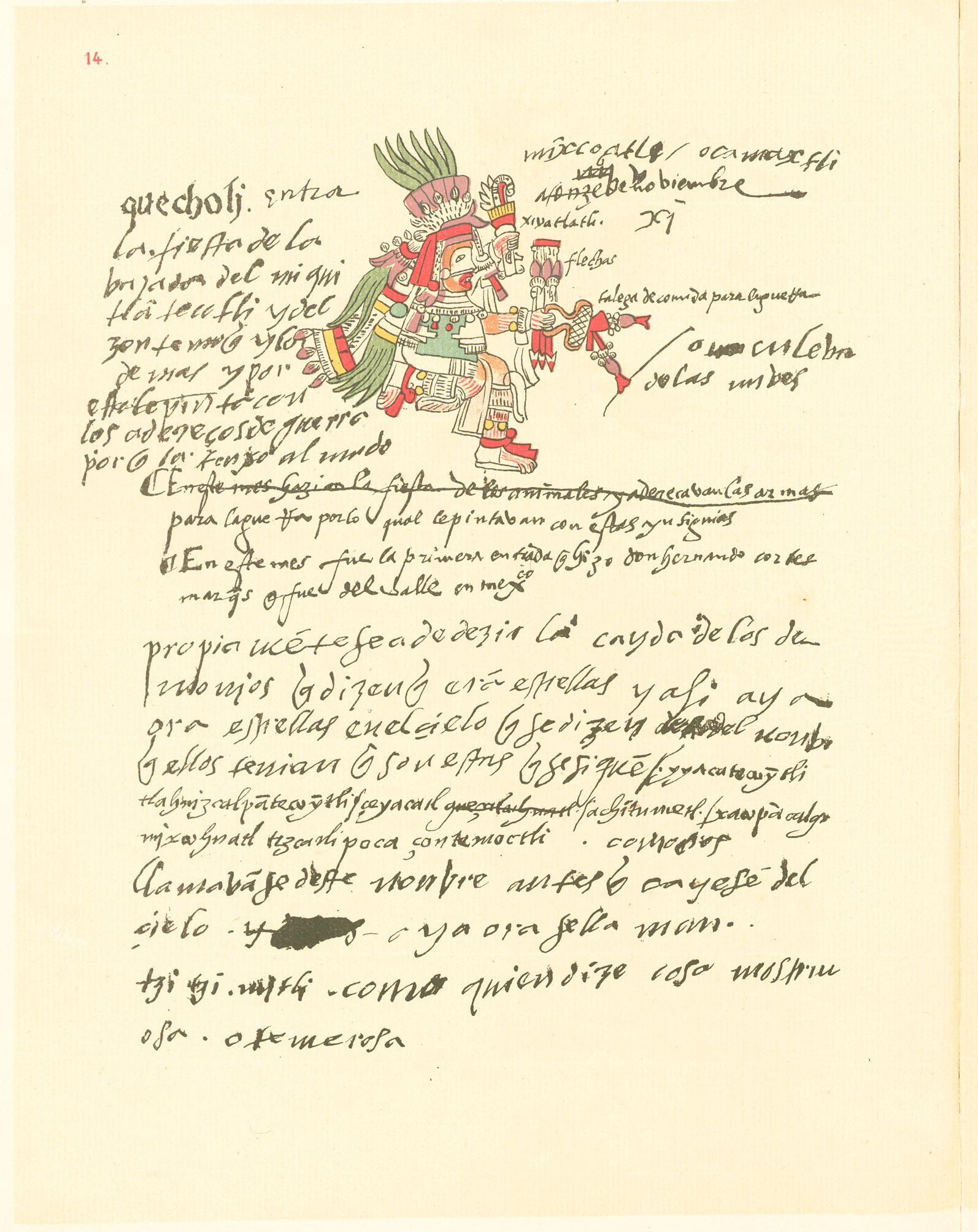
A page from the Codex Telleriano-Ramensis showing Mixcoatl with his hunting gear
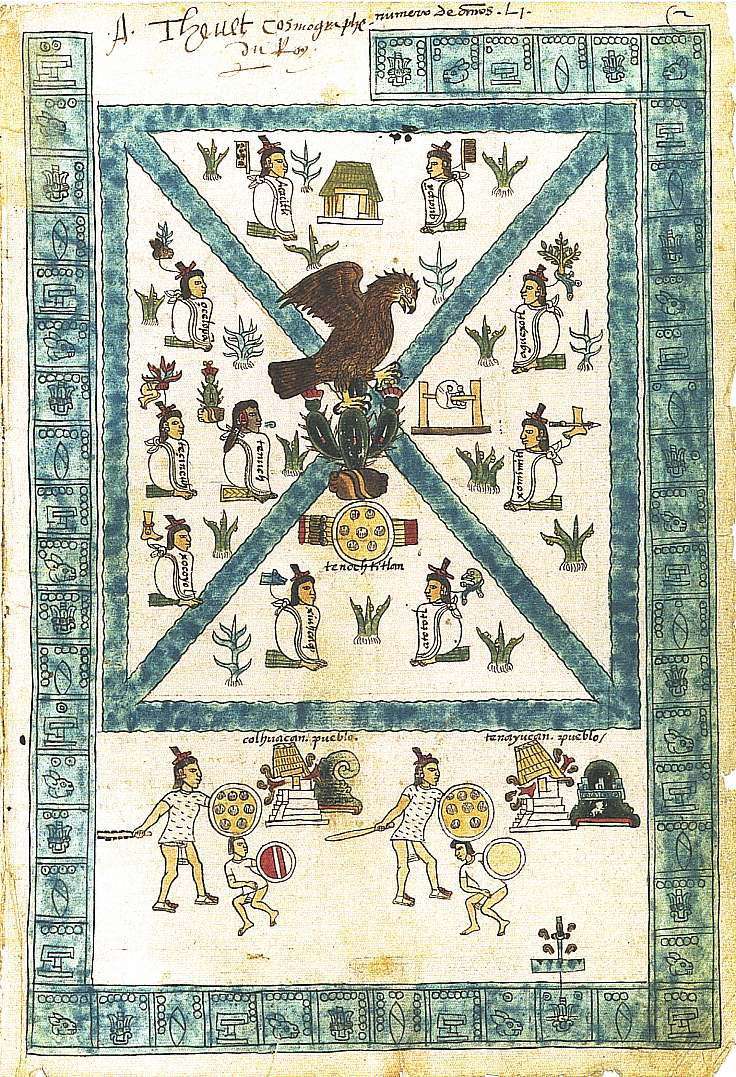
A page from the Codex Mendoza showing Huitzilopochtli in eagle form leading the Mexica to found Tenochtitlan

A page from the Florentine Codex depicting Aztec human sacrificial rites
As you can see, these are much more Spanish- and writing-heavy - closer to the European idea of books than the older Mexican codices, because they were being written by people now living under European rule and for a mostly European audience. They are still major primary sources for the study of Aztec religion and myth (because frankly, they are what we have and beggars can't be choosers), but they also inspire a lot more doubt and raise numerous questions about how accurate their version of stories might really be and how much European interference might be coloring what they contain.
Like most conquered mythologies, we have to do a lot of our learning about them from secondary sources - outside chroniclers like Duran, reproduced historical sources like the Codex Chimalpopoca, or mentions of the culture's practices in preserved resources from nearby peoples who interacted with them.
By the way, since you mentioned it, the Popol Vuh is indeed the major primary source for Maya mythology and is awesome, but it has its problems, too. The version of the Popol Vuh we have today was recorded by a Spanish priest named Francisco Ximenez at the beginning of the eighteenth century, most likely after having the story orally told to him by a K'iche Maya person in what is now Guatemala, and it's been through many transformations and probable changes from that original storyteller to us. The K'iche version may have differed substantially from the Mexican myths of the classical Maya period, to start with - a few hundred years and a lot of geography separate the two, and while they are definitely the same culture and obviously telling the same basic story based on their artwork, we'll never know what details might be different unless we find some new buried source somewhere. Then, the story was recorded after being orally told, making it almost certain that the recorder probably colored it with his own interpretations or changed or omitted some of it; then, there are several theories about who wrote it down first and in what form before Ximenez recopied it to make the first manuscript that was widely passed around, which no doubt included his biases and interpretations; and then various scholars in the eighteenth and nineteenth centuries played academic hockey with the manuscript, recopying and even stealing it, until it finally came into the form we have today.
This is a pretty common story when it comes to preservation of myth. We'd love to always have an accessible, well-preserved priamry source by unbiased natives to take a look at, but in reality that almost never happens. Mexico and its mythologies are prime examples of the infernal mess left behind by invading cultures with little interest in preservation of the peoples who came before them.
Subscribe to:
Posts (Atom)