Question: Are there any other cultures that have a divine end of days scenario aside from the Aesir and Ragnarok?
Oh, sure, tons of them. Eschatology, the study of the events of the end of the world, is not a purely European concept at all; many other cultures have their own ideas of what will happen at the death of the universe, some of them specifically marked and dated, others only implied.
The Norse stories of Ragnarok are very specific about times, places and people involved and so on, largely because they're predicated on prophecies. Details have been furnished by seers and soothsayers who have the ability to see into the future of Fate's weave; other cultures may not have as strong an emphasis on prophetic visions, and instead base their end-of-the-world scenarios on information gleaned from scripture or estimations based on their cosmological concepts of time and space.
One of the most famous, thanks to its religion still being a thriving and living one, is the end of the Kali Yuga in Hinduism. According to Hindu theology, every "day" - equivalent to literally millions of years, varying from four to several hundred depending on the scripture and sect - for Brahma, who experiences time much more slowly than mere humans, is equal to four ages in the world, roughly 24,000 years total. These four ages are the Satya Yuga (Age of Truth), in which religion, wisdom and prosperity are the rule of the universe; the Treta Yuga (Age of Three, referring to the number of pillars of Dharma remaining to support things at this time), in which evil begins to afflict the world but great heroes also arise to combat it; the Dvapara Yuga (Age of Two, referring to the now only at half-strength number of pillars), in which humanity is flawed but also kingly and learns to expiate their sins through study of the holy Vedas; and the Kali Yuga (Age of Kali, here referring to the asura Kali, not the goddess of the same name), during which humanity has degenerated into wanton sin and depravity and forgotten all but the most basic teachings of Hinduism.
We're currently in the Kali Yuga, which started at the moment that Vishnu left his last earthly incarnation, according to most interpretations of Hindu mythology (yes, just as in Greek mythology, we are the worst ever crop of humanity. Go us). Just as in the Norse myths of Ragnarok, the end of the Kali Yuga - and therefore the end of the world, when Brahma blinks and restarts the world once more at the beginning of the Satya Yuga - there are several prophesied events, culminating in a final showdown between the asura Kali, who is the one who has destroyed all righteousness on earth during the centuries of the Kali Yuga, and Kalki, the final avatar of Vishnu, who is destined to defeat him and in so doing end the world and make it ready for the beginning of the Satya Yuga again.
There's a ton of scripture out there on the Kali Yuga, not to mention reams of literature written by Hindu theologists and philosophers over the past thousand years or two, so if you want to really dig into it in detail, libraries and the internet are ready to help.
Of course, seldom in Scion do we discuss the problems of the Deva without also mentioning the Yazata, so a quick side trip into Zoroastrianism gets us another awesome end of the world scenario. The ancient Persian word for the event is Frashokereti, meaning "things become excellent", and as in Hindu tradition the world is broken up into ages, although in this case there are three instead of four (the first two were the Age of Creation and the Age of Pollution or Combination), and we're currently heading into the Age of Separation, when good and evil fight for supremacy.
According to Zoroastrian prophecy in the Avesta, the end of the world will be ushered in by the Saoshyant, a special hero and the son of the great Ahura Mazda himself (or in other traditions, Zarathustra), born from a virgin who bathes in a lake in which a trace of the supreme god's semen was left in order to impregnate her. The Saoshyant (who in Scion terms is definitely a kind of super specialized Scion, although in what terms totally depends on your take on Ahura Mazda) will wield the weapons of Vahram, resurrect the righteous dead to live again and lead the Yazata against the evil forces of the daeva, eventually defeating them. The gods will then melt the world into rivers of molten lava and metal, which will wash over all living things; the worthy and good will be able to wade through them to become one with heaven in bliss, but the evil will be utterly destroyed, along with Angra Mainyu and all his daeva minions.
Slightly north of Persia we run into the Slavs, who have their own eschatological forecast; according to Slavic tradition, Svarog lives for one million years, each day of which is the entire lifespan of the World (more than a little bit similar to Brahma, eh?). Each "day", he slumbers in the egg of the sun until he awakens in the evening, at which point he sweeps everything in the universe - all creation, living things, even the other gods - into one big pile and reconstitutes them into the pure stuff of creation, which he then fashions into the next world. This is called Sweeping Day and happens continually and regularly, like clockwork, and each time he recreates the Bogovi to take over their traditional foes, reborn with no memory of the last world. There's no specific time frame given for this, so we don't know how many years each world lasts; technically, Sweeping Day could be at any time, which is sobering. Someone with Prophecy should get on figuring that out.
We've also got the Mesopotamian religions; while they don't have any particular predictions for what will happen when the world ends, they do have an exact date. According to Babylonian texts, the world has a lifetime of "twelve times twelve sars", where one sar is equal to 36,000 years, so therefore the world is scheduled to last exactly 5,184,000 years. Furthermore, at the time of their civilization, they believed that there were only twelve sars - 432,000 years - left to go and that the vast majority of the world's lifespan was already over. So if we assume that's counting from the beginning of the major time of power for the Babylonian empire, around 1800 B.C.E., we're looking at a precise date for the end of the world in the year 430,200 C.E. In other words, too far away to care (which is probably what all that theoretical math was supposed to mean in Babylonian texts in the first place).
The two other major end-times scenarios that come to mind - those of the Aztec and Egyptian religions - are conditional, meaning that they aren't scheduled as an inevitability but will happen only if specific events occur first. For the Aztecs, we're currently living in the fifth world; the previous four worlds were each destroyed by large-scale disasters brought on by squabbles between the gods, in each case leading with the defection or destruction of the current sun deity. While there is no forecasted end of the world, it's understood that if the current sun - now embodied by Tonatiuh and protected by Huitzilopochtli - is destroyed or goes rogue, the fifth world will be destroyed as well. Depending on the tradition, some Mexican sources imply that a sixth world would then be created with a new god serving as the sun, while others - possibly more modern or influenced by Christianity - claim that the fifth world is the last one and that its destruction would spell the final and incontrovertible end.
Things are far more uncomfortable for the Egyptians; their cosmology is based on the idea that Ra, as the original creator of the universe, may at any time decide to become tired of it. If that occurs, he will decide to simply go to sleep, and as a result the world will be destroyed until such time as he decides to wake up and give remaking a new one a shot. While this hasn't happened yet, it's been a very near thing at least once; in one Egyptian story, Ra decides he's disenchanted with the whole affair and is about to pull the plug, and Hathor, goddess of beauty, joy and sexuality, narrowly averts disaster by lifting up her skirt and flashing him a full view of her incredibly attractive genitals. Ra is so amused he laughs uproariously, and then decides that he couldn't possibly destroy anything that awesome, so the world lives on another day. He could, however, decide to destroy the world at any moment; the only other end-of-the-world note is that Osiris is the only god expressly said to survive that apocalypse and be able to converse with Ra afterward, although he's not always very thrilled about the prospect.
With all this madness going on, there are plenty of doomsday possibilities to play with for Scion games. This is your hour to shine, oracles and prophets!

Showing posts with label Slavonia. Show all posts
Showing posts with label Slavonia. Show all posts
Sunday, December 1, 2013

Sunday, September 23, 2012
Son of the Slavs
Question: Do you know of any examples of Slavic Scions? I can’t seem to find any (my copy of Dr. Hudec’s book has yet to arrive).
Thanks to our slow and backed up question log, you may have already received that book by now, but in case you haven't (or in case someone else is interested):
There is only one true-blue for-reals Scion in Slavic mythology that I know of, the first and last Scion of the entire pantheon (until, of course, the escape of the Titans and the current uncomfortable new crop of young ones). His name is Mokosits, a Scion of Mokosh, and his myth is a tale of sadness and the importance of cosmic rules.
Jealous of Perun's popularity among mortals, who worshiped him for his life-giving rains, Mokosh took on human form and seduced a mortal man named Mitran, by whom she became pregnant with a son. Seeking to avoid being caught, she went to her father Rod and convinced him to speed up her pregnancy, allowing her to give birth to Mokosits before dawn and thus hide the baby from Svarozhich. He grew to adulthood the same day, and she installed him as the first priest of the Slavs, dedicated to her alone. He made frequent blood sacrifices to her, prayed to her and told other humans about her, thus increasing her popularity and worship significantly, and in return she visited him in his dreams to reward him for his loyalty.
Stribog, however, noticed what was happening, and having already been jealous of Perun's popularity was now equally irritated about Mokosh's. He outed the Scion's existence to Svarozhich, informing him of Mokosh's rule-breaking and asking for Mokosits to be killed, both to punish her and remove her unfair advantage. Mokosh's pleas to Svarozhich and Prove went mostly unheeded, but Svarozhich decided that since Mokosits had not caused any harm, he would not be killed but instead banished to the underworld, doomed to be the keeper to the gates of Peklo and the guardian of Veles' sacred domain. Mokosh, as the first to commit this particular crime, was banned from ever again receiving blood sacrifice, and was henceforth worshiped with offerings of food and drink only.
Because of the general ban on Scions, Mokosits is the only "official" one that I know of in Slavic mythology, and things did not work out particularly well for him, unfortunately. However, gods will misbehave, so if your game needs some other historical Scions of the Bogovi, there are easy options out there. Russian folk heroes like Vasilisa the Beautiful or Ivan Tsarevitch and semi-historical Slavic heroes like Prince Marko or the bogatyrs (especially Ilya Murmotes) might be considered to have been Scions, though how long they survived, whether they were discovered and what punishments might have rained down on themselves and their parents for their existence is up to the Storyteller.
Thanks to our slow and backed up question log, you may have already received that book by now, but in case you haven't (or in case someone else is interested):
There is only one true-blue for-reals Scion in Slavic mythology that I know of, the first and last Scion of the entire pantheon (until, of course, the escape of the Titans and the current uncomfortable new crop of young ones). His name is Mokosits, a Scion of Mokosh, and his myth is a tale of sadness and the importance of cosmic rules.
Jealous of Perun's popularity among mortals, who worshiped him for his life-giving rains, Mokosh took on human form and seduced a mortal man named Mitran, by whom she became pregnant with a son. Seeking to avoid being caught, she went to her father Rod and convinced him to speed up her pregnancy, allowing her to give birth to Mokosits before dawn and thus hide the baby from Svarozhich. He grew to adulthood the same day, and she installed him as the first priest of the Slavs, dedicated to her alone. He made frequent blood sacrifices to her, prayed to her and told other humans about her, thus increasing her popularity and worship significantly, and in return she visited him in his dreams to reward him for his loyalty.
Stribog, however, noticed what was happening, and having already been jealous of Perun's popularity was now equally irritated about Mokosh's. He outed the Scion's existence to Svarozhich, informing him of Mokosh's rule-breaking and asking for Mokosits to be killed, both to punish her and remove her unfair advantage. Mokosh's pleas to Svarozhich and Prove went mostly unheeded, but Svarozhich decided that since Mokosits had not caused any harm, he would not be killed but instead banished to the underworld, doomed to be the keeper to the gates of Peklo and the guardian of Veles' sacred domain. Mokosh, as the first to commit this particular crime, was banned from ever again receiving blood sacrifice, and was henceforth worshiped with offerings of food and drink only.
Because of the general ban on Scions, Mokosits is the only "official" one that I know of in Slavic mythology, and things did not work out particularly well for him, unfortunately. However, gods will misbehave, so if your game needs some other historical Scions of the Bogovi, there are easy options out there. Russian folk heroes like Vasilisa the Beautiful or Ivan Tsarevitch and semi-historical Slavic heroes like Prince Marko or the bogatyrs (especially Ilya Murmotes) might be considered to have been Scions, though how long they survived, whether they were discovered and what punishments might have rained down on themselves and their parents for their existence is up to the Storyteller.
Thursday, September 20, 2012
Birds of a Feather
Question: Do you have any information on the role of owls in Slavic folklore and myth? The only thing that I know is that the body of the Sirin is supposed to be that of an owl. While we’re on the subject, do you know anything about the Sirin and the Alkonost? The information that I have been able to dig up has been scarce.
Slavic party around here lately! Man, you'd think we had an interest or something.
Owls are not major players for most of Slavic myth, but they are present, and they're usually symbolic of the otherworldly and superhuman, often in a frightening capacity - pretty standard across non-Greek Europe, where owls usually have scary connotations thanks to their status as creatures of the night. Baba Yaga often appears with an owl roosting on her house, or owls living in the forest around the place, illustrating the imminent danger and her connection to the magical otherworld. The sirin is indeed often referred to as having the body of an owl, though sometimes the bird is unidentified; and though she's not specifically an owl, per se, the Simargl has dominion over all birdkind to a certain extent, so she could certainly have owls around if she wanted to. Polish folklore also features a nastily unsettling creature called the strzyga, a shape-changing owl-creature with vampiric tendencies, most likely borrowed from the Roman idea of the strix (witch) and transformed with typical Slavic aplomb.
The Sirin, a woman-headed singing bird monster, is one of those creatures borrowed from elsewhere to become part of the Slavic mythological landscape; as is probably pretty obvious, it's a direct import of the Greek siren, probably through Croatia and Macedonia and then on up into the more northerly Slavic lands. It shares its mythic space with the Alkonost (also a Greek import, this time from the story of Alcyone, turned into a bird for her hubris), often referred to as its "sister", and the two of them tend to appear as either a unit or as opposing but linked forces. As with many Slavic creatures, their connotations change over time and with your location; the Alkonost is usually the more dour of the two figures, singing sorrowful or dolefully prophetic songs and tormenting the souls doomed to Nav with her ear-piercing wails, while the Sirin is most often associated with joy, hope and just rewards (to the point that some medieval art in the Russian Orthodox Church actually features the Sirin as a symbol of God's divine will, or sets it as a creature of the Garden of Eden, now forbidden to mankind but occasionally venturing forth to bless saints and the deserving with its song).
But these roles actually reverse occasionally - in the more southern Slavic lands, the Sirin is more often the dangerously connoted creature (not surprising, as it's closer to the birthplace of the myth of the decidedly dangerous sirens) and is said to be a harbinger of death, while the Alkonost's song does not only torment souls in Nav but also brings joy and serenity to those blessed souls in Raj, where it lives. Occasionally one or the other of them is said to live on the Isle of Buyan instead of in the Underworld. Sometimes it's the Alkonost who brings joyous tidings and comfort to wanderers; sometimes the Alkonost is associated with the day and the Sirin with the night, or sometimes the association is reversed. The Alkonost's song, specifically, is also sometimes said to calm waters, probably another memory of the Greek Alcyone, whose father Aeolus calmed the weather to allow her to nest every year.
They're a lovely pair of ladies, and definitely perfect for appearances in Scion, whether as antagonists, helpers or characters in their own right. Exactly how much they're really related to the Greek siren and Alcyone is up to an individual Storyteller's discretion, but I like to think they're probably separate creatures, perhaps with good relations with their Greek cousins but so thoroughly Slavic that they can't just be mashed together and called the same, just as the Simargl and Simurgh aren't the same. (Or perhaps it's one and the other - maybe the Slavic Alkonost and Greek Siren hang out together, or vice versa!) The Bogovi supplement on our site presents only the Alkonost, and sets her as a composite creature, beautiful and benevolent to the deserving and terrifying and tormenting to the unworthy; really, all we're doing there is combining the two birds in one in order to let the siren remain a Greek creature, but Scion is more than able to accommodate all of them if you want it to.
For a gorgeous depiction of the two birds in action, check out Viktor Vasnetsov's Sirin and Alkonost - Birds of Joy and Sorrow:
Of course, which is which? Vasnetsov doesn't say. You'll have to draw your own conclusions. (And look up more of his work, if you liked what you saw - he's one of the best artists around for Slavic mythology.)
By the way, if you're a fan of Slavic bird-creatures, you might want to give the Gamayun, the third of the Slavic bird trio, a try as well. She, too, is a "sister" to the Alkonost and Sirin, though folklorists are not really sure where she came from since she doesn't seem to share their Greek origin and appears later in the body of Slavic folklore than they do. She is renowned for speaking prophecies and is also said to dwell on Buyan, where even the gods tend to leave her alone lest they hear something they didn't want to know.
Slavic party around here lately! Man, you'd think we had an interest or something.
Owls are not major players for most of Slavic myth, but they are present, and they're usually symbolic of the otherworldly and superhuman, often in a frightening capacity - pretty standard across non-Greek Europe, where owls usually have scary connotations thanks to their status as creatures of the night. Baba Yaga often appears with an owl roosting on her house, or owls living in the forest around the place, illustrating the imminent danger and her connection to the magical otherworld. The sirin is indeed often referred to as having the body of an owl, though sometimes the bird is unidentified; and though she's not specifically an owl, per se, the Simargl has dominion over all birdkind to a certain extent, so she could certainly have owls around if she wanted to. Polish folklore also features a nastily unsettling creature called the strzyga, a shape-changing owl-creature with vampiric tendencies, most likely borrowed from the Roman idea of the strix (witch) and transformed with typical Slavic aplomb.
The Sirin, a woman-headed singing bird monster, is one of those creatures borrowed from elsewhere to become part of the Slavic mythological landscape; as is probably pretty obvious, it's a direct import of the Greek siren, probably through Croatia and Macedonia and then on up into the more northerly Slavic lands. It shares its mythic space with the Alkonost (also a Greek import, this time from the story of Alcyone, turned into a bird for her hubris), often referred to as its "sister", and the two of them tend to appear as either a unit or as opposing but linked forces. As with many Slavic creatures, their connotations change over time and with your location; the Alkonost is usually the more dour of the two figures, singing sorrowful or dolefully prophetic songs and tormenting the souls doomed to Nav with her ear-piercing wails, while the Sirin is most often associated with joy, hope and just rewards (to the point that some medieval art in the Russian Orthodox Church actually features the Sirin as a symbol of God's divine will, or sets it as a creature of the Garden of Eden, now forbidden to mankind but occasionally venturing forth to bless saints and the deserving with its song).
But these roles actually reverse occasionally - in the more southern Slavic lands, the Sirin is more often the dangerously connoted creature (not surprising, as it's closer to the birthplace of the myth of the decidedly dangerous sirens) and is said to be a harbinger of death, while the Alkonost's song does not only torment souls in Nav but also brings joy and serenity to those blessed souls in Raj, where it lives. Occasionally one or the other of them is said to live on the Isle of Buyan instead of in the Underworld. Sometimes it's the Alkonost who brings joyous tidings and comfort to wanderers; sometimes the Alkonost is associated with the day and the Sirin with the night, or sometimes the association is reversed. The Alkonost's song, specifically, is also sometimes said to calm waters, probably another memory of the Greek Alcyone, whose father Aeolus calmed the weather to allow her to nest every year.
They're a lovely pair of ladies, and definitely perfect for appearances in Scion, whether as antagonists, helpers or characters in their own right. Exactly how much they're really related to the Greek siren and Alcyone is up to an individual Storyteller's discretion, but I like to think they're probably separate creatures, perhaps with good relations with their Greek cousins but so thoroughly Slavic that they can't just be mashed together and called the same, just as the Simargl and Simurgh aren't the same. (Or perhaps it's one and the other - maybe the Slavic Alkonost and Greek Siren hang out together, or vice versa!) The Bogovi supplement on our site presents only the Alkonost, and sets her as a composite creature, beautiful and benevolent to the deserving and terrifying and tormenting to the unworthy; really, all we're doing there is combining the two birds in one in order to let the siren remain a Greek creature, but Scion is more than able to accommodate all of them if you want it to.
For a gorgeous depiction of the two birds in action, check out Viktor Vasnetsov's Sirin and Alkonost - Birds of Joy and Sorrow:
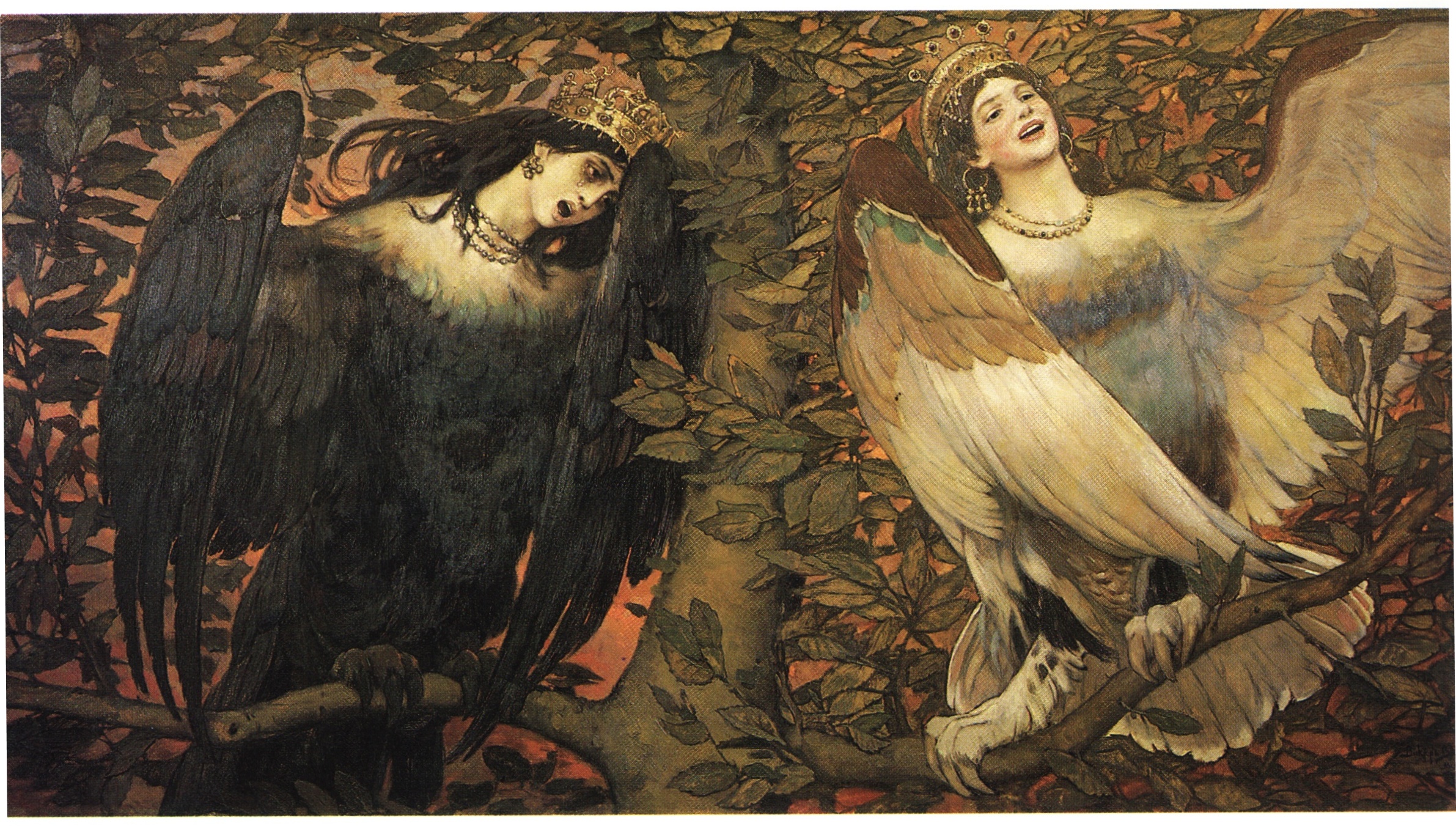
Of course, which is which? Vasnetsov doesn't say. You'll have to draw your own conclusions. (And look up more of his work, if you liked what you saw - he's one of the best artists around for Slavic mythology.)
By the way, if you're a fan of Slavic bird-creatures, you might want to give the Gamayun, the third of the Slavic bird trio, a try as well. She, too, is a "sister" to the Alkonost and Sirin, though folklorists are not really sure where she came from since she doesn't seem to share their Greek origin and appears later in the body of Slavic folklore than they do. She is renowned for speaking prophecies and is also said to dwell on Buyan, where even the gods tend to leave her alone lest they hear something they didn't want to know.
Monday, August 27, 2012
A Breath of Fresh Air
Question: Vetervnuk. I can’t seem to find information on them anywhere. Is there any chance we could learn little bit more about them and perhaps some other Slavic critters.
The Vetervnuk are the winds of the world, Stribog's grandchildren and therefore some of his most potent tools (and quite potent for Scions he lends them out to, as well!). Slavic myth paints them basically as little wind daemons or elementals, nominally sentient but playful and mindless, only controlled by Stribog himself. They're similar to sylphs, air spirits or the Anemoi of Greek mythology - mostly formless because they're just air in the end, but animated by life and thought and obedient to the wind-god's commands.
They're probably not very bright, nor are they very good at things that air can't do - they probably can't lift a lot and aren't great for more than a distraction in combat - but they probably make useful and entertaining helpers, attendants and message-bearers (particularly the last, as I imagine they're quite good with Divine Threnody). They're more of a flavor Follower than one a Scion will probably be finding an absolute need for most of the time, but they're thematic and very, very cool. Having the air move things around for you or whisper in peoples' ears is badass even if it doesn't help you punch the monsters much.
We're always willing to talk about more Slavic creatures! If there are specific ones you're interested in, hit us anytime.
The Vetervnuk are the winds of the world, Stribog's grandchildren and therefore some of his most potent tools (and quite potent for Scions he lends them out to, as well!). Slavic myth paints them basically as little wind daemons or elementals, nominally sentient but playful and mindless, only controlled by Stribog himself. They're similar to sylphs, air spirits or the Anemoi of Greek mythology - mostly formless because they're just air in the end, but animated by life and thought and obedient to the wind-god's commands.
They're probably not very bright, nor are they very good at things that air can't do - they probably can't lift a lot and aren't great for more than a distraction in combat - but they probably make useful and entertaining helpers, attendants and message-bearers (particularly the last, as I imagine they're quite good with Divine Threnody). They're more of a flavor Follower than one a Scion will probably be finding an absolute need for most of the time, but they're thematic and very, very cool. Having the air move things around for you or whisper in peoples' ears is badass even if it doesn't help you punch the monsters much.
We're always willing to talk about more Slavic creatures! If there are specific ones you're interested in, hit us anytime.
Friday, July 27, 2012
Reptilian Terror
Question: From what I can gather Slavic dragons tend to be multi-headed and wingless. My question is, which dragon do you think I should use to represent Slavic dragons, or perhaps another monster entirely?
If you're planning to use stats for a creature from the book (which I generally don't recommend because so many of those critters are kind of a huge mess stat-wise, but whatever works for you), you have a few options for similar beasties, depending on the Legend rating and challenge you want them to pose. Lindwurms and Tatzelwurms (Scion: Hero, page 313) are a good choice for a Hero-level threat. Scion: Demigod has a whole subsection on dragons on page 232, and Ladon, the first on the list, is exactly the kind of ground-bound multi-headed monstrosity it sounds like you're looking for, sized more for a Demigod-level encounter (the Tatsu, a few pages later, may also be a good place to look). The Hydra, found on page 262, might also be a good place to look, though whether or not you want to preserve its regenerative powers depends on the flavor of the encounter you plan on running. For more divine antagonists, I'd consider the Nagaraja from Scion: God, page 322, (just add legs!), the stormvurm (Scion: Ragnarok, page 123), the multi-headed Azhi Dahaka (Scion: Yazata, page 34) or even a slightly watered-down version of Jormungander (Scion: Ragnarok, page 113).
In general, though, I'd recommend statting your own zmey; you know your PCs better than any book and can tailor the dragon to be a good challenge for them, not to mention not having to pare away someone else's less useful creature qualities or rewrite material that doesn't quite fit. I'm not the master authority on antagonist creation - that's John - but I'm sure he'd be glad to give tips if you've got specific questions. You might also get some use out of Scion: Companion's Creating Titanspawn section on page 148, which is specifically geared toward helping you create antagonists that haven't been statted yet on your own.
If you're planning to use stats for a creature from the book (which I generally don't recommend because so many of those critters are kind of a huge mess stat-wise, but whatever works for you), you have a few options for similar beasties, depending on the Legend rating and challenge you want them to pose. Lindwurms and Tatzelwurms (Scion: Hero, page 313) are a good choice for a Hero-level threat. Scion: Demigod has a whole subsection on dragons on page 232, and Ladon, the first on the list, is exactly the kind of ground-bound multi-headed monstrosity it sounds like you're looking for, sized more for a Demigod-level encounter (the Tatsu, a few pages later, may also be a good place to look). The Hydra, found on page 262, might also be a good place to look, though whether or not you want to preserve its regenerative powers depends on the flavor of the encounter you plan on running. For more divine antagonists, I'd consider the Nagaraja from Scion: God, page 322, (just add legs!), the stormvurm (Scion: Ragnarok, page 123), the multi-headed Azhi Dahaka (Scion: Yazata, page 34) or even a slightly watered-down version of Jormungander (Scion: Ragnarok, page 113).
In general, though, I'd recommend statting your own zmey; you know your PCs better than any book and can tailor the dragon to be a good challenge for them, not to mention not having to pare away someone else's less useful creature qualities or rewrite material that doesn't quite fit. I'm not the master authority on antagonist creation - that's John - but I'm sure he'd be glad to give tips if you've got specific questions. You might also get some use out of Scion: Companion's Creating Titanspawn section on page 148, which is specifically geared toward helping you create antagonists that haven't been statted yet on your own.
Subscribe to:
Posts (Atom)