Saturday, June 8, 2013

Somehow This Post Is All About Beards

Question: How do you think Zeus has felt about his transformation of his image over the years? Like at first he was an older man without any facial hair to show he is not a barbarian with the Greeks, in Rome his followers gave him a beard which to them means wisdom I believe and last but not least, his likeness stolen to be the image of God to Christians. Is he angry over the facelifts and stolen identity or is he proud that at least his appearance has survived the ages to show he has power in the world?

Well, I think there may be some confusion over representations of Zeus across the ages... but that gives me an excuse to make a post with a lot of neat ancient art in it, so no complaints from me!

To start with, I'm not sure who told you that the ancient Greeks didn't like beards, but they were tragically wrong. The Greeks loved a nice beard, which they saw as a sign of virility and manliness, and having no beard was considered the mark of a young boy or a less-than-manly dude. They were so all about their beards that criminals in Sparta were sometimes forcibly shaved, thus publicly humiliating them. Of course, the ideal Greek beard was carefully trimmed and maintained, not a wild, bushy forest of follicles, but it certainly wasn't the mark of a barbarian. (However, fun fact: ancient Egyptians did make a point of shaving their beards, initially because it cut down on lice infestations and later because it had become a fashionable sign of nobility.)

So when you go out a-seeking ancient Greek images of Zeus, you'll almost always get beards, beards all across the landscape, in fact! Check it out:
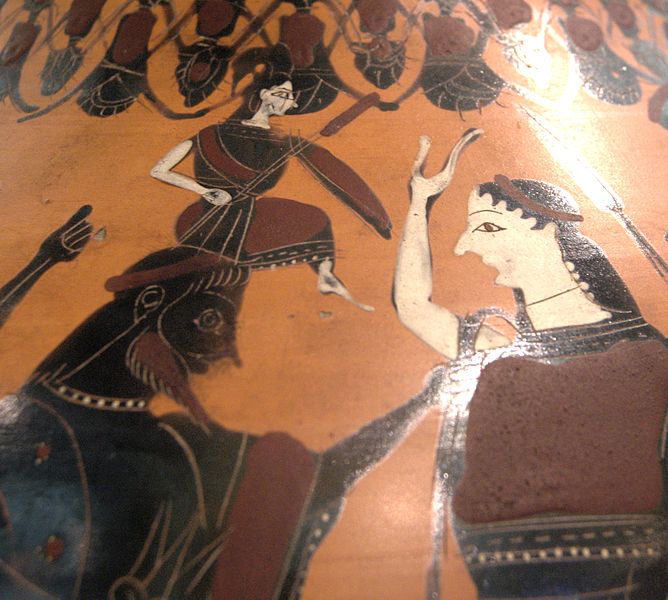

Zeus with Athena popping out of his head. Like a daisy!
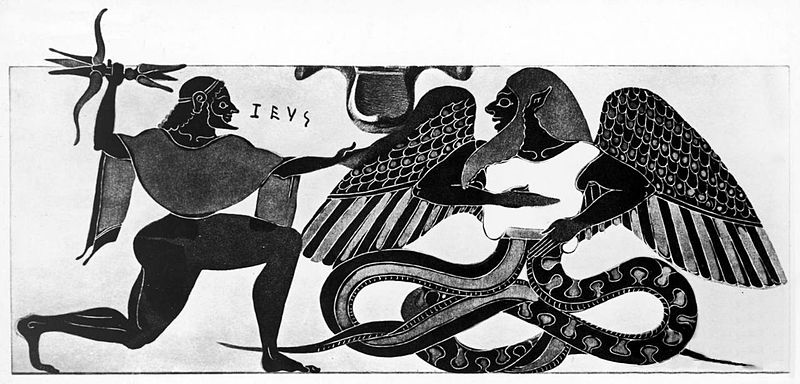

Zeus fighting Typhon, beard a-wagging!


Zeus and Hera having sexy hangouts!


However, the Romans, as they do, changed things up somewhat; early Rome didn't do much shaving, but by the second century B.C.E. clean-shaven faces had caught on as a serious fashion, denoting the discipline of the empire and visually reminding all and sundry that they weren't lazy hedonists who couldn't be bothered to pick up a razor or these other barbarian tribes with their face-forests (ironically, it was often specifically intended to broadcast to others that the Roman with such nicely shorn cheeks was not Greek). However, because the majority of religious art of Jupiter was based directly on previous Greek art, the god remained bearded despite the general disfavor of beards among the populace.


Jupiter rocking it out with the royal eagle!


Jupiter laying down some household law!


Jupiter on the back of a coin, looking suave!


Now, technically, there is no "image" of the big-G God of Judaism or Christianity or Islam; he's formless and made of unbelievable splendor and so forth, is never physically described in any of the religions surrounding him, and it was actually quite expressly forbidden to try to make images of God in the ancient and even medieval stages of the religions. However, humans are gonna be humans, which means they like making art of things they feel strongly about, so pictures of God inevitably came into the general cultural consciousness. It's no surprise that the image of God that eventually formed became one of an older, imposing male with flowing beard, similar to previous depictions of gods in the Middle East, because it came out of generally the same area. Images of God were scattered and generally ununified, happening on and off from around the tenth century when the Church officially lifted the ban on divine art, but as usual it's the Renaissance that really shaped the modern conception of what God "looks like"... and the Renaissance was, of course, born in Italy and heavily influenced by the Greco-Roman myths of its bygone ages. Painters were throwing god up on a sacristy and then turning around and splashing Jupiter across a colonnade, and it's inevitable that both took on a certain similar style.

However, it's not really accurate to say that Zeus' image was used for that of the Christian God; honestly, it really wasn't. As you can see from all the pictures up above there, the only things that images of Zeus and images of God really have in common is the beard and a certain air of importance, and even those usually aren't shown the same way. Zeus is usually naked or scantily clad, showing off his badass physique (because the ancient Greeks and Romans loved them some physique!); God is seldom shown in a full-body image, and when he is is almost invariably in long, concealing robes. Zeus has the typical Greco-Roman beard going on, closely shaved and curly, and when we have color usually black or brown; God usually has a flowing stick-it-in-your-belt beard, and is almost always grey or greying. Zeus appears in active poses, passing judgment, throwing thunderbolts, schmoozing with his wife and so on; God is usually passive, peering down at the action from heaven, or occasionally waving his hands to make pronouncements or bestow blessings.

There are exceptions to all of these, of course, but the bottom line is that the two deities really weren't actually conceived of all that similarly. Ancient Greek religion, which placed great emphasis on personal skill, majesty and personality, conceived and artistically represented their god as an athletic but imposing young ruler, a living and attractive part of the universe, while Christianity, which instead emphasizes God's omnipotent power and all-encompassing benevolence, needed a symbol with less action and more dignity, turning to the shorthand of venerable old age and benevolent distance from the world to represent the object of their worship.

Basically, God has to be dignified and fatherly, and Zeus has to be badass and sexy. The overlaps, prior to the modern day, are present but few.

However, I'd argue that it's not the image of God that's being infiltrated by Zeus in the modern day, but rather the other way around. Modern pop culture images of Zeus are clearly influenced by Christianity's ideal of the distantly benevolent, aged patriarch, leading to many, many images in which the King of Olympus has turned to white hair and overlong beard or appears far more distant from events that he might otherwise.


Age of Mythology's Zeus, with familiar muscles and beard but distinctly older than most Greek sources would have shown him.


God of War's Zeus, with beard a-flowin' and obviously advanced age.


Age of Zeus' Zeus, looking like he escaped from an old folks' home for people with superpowers.


Clash of the Titans' Zeus, not yet grey but rocking a crazy barbarian beard and restricted to moping around his house on Olympus for the whole movie hoping people will love him again.


Tip of the iceberg - go to any popular site for art and plug in the word "Zeus", and you'll see page after page of long white beards. The modern idea of what a god - specifically a fatherly, in-charge god - looks like has not only solidified the modern conception of the Christian god but now in reverse affects the gods of other cultures as well (Odin also gets a lot of this - the more modern the image, the more likely he is to look like an old and benevolent father figure instead of a crazy-ass war god).

Now that I've spent most of an hour looking at pretty amphora pictures instead of other useful things I should probably be paying attention to, we can finally roll on down to the last question, which is how Zeus might feel about all this mess. It's a question for individual Storytellers - every ST has different ideas about the exact personality of a given god in their games - but we'd probably assume that Zeus is perfectly fine with all of the above, when and if he notices it (which probably isn't a lot, he's a pretty busy guy). Zeus has always been one of the gods most recognized, worshiped and bowed to in the western world, and it probably doesn't even occur to him to be pleased by the continuing endurance of his image - that's just the natural order of things, after all. You don't get pleased that air still exists when you want to breathe; Zeus probably isn't pleased when mortals still love him, because he has a perfectly healthy ego and would never expect them to do otherwise. Of course, he would probably like some of the old respect to get back into play - where his burnt cattle, you guys? - but he'd be much more surprised if people forgot to make pictures of him than if they make pictures that are slightly wrong.

And, being a god who has at least enough Epic Appearance to barbecue Semele, he can probably look like basically whatever "version" of himself he likes, appropriate to his needs, audience and the moment. Most of the time, we assume he remains his youthfully bearded, sexily muscled Greek self, but since it's unlikely that those expecting to see a long grey beard are going to be any less impressed by him, the exact details are mostly superfluous. Zeus is Zeus. Bow down and everyone will get along just fine.

Friday, June 7, 2013

I'm the fellow who asked the 'How do the gods decide among themselves who is most powerful?' Question. I was not trying to troll you. I was not trying to get around your 'who would win' question ban. I did not know such a ban existed. I was asking an honest question. The 'perfect wording' to get around the ban is coincidence. I just wanted to make that clear. Thank you for answering my question. Have a great day. Eager to see Anne's project once its done.

Hey anonymous dude. We let our questions be anonymous, because this lets people feel free to ask questions without being embarrassed, or feel like we'll dislike them because of a question...but the flip side of that, is we dont know who is actually asking questions. Instead we just get a sea of questions, many of which are the same. We of course cant expect someone asking a question to have seen all our blogs/vlogs before, but its easy to get caught assuming that when you get so many of the same question that you've answered a couple times already.

So, to that, sorry for assuming you had heard us talk about this question before. We dont have a ban on questions, we just wont answer them, we really just get too many of em, and our answer will always be the same.

My Faux angry blogging is exxaggerated for film. Im not actually angry with you anonymous, although, hopefully you dont care if I was.

Eater of Stars

Question: Eztli has conquered the Titanrealm of stars?

If you ask her, most definitely. Coyolxauhqui probably has a different opinion, though.

Love, Lies and Looks

Question: How do you stop players from getting everything they want when they can throw around 100-200 successes on their social rolls?

Easy. Their enemies can also throw around 100-200 successes on their resistance rolls.

Once Scions get to their crazy godly levels of madness, they can pull off some insane feats of social mojo, turning the tides of the world's politics and the emotions of the divine just as their more physically- or mentally-minded compatriots can heft mountains, predict the end of the world or circle the universe in an hour. With positive Fatebonds and average rolls, Scions who aren't even trying can get an average of 56-66 on their social powers' rolls as gods; if they want to also Legendary Deed, channel Virtues, use Animal Aspect, apply relic bonuses or do one of a zillion other things Scions can opt for to buff themselves, they can easily head into the 100+ stratosphere. This makes them fucking crazy, and we are not going to pretend otherwise. When Sowiljr flips a jaunty grin and the finger guns, entire nations get up and dance.

When it comes to creatures of lesser power and hapless mortals, that's okay. If a god rolls 100 successes on a social roll, everybody who isn't close to as powerful as he is should probably do whatever he wants. That's what his powers do and that's certainly what happens when socially badass gods turn up around less-important figures in mythology.

But people not being able to resist a social character doesn't always mean that character gets exactly what she wants, so don't be afraid as a Storyteller to make sure you roleplay an NPC's reaction to various social stats and powers. Not every character's response to social powers is the same and they're certainly not all positive; something like Engender Love might get you lovey-dovey and complete devotion, but it also might get you psychotic obsession and violent consequences, depending on the personality of the creature who now blindly loves you. Lies that an NPC totally believes may still lead to them taking actions you might not have anticipated, and characters who are bowled over by your beauty (or terrorized by your hideousness) might react with uncontrollable lust or dangerous violence depending on what's going on.

Which is not to say that your PCs' awesome social badassery shouldn't often result in sweet prizes and effortless cooperation; those are their powers, and they should work a decent amount of the time or you're not being fair to them. But even though they can provoke strong emotional responses, they can't always control exactly how those manifest unless they micromanage their targets, which makes a major difference when it comes to how a scene plays out.

As for gods who are of similar power level, the good news for them is that those who are good at resisting have just as great a chance of saying no as the social Scions have of making them say yes. Resistance knacks - Crazy Like a Fox, Disorienting Countenance and Parapet of the Mind - allow divine figures to resist with their Epic Attributes just as much as their enemies are trying to finagle with them, putting everyone on an equal playing field. A Scion may be able to roll in with 100+ successes on their Overt Order, but if their target can pay Legend and potentially have just as many successes on their resistance roll, that's far from an easy instant win.

Now, how your game runs resistances makes a very big difference here. If you're playing with a system of static resistances, the defender is always going to end up at a disadvantage thanks to their inability to add a lot of the boosters that the social characters can use; most static mental resistance systems wouldn't allow you to buff yourself with Animal Feature or Bona Fortuna or Become the Herald or all that other stuff that affects rolls instead of derived values. This is one of the reasons we vastly prefer a system where resistances are actually rolled, because it gives defenders the ability to make their defenses juiced up and epic as much as attackers, and because where a static DV for physical attacks makes sense because you take varying levels of damage, a static resist is not as helpful for social powers where there are no varying levels of "I do the thing". If, by some insane chance, you are playing at the god level and still using the terrifyingly bad resistance system in the Scion books - Willpower + Integrity + Legend with no other bonuses or Epic possibilities, and the ability to just spend a Willpower to ignore social powers - nothing is going to work right and we can't help you. It is an awful system and we can't quite imagine making it all the way through Demigod with it.

And, of course, remember that these rules are all in effect for NPCs, too. If your PCs can steamroll enemies with their social knacks, odds are they can be in turn steamrolled, so make sure your resistance system and powers aren't too punishing in either direction (Overt Ordering Titans into volcanoes is totally fun, but the same thing happening in reverse is total balls). It's fine for PCs and NPCs who don't invest in any resistance ability to be pushovers - they spent their XP on being good at things other than resisting, so they're going to have to take their lumps - but if people who are really awesome at resistance are still getting destroyed on a more than regular basis, you may want to examine your system balance.

Now, all that above pretty much applies to actually using social powers, which means knacks or boons that roll your social stats and have specific effects. If you're asking about the passive effects of just having a lot of socials, that one's less mechanics-bound but also easier; don't make it complicated but do make it reasonable. The same guidelines are in place, just sans rolls; if your Scion has badass socials, things that are not close to his power level will fall all over themselves to love/believe/desire/fear him, while things closer to his power level will require actual work to take down.

For the most part, our rule of thumb for creatures near the same level is that if it's something that strongly influences or forces another being to do something they wouldn't have done of their own volition or would be opposed to, you can't do it without actually using a power, meaning that your badass Charisma will make that fellow young god really like you and want to make you happy, but it won't make him stab his brother for you unless you push the issue. He'll be unhappy that you asked, he'll feel sad and conflicted because he can't do both things he wants to do (safeguard his brother and make you happy), but you're not going to be able to order him around like you could a much less powerful creature. He's a god, too, and a Legendary power in his own right; social characters in mythology are very powerful, but even they have to actually put effort into making people do things. There're no opposing rolls and no specific mechanics because these are all passive effects, so your job as a Storyteller is not to make social rolls insanely overpowered instant-win buttons. It's fine for social characters to be able to get Thor to automatically like them and want to feast with them and take them with him into glorious battle; it's not fine for them to be able to get Thor to divorce his wife or turn on Odin or give them Mjolnir unless they can actually use appropriate powers and overcome his resists.

It's a fine balancing act - Storytelling for gods is hard, yo, and we feel you on the difficulty of making sure things are both power-level balanced and fun and epic. It takes practice to be able to find the sweet spot that works for your games, and you'll need to make some decisions about what's too overpowered for automatic passive social powers and what restrictions will make sure your game stays fun for all your players. Just don't panic, be as fair as you can be, and hopefully over time and with input from your players you'll be able to make it to the balancing point.

Thursday, June 6, 2013

If you could completely rework the Epic Attribute system what would you do?

Ive actually been talking about this topic a lot lately.

WINK

But its actually a really tough question to answer. I can start dreaming(and i certainly have) about many different systems that might work better then the epic attribute system. I think the person that figures it out will have the building blocks of an excellent game. I think the epic system works well enough, but Ive fallen out of love with it. But my complaints seem to be different from other people I talk to who dont like it.

Most people dont like how crazy the scale gets, but I love the scale. At times I think the scale should be bigger(my god fatebond rules make it bigger, kinda). But at the same time, I think there has to be a way to make it scale, but be more fluid, more....intuitive maybe? Im not even sure on the right word, but I feel like there can be some better way, but because most of the people looking for solutions are looking to get around the things about the epic system that I actually like, i often dont agree with new systems and work arounds.

I think the 9 attributes need to be in the game. Maybe they dont need to be "attributes" but they need to be super important parts of the game. With mythology in mind, I think dex, manip, intel could MAYBE get molded into a war/chaos/mystery boon path kinda thing. Where wits is normal intelligence or something but mystery/intelligence is godly intelligence....Im just spitballing here, but I know the rest are mandatory for gods, intelligence and manipulation are very important, but maybe could be bound up in boons in some way. And dexterity....is actually super rare amongst god stories and probably the attribute Id be ok with not existing.
With that said, game-wise dexterity, the ability to dodge and move fast and be flexible is very important, and i use it in a ton of rolls, mythologically, its not necessary.

That was a long, poorly thought out ramble, I apologize. Basically, I know, somewhere there is a better system then epics, however Ive spent tons of time on it....and I keep coming up without success. I think any system should keep most of the attributes though, and the scaling should be similar, if not larger.

Doctor Danger

Question: Hey, John and Anne, or Jo-Anne, as it were. Just wondering why you nerfed Dian Cecht to only having Health? And why does he now have so many enemies?

Man, Joanna is my sister. You've made this weird.

Anyway, one of these is a question we've already answered in olden days. Dian Cecht's nerfment was discussed over here, and it's pretty simple reasoning. He only has Health because he only does Health.

As for his enemies, that's also pretty simple. Dian Cecht is notorious for being insanely jealous and spiteful against anyone who might rival him for the title of Most Awesome Doctor, to the point that he killed his own son for being better at prosthetics than him and then punished his daughter and made human herbal medicine next to impossible for most people when she dared to get upset over it. His enormous enemy list is just a list of all the other major healing gods in the world; any and all of them would not only be rivals to his self-proclaimed title, but people he would probably intentionally take action against to stack the deck in his favor or punish them for presuming to doctor on his turf.

Penis Party

Question: What's with the Dagda dragging his dick across the ground?

Heh. Oh, Dagda, you crazy dude.

The image is most strongly found in the second Cath Maige Tuireadh, when the Dagda is sent by the rest of the Tuatha to go try to be diplomatic and buy time among the Fomorians. Because the Dagda is not exactly what you would call the most awesome politician, it doesn't go awesomely, although he does manage to keep everyone distracted with his ridiculousness for quite a while. Knowing his penchant for unappetizing Irish food, they make him a massive cauldron of porridge and demand that he eat it all in one go, which he does because Tuatha, and he promptly passes out from massive overeating. He then has to drag himself home with his belly as large as the cauldron, his clothes too small to cover his ass and his giant penis hanging down and waggling around as he trudges off beneath a hail of Fomorian insults. It's not his finest hour.

However, mere boyish Fomorian pranks are not all that is going on here. The Dagda is the major fertility figure of Ireland, and fertility gods are notorious for having gigantic junk; it's an easy shorthand symbol to let you know that their powers of penis (and thus their powers over all kinds of fertility, including that of the land) are prodigious, often seen in other fertility gods like Freyr, Oko, Priapus and Min. (Guys, those pictures are not safe for work. Because of the penis.)

In fact, the CMT up there is enjoying some good old-fashioned punning, which is one of Irish myth's favorite things to do. In the same passage where it describes the Dagda's sorry state, it explains that he's dragging his club behind him and leaving a massive furrow in the ground; however, the word most often used to describe the Dagda's club, lorg, is a double entendre that can mean both "club" and "penis". So yeah, maybe he's dragging his giant relic club around leaving furrows in the ground that divide the provinces of Ireland... or maybe he's leaving giant dick-ditches everywhere. Irish mythology thinks Irish mythology is hilarious.

So, really, the dick is enormous because the Dagda's job is to be the enormous dick of nature, or something. And it's enormous so it drags along the ground, because no one had invented dance belts in ancient Ireland. And that's what's up.