It's another vlog day, and this week, it's all about the Norse. Let's hit it!
Question: How much bigger, physically, are the Aesir Gods than the non-Aesir Gods? How much bigger physically are non-Aesir Gods than normal humans? How much bigger physically CAN the non-Aesir gods get than normal humans?
Question: Is Odin as colossal of a jerk to his brothers as he is to... everyone who does not meet the criteria 'NOT being a dick to this person will help prevent Ragnarok'?
Question: Is it ever explained what happened to Vili and Ve? After the creation myth, they seem to disappear.
Question: Why will Baldur go to Hel when he dies? Shouldn't he end up in Valhalla (or at least in Folkvangr)? Isn't he everyone's favorite person ever?
Question: After looking up seidr & learning men were considered effeminate if they used it, I'm curious about how the Aesir view the three fate purviews and male scions who use them. I'd imagine Magic has a bit of a stigma but what about Mystery & Prophecy?
Question: What is the difference between Helheim and Niflheim. I have seen both being used as Hel's house.
Question: What happens when a Titan with Ultimate Stamina dies and comes back? Does the concept they represent return to normal?
Question: How do you handle the Norse goddess Idun? She's technically not either Aesir, Vanir or giant but as the daughter of Ivaldi, a dwarf or svartalfar. My personal take on it is that she short and childlike looking. Half because she's a dwarf and half because she's the goddess of youth.
Next time, we're going to talk about characters and PCs and fun stuff related to playing and running them. See you then!

Showing posts with label Aesir. Show all posts
Showing posts with label Aesir. Show all posts
Saturday, April 5, 2014

Tuesday, April 1, 2014
Takes One to Know One
Question: Hi, there was a story of Thor losing his hammer and having to ask Loki for help. Is this possible? Because a.) Thor is still a powerful God in his own right and B. There are other Gods.
Um... well, yes? Not only is it possible, it's totally what happened in actual Norse mythology, so you can't get a much better authority on it than that.
In a nutshell, the story goes that Thrym, a powerful and sneaky giant, stole Thor's hammer Mjolnir while he was sleeping. Upon waking, Thor went to Loki for help; Loki took him to Freya's hall, where they borrowed her cloak of feathers and Loki used it to fly off to Jotunheim to look for the hammer. When he finds Thrym, Loki learns that the giant has hidden it and will only give it back if he's given Freya for a wife. Loki and Thor try to pressure Freya into marrying him to get the hammer back, but she's having none of their shit and kicks them out of her house.
At this point, all of the Aesir have a pantheon-wide meeting to discuss the problem and figure out what to do about it; nobody's willing to try to force Freya to give herself up to a giant, but they're all concerned that the giants might use Mjolnir to invade Asgard if they don't get it back. Heimdall jokingly suggests that they could just dress Thor up as Freya and send him to Jotunheim, but Loki is immediately like, "Bro, I can totally do that," convinces Thor to go along with it, and the two of them get their drag on and go to Thrym's castle. Hilarious hijinks ensue as Thor does a terrible job of impersonating Freya and Loki uses all his manipulation chops to convince Thrym that he's the real deal, and in the end when the wedding is about to take place and Mjolnir is brought out to sanctify it, Thor seizes the hammer, goes on a giant-killing rampage, and everyone gets to return home happy. (Except Thrym, obviously.)
So, yes, Thor definitely asked Loki for help. In fact, he also asked Freya for help, and then everybody else for help when solutions were not forthcoming from his first line of advisors. Your question seems to imply, when you say "there are other gods", that Thor would not want to go to Loki for some reason, but that's just not the case; Loki is the go-to guy for solving problems, especially shenanigans-style problems, and is also usually Odin's first choice when the Aesir have an issue. There are loads of stories of Loki and Thor hanging out and going on adventures together as bosom companions, and plenty of Loki helping the Aesir out with their problems (although, of course, sometimes Loki himself causes the problems. Such is the life of a trickster god). Loki and Thor are good buddies, and even if they weren't, he's great at this stuff and a no-brainer for advice when the problem is "help, somebody just pulled some trickster bullshit on me". Loki is the authority on trickster bullshit.
Thor is indeed a powerful god in his own right, but that doesn't mean that he doesn't need help from his fellow gods sometimes, or that it's unbelievable that he might go to them instead of striking out on a solo mission. Thor is massively mighty in combat, but without Loki's help he would never have had any idea where the hammer even was, much less who to go after to get it back, and Jotunheim is not a good place for a god to march off to alone even if he is a badass. He needed Loki to figure out what had happened, figure out where to go to deal with it, and then he absolutely needed Loki's expertise at disguise, persuasion and outright lying to get him into Thrym's hall so he would have a shot at getting the giant to reveal the hammer to him. Without Loki (and a little help from Freya), none of that would have been possible for him.
One of the running themes of Norse mythology is that it takes a trickster to handle a trickster, which is why Loki is both one of his pantheon's biggest irritants and also their chief problem-solver and wrangler of foreign tricksters who are trying to ruin the Aesir's day. It's not until he masterminds the killing of Baldur and is punished for it (eventually leading to Ragnarok) that Loki ever does anything to make himself an enemy to the Aesir; on the contrary, he's one of their closest allies, especially to Odin and Thor, who are his blood-brother and best friend, respectively. It would honestly be pretty weird if Thor woke up one day with a trickster problem and didn't ask Loki. Like... does he just not want to call his buddy who is specifically good at this exact thing to solve his problems, or what?
In Scion's landscape, where everybody is on the Ragnarok Progress Meter is of course up to an individual game and Storyteller, but for most, Baldur is perfectly alive and kicking, which means Loki hasn't ever actually done anything particularly bad to his fellow gods aside from a prank or two. He might be a pain in the ass sometimes, but so are Tezcatlipoca and Hermes, and just like their pantheons put up with them because they do an important job and are super useful when shenanigans arise, so do the Aesir mostly just sigh at Loki and hope he doesn't do anything that personally inconveniences them. It is definitely possible that there might be a shadow hanging over him - at least Odin knows that he's foretold to attack the pantheon at Ragnarok, which I'm sure is causing people some concern - but overall, there's no real reason the Aesir would shun him, and plenty of reasons they could use his expertise.
I'm not sure if you might have been having some Marvel's Thor-related confusion, or were just thinking that the evil deeds of Ragnarok had already happened rather than being foretold, or maybe something else that made Loki seem like a bad choice to you. But trust us, the story of Thor and Loki going on a sweet cross-dressing crusade to Jotunheim happened long before any Ragnarok-related unpleasantness, and the two gods are pretty much best pals until all that bad stuff begins to go down.
Um... well, yes? Not only is it possible, it's totally what happened in actual Norse mythology, so you can't get a much better authority on it than that.
In a nutshell, the story goes that Thrym, a powerful and sneaky giant, stole Thor's hammer Mjolnir while he was sleeping. Upon waking, Thor went to Loki for help; Loki took him to Freya's hall, where they borrowed her cloak of feathers and Loki used it to fly off to Jotunheim to look for the hammer. When he finds Thrym, Loki learns that the giant has hidden it and will only give it back if he's given Freya for a wife. Loki and Thor try to pressure Freya into marrying him to get the hammer back, but she's having none of their shit and kicks them out of her house.
At this point, all of the Aesir have a pantheon-wide meeting to discuss the problem and figure out what to do about it; nobody's willing to try to force Freya to give herself up to a giant, but they're all concerned that the giants might use Mjolnir to invade Asgard if they don't get it back. Heimdall jokingly suggests that they could just dress Thor up as Freya and send him to Jotunheim, but Loki is immediately like, "Bro, I can totally do that," convinces Thor to go along with it, and the two of them get their drag on and go to Thrym's castle. Hilarious hijinks ensue as Thor does a terrible job of impersonating Freya and Loki uses all his manipulation chops to convince Thrym that he's the real deal, and in the end when the wedding is about to take place and Mjolnir is brought out to sanctify it, Thor seizes the hammer, goes on a giant-killing rampage, and everyone gets to return home happy. (Except Thrym, obviously.)
So, yes, Thor definitely asked Loki for help. In fact, he also asked Freya for help, and then everybody else for help when solutions were not forthcoming from his first line of advisors. Your question seems to imply, when you say "there are other gods", that Thor would not want to go to Loki for some reason, but that's just not the case; Loki is the go-to guy for solving problems, especially shenanigans-style problems, and is also usually Odin's first choice when the Aesir have an issue. There are loads of stories of Loki and Thor hanging out and going on adventures together as bosom companions, and plenty of Loki helping the Aesir out with their problems (although, of course, sometimes Loki himself causes the problems. Such is the life of a trickster god). Loki and Thor are good buddies, and even if they weren't, he's great at this stuff and a no-brainer for advice when the problem is "help, somebody just pulled some trickster bullshit on me". Loki is the authority on trickster bullshit.
Thor is indeed a powerful god in his own right, but that doesn't mean that he doesn't need help from his fellow gods sometimes, or that it's unbelievable that he might go to them instead of striking out on a solo mission. Thor is massively mighty in combat, but without Loki's help he would never have had any idea where the hammer even was, much less who to go after to get it back, and Jotunheim is not a good place for a god to march off to alone even if he is a badass. He needed Loki to figure out what had happened, figure out where to go to deal with it, and then he absolutely needed Loki's expertise at disguise, persuasion and outright lying to get him into Thrym's hall so he would have a shot at getting the giant to reveal the hammer to him. Without Loki (and a little help from Freya), none of that would have been possible for him.
One of the running themes of Norse mythology is that it takes a trickster to handle a trickster, which is why Loki is both one of his pantheon's biggest irritants and also their chief problem-solver and wrangler of foreign tricksters who are trying to ruin the Aesir's day. It's not until he masterminds the killing of Baldur and is punished for it (eventually leading to Ragnarok) that Loki ever does anything to make himself an enemy to the Aesir; on the contrary, he's one of their closest allies, especially to Odin and Thor, who are his blood-brother and best friend, respectively. It would honestly be pretty weird if Thor woke up one day with a trickster problem and didn't ask Loki. Like... does he just not want to call his buddy who is specifically good at this exact thing to solve his problems, or what?
In Scion's landscape, where everybody is on the Ragnarok Progress Meter is of course up to an individual game and Storyteller, but for most, Baldur is perfectly alive and kicking, which means Loki hasn't ever actually done anything particularly bad to his fellow gods aside from a prank or two. He might be a pain in the ass sometimes, but so are Tezcatlipoca and Hermes, and just like their pantheons put up with them because they do an important job and are super useful when shenanigans arise, so do the Aesir mostly just sigh at Loki and hope he doesn't do anything that personally inconveniences them. It is definitely possible that there might be a shadow hanging over him - at least Odin knows that he's foretold to attack the pantheon at Ragnarok, which I'm sure is causing people some concern - but overall, there's no real reason the Aesir would shun him, and plenty of reasons they could use his expertise.
I'm not sure if you might have been having some Marvel's Thor-related confusion, or were just thinking that the evil deeds of Ragnarok had already happened rather than being foretold, or maybe something else that made Loki seem like a bad choice to you. But trust us, the story of Thor and Loki going on a sweet cross-dressing crusade to Jotunheim happened long before any Ragnarok-related unpleasantness, and the two gods are pretty much best pals until all that bad stuff begins to go down.
Thursday, March 27, 2014
Like Every Goddamn Question, Our Inbox Is So Full You Guys
It's time for another big fat post full of quickly-answered questions! Just know we love each and every one of you, question-askers, honest, and you can always ask for clarification in the comments if you didn't get what you were looking for.
Question: is there any mythological basis for Thor's greatest fear being a warm bed? (Just something I read in a novel).
Not that we know of, but we would hazard a guess that your book might be referring to the idea that Norse warriors aspired to die gloriously in battle, and would therefore be very unhappy with the idea of dying in bed.
Question: Sorry if this has already been covered, but doesn't Aengus have Artistry associated with him?
Nope, sure doesn't. While Aengus is theorized to be possibly associated with music and the arts, we don't have any real evidence of this and no stories of him being particularly artistic, so we did not give him the Avatar of Artistry. However, if your game likes a more artsy interpretation of Aengus, you can always assume he has some Artistry boons at his disposal.
Question: Months ago I asked why Cernunnos was so powerful because he had nine purviews. Rather than allude to his purviews this time, I'm just asking, why is he so powerful in general? Like, I know that he's the Horned God of Wicca, and I know he's a heavily occultic fertility deity, but based on his description in the Nemetondevos description, he seems like he should have intelligence and/or maybe wits as Associated as his attributes.
Cernunnos is undeniably the most recognizable (and therefore Legendary) of the Gaulish gods whose legends survive into the modern day, but unfortunately we don't really know all that much about him, nor do we have anything but piecemeal information about his associations and exploits. Cernunnos on our site is presented as an Odin-like patriarch because that's how he's written in the Scion Storyteller Screen, but honestly most of that is conjecture. You might want to check out this post about the problems of reconstructing Gaulish mythology.
Question: I want a sentient, witty, wise-cracking animal sidekick. Which would be better: creating a Follower or using Create Nemean/Typhonian? Thanks guys, love you guys and all your work!
Nemean and Typhonian creatures are generally not very bright or socially graceful, so you would probably want something smarter than that if you wanted a wise-cracking sidekick who you could actually have conversations with and hurl witty insults at enemies alongside. Birthright Creatures give you more opportunity to tailor your animal's stats to what you want it to do, and you can also use Epic Enhancement on them if you want to bolster any of their stats, so that's probably more what you're looking for.
Question: Was Anshar really evil? He kinda looks like a really senile sky god to me.
Anshar's clearly a Titan, so that really depends on whether or not you think all Titans are evil (we don't think so, although they are all pretty dangerous even if they aren't actively malicious). Like other ancient sky-father Titans, you could certainly play him as simply distant from and uninvolved in his pantheon.
Question: Are Dwarves and Svartalfar the same creature? Norse mythology is confusing.
No, but they do both live in Svartalfheim and some named svartalfar are occasionally also referred to or alluded to as dwarves, so the confusion is understandable. The Norse word for dwarves is dvergr, and is used to refer to creepy little short creatures that are crafty, morally questionable, and really awesome at making magical items like Mjolnir and Brisingamen. Svartalfar means "black elves" and is confusing because it's equated to both dverger and dokkalfar ("dark elves") in various places, which are fairly clearly attested as two different races, with the dark elves described as dwelling underground and being black of skin, and different in appearance from their light elf cousins.
Basically, some scholars think the svartalfar must be the same as the dvergr since they seem to live in the same or similar places and share some traits, but others point out that there are different terms and associations at work and that there's no reason to make that leap. So really, Storyteller's call on that one. We play them as different.
Question: Would it be possible for Artistry Gods to design relics that could enable Gods and Scions to better navigate the Titan Realms? Like relic goggles to give people temporary Epic Perception rankings to see around Keku? Or some kind of Fire-resistant suits to allow survival in Muspelheim?
Yep, sure is! Hephaestus actually made some flame-retardant armor for one of our groups to go to Muspelheim at one point. Artistry can make all kinds of neat stuff, although it's probably difficult and time-consuming to do so.
Question: When you have the Animal purview, you choose an animal to specialize in. We, in my game have been in minor fights about how specific you have to be. For example, the guy with Animal (Jackal) complaining over how he has less utility as the guy with Animal (Dog). Should one be penalized for being more general, or should I allow the more specialized guy to go outside the limits of his animal from time to time?
You might find this post helpful when trying to determine how specific an animal should be! Animals that are less commonly available do often have less utility than your Animal (Housefly) or Animal (Cow) people who can be fairly assured of their animals being around a lot, but Scions can always go seek out their animals at zoos, parks or in natural areas where they might occur, and of course at later levels they can summon or even create them at will. We do occasionally allow Scions with animals that are kind of close to try to use their boons on something that isn't technically their creature, but always at a disadvantage; for example, if your guy with Animal (Jackal) wanted to use his boons on a coyote, we would have him only understand some of what it was saying since the message would be garbled, or increase the difficulty of using other powers on it significantly to illustrate that he was trying to affect something that he isn't really aligned with.
Question: I know shape-shifting Appearance knacks makes this somewhat of a mote point, but for those Scion who don't invest in them, I was wondering what rolls would you make for disguise. And when say disguise, I'm taking about everything from putting on a wig and Groucho Marx glasses to applying Hollywood SFX prosthetics to change your race or sex.
It would depend on exactly what you were doing, but most of the time we would have you roll something along the lines of Appearance + Stealth or Manipulation + Stealth to actually sell the disguise itself, and probably a side order of Manipulation + Empathy and/or Wits + Empathy to not look suspicious while doing it. Tailor to individual Storyteller tastes.
Question: Can a scion with Animal Communication use social knacks on animals he can communicate with, or does he have to use Animal Obediance?
He has to use Animal Obedience, or else just be able to convince it to do what he wants through good old-fashioned charm. His refined powers of pulling a fast one on humanoids are lost on their animal brains.
Question: Have you ever considered a more free-form system for boons (e.g. Mage spheres or Dark Ages fae magic)? If you have, what worked? If you haven't, what would you imagine succeeding?
Nope, sorry. Spheres work pretty well in Mage, but we have no desire whatsoever to import them into Scion. You might want to check out the official forums, though, since we know there are a few games out there that do that sort of thing.
Question: What does the Darkness Virtue which Reverses Virtue due to the Inue? Nothing? Fire becoming Water? etc.
It reverses exactly; someone affected by Heart of Darkness with the Fire Virtue would abruptly have Anti-Fire. They would hate Fire in all its forms, attempt to stamp it out and campaign against its use and existence, and generally do everything that they could to destroy it with exactly as much fervor as they would normally want to protect and encourage it.
Question: What do you think the Godrealm and Underworld of the Orisha are?
You're looking for this post!
Question: How are Fatebonds handled with the Doppleganger boon from the Illusion tree? For example, say someone created a doppleganger of a fellow Scion and had the doppleganger interact with mortals--utilizing the boons it would have such as subtle knife and stolen face--would it be possible to incur a Fatebond in that way to the person being 'doppleganged'?
Question: Hello, John and Anne! Hope you guys are well. My group uses your resources and revisions on Scion (love 'em!) and I just recently started looking at the blog. You've answered a lot of questions that I've been curious about, and many that haven't even occurred to me. Now, I was wondering if you could answer another question, or if perhaps it's already been addressed. How exactly does a Fatebond work if you've stolen someone's face and then committed the acts that would Fatebond?
Fate is not fooled by your piddly doppelgaenger, nor your attempts to pretend you're someone else. It knows that the person being impersonated is not the one spending Legend, and therefore will not attach any Fatebonds to her; it also knows that you are the one spending Legend, so you're going to get the Fatebonds from doing so no matter what you look like. And before you ask, the same goes for any other way of impersonating someone or meddling with the free will of other people.
As always, jump into the comments if you're so moved.
Question: is there any mythological basis for Thor's greatest fear being a warm bed? (Just something I read in a novel).
Not that we know of, but we would hazard a guess that your book might be referring to the idea that Norse warriors aspired to die gloriously in battle, and would therefore be very unhappy with the idea of dying in bed.
Question: Sorry if this has already been covered, but doesn't Aengus have Artistry associated with him?
Nope, sure doesn't. While Aengus is theorized to be possibly associated with music and the arts, we don't have any real evidence of this and no stories of him being particularly artistic, so we did not give him the Avatar of Artistry. However, if your game likes a more artsy interpretation of Aengus, you can always assume he has some Artistry boons at his disposal.
Question: Months ago I asked why Cernunnos was so powerful because he had nine purviews. Rather than allude to his purviews this time, I'm just asking, why is he so powerful in general? Like, I know that he's the Horned God of Wicca, and I know he's a heavily occultic fertility deity, but based on his description in the Nemetondevos description, he seems like he should have intelligence and/or maybe wits as Associated as his attributes.
Cernunnos is undeniably the most recognizable (and therefore Legendary) of the Gaulish gods whose legends survive into the modern day, but unfortunately we don't really know all that much about him, nor do we have anything but piecemeal information about his associations and exploits. Cernunnos on our site is presented as an Odin-like patriarch because that's how he's written in the Scion Storyteller Screen, but honestly most of that is conjecture. You might want to check out this post about the problems of reconstructing Gaulish mythology.
Question: I want a sentient, witty, wise-cracking animal sidekick. Which would be better: creating a Follower or using Create Nemean/Typhonian? Thanks guys, love you guys and all your work!
Nemean and Typhonian creatures are generally not very bright or socially graceful, so you would probably want something smarter than that if you wanted a wise-cracking sidekick who you could actually have conversations with and hurl witty insults at enemies alongside. Birthright Creatures give you more opportunity to tailor your animal's stats to what you want it to do, and you can also use Epic Enhancement on them if you want to bolster any of their stats, so that's probably more what you're looking for.
Question: Was Anshar really evil? He kinda looks like a really senile sky god to me.
Anshar's clearly a Titan, so that really depends on whether or not you think all Titans are evil (we don't think so, although they are all pretty dangerous even if they aren't actively malicious). Like other ancient sky-father Titans, you could certainly play him as simply distant from and uninvolved in his pantheon.
Question: Are Dwarves and Svartalfar the same creature? Norse mythology is confusing.
No, but they do both live in Svartalfheim and some named svartalfar are occasionally also referred to or alluded to as dwarves, so the confusion is understandable. The Norse word for dwarves is dvergr, and is used to refer to creepy little short creatures that are crafty, morally questionable, and really awesome at making magical items like Mjolnir and Brisingamen. Svartalfar means "black elves" and is confusing because it's equated to both dverger and dokkalfar ("dark elves") in various places, which are fairly clearly attested as two different races, with the dark elves described as dwelling underground and being black of skin, and different in appearance from their light elf cousins.
Basically, some scholars think the svartalfar must be the same as the dvergr since they seem to live in the same or similar places and share some traits, but others point out that there are different terms and associations at work and that there's no reason to make that leap. So really, Storyteller's call on that one. We play them as different.
Question: Would it be possible for Artistry Gods to design relics that could enable Gods and Scions to better navigate the Titan Realms? Like relic goggles to give people temporary Epic Perception rankings to see around Keku? Or some kind of Fire-resistant suits to allow survival in Muspelheim?
Yep, sure is! Hephaestus actually made some flame-retardant armor for one of our groups to go to Muspelheim at one point. Artistry can make all kinds of neat stuff, although it's probably difficult and time-consuming to do so.
Question: When you have the Animal purview, you choose an animal to specialize in. We, in my game have been in minor fights about how specific you have to be. For example, the guy with Animal (Jackal) complaining over how he has less utility as the guy with Animal (Dog). Should one be penalized for being more general, or should I allow the more specialized guy to go outside the limits of his animal from time to time?
You might find this post helpful when trying to determine how specific an animal should be! Animals that are less commonly available do often have less utility than your Animal (Housefly) or Animal (Cow) people who can be fairly assured of their animals being around a lot, but Scions can always go seek out their animals at zoos, parks or in natural areas where they might occur, and of course at later levels they can summon or even create them at will. We do occasionally allow Scions with animals that are kind of close to try to use their boons on something that isn't technically their creature, but always at a disadvantage; for example, if your guy with Animal (Jackal) wanted to use his boons on a coyote, we would have him only understand some of what it was saying since the message would be garbled, or increase the difficulty of using other powers on it significantly to illustrate that he was trying to affect something that he isn't really aligned with.
Question: I know shape-shifting Appearance knacks makes this somewhat of a mote point, but for those Scion who don't invest in them, I was wondering what rolls would you make for disguise. And when say disguise, I'm taking about everything from putting on a wig and Groucho Marx glasses to applying Hollywood SFX prosthetics to change your race or sex.
It would depend on exactly what you were doing, but most of the time we would have you roll something along the lines of Appearance + Stealth or Manipulation + Stealth to actually sell the disguise itself, and probably a side order of Manipulation + Empathy and/or Wits + Empathy to not look suspicious while doing it. Tailor to individual Storyteller tastes.
Question: Can a scion with Animal Communication use social knacks on animals he can communicate with, or does he have to use Animal Obediance?
He has to use Animal Obedience, or else just be able to convince it to do what he wants through good old-fashioned charm. His refined powers of pulling a fast one on humanoids are lost on their animal brains.
Question: Have you ever considered a more free-form system for boons (e.g. Mage spheres or Dark Ages fae magic)? If you have, what worked? If you haven't, what would you imagine succeeding?
Nope, sorry. Spheres work pretty well in Mage, but we have no desire whatsoever to import them into Scion. You might want to check out the official forums, though, since we know there are a few games out there that do that sort of thing.
Question: What does the Darkness Virtue which Reverses Virtue due to the Inue? Nothing? Fire becoming Water? etc.
It reverses exactly; someone affected by Heart of Darkness with the Fire Virtue would abruptly have Anti-Fire. They would hate Fire in all its forms, attempt to stamp it out and campaign against its use and existence, and generally do everything that they could to destroy it with exactly as much fervor as they would normally want to protect and encourage it.
Question: What do you think the Godrealm and Underworld of the Orisha are?
You're looking for this post!
Question: How are Fatebonds handled with the Doppleganger boon from the Illusion tree? For example, say someone created a doppleganger of a fellow Scion and had the doppleganger interact with mortals--utilizing the boons it would have such as subtle knife and stolen face--would it be possible to incur a Fatebond in that way to the person being 'doppleganged'?
Question: Hello, John and Anne! Hope you guys are well. My group uses your resources and revisions on Scion (love 'em!) and I just recently started looking at the blog. You've answered a lot of questions that I've been curious about, and many that haven't even occurred to me. Now, I was wondering if you could answer another question, or if perhaps it's already been addressed. How exactly does a Fatebond work if you've stolen someone's face and then committed the acts that would Fatebond?
Fate is not fooled by your piddly doppelgaenger, nor your attempts to pretend you're someone else. It knows that the person being impersonated is not the one spending Legend, and therefore will not attach any Fatebonds to her; it also knows that you are the one spending Legend, so you're going to get the Fatebonds from doing so no matter what you look like. And before you ask, the same goes for any other way of impersonating someone or meddling with the free will of other people.
As always, jump into the comments if you're so moved.
Thursday, March 20, 2014
Do What You Do
Since we've gotten a bunch of these lately, here's a quick big-bang-style post with several questions about associations. Let's go at it!
Question: Why does Hera have Health associated?
Hera is strongly associated with childbirth and the health of children and pregnant women alike, which is covered by the Health purview. Not only is she one of the few gods to create children completely parthenogenically with no males involved (both Hephaestus and Typhon are said to be her children alone, although both also have alternative genealogies), but she was called upon to protect mothers and infants during pregnancy and birth and to prevent complications and diseases that might harm them, especially in her Roman guise as Juno. This is one of those places where an association comes more from cult associations than from a specific myth in which the association is demonstrated.
John would like to note that we're considering lately whether issues of childbirth and human fertility should contribute toward a Health association and how strongly, so if you have opinions, lay them on us.
Question: Does Epic Appearance really suit Tlaloc?
Have you seen him?
And many more. Some scholars think that these might be supposed to be geese instead of swans, in which case you could alternatively give her Animal (Goose), but we figured Swan fit with her aesthetic more. While we don't always give everyone an Animal association just because they appear with an animal in art a lot - sometimes the animal is just symbolic, or they have a myth that suggests it's not a good idea - Aphrodite is slim on associations like most Greek deities, and we figured she could use the help.
As for Fertility vs. Health, we're totally with you on the weirdness of that, but after doing as thorough a run through ancient Greek stories and descriptions of Aphrodite, that's where we ended up. Aphrodite is indeed associated with sex, but while Health does affect baby-making, it doesn't have a lot to do with the sex act itself beyond that, and so Aphrodite's strong connections to bangin' didn't really give her much of a connection there (although her Roman persona, Venus, is a little bit more linkable to Health as a concept). But the ancient Greeks connected human fertility and the fertility of the earth symbolically and even literally in many of their writings, so that Aphrodite is often praised as a bringer of earthly fertility despite not being a more classical plant-shaper. From Stasinus describing Aphrodite as eternally clothed in "crocus and hyacinth and flourishing violet and the rose's lovely bloom, so sweet and delicious, and heavenly buds, the flowers of the narcissus and lily; in such perfumed garments is Aphrodite clothed at all seasons," to the Homeric hymns stating that flowers spring up beneath her feet wherever she walks, plants turn up surprisingly frequently with Aphrodite. The reason is probably best summed up in Aeschylus' Danaides, in which Aphrodite herself describes the births of all the plants and trees and flowers of the world, and then claims, "Of all these things I am the cause," suggesting that because she is the motivator for sex which causes procreation, she is the root cause of all procreation of all life, even though she does not participate in the actual childbearing or mothering process.
Question: Shouldn't Hermes have Epic Dexterity and Illusion? Apologies if this has been answered already.
While Hermes certainly has decent amounts of both, neither was strong enough for us to want to give him the Ultimate expression of it. He does use Illusion occasionally, most notably in the tale where he makes himself a doppelgaenger of a man in order to drive him insane, but he doesn't do it all that often or all that impressively, so for the most part his trickery is probably the result of awesome Manipulation and Wits, and some low- to mid-level Illusion boons now and then. Dexterity doesn't really fit him, either; he does have the epithet "quick-footed", which helps, but for the most part the modern idea of him as super-fast comes from his role as messenger of the gods rather than any actual mythological association with speed of travel.
Question: Why does Njord have Fire associated?
Because of this passage in the Prose Edda:
The third among the Aesir is he that is called Njörd: he dwells in heaven, in the abode called Nóatún. He rules the course of the wind, and stills sea and fire; on him shall men call for voyages and for hunting.
Even more than Hel above, Njord suffers from the dearth of mythological information on the Aesir and Vanir. While his Water association as the god of the ocean is pretty solid, everything else tends to be like that - single statements that are clear, but don't have any other examples to back them up. Njord is supposed to be one of the most important and powerful of the Vanir, which is why he was traded to the Aesir in the first place, so we decided to give him Sky and Fire in spite of the lack of extra stories attached to them... but we feel like it's likely he may get demoted to a lot fewer associations in the future workup of lower-Legend gods. The Edda's very clear that he does those things, so we like them, but we also usually want more than one example, so thus is our quandary.
That's all our association questions for today - phew!
Question: Why does Hera have Health associated?
Hera is strongly associated with childbirth and the health of children and pregnant women alike, which is covered by the Health purview. Not only is she one of the few gods to create children completely parthenogenically with no males involved (both Hephaestus and Typhon are said to be her children alone, although both also have alternative genealogies), but she was called upon to protect mothers and infants during pregnancy and birth and to prevent complications and diseases that might harm them, especially in her Roman guise as Juno. This is one of those places where an association comes more from cult associations than from a specific myth in which the association is demonstrated.
John would like to note that we're considering lately whether issues of childbirth and human fertility should contribute toward a Health association and how strongly, so if you have opinions, lay them on us.
Question: Does Epic Appearance really suit Tlaloc?
Have you seen him?
Tlaloc is famously crazy-looking, even among the Mexican gods, where curlicue-faces and bizarre giant clothing styles are a way of life. He combines parts of a bunch of animals related to his elements, especially the crocodile teeth and giant frog eyes, and is so visually striking that he's one of the few gods we can pick out across various different levels of Mesoamerican myth in different cultures and time periods. The Googly-Eyed Rain Monster - that's a real term, I didn't make it up! - is a mainstay of wacky Mesoamerican religious art, and Tlaloc, representative of both the devouring earth that must be fed blood to be appeased and the terrible storm that devastates the landscape and brings disease and damage, is pretty clearly intended to be terrifying in a way that many others among the Teotl are not.
Question: why does Hel have Epic Stamina associated?
We'll admit to this one being more of a stretch. Hel lives in an area that is famously inhospitable, so much so that even the gods avoid it - freezing cold and filled with debilitating disease - seemingly without any problems, and also survived being "cast" or "thrown" from Yggdrasil into Helheim by Odin (it went better for her than the similar fall did for Hephaestus, at least!). We were at the time trying to make sure all Legend 12 deities had at least four associations, which we later relaxed to three, so this one is by far her least solid.
Question: Why does Hermes have Magic associated?
Because, as Hermes Trismegistus ("thrice-great Hermes" or "thrice-wise Hermes"), he is the inventer of sorcery and patron of the Hermetic order of magaicians, who of course named their organization after him. Hilariously, Hermes T is probably a combination of Hermes and Thoth, but at this point they're almost inseparable in that role, so we found that it made more sense to extend the association to both of them than to try to split them into separate parts. It's likely that Hermes/Mercury's association with magic originally comes from his association with luck, a necessary part of his function as god of shenanigans, thievery and other things you need good fortune to pull off, but it eventually evolved into a full-blown magic association that survives to this day. Not every branch of Greek or Roman religion accepted Hermes T as being the same as Hermes, so you could set him up as a completely different god if you wanted to, but we figured in this case simplicity was better.
Question: Where do you guys get Animal (Swan) and Fertility for Aphrodite? I mean, I know it's hard to figure out powers that she might have other than "being really hot" but I can't recall a single myth of her doing anything with swans or plant life. I could see the Health Purview, since it has powers that affect sex and HUMAN fertility, not to mention Human Clay would be a useful power for the Goddess of Beauty (she can give you beauty or take it away) but Fertility and Animal don't make much sense.
Aphrodite is actually associated with the swan all the time! The bird represented light and beauty to the ancient Greeks, which made it an easy one to associate with her. Take a gander (ha!) at all these ancient images of Aphrodite hanging out with swans:


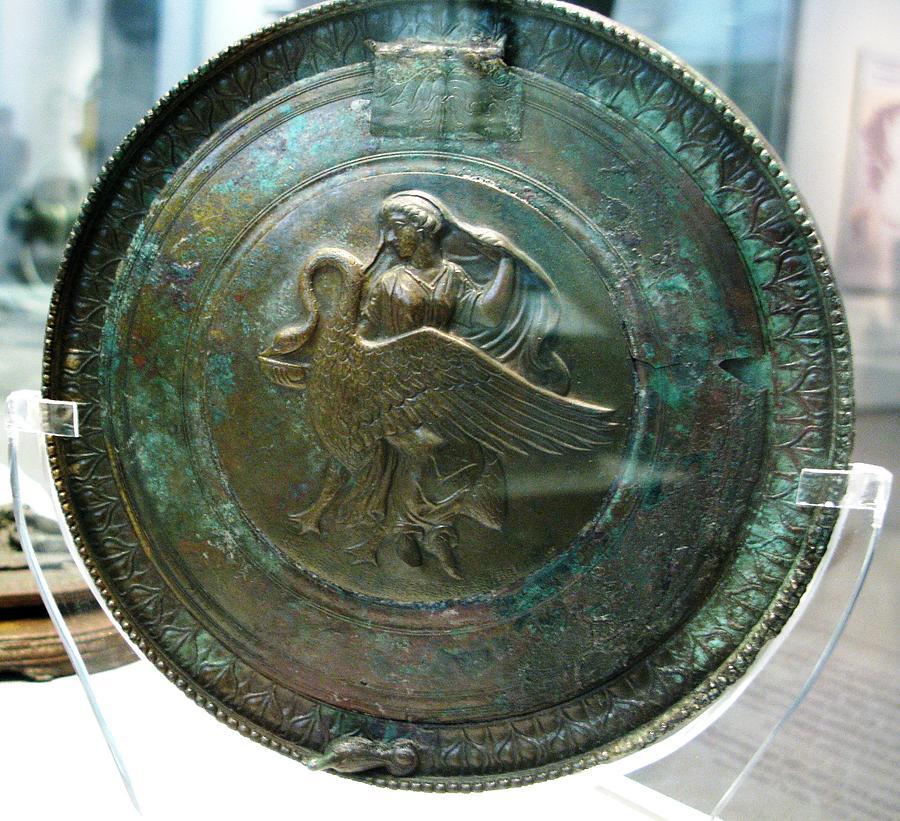
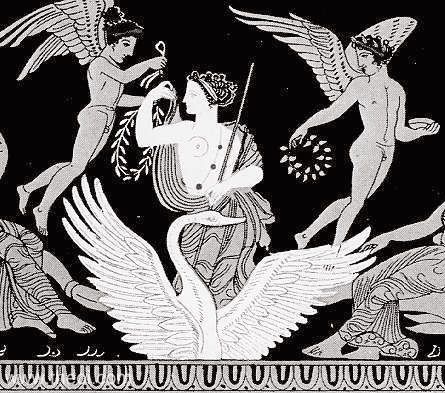
And many more. Some scholars think that these might be supposed to be geese instead of swans, in which case you could alternatively give her Animal (Goose), but we figured Swan fit with her aesthetic more. While we don't always give everyone an Animal association just because they appear with an animal in art a lot - sometimes the animal is just symbolic, or they have a myth that suggests it's not a good idea - Aphrodite is slim on associations like most Greek deities, and we figured she could use the help.
As for Fertility vs. Health, we're totally with you on the weirdness of that, but after doing as thorough a run through ancient Greek stories and descriptions of Aphrodite, that's where we ended up. Aphrodite is indeed associated with sex, but while Health does affect baby-making, it doesn't have a lot to do with the sex act itself beyond that, and so Aphrodite's strong connections to bangin' didn't really give her much of a connection there (although her Roman persona, Venus, is a little bit more linkable to Health as a concept). But the ancient Greeks connected human fertility and the fertility of the earth symbolically and even literally in many of their writings, so that Aphrodite is often praised as a bringer of earthly fertility despite not being a more classical plant-shaper. From Stasinus describing Aphrodite as eternally clothed in "crocus and hyacinth and flourishing violet and the rose's lovely bloom, so sweet and delicious, and heavenly buds, the flowers of the narcissus and lily; in such perfumed garments is Aphrodite clothed at all seasons," to the Homeric hymns stating that flowers spring up beneath her feet wherever she walks, plants turn up surprisingly frequently with Aphrodite. The reason is probably best summed up in Aeschylus' Danaides, in which Aphrodite herself describes the births of all the plants and trees and flowers of the world, and then claims, "Of all these things I am the cause," suggesting that because she is the motivator for sex which causes procreation, she is the root cause of all procreation of all life, even though she does not participate in the actual childbearing or mothering process.
Question: Shouldn't Hermes have Epic Dexterity and Illusion? Apologies if this has been answered already.
While Hermes certainly has decent amounts of both, neither was strong enough for us to want to give him the Ultimate expression of it. He does use Illusion occasionally, most notably in the tale where he makes himself a doppelgaenger of a man in order to drive him insane, but he doesn't do it all that often or all that impressively, so for the most part his trickery is probably the result of awesome Manipulation and Wits, and some low- to mid-level Illusion boons now and then. Dexterity doesn't really fit him, either; he does have the epithet "quick-footed", which helps, but for the most part the modern idea of him as super-fast comes from his role as messenger of the gods rather than any actual mythological association with speed of travel.
Question: Why does Njord have Fire associated?
Because of this passage in the Prose Edda:
The third among the Aesir is he that is called Njörd: he dwells in heaven, in the abode called Nóatún. He rules the course of the wind, and stills sea and fire; on him shall men call for voyages and for hunting.
Even more than Hel above, Njord suffers from the dearth of mythological information on the Aesir and Vanir. While his Water association as the god of the ocean is pretty solid, everything else tends to be like that - single statements that are clear, but don't have any other examples to back them up. Njord is supposed to be one of the most important and powerful of the Vanir, which is why he was traded to the Aesir in the first place, so we decided to give him Sky and Fire in spite of the lack of extra stories attached to them... but we feel like it's likely he may get demoted to a lot fewer associations in the future workup of lower-Legend gods. The Edda's very clear that he does those things, so we like them, but we also usually want more than one example, so thus is our quandary.
That's all our association questions for today - phew!
Friday, March 14, 2014
Living Words, Dead Religions
Question: I have heard that pre-Snorri oral tradition said that it was Utgard-Loki bound to the rock with venom dripping on him, and that Hod killed Baldur out of jealousy, and Loki was not even involved. Any thoughts on this?
Well, not really. The problem with pre-Snorri oral tradition is that it was oral, meaning it was never written down, which in turn means we have almost no idea what it could possibly have been about. We have literally no way of knowing what oral tradition was like in, say, first-century Iceland; we weren't there, and nobody wrote it down for us to learn about later, so it is an utter and total blank. They could have passed around oral tales of how Loki turned into an elephant and sucked the entire ocean into his trunk and then blew it back out in a shower of glittering rainbow sneezes and that's where the stars come from, for all we know.
Snorri's preservations of Icelandic mythology are from the thirteenth century and the Icelandic sagas are from the tenth, and along with the twelfth-century historical records of Saxo Grammaticus these are the earliest and most complete sources we still have. There are a few fragmentary poems from mainland German sources that are a little earlier (ninth or tenth century at best), but they're highly piecemeal and usually only mention mythological figures rather than recording any stories about them. But that's pretty much the entire extent of our sources for Norse mythology, which means that we know precious little about what happened before Christianity started coloring Norse religious ideas, and almost nothing about what oral stories might have been told in the many centuries before people started writing them down.
Like Greek mythology, the Norse legends of their gods and heroes enjoyed a sudden resurgence in popularity and study during teh nineteenth century, when mythology as a study discipline was firmly in vogue and the idea of the ancient yet noble religions and ideas of the ancestors of Europeans became a subject of much popular interest (and later, the Nazi party in twentieth-century Germany embraced some parts of Norse mythology as the indigenous religion of their "perfect race" and rewrote much of it in order to support their own agendas, which also helped keep the pantheon in the public eye). Unlike Greek mythology, however, Norse mythology didn't have a wealth of well-preserved epics and myths, just the few Icelandic and Danish sources that we already noted, and so scholars, as scholars always do, started making things up and trying to guess whether or not they were right.
Scholars love to theorize about Norse mythology and have been doing it for centuries, so I'm not surprised you've heard some theories about what pre-Snorri myths might have been like. Questions of whether or not some myths might be referencing Utgard-Loki instead of Loki are frequently popular, as well as the theory that the two figures are actually one and the same and their separation an accident of translation or the result of stories being confused over time. The idea of Hod killing Baldur out of jealousy actually probably comes from the Danish stories of Saxo Grammaticus, which we wrote about recently, in which Hod and Baldur are in direct conflict over Nanna and fight many battles for her love; because Hod wins Nanna in that story but she is married to Baldur in the Edda, scholars frequently theorize over what might have happened that changed that relationship and whether or not Hod might have "lost" her to him, resulting in a jealous motive for killing Baldur. Other theories of what pre-literate Norse myth might have been include the idea of Loki as a fire god (mostly based on extremely tenuous linguistic evidence, and a little bit of archaeology), the idea that Tyr was originally the All-Father and later superceded in importance by Odin's cult, the idea that Frigg and Freyja (as well as several other etymologically-similarly-named goddesses) were originally the same figure but were only separated in later myth, and a giant bucketful more on top of that.
So really, while Norse mythology certainly existed before Snorri, we can't know what it looked like. Early oral tradition hasn't been preserved, so all we know about it are guesses - very scholarly, very educated guesses, and that's definitely worth something, but guesses nonetheless! - and we therefore don't really know one way or the other whether either of the theories you mention are true. Unless new evidence about ancient Norse myths comes to light, we won't ever know one way or the other, which is one of those sad truths about mythology: we've probably forgotten at least as much as we remember, so learning about those old, old religions is a journey without an end. When it comes to Scion, each Storyteller has to basically choose which, if any, of the scholarly theories about Norse mythology they want to run with, because everyone's guess is pretty much as good as the next one's.
(It is important to note that orally-preserved mythology is no less real and importan, and that stories that have never been written down are not any less legitimate sources for studying a religion, but the different ways that oral mythologies have to be approached and the problems that academia has with accepting them in spite of their lack of citation are continuing issues in mythological studies, but that's a whole giant post on its own and I need to go to bed!)
Well, not really. The problem with pre-Snorri oral tradition is that it was oral, meaning it was never written down, which in turn means we have almost no idea what it could possibly have been about. We have literally no way of knowing what oral tradition was like in, say, first-century Iceland; we weren't there, and nobody wrote it down for us to learn about later, so it is an utter and total blank. They could have passed around oral tales of how Loki turned into an elephant and sucked the entire ocean into his trunk and then blew it back out in a shower of glittering rainbow sneezes and that's where the stars come from, for all we know.
Snorri's preservations of Icelandic mythology are from the thirteenth century and the Icelandic sagas are from the tenth, and along with the twelfth-century historical records of Saxo Grammaticus these are the earliest and most complete sources we still have. There are a few fragmentary poems from mainland German sources that are a little earlier (ninth or tenth century at best), but they're highly piecemeal and usually only mention mythological figures rather than recording any stories about them. But that's pretty much the entire extent of our sources for Norse mythology, which means that we know precious little about what happened before Christianity started coloring Norse religious ideas, and almost nothing about what oral stories might have been told in the many centuries before people started writing them down.
Like Greek mythology, the Norse legends of their gods and heroes enjoyed a sudden resurgence in popularity and study during teh nineteenth century, when mythology as a study discipline was firmly in vogue and the idea of the ancient yet noble religions and ideas of the ancestors of Europeans became a subject of much popular interest (and later, the Nazi party in twentieth-century Germany embraced some parts of Norse mythology as the indigenous religion of their "perfect race" and rewrote much of it in order to support their own agendas, which also helped keep the pantheon in the public eye). Unlike Greek mythology, however, Norse mythology didn't have a wealth of well-preserved epics and myths, just the few Icelandic and Danish sources that we already noted, and so scholars, as scholars always do, started making things up and trying to guess whether or not they were right.
Scholars love to theorize about Norse mythology and have been doing it for centuries, so I'm not surprised you've heard some theories about what pre-Snorri myths might have been like. Questions of whether or not some myths might be referencing Utgard-Loki instead of Loki are frequently popular, as well as the theory that the two figures are actually one and the same and their separation an accident of translation or the result of stories being confused over time. The idea of Hod killing Baldur out of jealousy actually probably comes from the Danish stories of Saxo Grammaticus, which we wrote about recently, in which Hod and Baldur are in direct conflict over Nanna and fight many battles for her love; because Hod wins Nanna in that story but she is married to Baldur in the Edda, scholars frequently theorize over what might have happened that changed that relationship and whether or not Hod might have "lost" her to him, resulting in a jealous motive for killing Baldur. Other theories of what pre-literate Norse myth might have been include the idea of Loki as a fire god (mostly based on extremely tenuous linguistic evidence, and a little bit of archaeology), the idea that Tyr was originally the All-Father and later superceded in importance by Odin's cult, the idea that Frigg and Freyja (as well as several other etymologically-similarly-named goddesses) were originally the same figure but were only separated in later myth, and a giant bucketful more on top of that.
So really, while Norse mythology certainly existed before Snorri, we can't know what it looked like. Early oral tradition hasn't been preserved, so all we know about it are guesses - very scholarly, very educated guesses, and that's definitely worth something, but guesses nonetheless! - and we therefore don't really know one way or the other whether either of the theories you mention are true. Unless new evidence about ancient Norse myths comes to light, we won't ever know one way or the other, which is one of those sad truths about mythology: we've probably forgotten at least as much as we remember, so learning about those old, old religions is a journey without an end. When it comes to Scion, each Storyteller has to basically choose which, if any, of the scholarly theories about Norse mythology they want to run with, because everyone's guess is pretty much as good as the next one's.
(It is important to note that orally-preserved mythology is no less real and importan, and that stories that have never been written down are not any less legitimate sources for studying a religion, but the different ways that oral mythologies have to be approached and the problems that academia has with accepting them in spite of their lack of citation are continuing issues in mythological studies, but that's a whole giant post on its own and I need to go to bed!)
Friday, February 21, 2014
Civil War
Question: Are there any myths about Baldr that aren't about him, you know, dying? Also, do we know if the Norse people thought Baldr was dead, or if his death had yet to happen?
Question: Why does Baldur have War associated?
Okay, this epic journey got deleted once, but never fear, it's back. Gather around, everyone, for Norse Storytime!
There are indeed myths about Baldur that are not about his death! However, they require a little bit more legwork to find. The major source for most of Norse mythology, the Edda preserved by Snorri Sturluson, only describe Baldur's prophetic dream of his coming death, his mother's attempts to prevent it and his eventual downfall at the hands of his blind brother Hod (with a little help from Loki). He then subsequently can't be rescued from Hel, and only returns to life after Ragnarok has wiped the slate clean for the entire universe. That's all the Edda really has to say about Baldur, and it probably is mostly designed to be prophetic stories of things that will happen, rather than that have already happened; certainly Ragnarok was still considered to be in the future, so Baldur's death, which kicks the whole thing off, is likewise probably in the future as well. You could decide that maybe Baldur is already dead and Loki imprisoned at this point, and the actual Ragnarok events past that haven't yet happened, but there's really no evidence one way or the other.
But Baldur is in fact doing other things in Norse and Germanic mythology besides just dying, so we are here to tell you all about them! First of all, there's a snippet of mythology preserved in a ninth-century German manuscript commonly called the Merseburg Charms; it contains several small mentions of various mythological figures and ideas, including Baldur, who appears (under his later Germanic name Phol) in a tale in which he is riding through the woods with Odin when his horse sprains its leg and halts the company. Frigg, Odin and the sun-goddess Sol all sing healing charms over the horse to help put it back together, and then they go on their merry way. There's no real context for this story, since it was being related mostly as an example of the kind of charm the manuscript was recording, and Baldur doesn't do much in it but look anxiously on, but he is in fact there and doing things with other gods.
However, the real showstopper is the story of Baldur, Hod and Nanna from the Gesta Danorum. The work (which means "History of the Danes") is by Saxo Grammaticus, a crusty old Danish historian from the twelfth century, who despite being Christian himself collected a great deal of indigenous European mythology and folklore for purposes of history and storytelling (incidentally, he's also one of our major sources for Slavic myth, too!). Saxo's stories are even more heavily euhemerized than Snorri's, and he's prone to frequently reminding the reader that gods aren't real and the ancient pagans were stupid, and he theorizes that figures like Odin were probably magicians who simply fooled the populace into thinking they were gods and later passed into legend; but he also preserves some great stories about the continental Germanic interpretations of the Norse gods that aren't included in Snorri's purely Icelandic Edda. Baldur gets an entire chapter in the Gesta Danorum, one full of interesting mythological ideas and alternative interpretations of themes we also see in the Edda and oh man, is he a busy dude.
The hero of the story actually isn't Baldur (here Latinized as Balderus) at all; it's his half-brother Hod (Hotherus), who is not blind at all in this tale but rather a mortal warrior and prince who has been fostering with King Gevar of Norway. He is described as athletic, strong, skilled in all sorts of sports and kinds of combat, and also an accomplished musician and orator. While living with King Gewar, he falls in love with Nanna, Gewar's daughter and a fan of all his awesome skills (in fact, they make a point of saying she falls in love with him because he's awesome even though he isn't very handsome, probably because he can't compete with Baldur in handsomeness later), and the two of them become lovers and make plans to marry.
Unfortunately, at this point Baldur arrives to utterly screw everything up for everyone. Baldur - handsome and awesome at war, as he is generally depicted in Norse mythology - happens to be passing by one day and catches a glimpse of Nanna bathing, and also falls hopelessy in love with her. He decides that nothing and no one, including Hod, is going to stand in his way when it comes to getting her hand in marriage, and sets off to go present himself to her father and ask for her. Hod, who is out hunting at the time, runs into some mysterious "wood-maidens" (probably valkyries, since they identify themselves as magical ladies in charge of warfare), who warn him about what Baldur is up to and caution him not to attack him, since Hod is a mere mortal man while Baldur (as the son of Odin) is a demigod and therefore out of his league. (Of course, Saxo doesn't believe anybody here is a god and will continue telling you so, but he explains it by saying that since Odin and Thor are great magicians, they have taught their art to Baldur and Hod is still outclassed.)
Hod doesn't believe his brother would do that, however, and suspects that the valkyries are a hallucination, so he ignores them and goes about his day; but he's in for a rude shock when he goes home to Norway, formally requests permission from Gewar to marry Nanna, and is told that Baldur already beat him to the punch. King Gewar, who thinks of Hod as a son, explains that he's very sorry, but Baldur's a demigod and he can't defeat him or afford to piss him off, so there was really nothing he could do except agree to the match. However, he does tell Hod that while Baldur is completely invulnerable to harm (Saxo doesn't say why, but it's most likely a reference to the familiar myth of Frigg weaving spells to prevent anything from hurting him), he's heard that there's a magic sword called Mistletoe (aha!) that is the only thing in the world that can hurt him, so Hod could conceivably defeat him if he found that. The sword is in the keeping of a "wood spirit" (described by different translators as a satyr, troll or other beastie) named Miming (probably referring to Mimir the giant in Norse myth), who also possesses a ring that always multiplies its owners wealth and sounds suspiciously similar to Odin's Draupnir.
So Hod sets off on a giant cross-country quest via reindeer-sled because of course Miming lives in the frozen northern reaches, and after camping out outside the cave where the creature lives for a few days, finally manages to jump him when he comes out, knock him down and tie him up, and proceed to threaten him until he gives up the treasures. He then heads home to confront his brother, although he is somewhat hampered by several local kings continually attacking his fleet when they realize he has awesome relics they would like to steal, and having to make a detour to go help an ally of his who is under attack by another kingdom.
But Baldur has not been just sitting around waiting for Hod to get back all this time; having gotten tired of Gewar's bullshitting and stalling for time, he girds up for war and rolls his whole army up to Gewar's castle to demand that he give Nanna up already. Gewar, still trying to play for time in the hopes that Hod will show up, tells him that he'll have to get consent from Nanna herself first, so Baldur spends a few days wooing her and trying to convince her that he's awesome and she'll love being married to him and that Hod dude wasn't all that great anyway. Nanna, however, is having none of his shenanigans, and refuses to marry him, giving the excuse that he's a demigod and she's a mortal, so she doesn't think this marriage would work out anyway. She, too, plays for more time by spending a few days coming up with creative ways to turn Baldur down while he gets more and more frustrated.
At about the point where Norway is about to have to either hold a wedding or get conquered, Hod finally makes it back into town, and attacks Baldur's forces with his own, touching off a massive naval battle in the royal harbor. Baldur's not about to take this lying down, and he calls in the cavalry - Odin and Thor, who arrive to start laying waste to Hod's forces and generally enjoying their Courage Virtue all over the landscape. Hod's army is in danger of being routed, since Thor alone is taking out entire regiments with every swing, but Hod saves the day by diving into the fray, managing to get up close to Thor, and cutting off part of Mjolnir's handle, which upsets the other god so much that he withdraws and the battle ends in stalemate. (This is in contrast to the Icelandic story in which Mjolnir's handle is shorter than it should be because of problems in the crafting process, but it's clearly the same idea being presented, even though Saxo refers to the weapon as a club instead of a hammer.) Baldur has to retreat with Odin and Thor, so Hod takes advantage of this opportunity to finally go home and marry Nanna, who is very happy to see him, and the two of them move to Sweden where the local rulers have invited him to become king.
Baldur is not done throwing a raging tantrum over this, however, so he marshals together his army and marches on Sweden, where he decimates Hod's armies and forces his brother and Nanna to flee back to her father's castle in Norway. Baldur chases them with his army, creating magical springs for his men to drink from all along the way, but he is tormented by terrible nightmares of Nanna in his brother's arms and visions of how much she doesn't love him, which cause him to become crazier and crazier as well as taking a physical toll on him.
Hod, correctly assuming that he's going to get his ass kicked and his wife kidnapped if he doesn't get an army together quickly, runs to Denmark, where the previous king has recently died, and makes himself king there. His stability is short-lived, however, because while he's out visiting his Swedish lands, Baldur also arrives in Denmark, where the people realize that he's so awesome that they want to elect him king instead; Hod gets back in time to try to fight him for the crown, but is losing badly again in short order and once again has to run for it to avoid being captured or killed by Baldur's forces.
At this point, things are going so badly for Hod that he spends a while just wandering sadly in the wilderness, wondering how his life got to this point and what he could possibly do to try to fix things. While doing so, he runs into some mysterious magical women who live in a cave deep in the forest (Saxo says it's valkyries again, but their behavior makes them more similar to the Norns), who tell him to get his shit together because he is currently doing a piss-poor job of achieving his destiny. They remind him that he has magical Baldur-killing relics, and furthermore tell him that Baldur eats a magical food every day to keep him divinely strong (possibly a related myth to the idea of the Aesir eating the apples of Idun), and that if he can get hold of some of it, he can be on an even playing field with his enemy.
So Baldur and Hod go to war again, causing massive slaughter and destruction all over the Danish landscape, while Hod quietly spies on Baldur's camp and tries to figure out how to get some of this magical foodstuff that can help him win. He eventually successfully disguises himself as an unremarkable soldier and manages to sneak his way in, where he woos the three maidens (again, possibly the Norns?) in charge of Baldur's food with his skills as a musician and convinces them that they should help him. They still refuse to give him any of Baldur's food, since that would break their vows to help Baldur, but they do give him a belt and girdle that ensure that the wearer will be victorious (they aren't aware that they're actually talking to Hod, and think they're just helping some good-hearted soldier survive the daily bloodbath out there).
Finally sure of success and covered in magical relics and prizes, Hod manages to waylay Baldur on his way back to camp and stabs him fatally with Mistletoe before returning to his army. Baldur, who knows he is dying but still refuses to back down or admit defeat, continues to command his troops and forces them to carry him out into battle when he can't walk anymore, until finally he has a vision of Hel (Saxo calls her Proserpina, using the Roman goddess of death as a stand-in for the Norse one) telling him that he will be with her on the morrow (very similar to his prophetic vision of his death in the Edda). He dies the next morning after three days of misery from his wound, still feverishly dreaming of Nanna, and Hod is able to finally win the battle now that Baldur's forces are leaderless and in disarray. Denmark holds a massive nation-wide mourning period for their fallen leader, and after that the story continues on with the familiar tale of Odin raping Rind in order to give birth to Vali so that he can kill Hod and avenge Baldur's death.
So, to answer the second question up there, Baldur has War associated because he is the most warringest warrior ever to war. Baldur's answer to everything is to get an army and go administer a military beatdown upon whomever is upsetting him, and with the exception of the single battle in which he is forced to withdraw with Thor and Odin, he also always wins. Even when he was dying of his wounds, he continued commanding his forces to victory from a litter in the middle of the battlefield. He's hardcore.
While there are a lot of details in Saxo's account that are close to those in Snorri's (Thor wielding a mighty weapon with a shortened handle, "mistletoe" being the only thing that can hurt Baldur and so on), there are also various issues that definitely don't match up, leaving the field open for different Storytellers to have a lot of different interpretations of what happened here. Scion: Ragnarok takes the approach that all three of these Norse gods involved - Baldur, Hod and Nanna - were Scions, and that this battle over the woman both brothers loved took place while they were demigods and still active in the World. That interpretation then leaves everyone free to go on to Snorri's prophecies of doom without too much story conflict.
But it doesn't solve everything. The most glaring inconsistency is Nanna herself; in Saxo's account, she is in love with Hod and marries him, but in the Edda, she is described as Baldur's wife and there is no mention anywhere of any conflict over that arrangement. If they were all demigods when this happened, what changed between then and now to make her leave one brother for the other? Was it just that Baldur became irresistibly hot and charismatic and she couldn't help herself, leaving Hod destitute and unable to compete? Did Odin come in and lay down the law on behalf of his favorite son? What about Hod's blindness - when and how did he become blind, and is that involved at all? Was it a punishment for his acts against Baldur, or was it the result of some accident we don't know about, or even self-inflicted in despair after losing his wife? If Baldur did steal Nanna away from Hod at some point, does she still have feelings for her former husband, and how do they interact socially and politically? If Hod resents Baldur for taking his wife, how does he reconcile that with Baldur's incredible beauty and charm, and is he really totally innocent when it comes to killing Baldur with the mistletoe spear? Was Loki involved in Baldur's death at all, or was this finally Hod's revenge - or, if he didn't mean to kill his brother, what kind of effect would this second accidental murder that echoes the first have on him and Nanna? Is one story true and the other completely made up by someone else, and if so, which one is the true one? And if we believe Saxo and Hod truly killed Baldur when they were only demigods, how is he even alive again in the first place?
These myths do not fit neatly together, so the answers to those questions lie primarily with the Storyteller. We have definitely enjoyed exploring the relationship between Baldur, Nanna and Hod in our games and fiction, but even so there are still unanswered questions out there for any game to make a call on.
But Baldur himself is definitely doing more in Norse/Germanic myth than just dying. Even if he does do that spectacularly and with more frequency than pretty much anyone else.
Question: Why does Baldur have War associated?
Okay, this epic journey got deleted once, but never fear, it's back. Gather around, everyone, for Norse Storytime!
There are indeed myths about Baldur that are not about his death! However, they require a little bit more legwork to find. The major source for most of Norse mythology, the Edda preserved by Snorri Sturluson, only describe Baldur's prophetic dream of his coming death, his mother's attempts to prevent it and his eventual downfall at the hands of his blind brother Hod (with a little help from Loki). He then subsequently can't be rescued from Hel, and only returns to life after Ragnarok has wiped the slate clean for the entire universe. That's all the Edda really has to say about Baldur, and it probably is mostly designed to be prophetic stories of things that will happen, rather than that have already happened; certainly Ragnarok was still considered to be in the future, so Baldur's death, which kicks the whole thing off, is likewise probably in the future as well. You could decide that maybe Baldur is already dead and Loki imprisoned at this point, and the actual Ragnarok events past that haven't yet happened, but there's really no evidence one way or the other.
But Baldur is in fact doing other things in Norse and Germanic mythology besides just dying, so we are here to tell you all about them! First of all, there's a snippet of mythology preserved in a ninth-century German manuscript commonly called the Merseburg Charms; it contains several small mentions of various mythological figures and ideas, including Baldur, who appears (under his later Germanic name Phol) in a tale in which he is riding through the woods with Odin when his horse sprains its leg and halts the company. Frigg, Odin and the sun-goddess Sol all sing healing charms over the horse to help put it back together, and then they go on their merry way. There's no real context for this story, since it was being related mostly as an example of the kind of charm the manuscript was recording, and Baldur doesn't do much in it but look anxiously on, but he is in fact there and doing things with other gods.
However, the real showstopper is the story of Baldur, Hod and Nanna from the Gesta Danorum. The work (which means "History of the Danes") is by Saxo Grammaticus, a crusty old Danish historian from the twelfth century, who despite being Christian himself collected a great deal of indigenous European mythology and folklore for purposes of history and storytelling (incidentally, he's also one of our major sources for Slavic myth, too!). Saxo's stories are even more heavily euhemerized than Snorri's, and he's prone to frequently reminding the reader that gods aren't real and the ancient pagans were stupid, and he theorizes that figures like Odin were probably magicians who simply fooled the populace into thinking they were gods and later passed into legend; but he also preserves some great stories about the continental Germanic interpretations of the Norse gods that aren't included in Snorri's purely Icelandic Edda. Baldur gets an entire chapter in the Gesta Danorum, one full of interesting mythological ideas and alternative interpretations of themes we also see in the Edda and oh man, is he a busy dude.
The hero of the story actually isn't Baldur (here Latinized as Balderus) at all; it's his half-brother Hod (Hotherus), who is not blind at all in this tale but rather a mortal warrior and prince who has been fostering with King Gevar of Norway. He is described as athletic, strong, skilled in all sorts of sports and kinds of combat, and also an accomplished musician and orator. While living with King Gewar, he falls in love with Nanna, Gewar's daughter and a fan of all his awesome skills (in fact, they make a point of saying she falls in love with him because he's awesome even though he isn't very handsome, probably because he can't compete with Baldur in handsomeness later), and the two of them become lovers and make plans to marry.
Unfortunately, at this point Baldur arrives to utterly screw everything up for everyone. Baldur - handsome and awesome at war, as he is generally depicted in Norse mythology - happens to be passing by one day and catches a glimpse of Nanna bathing, and also falls hopelessy in love with her. He decides that nothing and no one, including Hod, is going to stand in his way when it comes to getting her hand in marriage, and sets off to go present himself to her father and ask for her. Hod, who is out hunting at the time, runs into some mysterious "wood-maidens" (probably valkyries, since they identify themselves as magical ladies in charge of warfare), who warn him about what Baldur is up to and caution him not to attack him, since Hod is a mere mortal man while Baldur (as the son of Odin) is a demigod and therefore out of his league. (Of course, Saxo doesn't believe anybody here is a god and will continue telling you so, but he explains it by saying that since Odin and Thor are great magicians, they have taught their art to Baldur and Hod is still outclassed.)
Hod doesn't believe his brother would do that, however, and suspects that the valkyries are a hallucination, so he ignores them and goes about his day; but he's in for a rude shock when he goes home to Norway, formally requests permission from Gewar to marry Nanna, and is told that Baldur already beat him to the punch. King Gewar, who thinks of Hod as a son, explains that he's very sorry, but Baldur's a demigod and he can't defeat him or afford to piss him off, so there was really nothing he could do except agree to the match. However, he does tell Hod that while Baldur is completely invulnerable to harm (Saxo doesn't say why, but it's most likely a reference to the familiar myth of Frigg weaving spells to prevent anything from hurting him), he's heard that there's a magic sword called Mistletoe (aha!) that is the only thing in the world that can hurt him, so Hod could conceivably defeat him if he found that. The sword is in the keeping of a "wood spirit" (described by different translators as a satyr, troll or other beastie) named Miming (probably referring to Mimir the giant in Norse myth), who also possesses a ring that always multiplies its owners wealth and sounds suspiciously similar to Odin's Draupnir.
So Hod sets off on a giant cross-country quest via reindeer-sled because of course Miming lives in the frozen northern reaches, and after camping out outside the cave where the creature lives for a few days, finally manages to jump him when he comes out, knock him down and tie him up, and proceed to threaten him until he gives up the treasures. He then heads home to confront his brother, although he is somewhat hampered by several local kings continually attacking his fleet when they realize he has awesome relics they would like to steal, and having to make a detour to go help an ally of his who is under attack by another kingdom.
But Baldur has not been just sitting around waiting for Hod to get back all this time; having gotten tired of Gewar's bullshitting and stalling for time, he girds up for war and rolls his whole army up to Gewar's castle to demand that he give Nanna up already. Gewar, still trying to play for time in the hopes that Hod will show up, tells him that he'll have to get consent from Nanna herself first, so Baldur spends a few days wooing her and trying to convince her that he's awesome and she'll love being married to him and that Hod dude wasn't all that great anyway. Nanna, however, is having none of his shenanigans, and refuses to marry him, giving the excuse that he's a demigod and she's a mortal, so she doesn't think this marriage would work out anyway. She, too, plays for more time by spending a few days coming up with creative ways to turn Baldur down while he gets more and more frustrated.
At about the point where Norway is about to have to either hold a wedding or get conquered, Hod finally makes it back into town, and attacks Baldur's forces with his own, touching off a massive naval battle in the royal harbor. Baldur's not about to take this lying down, and he calls in the cavalry - Odin and Thor, who arrive to start laying waste to Hod's forces and generally enjoying their Courage Virtue all over the landscape. Hod's army is in danger of being routed, since Thor alone is taking out entire regiments with every swing, but Hod saves the day by diving into the fray, managing to get up close to Thor, and cutting off part of Mjolnir's handle, which upsets the other god so much that he withdraws and the battle ends in stalemate. (This is in contrast to the Icelandic story in which Mjolnir's handle is shorter than it should be because of problems in the crafting process, but it's clearly the same idea being presented, even though Saxo refers to the weapon as a club instead of a hammer.) Baldur has to retreat with Odin and Thor, so Hod takes advantage of this opportunity to finally go home and marry Nanna, who is very happy to see him, and the two of them move to Sweden where the local rulers have invited him to become king.
Baldur is not done throwing a raging tantrum over this, however, so he marshals together his army and marches on Sweden, where he decimates Hod's armies and forces his brother and Nanna to flee back to her father's castle in Norway. Baldur chases them with his army, creating magical springs for his men to drink from all along the way, but he is tormented by terrible nightmares of Nanna in his brother's arms and visions of how much she doesn't love him, which cause him to become crazier and crazier as well as taking a physical toll on him.
Hod, correctly assuming that he's going to get his ass kicked and his wife kidnapped if he doesn't get an army together quickly, runs to Denmark, where the previous king has recently died, and makes himself king there. His stability is short-lived, however, because while he's out visiting his Swedish lands, Baldur also arrives in Denmark, where the people realize that he's so awesome that they want to elect him king instead; Hod gets back in time to try to fight him for the crown, but is losing badly again in short order and once again has to run for it to avoid being captured or killed by Baldur's forces.
At this point, things are going so badly for Hod that he spends a while just wandering sadly in the wilderness, wondering how his life got to this point and what he could possibly do to try to fix things. While doing so, he runs into some mysterious magical women who live in a cave deep in the forest (Saxo says it's valkyries again, but their behavior makes them more similar to the Norns), who tell him to get his shit together because he is currently doing a piss-poor job of achieving his destiny. They remind him that he has magical Baldur-killing relics, and furthermore tell him that Baldur eats a magical food every day to keep him divinely strong (possibly a related myth to the idea of the Aesir eating the apples of Idun), and that if he can get hold of some of it, he can be on an even playing field with his enemy.
So Baldur and Hod go to war again, causing massive slaughter and destruction all over the Danish landscape, while Hod quietly spies on Baldur's camp and tries to figure out how to get some of this magical foodstuff that can help him win. He eventually successfully disguises himself as an unremarkable soldier and manages to sneak his way in, where he woos the three maidens (again, possibly the Norns?) in charge of Baldur's food with his skills as a musician and convinces them that they should help him. They still refuse to give him any of Baldur's food, since that would break their vows to help Baldur, but they do give him a belt and girdle that ensure that the wearer will be victorious (they aren't aware that they're actually talking to Hod, and think they're just helping some good-hearted soldier survive the daily bloodbath out there).
Finally sure of success and covered in magical relics and prizes, Hod manages to waylay Baldur on his way back to camp and stabs him fatally with Mistletoe before returning to his army. Baldur, who knows he is dying but still refuses to back down or admit defeat, continues to command his troops and forces them to carry him out into battle when he can't walk anymore, until finally he has a vision of Hel (Saxo calls her Proserpina, using the Roman goddess of death as a stand-in for the Norse one) telling him that he will be with her on the morrow (very similar to his prophetic vision of his death in the Edda). He dies the next morning after three days of misery from his wound, still feverishly dreaming of Nanna, and Hod is able to finally win the battle now that Baldur's forces are leaderless and in disarray. Denmark holds a massive nation-wide mourning period for their fallen leader, and after that the story continues on with the familiar tale of Odin raping Rind in order to give birth to Vali so that he can kill Hod and avenge Baldur's death.
So, to answer the second question up there, Baldur has War associated because he is the most warringest warrior ever to war. Baldur's answer to everything is to get an army and go administer a military beatdown upon whomever is upsetting him, and with the exception of the single battle in which he is forced to withdraw with Thor and Odin, he also always wins. Even when he was dying of his wounds, he continued commanding his forces to victory from a litter in the middle of the battlefield. He's hardcore.
While there are a lot of details in Saxo's account that are close to those in Snorri's (Thor wielding a mighty weapon with a shortened handle, "mistletoe" being the only thing that can hurt Baldur and so on), there are also various issues that definitely don't match up, leaving the field open for different Storytellers to have a lot of different interpretations of what happened here. Scion: Ragnarok takes the approach that all three of these Norse gods involved - Baldur, Hod and Nanna - were Scions, and that this battle over the woman both brothers loved took place while they were demigods and still active in the World. That interpretation then leaves everyone free to go on to Snorri's prophecies of doom without too much story conflict.
But it doesn't solve everything. The most glaring inconsistency is Nanna herself; in Saxo's account, she is in love with Hod and marries him, but in the Edda, she is described as Baldur's wife and there is no mention anywhere of any conflict over that arrangement. If they were all demigods when this happened, what changed between then and now to make her leave one brother for the other? Was it just that Baldur became irresistibly hot and charismatic and she couldn't help herself, leaving Hod destitute and unable to compete? Did Odin come in and lay down the law on behalf of his favorite son? What about Hod's blindness - when and how did he become blind, and is that involved at all? Was it a punishment for his acts against Baldur, or was it the result of some accident we don't know about, or even self-inflicted in despair after losing his wife? If Baldur did steal Nanna away from Hod at some point, does she still have feelings for her former husband, and how do they interact socially and politically? If Hod resents Baldur for taking his wife, how does he reconcile that with Baldur's incredible beauty and charm, and is he really totally innocent when it comes to killing Baldur with the mistletoe spear? Was Loki involved in Baldur's death at all, or was this finally Hod's revenge - or, if he didn't mean to kill his brother, what kind of effect would this second accidental murder that echoes the first have on him and Nanna? Is one story true and the other completely made up by someone else, and if so, which one is the true one? And if we believe Saxo and Hod truly killed Baldur when they were only demigods, how is he even alive again in the first place?
These myths do not fit neatly together, so the answers to those questions lie primarily with the Storyteller. We have definitely enjoyed exploring the relationship between Baldur, Nanna and Hod in our games and fiction, but even so there are still unanswered questions out there for any game to make a call on.
But Baldur himself is definitely doing more in Norse/Germanic myth than just dying. Even if he does do that spectacularly and with more frequency than pretty much anyone else.
Tuesday, February 4, 2014
Doomed and Doleful
Question: Why does Odin not have Prophecy?
I was sure we had answered this before. In fact, I was so sure I spent about half an hour searching the blog archives trying to find it. But I failed, so I must be hallucinating from the pain medication, or maybe remembering talking about it on the old White Wolf forums or something.
Anyway, Odin doesn't have Prophecy because he does not perform, inspire or appear to be associated with prophecies in any myths. In fact, he clearly doesn't have prophecies, because while we see others around him have visions or be said to have prophetic foreknowledge, including Frigg and Baldur, Odin never does, and when he wants to know the future, he actually has to outsource that job to someone else who does it for him.
The most obvious example of this is the Voluspa, the major poem in which the prophecies of Ragnarok are related. The entire premise of the poem is that after being troubled by the idea that something bad is coming, Odin seeks out and disinters a dead voelva, a wise-woman and prophetess who can see the future. He demands that she perform divinations for him and tell him about events yet to come, which she does against her will because he compels her with his powers over magic and the dead; over and over throughout the poem, she relates some of the prophecies of Ragnarok and then begs him to let her go back to her rest, only to be told that she will not be released until she tells him everything. Only at the poem's end, when she has finally told him everything to come, is the voelva allowed to return to her grave.
This is a pretty major example of Odin clearly not having Prophecy; if he had the ability to see the future, why would he need to go hunt up an oracle elsewhere and bother her until she did it for him? Similarly, the prophecies of Baldur's doom are given to Baldur himself in a dream, but Odin never sees or expands on them, and it's Frigg - also said to have the gift of prophecy but to refuse to tell anyone about her visions - who must try to interpret it for him. Odin himself never experiences visions of the future, reads omens of things to come or manages to do more than get uncomfortable when these things are happening to others; he knows something is going on, but apparently lacks the ability to discover exactly what. Even the few times he does directly tell someone that they're doomed or something is about to happen to them, such as when he does so to King Geirrod, he's not really delivering a prophecy so much as declaring his intent to fuck that person up.
So, no Prophecy associated for Odin. Considering that he demonstrates an obvious inability to do prophecy by himself and that as a god his role is to be a manipulator of Fate and ultimately destroyed by it, we think he probably has few or even no boons in that purview. His hanging of himself from the World Tree in order to gain secret knowledge is better expressed as an association with Mystery, which represents his connection to hidden knowledge.
I was sure we had answered this before. In fact, I was so sure I spent about half an hour searching the blog archives trying to find it. But I failed, so I must be hallucinating from the pain medication, or maybe remembering talking about it on the old White Wolf forums or something.
Anyway, Odin doesn't have Prophecy because he does not perform, inspire or appear to be associated with prophecies in any myths. In fact, he clearly doesn't have prophecies, because while we see others around him have visions or be said to have prophetic foreknowledge, including Frigg and Baldur, Odin never does, and when he wants to know the future, he actually has to outsource that job to someone else who does it for him.
The most obvious example of this is the Voluspa, the major poem in which the prophecies of Ragnarok are related. The entire premise of the poem is that after being troubled by the idea that something bad is coming, Odin seeks out and disinters a dead voelva, a wise-woman and prophetess who can see the future. He demands that she perform divinations for him and tell him about events yet to come, which she does against her will because he compels her with his powers over magic and the dead; over and over throughout the poem, she relates some of the prophecies of Ragnarok and then begs him to let her go back to her rest, only to be told that she will not be released until she tells him everything. Only at the poem's end, when she has finally told him everything to come, is the voelva allowed to return to her grave.
This is a pretty major example of Odin clearly not having Prophecy; if he had the ability to see the future, why would he need to go hunt up an oracle elsewhere and bother her until she did it for him? Similarly, the prophecies of Baldur's doom are given to Baldur himself in a dream, but Odin never sees or expands on them, and it's Frigg - also said to have the gift of prophecy but to refuse to tell anyone about her visions - who must try to interpret it for him. Odin himself never experiences visions of the future, reads omens of things to come or manages to do more than get uncomfortable when these things are happening to others; he knows something is going on, but apparently lacks the ability to discover exactly what. Even the few times he does directly tell someone that they're doomed or something is about to happen to them, such as when he does so to King Geirrod, he's not really delivering a prophecy so much as declaring his intent to fuck that person up.
So, no Prophecy associated for Odin. Considering that he demonstrates an obvious inability to do prophecy by himself and that as a god his role is to be a manipulator of Fate and ultimately destroyed by it, we think he probably has few or even no boons in that purview. His hanging of himself from the World Tree in order to gain secret knowledge is better expressed as an association with Mystery, which represents his connection to hidden knowledge.
Sunday, January 5, 2014
Broken Bonds
Question: How do Tyr and Fenris feel about each other?
Not wonderful, we imagine.
Tyr and Fenrir are complementary figures in the myth of the binding of the wolf; Fenrir is the great fear, the monster that even all the other Aesir are too afraid to approach, while Tyr is the god who possesses the most bravery and courage and is therefore the only one who can deal with him on an even footing. It's not hard to guess that they probably have some (okay, a lot of) animosity toward one another from that myth; Fenrir was promised by the Aesir that the ribbon he was being tied with was not a trick, a promise that turned out to be false, while Tyr lost his hand to the wolf's gnashing vengeance.
The breaking of an oath was a very big deal in Norse culture, to the point that most people who do it are swiftly punished in Norse myth and the term "oath-breaker" is used as a major insult not to be slung around lightly, so Tyr having made a guarantee to Fenrir that everything was going to be fine here is not something the wolf is ever going to forget, even if it didn't also have the very nasty side effect of getting him put in jail for literally the entire lifespan of the earth. Whether or not there was an official oath or just a lot of lying is unclear from the Edda, so your interpretation is as good as ours, but there was certainly an element of betrayal in the wolf's decision to trust the Aesir, represented by Tyr, and their subsequent binding of him. Tyr (who may have been symbolically "punished" for his false promise with the immediate loss of his hand) is not likely to be very happy about the monster that rendered him handicapped, either - he might have known that was going to happen and intentionally taken one for the team, but that doesn't mean he's going to therefore forgive and forget.
What might add a more interesting shade to their relationship, however, is the fact that Tyr is also the only one of the Aesir (other than Loki) who might have had a pre-existing connection with the wolf before the decision to bind him was made. In the Edda, it is said that the Aesir brought Fenrir to live with them in Asgard instead of his original home in Jotunheim, the only one of Loki's three monstrous children to explicitly get such treatment; why they did this is anybody's guess, although one of our favorite theories is that Odin (who already has some connection with wolves thanks to his position as god of battle and carnage) was hoping to use the wolf as a servant the way he does Loki's other son Sleipnir, and later realized that Fenrir was too dangerous to try to be brought to heel by the gods. It's also possible that the Aesir might have taken in one of Loki's children as a gesture of goodwill, since Loki is after all the All-Father's blood-brother and therefore killing off or imprisoning all his children without at least making an effort might be a politically thorny prospect, but that's also just a theory. Loki's never around when the Aesir are binding his children (yeah, dude, where is he?), so we don't get any input on what he thinks of the situation.
But, anyway, Fenrir lives in Asgard for a little while, or at least in close proximity to the gods, who are trying to keep an eye on him. However, he's so terrifying that none of them want to go near him, and therefore it's once again Tyr, god of being way braver than you, who is the only one who can handle interacting with the great canine menace. It becomes Tyr's job to feed Fenrir, which he does regularly while the other Aesir quietly freak out about how much meat the wolf eats, and that means that we have an interesting question of how much time the two of them might have spent together and whether or not they had any pre-existing relationship. Normal animals tend to be fond of, or at least trusting of, people who regularly feed them, so there may be more than one reason it had to be Tyr to calm Fenrir down and get him bound than just that god's stunning amount of heroism. Fenrir is also sapient, capable of thinking, conversing and interacting with the gods on their level, which also begs the question of what feeding him was like. The Edda never tell us - did he and Tyr ever talk? Did they hang out? What did Fenrir think of being held in Asgard away from the rest of his family, and of the other Aesir avoiding him? What did he think of Tyr?
We don't know any of this, because Fenrir's point of view is not addressed in Norse mythology until the binding myth occurs, at which point his point of view becomes "suspicious" followed by "very, very pissed off". However, there's a wealth of possibility there for Storytellers to monkey around with if they want to do something interesting, plot-wise, with the god of courage and the wolf of fear. It's not a stretch to think they were on at least cordial terms, possibly even friends, thanks to Tyr being the only real contact Fenrir had among the Aesir; so the betrayal of the binding and the violent removal of Tyr's hand afterward might have been doubly devastating for both parties, each of which trusted the other and were proven wrong. That's a rift that probably won't ever heal, no matter what you think they thought about each other before it happened.
Another interesting point here is the prophesied battle between Tyr and the hound Garm at Ragnarok, which Storytellers might want to tie in to the whole Tyr-Fenrir mess. Garm is a discrete character in Norse mythology, the bloody watcher at the gates of Hel, similar in role to other dogs that guard underworlds; however, while the poetic Edda mentions him several times in connection with death and the afterlife, only one line in the prose Edda claims that he will be involved in Ragnarok, when Snorri specifically says he'll come fight Tyr and both figures will be killed. Scholars have debated whether or not the fight between Tyr and Garm is legit for centuries; some believe that it probably refers to a myth that simply hasn't been written down anywhere else, a common problem in Norse mythology, while others point out that Snorri does a lot of editorializing and believe that it's just as likely he invented the combat between them for his own reasons since it's never mentioned or depicted in any art anywhere else.
There are a lot of questions about what this means, and as usual a veritable stew of scholarly suppositions and suggestions to answer them. One theory is that Snorri simply confused Garm and Fenrir, and thought that the two monstrous canines were the same beast, therefore repeating the original myth of their opposition in the context of Ragnarok. Another is that Snorri, seeking to balance the deaths of the Aesir and the myth of the resurrection of the world as evenly as possible, needed to give a story removing Tyr from the equation and therefore dredged up the idea of him killed by a great wolf or dog as a continuation of the story of his animosity with Fenrir, pulling Garm in as one of the only major canine monsters left who wasn't already doing something at Ragnarok. Another is that Garm, in spite of being said to be a dog rather than a wolf, may be one of the spawn of Fenrir like Hati and Skoll and that therefore he targets Tyr at Ragnarok in order to take vengeance for his monstrous father. And another is that there was originally a myth in which Fenrir comes after Tyr at Ragnarok as well as Odin - his direct betrayer as well as the king of the gods who conspired to bind him - and Snorri accidentally substituted Garm for the wolf, either because he misread something or thought that it was a continuity error to have the wolf attacking (and killed by) two different gods at the same battle. Even further down the well of scholar craziness, there are also theories that suggest that all evil canines in Norse mythology are really Fenrir, simply being called by different names or only split into different creatures late in Norse mythology, so therefore even if Tyr is fighting Garm, he's really fighting Fenrir anyway.
So, like a lot of Norse myth, there's a lot of room for interpretation since our sources are kind of scarce. Personally, we're inclined to think that there's a lot of soreness and broken trust between those two, and that both of them probably hate the other with a passion born from betrayal and shock at one anothers' actions and would love to visit vengeance upon them for doing such a thing to a one-time friend.
Not wonderful, we imagine.
Tyr and Fenrir are complementary figures in the myth of the binding of the wolf; Fenrir is the great fear, the monster that even all the other Aesir are too afraid to approach, while Tyr is the god who possesses the most bravery and courage and is therefore the only one who can deal with him on an even footing. It's not hard to guess that they probably have some (okay, a lot of) animosity toward one another from that myth; Fenrir was promised by the Aesir that the ribbon he was being tied with was not a trick, a promise that turned out to be false, while Tyr lost his hand to the wolf's gnashing vengeance.
The breaking of an oath was a very big deal in Norse culture, to the point that most people who do it are swiftly punished in Norse myth and the term "oath-breaker" is used as a major insult not to be slung around lightly, so Tyr having made a guarantee to Fenrir that everything was going to be fine here is not something the wolf is ever going to forget, even if it didn't also have the very nasty side effect of getting him put in jail for literally the entire lifespan of the earth. Whether or not there was an official oath or just a lot of lying is unclear from the Edda, so your interpretation is as good as ours, but there was certainly an element of betrayal in the wolf's decision to trust the Aesir, represented by Tyr, and their subsequent binding of him. Tyr (who may have been symbolically "punished" for his false promise with the immediate loss of his hand) is not likely to be very happy about the monster that rendered him handicapped, either - he might have known that was going to happen and intentionally taken one for the team, but that doesn't mean he's going to therefore forgive and forget.
What might add a more interesting shade to their relationship, however, is the fact that Tyr is also the only one of the Aesir (other than Loki) who might have had a pre-existing connection with the wolf before the decision to bind him was made. In the Edda, it is said that the Aesir brought Fenrir to live with them in Asgard instead of his original home in Jotunheim, the only one of Loki's three monstrous children to explicitly get such treatment; why they did this is anybody's guess, although one of our favorite theories is that Odin (who already has some connection with wolves thanks to his position as god of battle and carnage) was hoping to use the wolf as a servant the way he does Loki's other son Sleipnir, and later realized that Fenrir was too dangerous to try to be brought to heel by the gods. It's also possible that the Aesir might have taken in one of Loki's children as a gesture of goodwill, since Loki is after all the All-Father's blood-brother and therefore killing off or imprisoning all his children without at least making an effort might be a politically thorny prospect, but that's also just a theory. Loki's never around when the Aesir are binding his children (yeah, dude, where is he?), so we don't get any input on what he thinks of the situation.
But, anyway, Fenrir lives in Asgard for a little while, or at least in close proximity to the gods, who are trying to keep an eye on him. However, he's so terrifying that none of them want to go near him, and therefore it's once again Tyr, god of being way braver than you, who is the only one who can handle interacting with the great canine menace. It becomes Tyr's job to feed Fenrir, which he does regularly while the other Aesir quietly freak out about how much meat the wolf eats, and that means that we have an interesting question of how much time the two of them might have spent together and whether or not they had any pre-existing relationship. Normal animals tend to be fond of, or at least trusting of, people who regularly feed them, so there may be more than one reason it had to be Tyr to calm Fenrir down and get him bound than just that god's stunning amount of heroism. Fenrir is also sapient, capable of thinking, conversing and interacting with the gods on their level, which also begs the question of what feeding him was like. The Edda never tell us - did he and Tyr ever talk? Did they hang out? What did Fenrir think of being held in Asgard away from the rest of his family, and of the other Aesir avoiding him? What did he think of Tyr?
We don't know any of this, because Fenrir's point of view is not addressed in Norse mythology until the binding myth occurs, at which point his point of view becomes "suspicious" followed by "very, very pissed off". However, there's a wealth of possibility there for Storytellers to monkey around with if they want to do something interesting, plot-wise, with the god of courage and the wolf of fear. It's not a stretch to think they were on at least cordial terms, possibly even friends, thanks to Tyr being the only real contact Fenrir had among the Aesir; so the betrayal of the binding and the violent removal of Tyr's hand afterward might have been doubly devastating for both parties, each of which trusted the other and were proven wrong. That's a rift that probably won't ever heal, no matter what you think they thought about each other before it happened.
Another interesting point here is the prophesied battle between Tyr and the hound Garm at Ragnarok, which Storytellers might want to tie in to the whole Tyr-Fenrir mess. Garm is a discrete character in Norse mythology, the bloody watcher at the gates of Hel, similar in role to other dogs that guard underworlds; however, while the poetic Edda mentions him several times in connection with death and the afterlife, only one line in the prose Edda claims that he will be involved in Ragnarok, when Snorri specifically says he'll come fight Tyr and both figures will be killed. Scholars have debated whether or not the fight between Tyr and Garm is legit for centuries; some believe that it probably refers to a myth that simply hasn't been written down anywhere else, a common problem in Norse mythology, while others point out that Snorri does a lot of editorializing and believe that it's just as likely he invented the combat between them for his own reasons since it's never mentioned or depicted in any art anywhere else.
There are a lot of questions about what this means, and as usual a veritable stew of scholarly suppositions and suggestions to answer them. One theory is that Snorri simply confused Garm and Fenrir, and thought that the two monstrous canines were the same beast, therefore repeating the original myth of their opposition in the context of Ragnarok. Another is that Snorri, seeking to balance the deaths of the Aesir and the myth of the resurrection of the world as evenly as possible, needed to give a story removing Tyr from the equation and therefore dredged up the idea of him killed by a great wolf or dog as a continuation of the story of his animosity with Fenrir, pulling Garm in as one of the only major canine monsters left who wasn't already doing something at Ragnarok. Another is that Garm, in spite of being said to be a dog rather than a wolf, may be one of the spawn of Fenrir like Hati and Skoll and that therefore he targets Tyr at Ragnarok in order to take vengeance for his monstrous father. And another is that there was originally a myth in which Fenrir comes after Tyr at Ragnarok as well as Odin - his direct betrayer as well as the king of the gods who conspired to bind him - and Snorri accidentally substituted Garm for the wolf, either because he misread something or thought that it was a continuity error to have the wolf attacking (and killed by) two different gods at the same battle. Even further down the well of scholar craziness, there are also theories that suggest that all evil canines in Norse mythology are really Fenrir, simply being called by different names or only split into different creatures late in Norse mythology, so therefore even if Tyr is fighting Garm, he's really fighting Fenrir anyway.
So, like a lot of Norse myth, there's a lot of room for interpretation since our sources are kind of scarce. Personally, we're inclined to think that there's a lot of soreness and broken trust between those two, and that both of them probably hate the other with a passion born from betrayal and shock at one anothers' actions and would love to visit vengeance upon them for doing such a thing to a one-time friend.
Saturday, January 4, 2014
In the Name of Rome
Today on the vlog, we answer questions, I pronounce the word "jotun" wrong a lot, John passionately explains how much he loves Marduk, and a good time is had by all.
Question: Question about Form of the Giant/Jotun: upon activation, should I also use Undeniable Resemblance to shrink my size, do the bonus successes given stay? (Other than the DV bonus from Form of the Jotun, I know that one goes out.)
Question: Why do gods sleep with mortals? Compared to other gods and creatures of Legend, even the most amazing mortals are droll, hideous, stupid, and slow. Wouldn't it be like having sex with a chimp?
Question: Sexytimes with certain gods is probably really dangerous. How do you determine how much damage gets inflicted when you sleep with gods like the Morrigan, Sekhmet, Kali, or the Dagda?
Question: Is it possible for a relic to be some sort of reverse Maiming? I mean, it's like a tattoo and instead of taking your body part for power, the gods give/replace one for the power.
Question: Suppose a Scion was bored/curious/mischievous enough to shout the secret name of Rome in public within hearing distance of thousands of people. What might that do? Furthermore, how might the Roman gods and goddesses react?
Question: A question about 'purview lasers', or using purviews offensively against Titans/Titanspawn: Some applications are pretty easy to imagine, but what would a Psychopomp purview laser look like? Animal? Mystery? Artistry? Prophecy?
Question: Of all the pantheon heads, who do you consider the most beneficent King?
Question: In your games, if it has come up, how do the Aesir view their Marvel Comics counterparts?
The previous vlog where all this "purview laser" nonsense is explained can be found here. And the Marvel pantheons that appear in the Thor universe can be found checked out here if you're interested!
Question: Question about Form of the Giant/Jotun: upon activation, should I also use Undeniable Resemblance to shrink my size, do the bonus successes given stay? (Other than the DV bonus from Form of the Jotun, I know that one goes out.)
Question: Why do gods sleep with mortals? Compared to other gods and creatures of Legend, even the most amazing mortals are droll, hideous, stupid, and slow. Wouldn't it be like having sex with a chimp?
Question: Sexytimes with certain gods is probably really dangerous. How do you determine how much damage gets inflicted when you sleep with gods like the Morrigan, Sekhmet, Kali, or the Dagda?
Question: Is it possible for a relic to be some sort of reverse Maiming? I mean, it's like a tattoo and instead of taking your body part for power, the gods give/replace one for the power.
Question: Suppose a Scion was bored/curious/mischievous enough to shout the secret name of Rome in public within hearing distance of thousands of people. What might that do? Furthermore, how might the Roman gods and goddesses react?
Question: A question about 'purview lasers', or using purviews offensively against Titans/Titanspawn: Some applications are pretty easy to imagine, but what would a Psychopomp purview laser look like? Animal? Mystery? Artistry? Prophecy?
Question: Of all the pantheon heads, who do you consider the most beneficent King?
Question: In your games, if it has come up, how do the Aesir view their Marvel Comics counterparts?
The previous vlog where all this "purview laser" nonsense is explained can be found here. And the Marvel pantheons that appear in the Thor universe can be found checked out here if you're interested!
Friday, November 8, 2013
Bad Seeds
Question: Loki: So polarizing. So tragic. So evil. Love 'im. Anyway, all his kids are borderline eldritch horrors. What if you wanted to play this up in a game where you had a kid of Loki? How would YOU handle it? More prophecy stuff, or some weird, unique power that's kinda useful in game, but a MAJOR plot point in Ragnarok? Also, you guys should TOTALLY design your own game. In the future. After you make Scion as awesome as it can be. (I'd pre-order it!)
Indeed, most of Loki's children are not fun to be around at all. Jormungandr, the monstrous world serpent, and Fenrir, the great wolf, are some of the showstopping end-of-the-world monster powers of Norse mythology, and their sister Hel is clearly no picnic to be around, either, even though she's mostly humanoid. His children with his wife Sigyn (as opposed to with the giantess Angrboda, who brought us the exciting trio above, or the stallion Svadilfari, by whom Loki gave birth to eight-legged spider-horse Sleipnir) are generally normal in contrast and are never said to have any abnormal traits or frightening attributes, but even Vali and Narvi end up with similar problems when Odin turns the former into a monster wolf and has him eat the latter, after which Narvi's guts end up being used as chains to bind Loki to his prison. It's not your normal happy family landscape.
Honestly, however, we wouldn't handle that with unique powers or plot devices most of the time; Scions of Loki are, like all Scions, free to make their own Fates and may or may not choose to become monsters as their characters progress. Don't get us wrong - we love it when Scions end up embodying something from their parents' myths or bringing some cosmic story cycle around full circle with their actions, but while we're happy to lay some groundwork for that as Storytellers, the choices are always ultimately theirs. After all, it would be pretty shitty to tell people who wanted to play Scions of Loki that they were going to turn into monsters whether they wanted to or not. They might be predisposed that way, it might be something they worry about, they might do it or they might not, but PCs are always in charge of themselves. We might make a point of offering plot decisions or possibilities that could lead to monsterfication, but we'd still want pursuing them to be something the player decided to do independently.
NPC Scions of Loki are mostly the same deal, but a little more flexible; as Scions they still have free will and are perfectly capable of not being monster people if they don't want to be, but we'll be working them into the story wherever they're most important and relevant based on the metaplot and the actions of the PCs that might affect them. We still wouldn't have them born with any special power or random features just because Loki's their dad, any more than we'd say all Netjer Scions were born with animal heads or all Scions of Agni had to have Fire, even though those are things that always happen to those peoples' children in mythology. But as agents of the story instead of independent player-driven characters, it's totally possible we'd move them toward filling mythologically resonant roles as children of Loki. It all depends on the story.
As for children of Loki who aren't Scions, that's a lot easier; if they were children with Titans, like his kids with Angrboda, then the little monsters will be titanspawn and of course prone to coming out weird, twisted and ready to rumble from day one. Children with lesser immortals, such as alfar, could go either way, and would again depend on the plot of the game, what the players were doing in the story and what our overall goal for the cycle is. Children with other gods are likely to be gods themselves, like Vali and Narvi, but whether or not they have some monstrous features would again depend on what's going on in the story and would be a natural part of their divine powers, whether due to Birthrights or purviews. Gods often have weird stuff going on, after all, and far be it from Loki's family tree to be the exception.
We've had a few Scions of Loki in our games, and wouldn't you know it, they actually did not go the monster route at all (or at least not overtly). Two of them were pretty regular joes, albeit sneaky and underhanded; they both died in demigodhood, so whether or not that would have ever changed is a question that may never be answered. The other one did end up repeating the roles of some of Loki's children, but unfortunately for him, it was not any of the tales of powerful monsters but rather the doom of poor Narvi that most affected his life with its echo. Ironically, the fenrir pup one of these Scions owned, a titanspawn descendent of Loki several generations renewed, actually managed to rebel against his monstrous nature, become more humanoid, and join the Netjer as a wolf-headed god working under Anubis in the Duat.
But we did actually have this exact situation come up, only in regards to Hermes instead of Loki. Hermes, who has similar issues with children his pantheon considers weird and abnormal (Pan and Hermaphroditus, in particular), got progressively more and more pissed off with Goze as the Scion started collecting animal parts and failing to be socially acceptable to the rest of the Theoi, and finally just started sending him to various gods to be "fixed" in the hopes of avoiding being embarrassed by his progeny yet another time. Goze being Goze, it was a rocky road, but that same concept - of there being patterns in the cycles of the gods and even of the gods being aware of them - was very present in their intra-familial struggle.
But anyway, have fun with your Scions of Loki. They don't have to be monsters, but then again they don't have to avoid embracing monsterhood if that's what they want to do. The world is their oyster (at least until the Aesir decide to use them as devices to punish their wayward father).
Indeed, most of Loki's children are not fun to be around at all. Jormungandr, the monstrous world serpent, and Fenrir, the great wolf, are some of the showstopping end-of-the-world monster powers of Norse mythology, and their sister Hel is clearly no picnic to be around, either, even though she's mostly humanoid. His children with his wife Sigyn (as opposed to with the giantess Angrboda, who brought us the exciting trio above, or the stallion Svadilfari, by whom Loki gave birth to eight-legged spider-horse Sleipnir) are generally normal in contrast and are never said to have any abnormal traits or frightening attributes, but even Vali and Narvi end up with similar problems when Odin turns the former into a monster wolf and has him eat the latter, after which Narvi's guts end up being used as chains to bind Loki to his prison. It's not your normal happy family landscape.
Honestly, however, we wouldn't handle that with unique powers or plot devices most of the time; Scions of Loki are, like all Scions, free to make their own Fates and may or may not choose to become monsters as their characters progress. Don't get us wrong - we love it when Scions end up embodying something from their parents' myths or bringing some cosmic story cycle around full circle with their actions, but while we're happy to lay some groundwork for that as Storytellers, the choices are always ultimately theirs. After all, it would be pretty shitty to tell people who wanted to play Scions of Loki that they were going to turn into monsters whether they wanted to or not. They might be predisposed that way, it might be something they worry about, they might do it or they might not, but PCs are always in charge of themselves. We might make a point of offering plot decisions or possibilities that could lead to monsterfication, but we'd still want pursuing them to be something the player decided to do independently.
NPC Scions of Loki are mostly the same deal, but a little more flexible; as Scions they still have free will and are perfectly capable of not being monster people if they don't want to be, but we'll be working them into the story wherever they're most important and relevant based on the metaplot and the actions of the PCs that might affect them. We still wouldn't have them born with any special power or random features just because Loki's their dad, any more than we'd say all Netjer Scions were born with animal heads or all Scions of Agni had to have Fire, even though those are things that always happen to those peoples' children in mythology. But as agents of the story instead of independent player-driven characters, it's totally possible we'd move them toward filling mythologically resonant roles as children of Loki. It all depends on the story.
As for children of Loki who aren't Scions, that's a lot easier; if they were children with Titans, like his kids with Angrboda, then the little monsters will be titanspawn and of course prone to coming out weird, twisted and ready to rumble from day one. Children with lesser immortals, such as alfar, could go either way, and would again depend on the plot of the game, what the players were doing in the story and what our overall goal for the cycle is. Children with other gods are likely to be gods themselves, like Vali and Narvi, but whether or not they have some monstrous features would again depend on what's going on in the story and would be a natural part of their divine powers, whether due to Birthrights or purviews. Gods often have weird stuff going on, after all, and far be it from Loki's family tree to be the exception.
We've had a few Scions of Loki in our games, and wouldn't you know it, they actually did not go the monster route at all (or at least not overtly). Two of them were pretty regular joes, albeit sneaky and underhanded; they both died in demigodhood, so whether or not that would have ever changed is a question that may never be answered. The other one did end up repeating the roles of some of Loki's children, but unfortunately for him, it was not any of the tales of powerful monsters but rather the doom of poor Narvi that most affected his life with its echo. Ironically, the fenrir pup one of these Scions owned, a titanspawn descendent of Loki several generations renewed, actually managed to rebel against his monstrous nature, become more humanoid, and join the Netjer as a wolf-headed god working under Anubis in the Duat.
But we did actually have this exact situation come up, only in regards to Hermes instead of Loki. Hermes, who has similar issues with children his pantheon considers weird and abnormal (Pan and Hermaphroditus, in particular), got progressively more and more pissed off with Goze as the Scion started collecting animal parts and failing to be socially acceptable to the rest of the Theoi, and finally just started sending him to various gods to be "fixed" in the hopes of avoiding being embarrassed by his progeny yet another time. Goze being Goze, it was a rocky road, but that same concept - of there being patterns in the cycles of the gods and even of the gods being aware of them - was very present in their intra-familial struggle.
But anyway, have fun with your Scions of Loki. They don't have to be monsters, but then again they don't have to avoid embracing monsterhood if that's what they want to do. The world is their oyster (at least until the Aesir decide to use them as devices to punish their wayward father).
Saturday, October 12, 2013
Political Pantheon Party!
Aha! I bet you thought we forgot to vlog today, didn't you? Shows what you know! Not only did we remember, we actually did a whole pile of vlogs in one day, so that if we end up in a scheduling crunch in the weeks to come, you won't go without answered questions and our cheerful faces.
Question: What would you guys think of a game where Scions deal with a number of NPCs in the world bringing their pantheons back to prominance, all the while secretly guarding Zeus's "successor"?
Question: Why does Hades have Epic Stamina associated?
Question: I'm a little bit intrigued by the Orisha. It's crazy how everyone is married to everyone. How does that really work? Are they a big happy family or what?
Question: I'm STing a game and my scions (of Hel, Hades and Odin) are getting to God soon, and I need some ideas on how to make their rise to God memorable.
Question: My scion of Izanagi is finding himself being attracted to Amaterasu. He blames his attraction on being named the god of the moon (Tsuki-Yomi died), so is this argument valid? Also, should he be disgusted with himself since he is attracted to his sister? Would she be his full or half sister, since Izanagi created her and her brothers?
Question: Hey, I noticed that in your Eastern Promises and Gangs of New York games you only allow your PCs to pick four pantheons that actually had some level of cultural interaction. Just wondering if any other major pantheons on your site that could have that kind of thing going on, like say the Celtic pantheons, for instance?
Question: In your games, when and how did the gods learn that the Titans had escaped? Was there some big explosion in the Underworld? Did they simply slip out unnoticed until someone actually checked and saw that they had flown the coop?
Question: The Aztecs have a god of homosexuality despite their obvious dislike of the concept. How does the rest of the pantheon treat him?
Question: Norse vs. Borgovi? SWEET! But, say Loki tricked Thor and Perun into a room together - what would happen? A SPECTACULAR light show, or lots of drinking? OR something else?
Question: Power and responsibility go hand in hand. And with every great decision comes regret. Regret for what could have been, should have been, and what ultimately was. What do the gods regret?
Today's vlog is about gods, pantheons and related issues of their politics and powers. Happy viewing!
Question: What would you guys think of a game where Scions deal with a number of NPCs in the world bringing their pantheons back to prominance, all the while secretly guarding Zeus's "successor"?
Question: Why does Hades have Epic Stamina associated?
Question: I'm a little bit intrigued by the Orisha. It's crazy how everyone is married to everyone. How does that really work? Are they a big happy family or what?
Question: I'm STing a game and my scions (of Hel, Hades and Odin) are getting to God soon, and I need some ideas on how to make their rise to God memorable.
Question: My scion of Izanagi is finding himself being attracted to Amaterasu. He blames his attraction on being named the god of the moon (Tsuki-Yomi died), so is this argument valid? Also, should he be disgusted with himself since he is attracted to his sister? Would she be his full or half sister, since Izanagi created her and her brothers?
Question: Hey, I noticed that in your Eastern Promises and Gangs of New York games you only allow your PCs to pick four pantheons that actually had some level of cultural interaction. Just wondering if any other major pantheons on your site that could have that kind of thing going on, like say the Celtic pantheons, for instance?
Question: In your games, when and how did the gods learn that the Titans had escaped? Was there some big explosion in the Underworld? Did they simply slip out unnoticed until someone actually checked and saw that they had flown the coop?
Question: The Aztecs have a god of homosexuality despite their obvious dislike of the concept. How does the rest of the pantheon treat him?
Question: Norse vs. Borgovi? SWEET! But, say Loki tricked Thor and Perun into a room together - what would happen? A SPECTACULAR light show, or lots of drinking? OR something else?
Question: Power and responsibility go hand in hand. And with every great decision comes regret. Regret for what could have been, should have been, and what ultimately was. What do the gods regret?
Today's vlog is about gods, pantheons and related issues of their politics and powers. Happy viewing!
Saturday, September 28, 2013
Librarian Glee!
John tagged me in for today's vlog, where I will be way too excited and jump around waving my favorite things in front of the camera. Join me!
Question: Some myths say Nut is the granddaughter of Ra, while others say she was his wife. Some myths say he stopped her from having children because he didn't want his throne taken over, others say it was because Ra was jealous of her sleeping with Geb. What's up?
Question: I understand that in your games, all of the different mythological origin stories are true. That being said, how do you tie in the fact that fossils of animals from millions of years ago, and thus don't match up, have been found?
Question: I had someone ask me the other day if a nuclear winter would be anything like Fimbulwintr from Norse mythology. In your opinion, could a nuclear winter trigger Ragnarok?
Question: Do you guys use the Order of the Divine Glory in your games? If so, how prevalent are they?
Question: Do you think Aphrodite's lack of purview's can be accounted for by a butt load of Arete in abilities such as presence and empathy and command that gives her supernatural power over peoples emotions without a purview or misplaced epic attributes.
Question: At least under one interpretation, Christians, Jews and Muslims are (inadvertent) Titan-worshipers (somewhat similar to how C. S. Lewis depicts Muslims as inadvertent demon-worshippers). Would the gods care about this? Would it matter for the Titans in question that they're being worshipped?
Question: Just wondering - have you guys ever used Neith in your games, and how would you handle her if you did?
Question: Do the Aesir have a god of dawn? I'm asking this because I'm making a NPC for my games who represents not the dawn itself, but renovation and new life, and dawn just looks like the perfect role for me. Any ideas? What associations do you think I could use?
Question: How do powers like Control Water affect water-based liquids like most alcoholic beverages or sodas?
Question: You mentioned in a post earlier in the year that divine parents grant Birthrights for purviews that they are not associated with, but what about the Animal purview for animals that no god currently has (such as extinct ones)? Would the Scion simply have to purchase the boons without having a corresponding relic?
If you're interested in joining me on cloud nine, Lacambalam, the codex artist, has a website here where he shows comparisons of his art to the originals, and a Flickr gallery here with prices and much better images of the codices than my webcam could give you.
Question: Some myths say Nut is the granddaughter of Ra, while others say she was his wife. Some myths say he stopped her from having children because he didn't want his throne taken over, others say it was because Ra was jealous of her sleeping with Geb. What's up?
Question: I understand that in your games, all of the different mythological origin stories are true. That being said, how do you tie in the fact that fossils of animals from millions of years ago, and thus don't match up, have been found?
Question: I had someone ask me the other day if a nuclear winter would be anything like Fimbulwintr from Norse mythology. In your opinion, could a nuclear winter trigger Ragnarok?
Question: Do you guys use the Order of the Divine Glory in your games? If so, how prevalent are they?
Question: Do you think Aphrodite's lack of purview's can be accounted for by a butt load of Arete in abilities such as presence and empathy and command that gives her supernatural power over peoples emotions without a purview or misplaced epic attributes.
Question: At least under one interpretation, Christians, Jews and Muslims are (inadvertent) Titan-worshipers (somewhat similar to how C. S. Lewis depicts Muslims as inadvertent demon-worshippers). Would the gods care about this? Would it matter for the Titans in question that they're being worshipped?
Question: Just wondering - have you guys ever used Neith in your games, and how would you handle her if you did?
Question: Do the Aesir have a god of dawn? I'm asking this because I'm making a NPC for my games who represents not the dawn itself, but renovation and new life, and dawn just looks like the perfect role for me. Any ideas? What associations do you think I could use?
Question: How do powers like Control Water affect water-based liquids like most alcoholic beverages or sodas?
Question: You mentioned in a post earlier in the year that divine parents grant Birthrights for purviews that they are not associated with, but what about the Animal purview for animals that no god currently has (such as extinct ones)? Would the Scion simply have to purchase the boons without having a corresponding relic?
If you're interested in joining me on cloud nine, Lacambalam, the codex artist, has a website here where he shows comparisons of his art to the originals, and a Flickr gallery here with prices and much better images of the codices than my webcam could give you.
Tuesday, September 24, 2013
The Ladies' Gallery
Question: Sigyn, Sága, Snotra, Sjöfn, Fulla, Lofn. If you had to give these nice ladies a couple of associated powers, what would they be?
Poor lesser Norse deities. In another pantheon that had more major gods or more stories and material, they probably wouldn't be noticed all that much, fading into the background, but thanks to the combination of fairly small amount of mythology and centuries of intense mythological scrutiny, they've been analyzed half to death. There are more scholarly theories about what's going on with Fulla than there are for entire other religions. Them Germans and their Enlightenment.
Your list of goddesses is pretty much entirely Legend 9, and in some cases it's a struggle even to come up with the one association they probably have, but we can still take a crack at it!
Sigyn is Loki's wife; we know she's a goddess because the Edda tell us so a couple of times, but we have no evidence of cult worship for her or stories that involve her actions, so it's hard to assign her an association. Literally her only action ever in Norse mythology is to attempt to save her husband by catching the venom that drips into his eyes and burns him, which she does from the time he is imprisoned until he is released at Ragnarok. In light of that, we would say she probably has Guardian, not to mention a massively active Loyalty Virtue.
Frankly, I've always thought it was a pretty good bet that Saga is just a different epithet of Frigg's, based on the fact that her only appearances are in connection with Odin and there are parallels between her and things already described about Frigg, but if you want to play her as separate, I'd probably go with Perception as her one association. Her name means "seer", after all, although you could also interpret that as having Mystery or Prophecy, depending on the spin you want to put on her.
Like Sigyn, the only reason we know Snotra is a goddess is because she's listed as one; she doesn't do anything in Norse mythology and is mentioned a stunning total of twice ever, neither time taking any actions. Her name means "clever", so we would probably go with Intelligence as her association.
Sjofn and Lofn are even less distinct; they also appear only in lists of goddesses and kennings using their names seem to refer generally to women with no other firm connotations. Sjofn is described as "turning the minds of men and women to love", while Lofn is said to have permission to make marriages, even if they're forbidden or the dowries aren't working out right. There's still no love purview in Scion, but from those descriptions, we'd say Manipulation for Sjofn and Charisma for Lofn are probably the best fits.
Finally, Fulla, who is the only goddess on your list who actually goes out and does stuff! She works for Frigg (and is called her sister at least once, so if you consider Frigg a Vanir goddess, Fulla would be, too), carrying messages, sharing confidences, healing animals and so on. She's not up to the level of the real heavy hitters like Frigg or Freya, but she clearly has some mysterious importance here that makes her worthy of constant inclusion and notice from the other gods, and we actually think she might even be up to Legend 10 since she's clearly a cut above the other ladies on this list. Manipulation seems like a natural fit for her thanks to her ability to convince others on Frigg's behalf and to keep Frigg's secrets, and if you need a second, Psychopomp for her traveling and message-bearing roles or Appearance for the description of her golden face in Skaldskaparmal might work.
By the way, Scion: Ragnarok suggests that most of the handmaidens of Frigg are not real goddesses at all but merely other aspects of herself, including Sjofn, Snotra and Lofn, and suggests that she has the Co-Location boon in order to pull it off. This is one of those places where Scion decided that a mythological idea was too obscure and instead came up with a game spin on it. Sometimes we hate that, especially when it's a spin that doesn't make a lot of sense, but in this case we think it's a fine approach - Frigg's notoriously crafty, and since those other goddesses don't have a lot in the way of personalities themselves, nothing's really being lost and the added idea of Frigg running a shell game is pretty fun. But they can also be run as goddesses in their own right, albeit obscure ones, who are awaiting interaction from your band of Scions to become important and gain myths of their own.
Poor lesser Norse deities. In another pantheon that had more major gods or more stories and material, they probably wouldn't be noticed all that much, fading into the background, but thanks to the combination of fairly small amount of mythology and centuries of intense mythological scrutiny, they've been analyzed half to death. There are more scholarly theories about what's going on with Fulla than there are for entire other religions. Them Germans and their Enlightenment.
Your list of goddesses is pretty much entirely Legend 9, and in some cases it's a struggle even to come up with the one association they probably have, but we can still take a crack at it!
Sigyn is Loki's wife; we know she's a goddess because the Edda tell us so a couple of times, but we have no evidence of cult worship for her or stories that involve her actions, so it's hard to assign her an association. Literally her only action ever in Norse mythology is to attempt to save her husband by catching the venom that drips into his eyes and burns him, which she does from the time he is imprisoned until he is released at Ragnarok. In light of that, we would say she probably has Guardian, not to mention a massively active Loyalty Virtue.
Frankly, I've always thought it was a pretty good bet that Saga is just a different epithet of Frigg's, based on the fact that her only appearances are in connection with Odin and there are parallels between her and things already described about Frigg, but if you want to play her as separate, I'd probably go with Perception as her one association. Her name means "seer", after all, although you could also interpret that as having Mystery or Prophecy, depending on the spin you want to put on her.
Like Sigyn, the only reason we know Snotra is a goddess is because she's listed as one; she doesn't do anything in Norse mythology and is mentioned a stunning total of twice ever, neither time taking any actions. Her name means "clever", so we would probably go with Intelligence as her association.
Sjofn and Lofn are even less distinct; they also appear only in lists of goddesses and kennings using their names seem to refer generally to women with no other firm connotations. Sjofn is described as "turning the minds of men and women to love", while Lofn is said to have permission to make marriages, even if they're forbidden or the dowries aren't working out right. There's still no love purview in Scion, but from those descriptions, we'd say Manipulation for Sjofn and Charisma for Lofn are probably the best fits.
Finally, Fulla, who is the only goddess on your list who actually goes out and does stuff! She works for Frigg (and is called her sister at least once, so if you consider Frigg a Vanir goddess, Fulla would be, too), carrying messages, sharing confidences, healing animals and so on. She's not up to the level of the real heavy hitters like Frigg or Freya, but she clearly has some mysterious importance here that makes her worthy of constant inclusion and notice from the other gods, and we actually think she might even be up to Legend 10 since she's clearly a cut above the other ladies on this list. Manipulation seems like a natural fit for her thanks to her ability to convince others on Frigg's behalf and to keep Frigg's secrets, and if you need a second, Psychopomp for her traveling and message-bearing roles or Appearance for the description of her golden face in Skaldskaparmal might work.
By the way, Scion: Ragnarok suggests that most of the handmaidens of Frigg are not real goddesses at all but merely other aspects of herself, including Sjofn, Snotra and Lofn, and suggests that she has the Co-Location boon in order to pull it off. This is one of those places where Scion decided that a mythological idea was too obscure and instead came up with a game spin on it. Sometimes we hate that, especially when it's a spin that doesn't make a lot of sense, but in this case we think it's a fine approach - Frigg's notoriously crafty, and since those other goddesses don't have a lot in the way of personalities themselves, nothing's really being lost and the added idea of Frigg running a shell game is pretty fun. But they can also be run as goddesses in their own right, albeit obscure ones, who are awaiting interaction from your band of Scions to become important and gain myths of their own.
Tuesday, September 10, 2013
A Wild Wind
Question: I'd like to know some more about the Wild Hunt. I know that each culture has its own version of it. In Scion, how do you handled it?
Well, rolling in first of all with the fact that each culture actually doesn't have a version of the Wild Hunt - far from it, really. The concept is a very northern European one, and you won't find it in the same form in the rest of the world. But there are several possibilities for handing the Hunt within the lands of the European gods, so let's check them out!
First of all, there are basically just buckets of different interpretations of the Hunt, who's on it, who's leading it, who it's chasing, and what it means all over the place, so Storytellers have a veritable smorgasbord of folklore to choose from. In Germany and the Celtic lands surrounding it as well as the British Isles, the Hunt was thought of as made up of the spirits of the dead and the demons that attended them, frightful and dangerous to an living soul unlucky enough to be caught out at night while they were riding; they chase the living in order to add them to their number, and are especially fond of prideful young men and beautiful young women, who should always be cautious to make it indoors before sunset. In other Celtic areas, however, particularly England and Ireland, the Hunt is instead made up for fairy riders who ride with wild and ecstatic abandon, hunting magical animals, mortals who will be taken back to Faerie with them or even unlucky members of their own kind; whether they're dangerous to people or merely frightening and supernatural depends on the area and how comfortable a particular village or shire is with their relationship with the faeries. Sometimes, helping the fairy Wild Hunt can gain you magical prizes or favors (although, as with all things that come from fairies, they are often double-edged swords), but in other areas in any way interacting with them dooms you to share their Hunt, either for the single night or for eternity, and hindering them in any way (even accidental) will surely bring down their supernatural wrath on your head. Some parts of Wales split the difference and claim that the hunt is the hounds and gods of the underworld, chasing down ghosts or spirits that have escaped their final destination, and in areas where Christianity has strongly colored the folklore this is often transformed into a tale of the hounds of Hell chasing down the souls of sinners.
The biggest question, though, is always this: who is the leader of the Wild Hunt? There we have many options as well, all of them interesting and rife with possible plot hooks. Odin himself is one of the most popular options, and indeed the idea of the Wild Hunt in Scandinavia was almost exclusively associated with him, a legend that set him as the wild-eyed leader of a hunt of belling supernatural hounds and the dead warriors of the einherjar; remote areas even today still retain folksayings surrounding Odin being out on particularly stormy or ominously silent nights. On the continent around Denmark and Germany, the Hunt is often said to be helmed by a woman, however - the goddess Holle, who might be either Hel or Freya, leading her own horde of the dead for her dark amusement. In Britain, the figure of Herne the Hunter is often said to be the leader of the Wild Hunt, comprised of both the dead and the beasts of the deep woods, and more than a few scholars have pointed out that his name is etymologically very similar to that of Cernunnos, not to mention that both figures are often represented as horned or antlered. In Wales, the terrifying god Gwyn ap Nudd (literally "Gwyn, son of Nudd", who is the Welsh version of Nuada) leads the hunt from the Underworld flanked by the demons of death, the better to catch the fleeing souls of those who have just died and take them home with him again; Nuada himself isn't associated with the hunt over in Ireland, but Manannan mac Lir, god of the galloping waves which are his horses, has been theorized by scholars to perhaps do the same, possibly in search of the souls of heroes who have died in the crossing to Mag Mell. In areas where the Wild Hunt is a fairy event, it is often said to be led by Auberon or whomever the local king or queen of the fairies is considered to be. And, one of the youngest but most interesting versions, it's also a matter of myth in some parts of Britain that the Wild Hunt is led by King Arthur himself, still searching for the Questing Beast with the shades of his loyal knights, spending the ages searching for it until, on the day he succeeds, he returns to lead England to glory again.
As for us, our games have actually seen the Skeins of Fate group participate in the Wild Hunt, which was held by the fairies of the Autumn Court with a hapless Gaulish Scion as their quarry. It was led by the Autumn King, who was a creature of indistinct nightmare that no one got a very good look at; it's still unsure if he's simply a fairy they had an encounter with, or if he might have been a god in disguise that they didn't recognize. Certainly, Aurora pulled off some very ballsy maneuvers there and largely got away with it, so one has to wonder whether or not there were two eyes under that dark crown. One of the Eastern Promises groups also heard tell of the Wild Hunt beginning soon somewhere nearby, but they ended up going somewhere else to solve their problems, and consequently still have not encountered whomever or whatever hunts at midnight.
We like to keep the Hunt ambiguous - who knows if they players will ever investigate enough to learn the real truth? But there are myriad possibilities for anyone who wants to use them in a game, and the plots practically write themselves.
P.S.: Do you guys know this song? It's on our playlist for the Strawberry Fields game thanks to Seamus, our Scion of Manannan mac Lir, and although not strictly about the Hunt, you can almost feel the hoofbeats shaking the ground as they go.
Well, rolling in first of all with the fact that each culture actually doesn't have a version of the Wild Hunt - far from it, really. The concept is a very northern European one, and you won't find it in the same form in the rest of the world. But there are several possibilities for handing the Hunt within the lands of the European gods, so let's check them out!
First of all, there are basically just buckets of different interpretations of the Hunt, who's on it, who's leading it, who it's chasing, and what it means all over the place, so Storytellers have a veritable smorgasbord of folklore to choose from. In Germany and the Celtic lands surrounding it as well as the British Isles, the Hunt was thought of as made up of the spirits of the dead and the demons that attended them, frightful and dangerous to an living soul unlucky enough to be caught out at night while they were riding; they chase the living in order to add them to their number, and are especially fond of prideful young men and beautiful young women, who should always be cautious to make it indoors before sunset. In other Celtic areas, however, particularly England and Ireland, the Hunt is instead made up for fairy riders who ride with wild and ecstatic abandon, hunting magical animals, mortals who will be taken back to Faerie with them or even unlucky members of their own kind; whether they're dangerous to people or merely frightening and supernatural depends on the area and how comfortable a particular village or shire is with their relationship with the faeries. Sometimes, helping the fairy Wild Hunt can gain you magical prizes or favors (although, as with all things that come from fairies, they are often double-edged swords), but in other areas in any way interacting with them dooms you to share their Hunt, either for the single night or for eternity, and hindering them in any way (even accidental) will surely bring down their supernatural wrath on your head. Some parts of Wales split the difference and claim that the hunt is the hounds and gods of the underworld, chasing down ghosts or spirits that have escaped their final destination, and in areas where Christianity has strongly colored the folklore this is often transformed into a tale of the hounds of Hell chasing down the souls of sinners.
The biggest question, though, is always this: who is the leader of the Wild Hunt? There we have many options as well, all of them interesting and rife with possible plot hooks. Odin himself is one of the most popular options, and indeed the idea of the Wild Hunt in Scandinavia was almost exclusively associated with him, a legend that set him as the wild-eyed leader of a hunt of belling supernatural hounds and the dead warriors of the einherjar; remote areas even today still retain folksayings surrounding Odin being out on particularly stormy or ominously silent nights. On the continent around Denmark and Germany, the Hunt is often said to be helmed by a woman, however - the goddess Holle, who might be either Hel or Freya, leading her own horde of the dead for her dark amusement. In Britain, the figure of Herne the Hunter is often said to be the leader of the Wild Hunt, comprised of both the dead and the beasts of the deep woods, and more than a few scholars have pointed out that his name is etymologically very similar to that of Cernunnos, not to mention that both figures are often represented as horned or antlered. In Wales, the terrifying god Gwyn ap Nudd (literally "Gwyn, son of Nudd", who is the Welsh version of Nuada) leads the hunt from the Underworld flanked by the demons of death, the better to catch the fleeing souls of those who have just died and take them home with him again; Nuada himself isn't associated with the hunt over in Ireland, but Manannan mac Lir, god of the galloping waves which are his horses, has been theorized by scholars to perhaps do the same, possibly in search of the souls of heroes who have died in the crossing to Mag Mell. In areas where the Wild Hunt is a fairy event, it is often said to be led by Auberon or whomever the local king or queen of the fairies is considered to be. And, one of the youngest but most interesting versions, it's also a matter of myth in some parts of Britain that the Wild Hunt is led by King Arthur himself, still searching for the Questing Beast with the shades of his loyal knights, spending the ages searching for it until, on the day he succeeds, he returns to lead England to glory again.
As for us, our games have actually seen the Skeins of Fate group participate in the Wild Hunt, which was held by the fairies of the Autumn Court with a hapless Gaulish Scion as their quarry. It was led by the Autumn King, who was a creature of indistinct nightmare that no one got a very good look at; it's still unsure if he's simply a fairy they had an encounter with, or if he might have been a god in disguise that they didn't recognize. Certainly, Aurora pulled off some very ballsy maneuvers there and largely got away with it, so one has to wonder whether or not there were two eyes under that dark crown. One of the Eastern Promises groups also heard tell of the Wild Hunt beginning soon somewhere nearby, but they ended up going somewhere else to solve their problems, and consequently still have not encountered whomever or whatever hunts at midnight.
We like to keep the Hunt ambiguous - who knows if they players will ever investigate enough to learn the real truth? But there are myriad possibilities for anyone who wants to use them in a game, and the plots practically write themselves.
P.S.: Do you guys know this song? It's on our playlist for the Strawberry Fields game thanks to Seamus, our Scion of Manannan mac Lir, and although not strictly about the Hunt, you can almost feel the hoofbeats shaking the ground as they go.
Saturday, August 31, 2013
Half an Hour of Questions
Hi, everybody! Today, John is not home so I go off the rails on a mad question-answering spree. As usual, trying to get caught up so you guys don't have to feel like you send in your questions to a massive black hole in the universe. Hooray!
Question soup, coming at you:
Question: I don't remember where I read this, but there was an article that said that the reason Zeus went on a raping frenzy was so that Hercules would be born to deal with the gaints that Gaia created, and that the battle of Troy was orchestrated so that Zeus could get rid of the demigods that were born as a result of this Batman gambit for Hercules to be born. Is this part of Greek myth?
Question: Mechanically, how do you deal with Thor's strength belt and how it works when it doubles his strength, especially when he pops Ultimate Strength while wearing it?
Question: How would you classify the Aztec land of Tlillan-Tlapallan? Terra Incognita? Part of the Overworld? Sanctum for Quetzalcoatl? Alternate name for some mundane place (some scholars think it might be a name for Chichen Itza)?
Question: Did any of your Visitations have a parent god show up in their true form, or were they all avatared down?
Question: Can you name some of the Titans that might have been responsible for the shattering of Tartarus?
Question: How do you deal with Negative Epic Appearance in a party? Every game I see forces that player to get My Eyes Are Up Here or Visage Great & Terrible, or get kicked out of the group. Nobody wants to be constantly terrified of you or throwing up.
Question: So Hera being the enforcer of fidelity in marriage seems to mean that she only enforces fidelity from wives to their husbands, not the other way around. She never comes down on Zeus, and never smites any mythological male hero who is married for not keeping it in his pants, but comes down on all the women who cheated with Zeus.
Question: In your Fatebinding system, are the expectations and rejections worked out as soon as the Legend is spent? If a Scion spends a bunch of Legend, and then quickly follows that up with some awesome heroic stuff that doesn't cost Legend, would Fate take that into account? Or is it just based on the "initial spend" kind of thing?
Question: Speaking of Celtic Underworlds! Any ideas on the Overworlds and Underworlds of the continental Celts and the Nemetondevos?
Question: Hey, on the progress bar I see there is a Secret Project. Is there anything you can tell us about what it may entail and how large it may be?
Man, sorry for the crazy lighting changes. Someday I'll learn how to video.
Question soup, coming at you:
Question: I don't remember where I read this, but there was an article that said that the reason Zeus went on a raping frenzy was so that Hercules would be born to deal with the gaints that Gaia created, and that the battle of Troy was orchestrated so that Zeus could get rid of the demigods that were born as a result of this Batman gambit for Hercules to be born. Is this part of Greek myth?
Question: Mechanically, how do you deal with Thor's strength belt and how it works when it doubles his strength, especially when he pops Ultimate Strength while wearing it?
Question: How would you classify the Aztec land of Tlillan-Tlapallan? Terra Incognita? Part of the Overworld? Sanctum for Quetzalcoatl? Alternate name for some mundane place (some scholars think it might be a name for Chichen Itza)?
Question: Did any of your Visitations have a parent god show up in their true form, or were they all avatared down?
Question: Can you name some of the Titans that might have been responsible for the shattering of Tartarus?
Question: How do you deal with Negative Epic Appearance in a party? Every game I see forces that player to get My Eyes Are Up Here or Visage Great & Terrible, or get kicked out of the group. Nobody wants to be constantly terrified of you or throwing up.
Question: So Hera being the enforcer of fidelity in marriage seems to mean that she only enforces fidelity from wives to their husbands, not the other way around. She never comes down on Zeus, and never smites any mythological male hero who is married for not keeping it in his pants, but comes down on all the women who cheated with Zeus.
Question: In your Fatebinding system, are the expectations and rejections worked out as soon as the Legend is spent? If a Scion spends a bunch of Legend, and then quickly follows that up with some awesome heroic stuff that doesn't cost Legend, would Fate take that into account? Or is it just based on the "initial spend" kind of thing?
Question: Speaking of Celtic Underworlds! Any ideas on the Overworlds and Underworlds of the continental Celts and the Nemetondevos?
Question: Hey, on the progress bar I see there is a Secret Project. Is there anything you can tell us about what it may entail and how large it may be?
Man, sorry for the crazy lighting changes. Someday I'll learn how to video.
Monday, August 5, 2013
Our PCs Hate These People
Question: How do you handle Hod in your games? Does he come up? Is he the'elephant in the room no one talks about or what? Does he hate Baldur? Also, how does Odin get along with his various children? Does he have a soft spot for them, or is he a king first and a father second?
Aww, Hod! Hod has actually appeared as a major character in our games, thanks to both Geoff Matheson's and Aurora Dahl's bands being heavily involved in Ragnarok and the events leading up to it. If you're interested in reading some of our interactions with Hod "live", so to speak, there are stories involving Geoff's interactions with him here and here, and detailing Aurora's relationship with him here and here.
But if you're not into our stories, that's cool, we'll talk about Hod here, too! The Scion books do a really weird number on Hod, from trying to suggest that he wants to kill Baldur to demanding that Aesir Scions who don't try to kill him roll Loyalty (what? that's the exact opposite of Loyalty, dudes!). We have many opinions, because when do we not?
First of all, prior to Ragnarok, Hod is certainly around, though in what dimension is entirely up to the Storyteller. He may know he's destined to kill his brother, but until that time he hasn't actually done anything and can't be punished for a crime he has yet to commit, so just like Loki is still given free run of Asgard until such time as he starts misbehaving, so is Hod still allowed to live in his homeland. In fact, he's probably more welcomed and better-treated than Loki, considering that he's a native son of Odin and Frigg, although his blindness would make him an object of pity and/or scorn for a culture that values fighting ability above most other things. In our games, once Fimbulwinter started, Hod took to hiding in the Mirkwood in the hopes that he would be trapped there and unable to kill his brother; you might decide he does something similar, or else is still in Asgard hoping to overturn his Fate or fatalistically awaiting the day it comes for him.
As for Hod's relationship with Baldur, it's a complicated one, but hatred is probably not in the cards there. It's almost literally impossible to hate Baldur, who is the epitome of lovableness and whose Ultimate Charisma and Ultimate Appearance make him impossible to ignore or dislike even a little. Even without the strong bonds of brotherhood and family, Hod would have trouble thinking nasty thoughts about Baldur, let alone actually nursing hatred of him. On the other hand, Baldur has very concretely Done Him Wrong in taking Nanna from him to be his wife; according to the story of their awesome rivalry over the goddess, she loved Hod and he successfully fought for her and defeated Baldur, but she's now married to Baldur anyway. The Norse sagas don't explain where that switcheroo happened, so you're free to draw your own conclusions; we think it's most likely that Baldur just up and used his Ultimate Mojo on her, possibly in some kind of permanent Engender Love that left Hod utterly unable to compete with him, but it's also possible that some outside agency (Loki, is that you again?) engineered it or that Nanna has motives of her own that we don't know about. Whatever happened, the fact remains that the love of Hod's life is now his brother's wife, and that's bound to put some sour raisins into the bread pudding of his emotional state. That still doesn't override either Baldur's social mastery or Hod's own Loyalty to him, but it surely makes for a confusing and upsetting relationship between them sometimes.
It's pretty well-established in Norse myth that Hod does not kill Baldur on purpose; he's tricked into doing so by Loki, for mysterious reasons that are never fully explained (theories range from "attempting to prevent Ragnarok" to "giving Odin a big fuck you" or even "matchmakng Baldur to marry his daughter"). We don't see any reason to assume Hod would want to kill him, and although he's almost certainly extremely sad and even angry over the loss of Nanna, it's not enough of a motivation to explain him suddenly deciding to take vengeance on his brother after centuries of playing nice. What Hod is doing and feeling up to Ragnarok depends on the Storyteller, but our Hod was always pretty despondent over the idea that he was going to kill Baldur and there was nothing he could do about it, and would have loved to find a way to avoid it, just like most of the Aesir are not enthused about their eventual fates.
As for Odin... well, as you all know, Odin is more than a little bit of a humongous dick. This extends to his children as well as to everyone else; you only have to look at the stories of him cheerfully punking Thor's face off in disguise or nodding sagely as Tyr gets his hand bitten off to know that. That doesn't mean he doesn't care about them, of course, but he's always been very much about his own schemes first and foremost, and everybody's welfare somewhere a distant second. He would undoubtedly want to help his kids when they need it, provided he can do so without some kind of heinous penalty, but if there's something else he needs to be doing or helping them out would be just too much of a pain in the ass, he's likely to let them figure it out themselves rather than stepping in. He's trying to simultaneously avert Ragnarok, hold onto his own power and still have time for prankship along the way; he ain't got time for your problems right now, Bragi.
Of course, if you asked him, I'm sure he would tell you that averting Ragnarok is in everyone's best interests and he is therefore constantly working to safeguard his people. It just happens to come with the delicious side benefit of himself not getting eaten by a giant wolf. He's an altruist!
Aww, Hod! Hod has actually appeared as a major character in our games, thanks to both Geoff Matheson's and Aurora Dahl's bands being heavily involved in Ragnarok and the events leading up to it. If you're interested in reading some of our interactions with Hod "live", so to speak, there are stories involving Geoff's interactions with him here and here, and detailing Aurora's relationship with him here and here.
But if you're not into our stories, that's cool, we'll talk about Hod here, too! The Scion books do a really weird number on Hod, from trying to suggest that he wants to kill Baldur to demanding that Aesir Scions who don't try to kill him roll Loyalty (what? that's the exact opposite of Loyalty, dudes!). We have many opinions, because when do we not?
First of all, prior to Ragnarok, Hod is certainly around, though in what dimension is entirely up to the Storyteller. He may know he's destined to kill his brother, but until that time he hasn't actually done anything and can't be punished for a crime he has yet to commit, so just like Loki is still given free run of Asgard until such time as he starts misbehaving, so is Hod still allowed to live in his homeland. In fact, he's probably more welcomed and better-treated than Loki, considering that he's a native son of Odin and Frigg, although his blindness would make him an object of pity and/or scorn for a culture that values fighting ability above most other things. In our games, once Fimbulwinter started, Hod took to hiding in the Mirkwood in the hopes that he would be trapped there and unable to kill his brother; you might decide he does something similar, or else is still in Asgard hoping to overturn his Fate or fatalistically awaiting the day it comes for him.
As for Hod's relationship with Baldur, it's a complicated one, but hatred is probably not in the cards there. It's almost literally impossible to hate Baldur, who is the epitome of lovableness and whose Ultimate Charisma and Ultimate Appearance make him impossible to ignore or dislike even a little. Even without the strong bonds of brotherhood and family, Hod would have trouble thinking nasty thoughts about Baldur, let alone actually nursing hatred of him. On the other hand, Baldur has very concretely Done Him Wrong in taking Nanna from him to be his wife; according to the story of their awesome rivalry over the goddess, she loved Hod and he successfully fought for her and defeated Baldur, but she's now married to Baldur anyway. The Norse sagas don't explain where that switcheroo happened, so you're free to draw your own conclusions; we think it's most likely that Baldur just up and used his Ultimate Mojo on her, possibly in some kind of permanent Engender Love that left Hod utterly unable to compete with him, but it's also possible that some outside agency (Loki, is that you again?) engineered it or that Nanna has motives of her own that we don't know about. Whatever happened, the fact remains that the love of Hod's life is now his brother's wife, and that's bound to put some sour raisins into the bread pudding of his emotional state. That still doesn't override either Baldur's social mastery or Hod's own Loyalty to him, but it surely makes for a confusing and upsetting relationship between them sometimes.
It's pretty well-established in Norse myth that Hod does not kill Baldur on purpose; he's tricked into doing so by Loki, for mysterious reasons that are never fully explained (theories range from "attempting to prevent Ragnarok" to "giving Odin a big fuck you" or even "matchmakng Baldur to marry his daughter"). We don't see any reason to assume Hod would want to kill him, and although he's almost certainly extremely sad and even angry over the loss of Nanna, it's not enough of a motivation to explain him suddenly deciding to take vengeance on his brother after centuries of playing nice. What Hod is doing and feeling up to Ragnarok depends on the Storyteller, but our Hod was always pretty despondent over the idea that he was going to kill Baldur and there was nothing he could do about it, and would have loved to find a way to avoid it, just like most of the Aesir are not enthused about their eventual fates.
As for Odin... well, as you all know, Odin is more than a little bit of a humongous dick. This extends to his children as well as to everyone else; you only have to look at the stories of him cheerfully punking Thor's face off in disguise or nodding sagely as Tyr gets his hand bitten off to know that. That doesn't mean he doesn't care about them, of course, but he's always been very much about his own schemes first and foremost, and everybody's welfare somewhere a distant second. He would undoubtedly want to help his kids when they need it, provided he can do so without some kind of heinous penalty, but if there's something else he needs to be doing or helping them out would be just too much of a pain in the ass, he's likely to let them figure it out themselves rather than stepping in. He's trying to simultaneously avert Ragnarok, hold onto his own power and still have time for prankship along the way; he ain't got time for your problems right now, Bragi.
Of course, if you asked him, I'm sure he would tell you that averting Ragnarok is in everyone's best interests and he is therefore constantly working to safeguard his people. It just happens to come with the delicious side benefit of himself not getting eaten by a giant wolf. He's an altruist!
Wednesday, July 17, 2013
Bright Servant
Question: What happened with Skirnir in your chronicles?
Nothing, actually! None of the PCs have ever met Skirnir, nor do I think they've ever even talked about him. His major adventure in Norse mythology, that of helping Freyr convince the giantess Gerd to become his wife and consequently losing the sword that ensures his defeat at Ragnarok, happened long before the current generation of Scions were born, and Skirnir had vanished by the time they made their way to Asgard. As Skirnir disappeared from Norse myth after Freyr was married, so he vanished from Scion's landscape.
The PCs never tried to find him, so they've never heard any more from him. They did in fact go looking for Freyr's sword, but Skirnir did not have it. And without actually trying to find out more, they probably won't know any more.
Nothing, actually! None of the PCs have ever met Skirnir, nor do I think they've ever even talked about him. His major adventure in Norse mythology, that of helping Freyr convince the giantess Gerd to become his wife and consequently losing the sword that ensures his defeat at Ragnarok, happened long before the current generation of Scions were born, and Skirnir had vanished by the time they made their way to Asgard. As Skirnir disappeared from Norse myth after Freyr was married, so he vanished from Scion's landscape.
The PCs never tried to find him, so they've never heard any more from him. They did in fact go looking for Freyr's sword, but Skirnir did not have it. And without actually trying to find out more, they probably won't know any more.
Sunday, July 7, 2013
Dead on Our Feet
Question: Working to create a new Titanrealm of Death and I was interested to see what 'Titans' would call it home and why. Japanese, Norse, Egyptian, and Aztec are of particular interest since its what we have in our game.
Well, good news - we actually wrote a Titanrealm of Death for our most recent pantheon supplement, The K'uh, which is available for free download and might give you some interesting starting places! It starts on page 27 of the PDF and contains Maya, Persian, Hindu and Greek Titan Avatars.
However, none of those Avatars are from the cultures you mentioned - bummer, right? It's actually very difficult to find true-blue Avatars of Death in many mythologies, which is at first glance surprising considering how much humanity tends to be afraid of and unhappy about death as a concept. It's that very fear and dislike that makes it less likely for there to be Titans of Death, however; because death is always the end of mortal life and therefore of supreme importance to humans, it's necessary for there to be gods to oversee it, lending humans the comfort of knowing that someone will take care of them after death, that there are rules, rewards and punishments that make the whole thing make sense. This is why there are tons of death gods, at least one or two per pantheon and in some cases many more, and why conversely there are few Death Titans; human societies don't like death-aligned figures, but they seldom invent ones that don't in some way help or reassure them about the great unknown of the afterlife.
That doesn't mean they don't exist, though! The easiest of your cultures to find one in is actually the Amatsukami, where the terrible figure of Izanami, murdering as many people as her husband creates each day and dragging them down into the miserable depths of Yomi, has many of the hallmarks of a Titan. She's a goddess in the original writeup, and we've gone back and forth on whether she should stay that way or move over to becoming Titanic, but if you want the death-aligned big bad of the Amatsukami, she's obviously it. Unlike most death gods, she doesn't really have any positive side, any things she does to help or safeguard humanity; she's a prison warden who is always looking to add to her prisoners so they can be miserable along with her, and that's a setup perfect for Titanhood. Plus, the tragic story of how she died and ended up as what she is now often lends a lot of emotional resonance to the dealings of gods and Scions with her, and might give you a lot of cool story options. There are other death figures in the Japanese pantheon, most notably Susanoo (who was cursed to become part of the Underworld when he sided with Izanami against his father) and Jigoku (lord of the Buddhist hell, most likely an import of Yama who later took on his own identity as a Japanese deity), but since they do have stories and functions as deities, interacting with the other gods or rehabilitating the dead according to their deeds in life, they're probably better left as gods instead of Titans.
The Norse are not so easy: they have three death people, and they're Odin, Freya and Hel, and none of them are straight-up easy choices for Titanhood. As leader of the pantheon, Odin's pretty clearly out of the question (although sometimes his behavior is downright Titanic, amirite, guys?), and as one of the Vanir prisoners and a major and generally benevolent goddess who features in many important stories, Freya's not a good choice, either. That leaves Hel, who, like Izanami, is not a very nice person thanks to her pantheon shitting on her, but she doesn't have the same Titanic flavor as her Japanese counterpart. Hel doesn't actively do anything to oppose the gods; nobody likes her, true enough, and people are generally afraid to go to her house, but she doesn't attack anyone, doesn't go around trying to kill more humans for her own ends, and doesn't cosmically try to screw anyone, spending most of her time sullenly watching over the kingdom they punted her into. She does try to prevent Baldur's resurrection, but you can hardly blame her for being A) not very inclined to be nice to the Aesir, and B) enforcing the rules of the domain they demanded she take over in the first place. If you don't use Hel, unfortunately there really aren't very many other options among the Norse gods and antagonists; the best other option I can think of is Modgrud, the giantess who guards the bridge to Hel and controls whether or not the dead (or living) are allowed across it, but since she's both fairly minor and also not very antagonistic, I really wouldn't recommend her.
The Egyptians have the opposite problem from the Norse - ten bazillion kajillion death-aligned gods, but almost all of them are benevolent friends to humanity and their pantheon, hardly Titans bent on opposing them. Because the ancient Egyptians were so strongly invested in the idea of the afterlife being a second chance for them if they observed all their death rituals and were judged worthy, there are veritable slews of gods helping take care of the place, from guiding lost souls to performing burial rites to defending them from demons to judging their worthiness to continue to a new life. That doesn't leave a lot of room for deathly gods who are trying to ruin all that, but you do have a few options you might be able to explore nevertheless. The first is Ammit, the terrible crocodile/hippopotamus/lion amalgam creature that is said to dwell in Duat; eternally hungry, she devours the souls of anyone who fails to measure up when weighed against feather of Ma'at, consigning their souls to awful oblivion instead of allowing them to move on. While we use Ammit as an Avatar of the Titanrealm of Destruction, emphasizing her role as the void that utterly destroys, we could also see her as an Avatar of Death representing final, irrevocable and afterlife-less death, something that surely gives most people extreme heebie-jeebies. Ammit is slightly problematic, however, in that she works for (or at least with) the gods, allowing Anubis and Thoth to decide who she gets to eat and doesn't, so you'd need to come up with a backstory reason why she's ditched that job and begun rampaging on her own. The only other suggestion I have for you is a minor god called Ba-Pef, who is believed to have represented the grief and suffering associated with death and who lives in the House of Woe in Duat. Ba-Pef was on our original list for possibilities for our own Titanrealm of Death; we ended up cutting him since he was such a minor god with very little information on him out there, but he does fill a neat death-related niche, so he's an outside option.
Finally, the Aztecs, with a similar lack of useful possibilities. Like most Mesoamerican cultures, the Aztecs had a pretty overwhelming fear and hatred of death and things associated with it, but as a result they set up several gods as goalies to keep dead people from getting out to frighten the living and called it a day. Huitzilopochtli, Tlaloc and other gods who technically control Underworlds are obviously not Titan material, and while Itzpapalotl does oversee the souls of dead infants and miscarriages, she's so strongly tied to the tzitzimime that it would be a pretty weird move to set her up in a Death realm instead of the Stars. The really major scary death figure for the Aztecs is Mictlantecuhtli (and his wife, Mictecacihuatl, who fucntions with him as a unit), but he has the same problems as Hel above - performs the useful function of keeping the dead away from the living, doesn't oppose or endanger humanity or his pantheon, has no particularly evil issues other than being very unpleasant to be around, and only clashes with the gods when they invade his home and try to break the rules of death. He's certainly scary and disliked, so you could decide that he's a Titan, but it's hard to extrapolate much misbehavior out of him when his favorite pastime is staying at home and refusing to not do his job. If you want to get creative, though, you could try going modern and using Santa Muerte ("Saint Death" or "Holy Death" in Spanish) as a new Titan Avatar horning in on the traditional Aztec territories. Santa Muerte is probably actually a figure synthesized from Mictlantecuhtli/Mictecacihuatl and the influence of Catholicism from the invading Spaniards, but wherever she came from she's become one of the most powerful (and frightening, depending on who you ask) cult figures in Mexico, with cults reaching all the way up into the US and down through Central America. If you want to use her as a being in her own right, she could be parlayed into an interesting Titanic figure opposing the old death gods of the Aztlanti, flourishing in worship where they did not.
That's about all I've got to suggest for you, I'm afraid. Death's a very hard one, and I salute you for giving it a good go. In addition to the suggestions above, we also had Iapetus, Greek Titan of mortality and the lifespan, as a possibility on our original list for our Death realm, as well as Mrtyu, Hindu personification of death.
Well, good news - we actually wrote a Titanrealm of Death for our most recent pantheon supplement, The K'uh, which is available for free download and might give you some interesting starting places! It starts on page 27 of the PDF and contains Maya, Persian, Hindu and Greek Titan Avatars.
However, none of those Avatars are from the cultures you mentioned - bummer, right? It's actually very difficult to find true-blue Avatars of Death in many mythologies, which is at first glance surprising considering how much humanity tends to be afraid of and unhappy about death as a concept. It's that very fear and dislike that makes it less likely for there to be Titans of Death, however; because death is always the end of mortal life and therefore of supreme importance to humans, it's necessary for there to be gods to oversee it, lending humans the comfort of knowing that someone will take care of them after death, that there are rules, rewards and punishments that make the whole thing make sense. This is why there are tons of death gods, at least one or two per pantheon and in some cases many more, and why conversely there are few Death Titans; human societies don't like death-aligned figures, but they seldom invent ones that don't in some way help or reassure them about the great unknown of the afterlife.
That doesn't mean they don't exist, though! The easiest of your cultures to find one in is actually the Amatsukami, where the terrible figure of Izanami, murdering as many people as her husband creates each day and dragging them down into the miserable depths of Yomi, has many of the hallmarks of a Titan. She's a goddess in the original writeup, and we've gone back and forth on whether she should stay that way or move over to becoming Titanic, but if you want the death-aligned big bad of the Amatsukami, she's obviously it. Unlike most death gods, she doesn't really have any positive side, any things she does to help or safeguard humanity; she's a prison warden who is always looking to add to her prisoners so they can be miserable along with her, and that's a setup perfect for Titanhood. Plus, the tragic story of how she died and ended up as what she is now often lends a lot of emotional resonance to the dealings of gods and Scions with her, and might give you a lot of cool story options. There are other death figures in the Japanese pantheon, most notably Susanoo (who was cursed to become part of the Underworld when he sided with Izanami against his father) and Jigoku (lord of the Buddhist hell, most likely an import of Yama who later took on his own identity as a Japanese deity), but since they do have stories and functions as deities, interacting with the other gods or rehabilitating the dead according to their deeds in life, they're probably better left as gods instead of Titans.
The Norse are not so easy: they have three death people, and they're Odin, Freya and Hel, and none of them are straight-up easy choices for Titanhood. As leader of the pantheon, Odin's pretty clearly out of the question (although sometimes his behavior is downright Titanic, amirite, guys?), and as one of the Vanir prisoners and a major and generally benevolent goddess who features in many important stories, Freya's not a good choice, either. That leaves Hel, who, like Izanami, is not a very nice person thanks to her pantheon shitting on her, but she doesn't have the same Titanic flavor as her Japanese counterpart. Hel doesn't actively do anything to oppose the gods; nobody likes her, true enough, and people are generally afraid to go to her house, but she doesn't attack anyone, doesn't go around trying to kill more humans for her own ends, and doesn't cosmically try to screw anyone, spending most of her time sullenly watching over the kingdom they punted her into. She does try to prevent Baldur's resurrection, but you can hardly blame her for being A) not very inclined to be nice to the Aesir, and B) enforcing the rules of the domain they demanded she take over in the first place. If you don't use Hel, unfortunately there really aren't very many other options among the Norse gods and antagonists; the best other option I can think of is Modgrud, the giantess who guards the bridge to Hel and controls whether or not the dead (or living) are allowed across it, but since she's both fairly minor and also not very antagonistic, I really wouldn't recommend her.
The Egyptians have the opposite problem from the Norse - ten bazillion kajillion death-aligned gods, but almost all of them are benevolent friends to humanity and their pantheon, hardly Titans bent on opposing them. Because the ancient Egyptians were so strongly invested in the idea of the afterlife being a second chance for them if they observed all their death rituals and were judged worthy, there are veritable slews of gods helping take care of the place, from guiding lost souls to performing burial rites to defending them from demons to judging their worthiness to continue to a new life. That doesn't leave a lot of room for deathly gods who are trying to ruin all that, but you do have a few options you might be able to explore nevertheless. The first is Ammit, the terrible crocodile/hippopotamus/lion amalgam creature that is said to dwell in Duat; eternally hungry, she devours the souls of anyone who fails to measure up when weighed against feather of Ma'at, consigning their souls to awful oblivion instead of allowing them to move on. While we use Ammit as an Avatar of the Titanrealm of Destruction, emphasizing her role as the void that utterly destroys, we could also see her as an Avatar of Death representing final, irrevocable and afterlife-less death, something that surely gives most people extreme heebie-jeebies. Ammit is slightly problematic, however, in that she works for (or at least with) the gods, allowing Anubis and Thoth to decide who she gets to eat and doesn't, so you'd need to come up with a backstory reason why she's ditched that job and begun rampaging on her own. The only other suggestion I have for you is a minor god called Ba-Pef, who is believed to have represented the grief and suffering associated with death and who lives in the House of Woe in Duat. Ba-Pef was on our original list for possibilities for our own Titanrealm of Death; we ended up cutting him since he was such a minor god with very little information on him out there, but he does fill a neat death-related niche, so he's an outside option.
Finally, the Aztecs, with a similar lack of useful possibilities. Like most Mesoamerican cultures, the Aztecs had a pretty overwhelming fear and hatred of death and things associated with it, but as a result they set up several gods as goalies to keep dead people from getting out to frighten the living and called it a day. Huitzilopochtli, Tlaloc and other gods who technically control Underworlds are obviously not Titan material, and while Itzpapalotl does oversee the souls of dead infants and miscarriages, she's so strongly tied to the tzitzimime that it would be a pretty weird move to set her up in a Death realm instead of the Stars. The really major scary death figure for the Aztecs is Mictlantecuhtli (and his wife, Mictecacihuatl, who fucntions with him as a unit), but he has the same problems as Hel above - performs the useful function of keeping the dead away from the living, doesn't oppose or endanger humanity or his pantheon, has no particularly evil issues other than being very unpleasant to be around, and only clashes with the gods when they invade his home and try to break the rules of death. He's certainly scary and disliked, so you could decide that he's a Titan, but it's hard to extrapolate much misbehavior out of him when his favorite pastime is staying at home and refusing to not do his job. If you want to get creative, though, you could try going modern and using Santa Muerte ("Saint Death" or "Holy Death" in Spanish) as a new Titan Avatar horning in on the traditional Aztec territories. Santa Muerte is probably actually a figure synthesized from Mictlantecuhtli/Mictecacihuatl and the influence of Catholicism from the invading Spaniards, but wherever she came from she's become one of the most powerful (and frightening, depending on who you ask) cult figures in Mexico, with cults reaching all the way up into the US and down through Central America. If you want to use her as a being in her own right, she could be parlayed into an interesting Titanic figure opposing the old death gods of the Aztlanti, flourishing in worship where they did not.
That's about all I've got to suggest for you, I'm afraid. Death's a very hard one, and I salute you for giving it a good go. In addition to the suggestions above, we also had Iapetus, Greek Titan of mortality and the lifespan, as a possibility on our original list for our Death realm, as well as Mrtyu, Hindu personification of death.
Subscribe to:
Posts (Atom)