Question: Hey, do you know any good reference material for Iroquois mythology? I think about doing an Iroquois pantheon for Scion, but it seems the sources are pretty rare because much of that religion is lost. Greetings from good ol' Germany!
Hey, there, we're waving at you from the States!
While we did sadly lose a great deal of native American religion and culture when the European invasion rolled through the Americas, Iroquois mythology isn't as lost as all that. Much of it was preserved through oral retelling and later recorded in the written word, and there are people who continue to follow versions of those ancient beliefs today, although it's always uncertain how much it may have changed in the past few centuries since the introduction of Christianity and other European ideals.
The most major problem with trying to research Iroquois mythology - or any native American mythology, really - is that the majority of reference works are on "Native American Mythology" instead of focusing on any one group. Obviously that tends to make them less than a thorough overview, since these books are trying to cover a billion different religions in a single text, often with overgeneralizations based on outdated scholarship or misguided ideas of cultural similarity. It's the same problem that you'll run into with southern American religions, which are often presented as part of anthology-style reference works about the Aztec AND the Maya AND the Inca, but at least those cultures only have to fight two other squatters in the book for attention. Native American cultures have to compete against every ethnic group on the entire continent, and you never know how successful a general book like that is at providing useful information on any one culture until you do the slog-work of going through it.
But don't get discouraged, because there is stuff out there about Iroquois mythology and you can find it and enjoy it to your heart's content! A couple of the books I would start with include Alex Mogelon's The People of Many Faces and Anthony Wonderley's At the Font of the Marvelous, which are both good overviews of the Iroquois area's myths. Remember that Iroquois is itself an umbrella term for several nearby cultures as well, so you can find plenty of good material by zeroing in on some of them - for example, Arthur Parker's Seneca Myths and Folktales is a good source specific to the Seneca, who are a specific part of the Iroquois nation.
If you don't have access or funds to get hold of print books, you can find some older scholarship on Iroquois religion online, especially at Sacred Texts, which provides links to free copies of late nineteenth- and early twentieth-century books on the subject. As always with old sources, take them with a grain of salt, since they're likely to be biased with the outdated perceptions and opinions of a bunch of old white Christians, but they can still contain some useful information, especially when they stop trying to analyze things and just tell stories so that you can make your own judgments.
I believe I know of at least one occasional visitor to our site who is also working on an Iroquois pantheon, so if he's around, hopefully he'll weigh in with what he's found most useful. :)

Showing posts with label texts. Show all posts
Showing posts with label texts. Show all posts
Sunday, November 10, 2013

Monday, October 7, 2013
Source of All Knowledge
Question: What are the main primary sources for Aztec mythology? Ideally something written by Aztecs themselves? Is there an Aztec equivalent to the Popol Vuh?
The main primary sources for Aztec mythology are the codices, which I'm sure you guys have heard me yell about until you're tired of me (did you know I have reproductions of some in my house, because I do!). Codices fall into two major groups: pre-Conquest, which were created by the Aztecs before any Europeans arrived to blow things up, and post-conquest, which were created by Aztec scribes who continued to write after the arrival of the Spanish and colonization of Mexico.
Pre-Conquest codices are, of course, the objectively "best" primary sources we have for Aztec mythology; because they were made before any European interference arrived, they give a clearer picture of the religion and history of the Aztec people. These include the Borbonicus, Borgia, Fejervary-Mayer and Vaticanus B codices, all of which are now preserved in museums and many of which are sadly fragmentary and incomplete. (That list is only Aztec/Mexica codices, by the way, but we also have a few pre-Conquest codices from other Mesoamerican peoples, including the Mixtec Nuttall and Selden codices, the Tlaxcallan Cospi codex, and the Mayan Dresden, Madrid and Paris codices. They're beautiful, but also difficult to read, since they're from the time period that priest-assisted codex performance would have been common and have little writing to go along with their symbolic and pictorial contents (although some Latinized writing in both Spanish and Nahuatl was added to a few of them after the conquest, especially the Borbonicus). They're lovely artifacts of history that some scholars have been studying their entire lives and still not fully explained every bit of iconography and myth, although many of them have certainly tried.
Unfortunately, we have way fewer pre-Conquest codices than we do post-Conquest ones. The vast majority of them were destroyed during the invasion by Europeans who either didn't see them as having any value or were trying to make sure the natives stopped practicing their religion so they could be converted to Christianity as quickly as possible. That brings us up to the time of the post-Conquest codices, which were made after the Aztec empire had been conquered. Unlike the earlier codices, which are mostly concerned with recording history and mythology, telling ceremonial stories and lauding the deeds of particularly awesome kings, the post-Conquest codices are much more a portrait of a people under duress. They tend more toward attempting to record what was happening in the here-and-now and tying it to what the Aztecs knew of their own history, and while some do have great mythological value, many of them intentionally leave out religious imagery or euhemerize it down to the deeds of men or demons to avoid the authors getting into trouble with the Catholic Church. Some, like the Duran Codex, were actually overseen personally by Spanish priests and officials who commissioned the works as gifts for royalty back home or had an interest in preserving native history, which naturally led to them being even more skewed toward the authors' attempts to avoid ending up on trial for heresy and the overseers' own commentary and interpretations. The most famous works of this time period are the Florentine, Magliabecchi, Mendoza, Telleriano-Ramensis and Xolotl codices.
As you can see, these are much more Spanish- and writing-heavy - closer to the European idea of books than the older Mexican codices, because they were being written by people now living under European rule and for a mostly European audience. They are still major primary sources for the study of Aztec religion and myth (because frankly, they are what we have and beggars can't be choosers), but they also inspire a lot more doubt and raise numerous questions about how accurate their version of stories might really be and how much European interference might be coloring what they contain.
Like most conquered mythologies, we have to do a lot of our learning about them from secondary sources - outside chroniclers like Duran, reproduced historical sources like the Codex Chimalpopoca, or mentions of the culture's practices in preserved resources from nearby peoples who interacted with them.
By the way, since you mentioned it, the Popol Vuh is indeed the major primary source for Maya mythology and is awesome, but it has its problems, too. The version of the Popol Vuh we have today was recorded by a Spanish priest named Francisco Ximenez at the beginning of the eighteenth century, most likely after having the story orally told to him by a K'iche Maya person in what is now Guatemala, and it's been through many transformations and probable changes from that original storyteller to us. The K'iche version may have differed substantially from the Mexican myths of the classical Maya period, to start with - a few hundred years and a lot of geography separate the two, and while they are definitely the same culture and obviously telling the same basic story based on their artwork, we'll never know what details might be different unless we find some new buried source somewhere. Then, the story was recorded after being orally told, making it almost certain that the recorder probably colored it with his own interpretations or changed or omitted some of it; then, there are several theories about who wrote it down first and in what form before Ximenez recopied it to make the first manuscript that was widely passed around, which no doubt included his biases and interpretations; and then various scholars in the eighteenth and nineteenth centuries played academic hockey with the manuscript, recopying and even stealing it, until it finally came into the form we have today.
This is a pretty common story when it comes to preservation of myth. We'd love to always have an accessible, well-preserved priamry source by unbiased natives to take a look at, but in reality that almost never happens. Mexico and its mythologies are prime examples of the infernal mess left behind by invading cultures with little interest in preservation of the peoples who came before them.
The main primary sources for Aztec mythology are the codices, which I'm sure you guys have heard me yell about until you're tired of me (did you know I have reproductions of some in my house, because I do!). Codices fall into two major groups: pre-Conquest, which were created by the Aztecs before any Europeans arrived to blow things up, and post-conquest, which were created by Aztec scribes who continued to write after the arrival of the Spanish and colonization of Mexico.
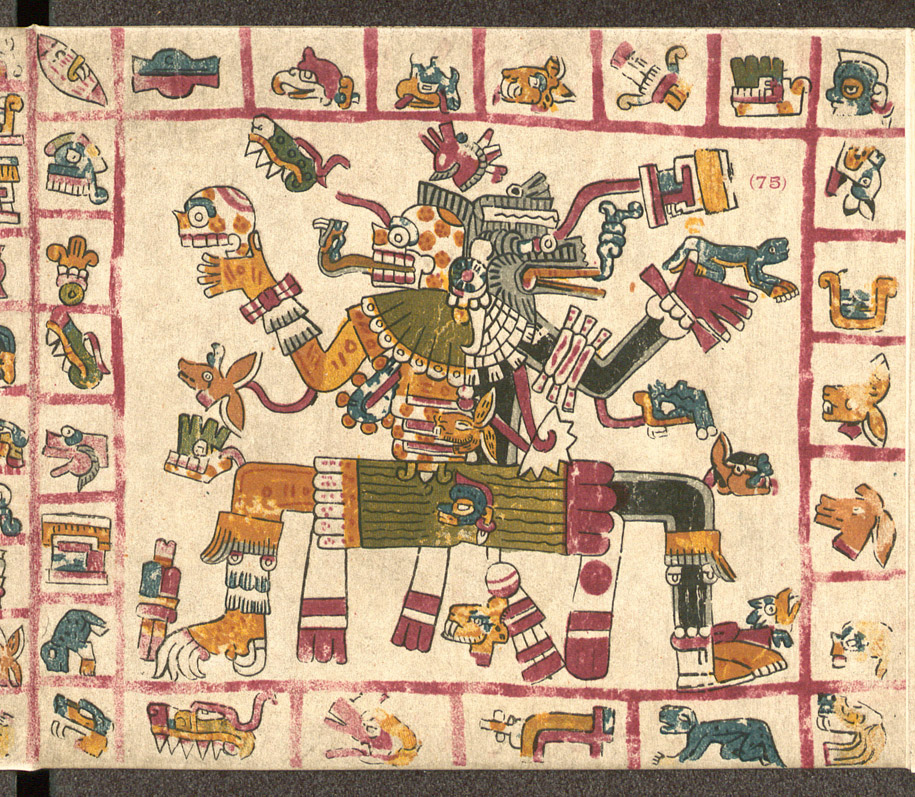
Pre-Conquest codices are, of course, the objectively "best" primary sources we have for Aztec mythology; because they were made before any European interference arrived, they give a clearer picture of the religion and history of the Aztec people. These include the Borbonicus, Borgia, Fejervary-Mayer and Vaticanus B codices, all of which are now preserved in museums and many of which are sadly fragmentary and incomplete. (That list is only Aztec/Mexica codices, by the way, but we also have a few pre-Conquest codices from other Mesoamerican peoples, including the Mixtec Nuttall and Selden codices, the Tlaxcallan Cospi codex, and the Mayan Dresden, Madrid and Paris codices. They're beautiful, but also difficult to read, since they're from the time period that priest-assisted codex performance would have been common and have little writing to go along with their symbolic and pictorial contents (although some Latinized writing in both Spanish and Nahuatl was added to a few of them after the conquest, especially the Borbonicus). They're lovely artifacts of history that some scholars have been studying their entire lives and still not fully explained every bit of iconography and myth, although many of them have certainly tried.
A page from the Codex Borbonicus, depicting Itzlacoliuhqui with the barb of Tonatiuh through his skull
A page from the Codex Vaticanus B, showing Mictlantecuhtli and Quetzalcoatl back to back
a page from the Codex Borgia, showing Tlaloc, Xochiquetzal and Chalchiuhtlicue


Unfortunately, we have way fewer pre-Conquest codices than we do post-Conquest ones. The vast majority of them were destroyed during the invasion by Europeans who either didn't see them as having any value or were trying to make sure the natives stopped practicing their religion so they could be converted to Christianity as quickly as possible. That brings us up to the time of the post-Conquest codices, which were made after the Aztec empire had been conquered. Unlike the earlier codices, which are mostly concerned with recording history and mythology, telling ceremonial stories and lauding the deeds of particularly awesome kings, the post-Conquest codices are much more a portrait of a people under duress. They tend more toward attempting to record what was happening in the here-and-now and tying it to what the Aztecs knew of their own history, and while some do have great mythological value, many of them intentionally leave out religious imagery or euhemerize it down to the deeds of men or demons to avoid the authors getting into trouble with the Catholic Church. Some, like the Duran Codex, were actually overseen personally by Spanish priests and officials who commissioned the works as gifts for royalty back home or had an interest in preserving native history, which naturally led to them being even more skewed toward the authors' attempts to avoid ending up on trial for heresy and the overseers' own commentary and interpretations. The most famous works of this time period are the Florentine, Magliabecchi, Mendoza, Telleriano-Ramensis and Xolotl codices.
A page from the Codex Telleriano-Ramensis showing Mixcoatl with his hunting gear
A page from the Codex Mendoza showing Huitzilopochtli in eagle form leading the Mexica to found Tenochtitlan
A page from the Florentine Codex depicting Aztec human sacrificial rites
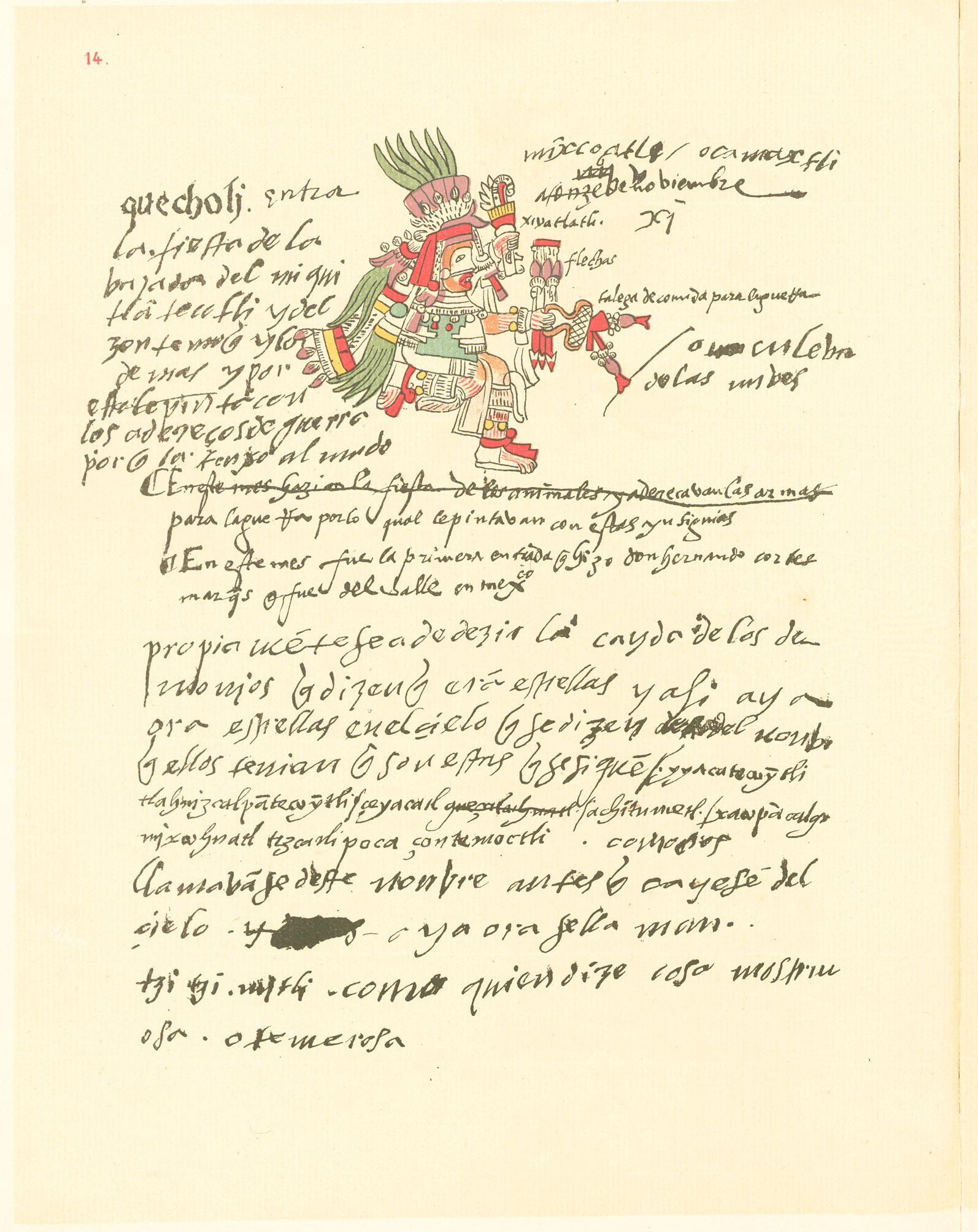
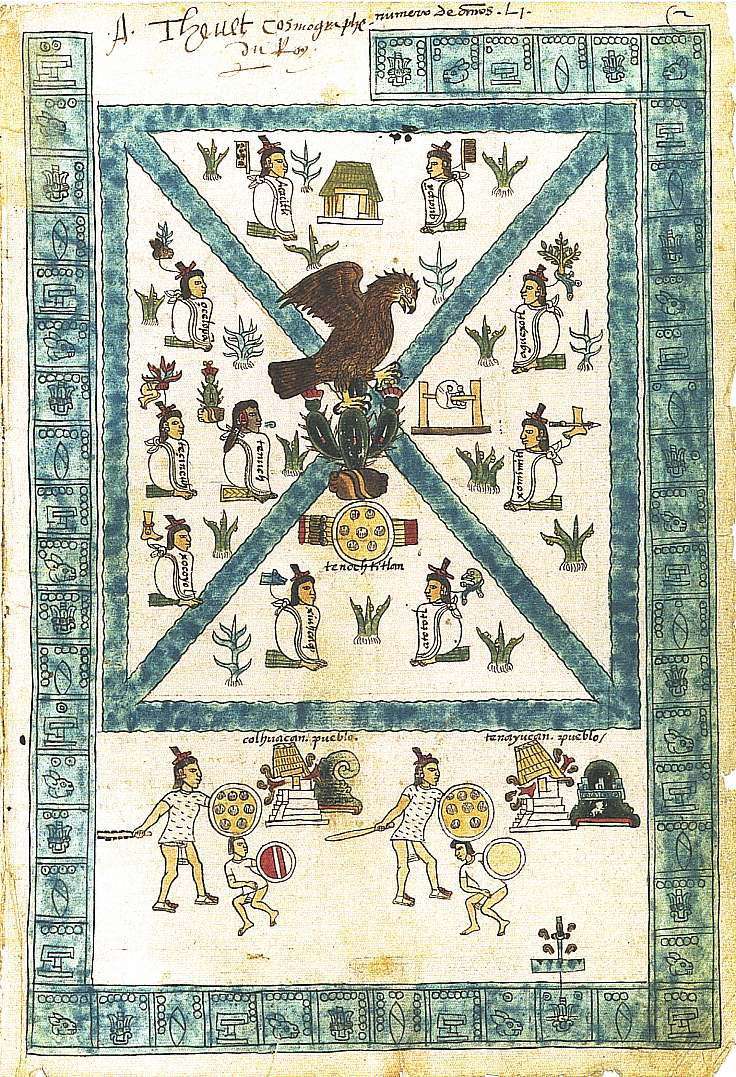

As you can see, these are much more Spanish- and writing-heavy - closer to the European idea of books than the older Mexican codices, because they were being written by people now living under European rule and for a mostly European audience. They are still major primary sources for the study of Aztec religion and myth (because frankly, they are what we have and beggars can't be choosers), but they also inspire a lot more doubt and raise numerous questions about how accurate their version of stories might really be and how much European interference might be coloring what they contain.
Like most conquered mythologies, we have to do a lot of our learning about them from secondary sources - outside chroniclers like Duran, reproduced historical sources like the Codex Chimalpopoca, or mentions of the culture's practices in preserved resources from nearby peoples who interacted with them.
By the way, since you mentioned it, the Popol Vuh is indeed the major primary source for Maya mythology and is awesome, but it has its problems, too. The version of the Popol Vuh we have today was recorded by a Spanish priest named Francisco Ximenez at the beginning of the eighteenth century, most likely after having the story orally told to him by a K'iche Maya person in what is now Guatemala, and it's been through many transformations and probable changes from that original storyteller to us. The K'iche version may have differed substantially from the Mexican myths of the classical Maya period, to start with - a few hundred years and a lot of geography separate the two, and while they are definitely the same culture and obviously telling the same basic story based on their artwork, we'll never know what details might be different unless we find some new buried source somewhere. Then, the story was recorded after being orally told, making it almost certain that the recorder probably colored it with his own interpretations or changed or omitted some of it; then, there are several theories about who wrote it down first and in what form before Ximenez recopied it to make the first manuscript that was widely passed around, which no doubt included his biases and interpretations; and then various scholars in the eighteenth and nineteenth centuries played academic hockey with the manuscript, recopying and even stealing it, until it finally came into the form we have today.
This is a pretty common story when it comes to preservation of myth. We'd love to always have an accessible, well-preserved priamry source by unbiased natives to take a look at, but in reality that almost never happens. Mexico and its mythologies are prime examples of the infernal mess left behind by invading cultures with little interest in preservation of the peoples who came before them.
Wednesday, August 28, 2013
Fact, Fiction and Fancy
Question: How can we tell if ancient mythological texts are not just fiction? As in, someone ancient wrote some fiction and we took it to be an accurate myth?
It's impossible to ever be 100% sure since we weren't there, but most of the time those judgments are based on corroborating evidence and the sociological evolution of the written word. (Which are words I know you guys just love to hear me say.)
It's a very weird concept for us nowadays, surrounded by popular fiction that spawns massive franchises at the drop of a hat, but in previous centuries across large swaths of the world, there was no such thing as a fiction book. People didn't write them.
That's not because awesome fiction stories weren't being made up; on the contrary, they were, but they were almost always preserved, disseminated and retold orally. Most people in any given ancient society could neither read nor write, making trying to launch a career as an author pretty pointless, and those that could were almost always specially trained as a result of their careers: scribes, accountants, priests and other people who had to work with information that needed to be recorded in some concrete way. The written word wasn't thought of as a vehicle for entertainment, but rather as a way of preserving important records and information that couldn't just be remembered easily, which is why the vast majority of our ancient documents are laws, histories, religious texts or accounting lists, with a few poems or letters to and from scholars or administrators to give us a slice of everyday life. Nobody was writing down made-up stories; not only was there no reader audience for them, but it would have been seen as a strange and frivolous use of the written word, and anyway most of the people who could write were too busy for such a weird hobby anyway.
Of course, people are people, so mythological texts, even when written for religious purposes, probably all bear the marks of some long-forgotten scribe's embellishments. Kings ordered the changing of myths occasionally for official or political reasons, and individual scribes almost certainly added their own flair, which was then magnified by cases where a scholar from one culture retold a myth he had heard in his homeland with new touches meant to make it more comprehensible to the home audience (Plutarch does this all the freaking time, for example). Just like you usually won't get to the end of a game of Telephone with exactly the same words, let alone the same inflection and tone, so the giant historical game of Myth Telephone has probably presented us with things that are at least slightly mutated from their "original" forms. Which isn't always bad; sometimes those mutations become part of the religion itself, in which case they stop being mistakes and start being religious evolution.
At any rate, that's the main reason scholars never really have to sit around worrying that their papyri and tablets are actually just chronicling someone's ancient fantasy epic.
Beyond that, there's contextual and corroborating evidence, which are things every historical scholar learns to love and despair over. If your tablets were found in the remains of an ancient temple, it's likely they were religious texts, not romance novels, and if your account of the geneaology of the gods was labeled "BY ORDER OF HIS IMPERIAL MAJESTY", it's probably an official government religion, not something some scribe whipped up in his free time on the side. Many sources repeating or referring to the same story, especially in different areas of the same culture, also help to make it clear that it's something that was widespread and religiously pervasive.
To wade into the murky and dangerous waters of religion versus sociology here for a minute, though, at the bottom of this question is really the question of whether or not you personally have any beliefs centered around these ancient religions. If you do, then myths are reality for you; they have particular purposes and matter in a religious sense, and in some way they really happened and affected the world. If you don't, pure sociology says that of course mythology is fiction - every mythological story started somewhere with someone making up a story to explain why the rain falls or the night is dark or their grandson's father isn't coming back after the most recent buffalo hunt. Mythology is fiction and all fiction has the theoretical potential to become mythology, as long as a people embrace it and make it into a religious truth instead of a pastime. A silly but accurate example of this is the evolution of Star Trek into several religions on the television show Futurama; once someone begins to believe and worship in something as a religion, it leaves the realm of fiction and becomes myth.
By the way, despite all the things I just said, there are a few examples of ancient fiction out there, and the most famous are probably China's Journey to the West and Romance of the Three Kingdoms. Compared to a lot of other religions' texts, these are very young and bear all the hallmarks of being written as popular fiction treatments of their subjects, intended to entertain as well as educate. They were the forerunners of the modern wuxia novel and kung fu film. We still use them as a mythological source, however, because various other parts of Chinese folk mythology also mention or allude to the same characters and events, and because official Chinese histories of the time agreed with them. It's a bit like reading historical fiction, where the events and characters may be the same as the ones in history but the author puts her own spin on them or tweaks things slightly to play up certain ideas.
You guys are really spoiling me with all the book questions lately.
It's impossible to ever be 100% sure since we weren't there, but most of the time those judgments are based on corroborating evidence and the sociological evolution of the written word. (Which are words I know you guys just love to hear me say.)
It's a very weird concept for us nowadays, surrounded by popular fiction that spawns massive franchises at the drop of a hat, but in previous centuries across large swaths of the world, there was no such thing as a fiction book. People didn't write them.
That's not because awesome fiction stories weren't being made up; on the contrary, they were, but they were almost always preserved, disseminated and retold orally. Most people in any given ancient society could neither read nor write, making trying to launch a career as an author pretty pointless, and those that could were almost always specially trained as a result of their careers: scribes, accountants, priests and other people who had to work with information that needed to be recorded in some concrete way. The written word wasn't thought of as a vehicle for entertainment, but rather as a way of preserving important records and information that couldn't just be remembered easily, which is why the vast majority of our ancient documents are laws, histories, religious texts or accounting lists, with a few poems or letters to and from scholars or administrators to give us a slice of everyday life. Nobody was writing down made-up stories; not only was there no reader audience for them, but it would have been seen as a strange and frivolous use of the written word, and anyway most of the people who could write were too busy for such a weird hobby anyway.
Of course, people are people, so mythological texts, even when written for religious purposes, probably all bear the marks of some long-forgotten scribe's embellishments. Kings ordered the changing of myths occasionally for official or political reasons, and individual scribes almost certainly added their own flair, which was then magnified by cases where a scholar from one culture retold a myth he had heard in his homeland with new touches meant to make it more comprehensible to the home audience (Plutarch does this all the freaking time, for example). Just like you usually won't get to the end of a game of Telephone with exactly the same words, let alone the same inflection and tone, so the giant historical game of Myth Telephone has probably presented us with things that are at least slightly mutated from their "original" forms. Which isn't always bad; sometimes those mutations become part of the religion itself, in which case they stop being mistakes and start being religious evolution.
At any rate, that's the main reason scholars never really have to sit around worrying that their papyri and tablets are actually just chronicling someone's ancient fantasy epic.
Beyond that, there's contextual and corroborating evidence, which are things every historical scholar learns to love and despair over. If your tablets were found in the remains of an ancient temple, it's likely they were religious texts, not romance novels, and if your account of the geneaology of the gods was labeled "BY ORDER OF HIS IMPERIAL MAJESTY", it's probably an official government religion, not something some scribe whipped up in his free time on the side. Many sources repeating or referring to the same story, especially in different areas of the same culture, also help to make it clear that it's something that was widespread and religiously pervasive.
To wade into the murky and dangerous waters of religion versus sociology here for a minute, though, at the bottom of this question is really the question of whether or not you personally have any beliefs centered around these ancient religions. If you do, then myths are reality for you; they have particular purposes and matter in a religious sense, and in some way they really happened and affected the world. If you don't, pure sociology says that of course mythology is fiction - every mythological story started somewhere with someone making up a story to explain why the rain falls or the night is dark or their grandson's father isn't coming back after the most recent buffalo hunt. Mythology is fiction and all fiction has the theoretical potential to become mythology, as long as a people embrace it and make it into a religious truth instead of a pastime. A silly but accurate example of this is the evolution of Star Trek into several religions on the television show Futurama; once someone begins to believe and worship in something as a religion, it leaves the realm of fiction and becomes myth.
By the way, despite all the things I just said, there are a few examples of ancient fiction out there, and the most famous are probably China's Journey to the West and Romance of the Three Kingdoms. Compared to a lot of other religions' texts, these are very young and bear all the hallmarks of being written as popular fiction treatments of their subjects, intended to entertain as well as educate. They were the forerunners of the modern wuxia novel and kung fu film. We still use them as a mythological source, however, because various other parts of Chinese folk mythology also mention or allude to the same characters and events, and because official Chinese histories of the time agreed with them. It's a bit like reading historical fiction, where the events and characters may be the same as the ones in history but the author puts her own spin on them or tweaks things slightly to play up certain ideas.
You guys are really spoiling me with all the book questions lately.
Friday, August 23, 2013
Tlilli Tlapalli
Question: So I learned in school that the Aztecs didn't have writing and couldn't write down any of their stories until the Spanish came. But you mentioned something called the "codices" a few times with myths in them - are those some kind of books? Is my teacher just wrong?
People were endangered by the reckless speed with which I shot across the planet to answer this question. Sonic booms disordered friendly airspace; trails of flying debris ended up haphazardly beside roads; John and the cats are in hiding. I'm a mythology enthusiast and a librarian and a Mexican-flag-wavin' fan of the Aztecs in Scion, and you have basically just asked me a jackpot question.
The pre-conquest Mexicans did not have writing in the same sense that Europeans at the time did; that is, there was no widely-used alphabet that represented specific sounds, and their written records often didn't look very much like those of the Spanish. Instead, they wrote pictographically, which means all of their words were in fact symbols and pictures that represented concepts instead of noises. There were symbols for specific noises, but they would never use them to write unless they were trying to describe something totally foreign to their language - why use three symbols to write B-OO-K when they could just use one symbol that meant "book", right? Why use a couple of different symbols that made up the sounds of "rabbit", when they could just draw a picture of a rabbit and be done with it?
The Spanish - and other European nations, when they eventually paid attention to what was going on in the southern New World - looked at these weird symbols and drawings and believed that the Aztecs must not be capable of reading or writing, and were instead relying on crude artwork to communicate because of this deficiency. In fact, the idea that they were a sub-literate people was one of the chief arguments in claiming that the giant urban civilization was in fact composed of savages, and that the influence of the Europeans was a benevolent thing that helped drag them up to the level of civilized culture. The fact that those self-same Europeans also burned the vast majority of Aztec codices they found, in order to prevent the natives from clinging to any pesky culture or religion they hadn't approved, resulted in very few of them surviving, which only fueled the idea back in Europe that the Aztecs couldn't write at all, poor dears.
There's another layer of philological difficulty in play here as well, in that the surviving Aztec codices don't always have very much writing in them, either.
Well... shit. That looks bananas even to us, who are now used to different kinds of written communication, so imagine what it looked like to the conquistadors. There are clearly some symbols here, as well as some in medias res action scenes, but how the hell are you supposed to read that and come up with an actual story?
The answer is that you aren't, because the Aztecs didn't conceive of their codices the same way we do the printed word today. Books weren't something that you created and then anyone could just pick up and immediately get all the information out of (in fact, for most of the history of the written word across most of the world, books were considered something only the very wealthy or the priesthood was going to be able to read anyway); rather, many of them - especially those created for the clergy or religious rites - were actually intended to be performed instead of simply read. Instead of writing down as many words as possible to get the idea across to a reader, codices of this sort were filled with triggering symbols and relevant images, which were meant to be seen by a specially trained person (usually a priest) who had memorized the story that they were retelling. In essence, the codex was a compendium of mnemonic devices, designed to trigger a particular history, religious tale or edict in the mind of a person who had already memorized it, and then he would go ahead and verbally tell the story while referring to the codex for reminders and pictorial illustration.
This is one of my favorite incredibly neat things about the Aztec codices - that they're not just books, but actually performances, and that you need both the codex and the person who was trained to read it in order to get the full, beautiful impact of the story. It was both an artform and a complex way of storing important information - a synthesis of the more common methods in other cultures of either writing things down or passing them down orally with no written component.
Unfortunately, that system was almost totally destroyed with the coming of the Spanish. Not only did they have no interest in Aztec religious or historical book-performance (in fact, they severely discouraged it, since they wanted everyone to convert to European religion and law as quickly as possible), but they destroyed most of the codices, which in turn removed those all-important compendiums of story-triggers from play. Add in the fact that many Aztecs perished in the struggle over the empire, and you ended up with some ex-scribes or ex-priests who could have read the codices but never would again since they were now destroyed, trying to remember what they could without the compendiums they'd been taught to work with, or a few remaining codices that nobody could read, having lost whomever was trained to do so. Some histories written by Europeans who tried to ask Aztec people about reading them record that they actually refused to do so after a while - which was not surprising, considering that reciting forgotten lore about their native gods or sacred histories could get a native Mexican a one-way ticket to the Inquisition with blistering speed.
So the Spanish shrugged, said that the Aztecs obviously couldn't read or write, and sent a few of their pretty picture-books back to Europe as curiosities, and there the matter laid until a few centuries later, when scholars realized that there was actually a whole lot going on in the codices and that the idea that the Aztecs weren't literate because they used symbols instead of letters was about as ridiculous as saying that people from China couldn't read for the same reason.
Of course, just like we have in our society, the Aztecs had a lot of different forms of written communication, and the codices were only one of them. They also kept royal records and tax accounts, created elaborate maps and banners to mark places and people, and generally went about labeling things where useful about the way you'd expect. They just did so with colorful pictures instead of representative letters, leading to a sort of renaissance for modern archaeologists when they realized that they were actually looking at words and sentences, not just interesting artwork. Some codices do have phonetic writing in them, in both Spanish and Nahuatl, because they were written after the coming of the Europeans by Aztecs who had been partially assimilated into the new culture, while others are entirely composed of the combined-symbol glyphs of the pre-conquest artistic writing system.
By the way, the Mexica/Aztecs weren't the only ones to use codices this way; it was common in ancient Mesoamerica and the Mixtec and Zapotec also used the same style, which probably influenced the Aztecs into following suit. The Maya do have their own writing system, which is also glyph-based but a lot more elaborate and complicated (often compared to Mandarin Chinese), but it's an entirely different kettle of fish, one that has parts that are still being translated and puzzled out by scholars and archaeologists even today.
If you view writing as only words on a page, then it's possible you could say that the Aztecs didn't have it, but to do so would be to ignore their unique cultural advancements and methods of preserving their histories and beliefs, which were exciting and interactive in their own way. As a person who deals professionally in different ways of recording and sharing information, I never cease to be fascinated by the codices, or how much they can still tell us even centuries later and without their human half.
People were endangered by the reckless speed with which I shot across the planet to answer this question. Sonic booms disordered friendly airspace; trails of flying debris ended up haphazardly beside roads; John and the cats are in hiding. I'm a mythology enthusiast and a librarian and a Mexican-flag-wavin' fan of the Aztecs in Scion, and you have basically just asked me a jackpot question.
The pre-conquest Mexicans did not have writing in the same sense that Europeans at the time did; that is, there was no widely-used alphabet that represented specific sounds, and their written records often didn't look very much like those of the Spanish. Instead, they wrote pictographically, which means all of their words were in fact symbols and pictures that represented concepts instead of noises. There were symbols for specific noises, but they would never use them to write unless they were trying to describe something totally foreign to their language - why use three symbols to write B-OO-K when they could just use one symbol that meant "book", right? Why use a couple of different symbols that made up the sounds of "rabbit", when they could just draw a picture of a rabbit and be done with it?

The Spanish - and other European nations, when they eventually paid attention to what was going on in the southern New World - looked at these weird symbols and drawings and believed that the Aztecs must not be capable of reading or writing, and were instead relying on crude artwork to communicate because of this deficiency. In fact, the idea that they were a sub-literate people was one of the chief arguments in claiming that the giant urban civilization was in fact composed of savages, and that the influence of the Europeans was a benevolent thing that helped drag them up to the level of civilized culture. The fact that those self-same Europeans also burned the vast majority of Aztec codices they found, in order to prevent the natives from clinging to any pesky culture or religion they hadn't approved, resulted in very few of them surviving, which only fueled the idea back in Europe that the Aztecs couldn't write at all, poor dears.
There's another layer of philological difficulty in play here as well, in that the surviving Aztec codices don't always have very much writing in them, either.
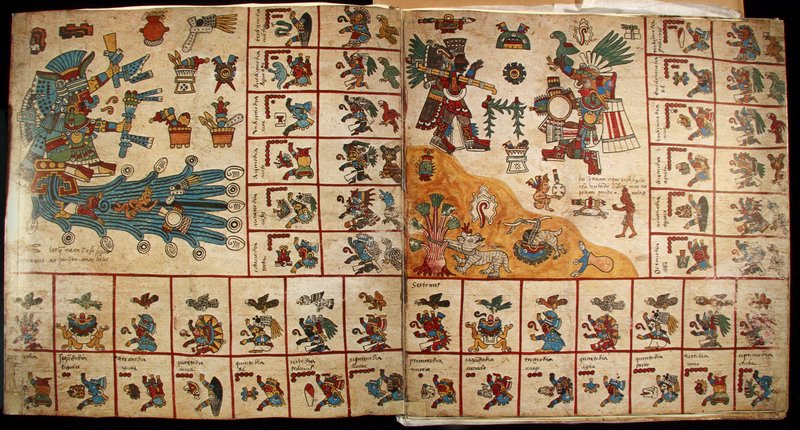
Well... shit. That looks bananas even to us, who are now used to different kinds of written communication, so imagine what it looked like to the conquistadors. There are clearly some symbols here, as well as some in medias res action scenes, but how the hell are you supposed to read that and come up with an actual story?
The answer is that you aren't, because the Aztecs didn't conceive of their codices the same way we do the printed word today. Books weren't something that you created and then anyone could just pick up and immediately get all the information out of (in fact, for most of the history of the written word across most of the world, books were considered something only the very wealthy or the priesthood was going to be able to read anyway); rather, many of them - especially those created for the clergy or religious rites - were actually intended to be performed instead of simply read. Instead of writing down as many words as possible to get the idea across to a reader, codices of this sort were filled with triggering symbols and relevant images, which were meant to be seen by a specially trained person (usually a priest) who had memorized the story that they were retelling. In essence, the codex was a compendium of mnemonic devices, designed to trigger a particular history, religious tale or edict in the mind of a person who had already memorized it, and then he would go ahead and verbally tell the story while referring to the codex for reminders and pictorial illustration.
This is one of my favorite incredibly neat things about the Aztec codices - that they're not just books, but actually performances, and that you need both the codex and the person who was trained to read it in order to get the full, beautiful impact of the story. It was both an artform and a complex way of storing important information - a synthesis of the more common methods in other cultures of either writing things down or passing them down orally with no written component.
Unfortunately, that system was almost totally destroyed with the coming of the Spanish. Not only did they have no interest in Aztec religious or historical book-performance (in fact, they severely discouraged it, since they wanted everyone to convert to European religion and law as quickly as possible), but they destroyed most of the codices, which in turn removed those all-important compendiums of story-triggers from play. Add in the fact that many Aztecs perished in the struggle over the empire, and you ended up with some ex-scribes or ex-priests who could have read the codices but never would again since they were now destroyed, trying to remember what they could without the compendiums they'd been taught to work with, or a few remaining codices that nobody could read, having lost whomever was trained to do so. Some histories written by Europeans who tried to ask Aztec people about reading them record that they actually refused to do so after a while - which was not surprising, considering that reciting forgotten lore about their native gods or sacred histories could get a native Mexican a one-way ticket to the Inquisition with blistering speed.
So the Spanish shrugged, said that the Aztecs obviously couldn't read or write, and sent a few of their pretty picture-books back to Europe as curiosities, and there the matter laid until a few centuries later, when scholars realized that there was actually a whole lot going on in the codices and that the idea that the Aztecs weren't literate because they used symbols instead of letters was about as ridiculous as saying that people from China couldn't read for the same reason.
Of course, just like we have in our society, the Aztecs had a lot of different forms of written communication, and the codices were only one of them. They also kept royal records and tax accounts, created elaborate maps and banners to mark places and people, and generally went about labeling things where useful about the way you'd expect. They just did so with colorful pictures instead of representative letters, leading to a sort of renaissance for modern archaeologists when they realized that they were actually looking at words and sentences, not just interesting artwork. Some codices do have phonetic writing in them, in both Spanish and Nahuatl, because they were written after the coming of the Europeans by Aztecs who had been partially assimilated into the new culture, while others are entirely composed of the combined-symbol glyphs of the pre-conquest artistic writing system.
By the way, the Mexica/Aztecs weren't the only ones to use codices this way; it was common in ancient Mesoamerica and the Mixtec and Zapotec also used the same style, which probably influenced the Aztecs into following suit. The Maya do have their own writing system, which is also glyph-based but a lot more elaborate and complicated (often compared to Mandarin Chinese), but it's an entirely different kettle of fish, one that has parts that are still being translated and puzzled out by scholars and archaeologists even today.
If you view writing as only words on a page, then it's possible you could say that the Aztecs didn't have it, but to do so would be to ignore their unique cultural advancements and methods of preserving their histories and beliefs, which were exciting and interactive in their own way. As a person who deals professionally in different ways of recording and sharing information, I never cease to be fascinated by the codices, or how much they can still tell us even centuries later and without their human half.
Thursday, July 25, 2013
Thesis Defense
Question: I know you strive for accuracy, but first person reference material is hard to find! Percentage-wise, how accurate do you think each of your pantheon representations are?
First-person reference material ain't just hard to find; for most of these pantheons, many of whom died thousands of years ago in the popular public eye, it's literally impossible. Unless we happen to find some ancient Sumerians frozen in a glacier somewhere who we can thaw out and ask some searching religious questions of, that's just the way it's gotta be. For those religions that do have modern worshipers, the modern practice and beliefs are often vastly different from those of the ancient religion that they came from, making those first-person accounts we can get access to of varying degrees of usefulness.
However, I'm not sure this is a useful question. We can't give you a "percentage" of accuracy, which would be a meaningless number; compared to what, with what criteria, on what scale? I could say, "Eh, 90%," and send you on your way, but other than being a nice encouraging number, it wouldn't actually give you any good idea of what that means our content is like.
But I can try to give you a better answer, and that's this: they're always exactly as accurate as we're able to make them. We strive to get as much reference material as possible for each project, to talk to as many experts as we can gain access to, to take into account both traditional scholarship and new theories and discoveries, and to weigh the many conflicting options out there as well as the possible influence of modern versions of the gods involved. Those are things we are always reaching for to the best of our ability, but realistically, how successful we are varies from pantheon to pantheon with the shifting amounts of our access to those things. For some pantheons, like the Anunna, there's a glut of mythological scholarship and material to draw on; for others, like the Alihah, there's practically none. For some pantheons, like the K'uh, it's easy to get our hands on English-material and speak to local authorities on the subject; for others, like the Bogovi, we had to field-translate Croatian and sift through reams of opinions with very few sources to back them up. For some pantheons, like the Elohim, worship has been dead for thousands of years and is easy to study and interpret without worrying about change; for others, like the Apu, the influences and incarnations their gods have taken on over the centuries have colored and changed the information available on them. We never say, "That's probably good enough," if we know there's another book or source we haven't tapped yet, and we never say, "Eh, let's just ignore that so we don't have to explain why it's different in modern religion," if something interferes with our current progress.
I'll be the first to say that we could never claim 100% accuracy. We weren't in ancient Babylon and neither was anyone else, so anyone who makes that claim is lying. We also can't claim 100% accuracy to what we know now in the modern day, and that's again something nobody could say - there are too many different theories and digs and languages and possibilities and scholarly circles involved, and no one person could ever know the details of all of them, let alone know which were accurate in the long-ago. But we do our best, and we never put anything out there that we don't feel has real, solid accuracy beneath it and as many cool features and cultural concepts included as we can find. We're uncomfortable with anything less.
So I can't give you a percentage; sorry. In very specific scientific terms, we are more accurate than some yutz using Wikipedia and pagan reconstructionism messageboards for a casual writeup done in a few hours, but less accurate than a Harvard professor who speaks fourteen languages and has personally unearthed parts of Kom Ombo.
First-person reference material ain't just hard to find; for most of these pantheons, many of whom died thousands of years ago in the popular public eye, it's literally impossible. Unless we happen to find some ancient Sumerians frozen in a glacier somewhere who we can thaw out and ask some searching religious questions of, that's just the way it's gotta be. For those religions that do have modern worshipers, the modern practice and beliefs are often vastly different from those of the ancient religion that they came from, making those first-person accounts we can get access to of varying degrees of usefulness.
However, I'm not sure this is a useful question. We can't give you a "percentage" of accuracy, which would be a meaningless number; compared to what, with what criteria, on what scale? I could say, "Eh, 90%," and send you on your way, but other than being a nice encouraging number, it wouldn't actually give you any good idea of what that means our content is like.
But I can try to give you a better answer, and that's this: they're always exactly as accurate as we're able to make them. We strive to get as much reference material as possible for each project, to talk to as many experts as we can gain access to, to take into account both traditional scholarship and new theories and discoveries, and to weigh the many conflicting options out there as well as the possible influence of modern versions of the gods involved. Those are things we are always reaching for to the best of our ability, but realistically, how successful we are varies from pantheon to pantheon with the shifting amounts of our access to those things. For some pantheons, like the Anunna, there's a glut of mythological scholarship and material to draw on; for others, like the Alihah, there's practically none. For some pantheons, like the K'uh, it's easy to get our hands on English-material and speak to local authorities on the subject; for others, like the Bogovi, we had to field-translate Croatian and sift through reams of opinions with very few sources to back them up. For some pantheons, like the Elohim, worship has been dead for thousands of years and is easy to study and interpret without worrying about change; for others, like the Apu, the influences and incarnations their gods have taken on over the centuries have colored and changed the information available on them. We never say, "That's probably good enough," if we know there's another book or source we haven't tapped yet, and we never say, "Eh, let's just ignore that so we don't have to explain why it's different in modern religion," if something interferes with our current progress.
I'll be the first to say that we could never claim 100% accuracy. We weren't in ancient Babylon and neither was anyone else, so anyone who makes that claim is lying. We also can't claim 100% accuracy to what we know now in the modern day, and that's again something nobody could say - there are too many different theories and digs and languages and possibilities and scholarly circles involved, and no one person could ever know the details of all of them, let alone know which were accurate in the long-ago. But we do our best, and we never put anything out there that we don't feel has real, solid accuracy beneath it and as many cool features and cultural concepts included as we can find. We're uncomfortable with anything less.
So I can't give you a percentage; sorry. In very specific scientific terms, we are more accurate than some yutz using Wikipedia and pagan reconstructionism messageboards for a casual writeup done in a few hours, but less accurate than a Harvard professor who speaks fourteen languages and has personally unearthed parts of Kom Ombo.
Thursday, June 20, 2013
Life in the Library Lane
Question: Hi, guys, great work on everything! You guy really have inspired me to do my own revamp of the pantheons and I was wondering if you guys had any books and source material you could recommend.
Hey, thanks! We love doing this stuff and we think it's awesome when other people love doing it, too. Go out and make neat stuff!
Source material's hard, not because it's hard to give you recommendations but because it's such a huge question - there are literal tons of books and resources out there that are fun to read and informative for Scion!
To start with, if you're revamping pantheons, we recommend picking one and working on it first rather than trying to overhaul every pantheon all at once. It's hard enough to get all the crazy awesomeness of a single pantheon in your brain at the same time, let alone twelve of them. We usually look at somewhere in the neighborhood of twenty to thirty books, online articles or other resources when working on a pantheon, and there are plenty others we don't end up using, so it's kinda impossible to give you those lists for every pantheon you might want to hit up... but our advice is to start with one you're passionate about and go to your local libraries to get some goodness. Look up books on the pantheon, its individual gods or the religions that worshiped them; use the internet to find articles (with good sourcing!) on the same; ask a librarian what other resources might be available to you, in case your library has access to periodicals, online databases or other awesome stuff you might not be able to get at home. Go bananas. We certainly do.
As a close runner-up, you can never go wrong reading the original myths and stories of the gods (and as a bonus, they're usually more fun than some scholar expounding on the ritual use of bone fragments or whatever!). Luckily, most of these myths are ancient and in the free public domain, so you can get access to them with an internet connection almost instantly. Sacred Texts is a great starting source if you want to go read some free translations of the Eddas, Cattle Raids, Hindu epics or any other set of original myths, and a little Googling around will probably get you loads of other sources around the 'net. Be wary of accidents - you probably don't want to mistakenly pick up someone's original fiction thinking it's ancient myth - but there's plenty out there in the ether if you're diligent about looking.
Other than that, the best advice is just to have fun. Figure out what kind of images, ideas or feeling you want when working on your pantheon and find all the neat stuff out there that fits into it. Make art, write stories, build up your gameworld and have a blast.
Hey, thanks! We love doing this stuff and we think it's awesome when other people love doing it, too. Go out and make neat stuff!
Source material's hard, not because it's hard to give you recommendations but because it's such a huge question - there are literal tons of books and resources out there that are fun to read and informative for Scion!
To start with, if you're revamping pantheons, we recommend picking one and working on it first rather than trying to overhaul every pantheon all at once. It's hard enough to get all the crazy awesomeness of a single pantheon in your brain at the same time, let alone twelve of them. We usually look at somewhere in the neighborhood of twenty to thirty books, online articles or other resources when working on a pantheon, and there are plenty others we don't end up using, so it's kinda impossible to give you those lists for every pantheon you might want to hit up... but our advice is to start with one you're passionate about and go to your local libraries to get some goodness. Look up books on the pantheon, its individual gods or the religions that worshiped them; use the internet to find articles (with good sourcing!) on the same; ask a librarian what other resources might be available to you, in case your library has access to periodicals, online databases or other awesome stuff you might not be able to get at home. Go bananas. We certainly do.
As a close runner-up, you can never go wrong reading the original myths and stories of the gods (and as a bonus, they're usually more fun than some scholar expounding on the ritual use of bone fragments or whatever!). Luckily, most of these myths are ancient and in the free public domain, so you can get access to them with an internet connection almost instantly. Sacred Texts is a great starting source if you want to go read some free translations of the Eddas, Cattle Raids, Hindu epics or any other set of original myths, and a little Googling around will probably get you loads of other sources around the 'net. Be wary of accidents - you probably don't want to mistakenly pick up someone's original fiction thinking it's ancient myth - but there's plenty out there in the ether if you're diligent about looking.
Other than that, the best advice is just to have fun. Figure out what kind of images, ideas or feeling you want when working on your pantheon and find all the neat stuff out there that fits into it. Make art, write stories, build up your gameworld and have a blast.
Subscribe to:
Posts (Atom)