Question: I've read that there is a version of the Vritra myth where Sarasvati kills Vritra. What do you think of the idea?
This is a fun one. Actually, there's not an alternate version of the myth, really; anywhere the myth of Vritra's slaying is retold, you will almost always see it attributed to Indra. However, there is a single mention in the Rigveda, in a hymn specifically dedicated to Sarasvati, that suggests that she might have killed Vritra. Griffith's translation of the lines says:
May the divine Sarasvatī, rich in her wealth, protect us well,
Furthering all our thoughts with might
Whoso, divine Sarasvatī, invokes thee where the prize is set,
Like Indra when he smites the foe.
Aid us, divine Sarasvad, thou who art strong in wealth and power
Like Pūṣan, give us opulence.
Yea, this divine Sarasvatī, terrible with her golden path,
Foe-slayer, claims our eulogy.
Sarasvati is here directly compared to Indra and his prowess at smiting enemies, and in the verse where she is called in this (embarrassingly poor) translation "foe-slayer", the actual word used for her is vritragni, which translates more literally as slayer of Vritra and is a cognate to Indra's traditional title of vritrahan.
So what we really have is a single line in a single hymn that calls Sarasvati by the title Vritra-Slayer, or thereabouts. To our knowledge, however, there is no alternative version of the myth that actually describes Sarasvati slaying Vritra, nor rewrites that story to make it about her exploits rather than Indra's. So in that case, the question is really why that epithet is given to her here, and what it might mean.
There are tons of possible philosophical interpretations. For example, the hymn is here praising Sarasvati's powers over wealth and good fortune, so it may be calling her the slayer of Vritra symbolically; as it says in earlier lines, he who calls upon Sarasvati to succeed smites his foe like Indra in battle, so it might be viewed as Sarasvati granting her supplicants this symbolic power to succeed. It might also be suggesting that she lent her divine aid, in a symbolic or spiritual sense, to Indra himself, and that this in part enabled him to succeed in slaying Vritra. It might be referring to the fact that Sarasvati is the goddess of the river that bears her name, and that as a water goddess she symbolically defeats Vritra, bringer of drought, with her life-giving waters. Or it might be a purely metaphorical title, with nothing to do with Vritra himself at all, that is intended to showcase Sarasvati's great spiritual might and how important she is to her worshipers.
But if you guys would follow me down the rabbit hole of comparative mythology for a second, here's an interesting tidbit: this myth is actually one of the many places where Persian and Hindu mythology intersect and probably share common roots. Vritragni is exceptionally close to verethragna, which happens to be the ancient Avestan term for "slayer of the dragon" or "slayer of the evil" and the major epithet of the god Vahram, the warrior and god of victory among the Yazata. And, just as we see among the Deva, while there's one major god who bears the name vritrahan/verethragna, there is also one major goddess who is referred to as the slayer of the dragon in a single other instance. In the Persians' case, it is Anahita - like Sarasvati, a goddess of waters and a benevolent figure who responds to the requests of her worshipers for wisdom and aid - who grants to the hero Thraetaona her own magical power so that he will be able to successfully defeat Azhi Dahaka, the great dragon of Persian mythology.
Of course, Sarasvati and Anahita aren't the same person; their pantheons have been separated (violently and with great dislike for one another) for thousands of years, and the two of them, even if they might have shared some common roots or influences in the past, are clearly no longer even remotely the same figure. But we still may be seeing an echo of both cultures telling the same incredibly ancient story, still lingering on after century upon century of retelling with new cultural additions and interpretations. In Anahita's case, she clearly did not go fight the dragon; she bestowed a boon of victory on a supplicant who offered her the proper praise and sacrifices, and he went out and actually did the deed. In Sarasvati's case, we have no reason to think she ever fought Vritra herself, and plenty of evidence that Indra did, but it wouldn't be a stretch at all to think that she might have granted Indra her support, just as the Vedic hymn above calls upon her to grant it to others who offer her their devotion.
So, we doubt, in this case, that Sarasvati was ever actually believed to be the dragon-slayer instead of Indra. But that doesn't mean she's any less amazing or powerful, simply that she chooses to manifest that power in a less direct manner.

Showing posts with label Deva. Show all posts
Showing posts with label Deva. Show all posts
Tuesday, March 4, 2014

Saturday, February 8, 2014
Fighting the Good Fight
Iiiiit's vlog time! Today we have those fancy new lights and I look less like a zombie, but I'm also on pain drugs so I sound a little bit more like a crazy person than usual. Trade-off. Next week I hope to be more functional, and of course John is here being a helpful rock of sanity.
Today's questions are on a bunch of topics including Titans, relics and politics, but they're all about the greater world of Scion at large. So here we go!
Question: In your games, I'm assuming that the gods are very much besieged on all sides by Titanrealms and Avatars aplenty, and the corebooks make a point of saying how Avatars have to stay in their realms most of the time to avoid being rebound. My question is, if the terrifying nature of the Titanrealms is what is preventing various pantheons from attacking them en masse, what is it that's preventing Avatars from doing the same to the gods? Do Overworlds (and Underworlds, I guess) have similar built-in defenses?
Question: Why do relics bite when not bound to you? There seem to be multiple myths where people take each others' weapons and use them, and I can't name any where that has actually damaged the person (without the involvement of a curse/geasa).
Question: How do you deal with gods that have unique powers that don't seem to fit in with any of the purviews? The best examples I can come up with are mostly from the Deva. For example, Shiva's "Destructo-Eye?" The guy opens his third eye and shit just blows up! How does one make that happen in Scion? For that matter, Shiva and Kali are both known for their destructive dances wherein they dance and the world just starts to fall apart. How do these things work in your system?
Question: How would you represent Diomedes in Scion, given how he's Mr. "I'm totally a mortal man but I'm so badass that I fuck up Scions and gods alike, and then Athena made me into a god when I died?" I mean, the dude got in a fight with *Ares* and kicked his ass!
Question: I've been doing some (admittedly small) amount of research into the Orisha. Is Courage really a valid Virtue for them? They certainly talk a big game, but most of their conflicts are tricks and pranks against each other rather than huge monsters (compare to the Theoi). At the same time, they seem to highly value Intellect. Particularly with Orunmila.
Question: Could the Olympic Games have been a Birthright? It may sound stupid, but you've discussed relic songs before, and your Birthright PDF has a Shinto shrine for the Kami. Could Zeus have gotten some cool bonuses when mortals dedicated their great victories in his honor?
Question: This might be a weird question, but what are the likely consequences (politically) when a Titan (and its Avatar) manages to overpower a pantheon?
Question: How do you guys feel about the idea of making Titanrealms a one-per-purview deal? Currently I'm having to choose between one realm per pantheon (where the realms don't match up to purviews, e.g. the Kami opposed by the realm of corruption) and one per purview (e.g. the kami are opposed by Izanami as a death titan but the realm itself is split between them and the K'uh), and I can't decide which I prefer. What do you think?
Question: So my game master is most likely planning to have my character's godly parent marry her away as part of inter-pantheon politics. I know how common a practice that has been through time; is that something you have dealt with before? I'd like to know more about how the gods use their children in the politics game now that it has expanded so much since the start of the war.
Question: So, among a handful of us, "Goddamnit, Stribog" has become a touch memetic. What the chuffing hell is he doing?
Oh, Stribog. I know the players hope you never change.
Saturday, November 16, 2013
Socializing in the Sky
Are you guys ready for another session of marathon vlogs? Here they come! Today's is about politics and insanity among the gods, who never seem to have getting along near the top of their to-do lists.
Question: From a social perspective, what does it mean to the gods when one god has more associated purviews and/or Epics than another god?
Question: Would it be possible for a god, through either Fate-dickery or Magic or just sheer force of will, to change their modus operandi? I have a game idea that partially revolves around the idea of Odin abandoning his normal methods to try the novel approach of honesty and good faith in order to avert Ragnarok. Is this plausible?
Question: Can you elaborate on the relationship between the Yazata and the Deva? Why do they see each other as enemies?
Question: You always talk about gods leaving the World because of Fatebonds. Why did they stay in the first place? They would have known about Fatebonds during that time. Was the risk just worth the reward?
Question: Would it be accurate to say that pantheons that have more Virtues in common (such as the Aesir and Nemetondevos) would be on better terms with each other than those that have few in common (like the Anunna and Theoi)?
Question: Every god has a rivals and enemies listing on their page, but what does that MEAN to them? To be specific, Odin has enemies - does he hate them, or are they merely names on his "to kill list"? When you say a god has enemies, does that mean hatred and active attempts at murder and sabotage, or something less intense and more passive?
Question: I've got a Scion game coming up where all the PCs are either Kami or Teotl. I was wondering if you had any ideas for ways in which those two pantheons would interact, as I'm currently drawing a blank.
Just be nice, everyone. Is that so hard?!
Saturday, September 7, 2013
Bowl Full of Wisdom (and Cake)
Hey, folks. Today John and I have death fevers and are way not fit to be on camera, so we're going to have to leave you with a normal post instead of our usual vlog. We're sorry. We might be able to vlog later in the week, but my class schedule's pretty rough, so if you don't hear from us, we'll definitely be back to our normal Saturday schedule next week.
And in the meantime, a question!
Question: Why does Ganesha have Animal (Elephant) associated? As far as I know, he never DOES anything with elephants, beyond having an elephant's head, and by that logic Nergal should have Animal (Lion).
You know, this is a tricky one, and one of those places where a hard-and-fast association rule is difficult to put into effect. The acquisition of Ganesha's elephant head is certainly not the usual kind of myth we'd look for in justifying Animal; after being beheaded by his father, his head was hastily replaced with that of a local elephant in order to restore him and pacify his understandably upset mother. It seems as if the unlucky elephant in question just happened to be the closest appropriately-sized critter when Shiva needed a backup cranium.
But Ganesha does indeed have Animal associated in our games, and yet does not have any myths where he runs around commanding or creating animals. He's not the only one; several of the Netjer are similar (for example, Anubis, who appears with a jackal's head but doesn't do much with actual jackals) in that they are strongly associated with an animal but without any myths that portray them interacting with them much. So how do we make that association call, when we decide against Animal for other gods in seemingly the same boat?
This is one of the places where cult worship and symbolism sometimes come into play in our associations-assignment process. Ganesha's religious presence and symbolism do involve elephants, and so had to be taken into account. Temples to Ganesha have been known to keep elephants, even large herds of them, in his honor and to involve them in religious festivals in his name; perhaps more importantly, Ganesha's connection to the elephant is also deeply symbolic, representing wisdom, intelligence, memory and perception, all qualities that the Hindu religion believes are innate to both elephants and Ganesha himself. In a very direct way, Ganesha embodies elephantness, for lack of a better word, appearing as an eternally elephantine, ever-constant symbol of all the qualities a Hindu would consider the animal to have.
Just as the Animal purview is split into two general categories - doing things with your animal, and being your animal - so are there different kinds of Animal gods. It's a lot easier to pinpoint one of the second category if they're nice enough to do things like transforming into their animals or showing up as their animals all the time, like Bastet running around as a cat or Tezcatlipoca transforming into Tepeyollotl, but there are a lot of gods of a lot of religions out there, and a blanket rule can't cover all of them. Ganesha is a god who always appears as an elephant at least in part and who furthermore permanently embodies all the qualities of elephants in an intentional way, so he seems to us to be a great example of a god that has Animal by virtue of really being an animal himself rather than by virtue of commanding or spending time with them.
We have a lot of other gods like that, actually - for example, Sekhmet, who was conceived of as a lion for embodying the animal's ferocity and power and whose cults kept lions in the temple in her honor, or Huitzilopochtli, who despite having no myths in which he does anything with hummingbirds was so inextricably linked to the birds that they were said to be the souls of his dead warriors and the creature became one of his names. It's much easier to give someone Animal when, like Mah, they're actually hanging out with or creating that animal, but it's not the only time it's possible. Just like every other association, we love examples in myth and lean on them whenever possible, but iconography, symbolism and cult worship always have the opportunity to weigh in as well.
In the end, like all associations, it comes down to a judgment call based on the specific god's situation. In our opinion, the elephant is one of the central and inescapable parts of Ganesha's character, and he must have the purview associated with him.
As for Nergal, I don't know what to tell you, friend. I was in favor of him having Lion, John wasn't, so he is what he is now (and I would say go either way, nobody's going to be too upset).
Sunday, August 25, 2013
Progeny by Proxy
Question: Would the children of two Avataras (Rama and Sita) be considered Scions, or just mortals? (Lava and Kusha)
Ooh, neat question!
We would consider children of Hindu avatara to function just like the children of Scions who have not yet achieved apotheosis; their parents could never make them Scions since avatara can't get that high in Legend, but their "grandparents" - that is, the god who the avatar belongs to - could. Lava and Kusha could be called to become Scions by either Vishnu or Lakshmi, or left to live out their lives as mortals. As we can see from their city-founding exploits, the two probably were Hero-level Scions.
However, the Avatara boon depends on a goddess not interfering with her avatar, and that includes any children she might have borne. If she wants to involve herself in that child's life by admitting she's his real mother, she will likely lose the benefits of the Avatara boon and have to create a new avatar to spread her legend on earth.
Monday, July 8, 2013
Deva My Ride
Question: How do you handle Vahanas?
Man, how excited am I about our PCs one day soon getting vahana of their very own? So excited!
At the moment, we actually technically don't handle vahana, though it's not because we don't want to; none of our Deva PCs, awesome though they are, are grown up enough yet to have them. However, when we do get there, we are tentatively planning to treat them as custom Birthrights (similar to how we treat nahualli, and actually both are mentioned in this old post here). Most likely, Scions will gain their vahana when they reach apotheosis (or soon before), since the Devas themselves have such fantastical mounts but Hindu heroes generally don't.
Every vahana will probably be different, tailored to the specific Scion in question and what he or she is aiming to be god of, but there will probably be common threads. To start with, the vahana is actually a thing, usually an animal but sometimes a magical moving object or even person, so it will be able to transport the Scion about. At what speed depends on the Scion's preference and how many dots this thing is going to be; a psychopomp's vahana is probably better at getting around than a fire god's, for example. If the vahana is a living thing, it may also be able to interact with and perform some tasks for the Scion, the same way that Garuda sometimes fights or runs errands for Vishnu.
Vahana also often represent some facet or symbol of the power of the god who owns them, such as Skanda's peacock representing his ferocity and majesty, so it will likely grant some kind of bonus to things that are especially strong foci for the Scion. That doesn't necessarily mean a straight +Legend to Magic Boons or anything (although it could!), but could also include specific boons being bolstered (by making them cost less, last longer in duration, substitute what stats they use or work in concert with other powers more effectively) or specific actions being supported (such as gaining bonuses to making speeches to the common folk, building architecture, fighting descendents of Vritra or whatever other specific the Scion is all about).
Vahana also sometimes represent things that are the opposite of their god's attributes, in order to show that the god has dominion and control over them (for example, Mushika, Ganesha's rat, represents ignorance and laziness, which he sits atop and crushes to show wisdom and action prevailing). So we would also consider a vahana being able to grant a Scion resistance-style bonuses to those things while mounted on it, whether in the form of increased resistance to mental meddling, better perceptions or understanding of shenanigans, immunity to specific singular powers or bonuses that only apply when the Scion is actively opposing the represented evil. A Scion who has a vahana representing wrath, for example, might be more difficult to send into Virtue Extremity or madness with some of the magical powers in the game. It might also be interesting for a Scion with this kind of vahana to have some risk attached to it - namely, if the vahana represents something bad that he has to master and control by riding it, it might be prone to doing bad things if it happens to be out and about without him keeping it under control, or give him negatives if he's not firmly reminding it of his weight at all times.
We probably wouldn't give every one of these bonuses to every vahana, because that would be bananas, but it's a wide selection for Scions to choose from when it comes to what their sacred vehicle, from which they are likely never to be parted, actually does for them mechanically. How many dots the vahana is worth will restrict how many powers and effects it can have on the Scion, as well as what its own independent abilities might be; a three-dot vahana probably doesn't do much but drive the Scion around and give him +Legend versus Chaos boons, but a nine-dot vahana can probably think and fight on its own with decent stats and provide a bunch of different possible benefits, and a star-level or higher one will rival the fabled mounts of the old Devas themselves.
If it's not immediately obvious, I am way too excited about vahana. Grow up faster, Akhileswar, Mohini, Mrs. Young, Padma, and Shanti!
Sunday, May 12, 2013
Deva Decisions
Question: A few questions about the Devas: First, why does Lakshmi have Epic Intelligence? Second, have you ever considered rethinking the Deva Virtues? For a pantheon and a culture dedicated to the ideals of Dharma, Duty seems a much better fit than Order, since Dharma is much closer in meaning to duty than to any concept of mortal law. Also, it seems a bit strange that the most worshipped pantheon in the world doesn't have Piety.
Well, Lakshmi's easy, anyway. Her Epic Intelligence is included in an attempt to model her role as patron goddess of spiritual enlightenment - mental wealth, if you will, to go with her ability to grant material good luck and wealth through the Magic purview. We're not sure it's the best possible way to represent that idea, however, so if you decided to strip it from her, we wouldn't cry any tears. We often have this problem with the Devas, not to mention other eastern religions that heavily depend on ideas of enlightenment and trandscendence; there's no direct enlightenment stat, so we usually end up juggling around to see if Epic Intelligence or Mystery or Occult is a better fit, or some combination thereof. Lakshmi's connection to Intelligence is probably her weakest, and with Sarasvati already doing that for the Tridevi in spades, you may want to just ignore it.
Secondly... well, we've considered changing Virtues for everybody, although so far we've only done it in one case (giving the Yazata Order instead of Duty, because while Duty is not a bad fit for them, holy shit do those guys definitely have Order). We might at some point in the future do a serious examination of what Virtues everyone has and whether any of them need to change, but for the moment none of them are so heinously out of order that we're not getting that awesome religious flair in our games, so it's not a priority. As we talked about back when we were working on the Orisha, for most pantheons it's not really a question of finding the Virtues they espouse as much as it's one of whittling down most or all of the Virtues to find the ones they represent the most; most of the Virtues are prized by most of the pantheons to one degree or another, and that means that cutting it down to four can be challenging.
As far as dharma goes, yes, I think you're righ that Duty is a Virtue that the Devas would most definitely respect. But do they respect it more than Intellect, with their beeline focus on reaching for enlightenment and wisdom? More than Harmony, when the connection and spiritual foundation of all things in the universe is one of their religion's core tenets? More than Endurance, when marathon asceticism is their divine national sport? I think if you were going to replace anything it would probably be Order, which is in a similarly nebulous state of yes-they-like-it-but-do-they-like-it-the-most. I don't necessarily think you're wrong, actually - Duty would definitely be a good fit for them. We'll have to chew it around a bit.
Piety, however, naw. While having pious worshipers is great, it doesn't necessarily translate to the gods themselves having Piety, if you see what I mean. Pantheons like the Anunna have Piety because they genuinely believe they're the supreme powers of the universe and that all other gods owe their existence to them, while pantheons like the Tuatha de Danann have Piety because they're so supremely dedicated to the idea of their own importance that they have no moral problems whatsoever setting up divine shop in places that clearly don't belong to them, because obviously Ireland being Tuatha-controlled is way more awesome than it remaining with whatever second-stringers owned it previously. The Devas are certainly fans of themselves, especially the big triads, but they're lacking that fanatical devotion to the Devas above all other things; their religion actually suggests that all gods of all pantheons are really the same when you get down to the cosmic principles of things, and in their earliest stories they even acknowledge another pantheon, the asuras, as their equals.
Theoretically, every pantheon has at one time or another had an insanely pious core base of people who believed in them utterly, wholeheartedly and above other gods. But while the inclinations of a pantheon's home culture do help shape their Virtue setup, if we used that as our yardstick everybody would just have Piety.
Saturday, May 4, 2013
Riding the Wheel
Question: On regards to the Mahaprasthana boon, I've noticed none of the Devas have more than six associated abilities. While I understand the balance concerns, if this aspect of the boon is never used, should it really be a part of the boon? I don't know many legends of instances where the Legend 12 Devas were reincarnated, but at least Parvati and possibly Ganesha when he lost his head seem like good candidates to have used it.
You're right; the Devas, like all of the other divine parents in Scion, are rocking only six associated abilities, despite the fact that the Mahaprasthana boon would have technically allowed them to choose a seventh at some point in their past if they'd wanted to. And yes, one of the reasons for this is just normal, boring old game balance. Of course, you guys know how profoundly not worried about things like slight XP discount imbalances we are in our games, but we still prefer that those things be choices made by the players where applicable, not arbitrarily handed down by us, and therefore we don't want to have some of the Devas wandering around as the only set of gods in the game with seven associated abilities. Not only that, but trying to figure out how to even do it would be weird; I mean, they probably didn't all choose to use that clause, so how do we decide which ones used the boon how in what nebulous history? It looks like a lot of research and guesswork for not much payoff, so we're happily going to ignore it.
However, that doesn't mean that the boon shouldn't be able to do that, and we have plenty of reasons why. Firstly, it's important to make a distinction between what powers gods and Scions can use during the course of a game and what their default setup is for purposes of beginning said game. Gods have all kinds of powers, pantheon-specific and otherwise, that could wildly have changed the course of history if they'd used them in a certain way at a certain time... but since they didn't, we choose to believe they haven't been up to much so that the PCs can come into whatever setting you play the game in and be the important change-makers instead of having all that epicness already taken out of their hands by NPCs before the game even started. Unless your plot has a good reason to want it to happen, there's no point in sitting around what-iffing; the default setting of the game is the myths more or less as they appear in their cultures' legends, so all the other stuff they could have done doesn't really matter. What gods are doing in the background before a game's plot starts is irrelevant; there's no point in wondering what a god theoretically used his Mahaprasthana on any more than trying to figure out how much XP Zeus would have if he were a PC and why he wouldn't have bought six more purviews. They're not PCs and don't need to be treated the same way.
Also, just because you don't have a direct example of a god using that particular facet of a boon doesn't mean it shouldn't exist or that PCs can't do it. Mahaprasthana (and a lot of the rest of Samsara, actually) is a very internal, spiritual kind of a boon, and as a result it's difficult to know when or how any individual might have used it. Just because they didn't use it in a way that resulted in a concrete stat change you could look at doesn't mean it didn't happen, and such shaky objections aren't good enough for us to want to deprive PCs of the rockin' awesome option if they want to go for it. Keep in mind also that the divine parents with stats posted on our page are only a very small sample of the massive numbers of Devas that there actually are, and just because none of them appear to have used the boon that way doesn't mean that nobody else has.
Because of the special mechanics Mahaprasthana uses, as well, there's another alternative option, too: some of the gods simply may not have used it yet. The boon is only usable once, and most Scions will do so relatively early in their careers as they meddle around with what they spend XP on and what they want to grow into as gods, but those concerns don't apply to most of the Devas. They were born gods, they don't spend XP, and without a compelling reason to use the boon (such as deciding to totally reinvent oneself and what one's Scions have access to), they have no reason to rush it. Mahaprasthana doesn't kick in until a Scion or god who possesses it dies, and many of the Devas simply never have. Might as well save that free reincarnation for the moment they need it, right?
By the way, I agree that Parvati (who was Sati but died and was reincarnated) and Ganesha (who was beheaded by his cranky father and then hastily reconstructed from elephant parts when his mother pitched a fit over it) are good examples of Devas who might have used Mahaprasthana, simply because they actually have died and returned in some other form. I'd also add Yama, who has died at least twice, to that august list of Devas who have continuity problems.
Monday, April 15, 2013
No, We Can't All Just Get Along
Question: In your game, what transpired to make the Trimurti, Quetzalcoatl and Tezcatlipoca the enemies of Odin?
Two separate events, actually.
Quetzalcoatl and Tezcatlipoca join the rest of their pantheon in hating most of Odin's guts. While the two pantheons were supposedly allies, working together and sealed as neighbors by the marriage of their children Geoff and Sangria, Odin was behind the scenes attempting to annex as much of Mexico as he could get away with, partly out of his usual Odin-esque desire for conquest and expansion and partly because he was hoping that entangling his Fate with that of the Aztlanti might help him get out of Ragnarok. The Mexican gods, embroiled as they were in fighting several Titans at the time, didn't notice what he was doing until serious damage had been done, and things eventually came to a cataclysmic and destructive head when they confronted each other. I won't say exactly what happened because it's going to be the subject of some of the upcoming stories about Geoff's band, but the rift between the two pantheons was massive and the vast majority of the Aztlanti now view Odin as a traitor to their alliance.
As for the Trimurti, in their case they were the aggressors. After having serious problems on the home front with a certain one of their members deciding to go batshit and try to uncreate a lot of stuff, they shanghaied Aurora's band into helping them defeat him and clean up the mess. Unfortunately, they didn't ask first, and being that they tend to have a somewhat lofty opinion of themselves, they really didn't feel like they needed to. When Aurora expressed some concern that their divine parents were likely to kick their asses for haring off on a trans-continental Indian adventure instead of doing what they'd been told to do, the Trimurti rolled up into Asgard and Odin's feasting hall while he was having dinner, dropped off the kids and declared in front of most of the Aesir that nobody was to punish them or they would have to answer to them. Then they went home, blissfully uncaring of the epic insult they had just delivered to the king of the Aesir, and the band had to deal with the unpleasant fallout.
While the shenanigans with the Trimurti are not ready to make it to fiction for a while yet, you can see some of the ramp-up of the problems between the Aesir and Aztlanti in some of the stories. In Foundations, the first evidence of problems in Mexico appears and the first accusations of Norse involvement are leveled; in Drums of War the Norse confirm what they're up to but have not yet erupted into actual conflict; in Bone, Muscle, Heart and Sinew Sangria and her fellow Aztlanti Scions begin dealing with the problem and attempting to safeguard their people, and in What Dreams May Come Woody's band sees the Aesir contingent hard at work in Mexico and is warned about the fighting that has begun to break out.
Saturday, March 23, 2013
Little Things from Yorubaland
Another solo vlog! Sorry, folks. You'll have to put up with me for just a week longer, but to make up for it, here's a bunch of questions about the Orisha!
Question: How should a group that doesn't use your Fatebond system use the Akunleyan boon?
Question: Is there any correlation between Erinle and Ganesha?
Question: How much of a freaking badass is Eshu?
Question: What are some cool Orisha relics for a Scion of Oko?
Question: Hello. I'm a little curious about something in your Orisha writeup. You mention that Oya is a warlike goddess, yet she doesn't have the War purview. Why not?
I'm imagining elephant parties now and they are totally ponderously awesome. (But the posturing and gang signs between the African and Indian elephants are getting dangerous. Elephants are serious business.)
Tuesday, March 19, 2013
The Burning Seed
Question: What level of Legend and associated powers would you give the Hindu god Murugan/Skanda/Kartikeya?
Last time we were messing around with the Devas, I made a valiant effort to get this guy onto the playable roster. I didn't succeed, mostly due to the problems involved with him being a massively big deal in some parts of India and southern Asia and eclipsed by folks like Shiva in others and John generally being a hardass about new gods and their assocations, but we're well aware of him and his awesomeness. If you're running a Deva-heavy chronicle, he should definitely be involved!
Skanda (using the Puranic name because we are old school like that) definitely has War associated; he is all about the wars, from being the general of the gods to waging successful campaigns against the asuras to being referred to by Krishna as "that guy who's the best at wars". He's not just a badass in his own right, but a leader of armies and military dominator of the countryside. War is the quickest, easiest and most perfect association for him.
Past that point, things get a little more hazy. Epic Dexterity is a definite possibility, based on the story of his lightning-swift triple circumvention of the world (but, alas, not quite as swift as Ganesha's elephantine brains!); so is Epic Appearance, as Skanda is the god of eternal youth and beauty and is often praised for his appearance and elegance in hymns and Puranic descriptions. You might also be able to swing Epic Charisma, thanks to his enduringly ancient but still very popular cult and the descriptions of his parents' immediate and abiding affection whenever they look at him.
But after that, things start to deteriorate down to things that Skanda is associated with only sort of - the kinds of things that he probably has several boons or dots of Epics in, but not the Avatars/Ultimates. He turns up with his peacock a lot, but as it's his vahana that's no different from any other Hindu god, and he doesn't actually do anything with peacocks other than ride one. He was conceived from seed (either Agni's or Shiva's) that was too hot to be touched and some old paintings depict him breathing fire, but he's lost those associations so thoroughly that no story in which he really does anything with flame survives (that we know of, anyway - if we're wrong, shoot us the myths!). He's famous for sexual prowess, both his own and his father's, and once tunneled through a mountain to get to his foes, but is that enough for him to have the same level of Epic Stamina or Strength as a Thor or Huitzilopochtli? He tends to turn women into trees when they come too close to his grove, but is he really a god of Fertility or Magic, or does he have just enough boons to be a dick to people?
Skanda's weird because his enduring popularity in southern India and neighboring Asian states definitely makes him look good, but the curious withering of his cults in northern India down to mere footnotes is bewildering to manage from a Legend level perspective. We would say that he's definitely at least Legend 10, and lean toward War and Epic Appearance as his associations; if you want to bump him up a little, he could make Legend 11 and add Epic Charisma to his bag of tricks. We wouldn't feel great about giving him anything else, unfortunately.
But that doesn't mean you can't use him in games - go forth and war god to your hearts' content, and make your own judgment calls about what he might and might not be capable of. If there's one guy the Devas want in their corner during the war against the Titans, it's their asura-smiting war-leader.
Monday, February 11, 2013
Open Hostilities
Question: So, I kind of wanted to know a little bit more about the universe you and John have made for your games. To be specific, I wanted to know what inter-pantheon disputes were going on. I know that the Aztecs and the Aesir were having some difficulties, as well as the Gaelic and the Olympians, but how about the others? Are Kalfu and Tsuki-Yomi battling it out on the moon, chucking space rocks at each other?
Inter-pantheon disputes. They are the stuff of epic disaster, and they have happened in our main universe a lot.
The two most obvious in the stories so far are the ones you mentioned; the Aesir are encroaching on Aztlanti territory and the Aztlanti are kind of peeved with them about it, and the Dodekatheon have renewed their ancient feud with the Nemetondevos. The first conflict has led to a lot of dead Scions and lesser immortals on both sides as the lower levels of the Aesir and Aztlanti powers fight amongst themselves while the gods keep giving them contradictory orders, and the second has killed at least one god already. Things are not looking good on either front, and they're going to get worse.
The Amatsukami, to jump a whole continent away, are mad at pretty much everybody, but they're specifically feuding with the Aesir, Dodekatheon, Aztlanti and Pesedjet at the moment. They attempted to simply create an impenetrable safeguard around Japan, preventing any Titans from touching it, but the other four pantheons banded together to stop them, correctly assessing that they would withdraw from helping fight the Titans if they no longer had a horse in the race. The direct assault on Japan was led by Odin, Thoth, Quetzalcoatl and Apollo, and again claimed the lives of at least two gods. It was successful in that the Amatsukami are forced to continue participating in the affairs of the world, but has earned their furious enmity against the pantheons that pulled it off (to the point where they're now actively trying to cause Ragnarok just as a big middle finger to everybody who stopped them).
The Devas and Yazata, as usual, are thoroughly opposed to one another and thwart one anothers' plans as every turn. This has been going on for millennia and isn't particularly new, but it causes severe problems for anyone trying to cooperate with both of them, and plays directly into the Titans' hands as they remain divided by fighting each other as much as their other enemies. A few of them occasionally cross over between pantheons, but there's no question of open truce at the moment.
The Aztlanti also recently experienced a resurgance of revolt from the Maya pantheon, which in our games had been conquered by them a while back but decided that they could make a bid for sovereignty again while the Aztec gods were distracted by Norsemen and Titans. As usually does with wars between Mesoamerican pantheons, things got very bloody very quickly, and at least two of the Maya gods perished in the struggle.
Unfortunately for the Australian pantheon, minions of the Aesir, Aztlanti and Dodekatheon swept through it on a killing and imprisoning rampage early in our games; not because they particularly disliked the Australian gods, but because they were on a mission to gain more power and influence for themselves by doing so. They succeeded, but dregs of the Australians live on in unexpected places, and any of them would no doubt be happy to see the pantheons that razed them stabbed in the back.
And, of course, the Pesedjet are in the middle of a civil war. So they've got their own problems.
Every pantheon usually has sparks fly when they encounter another set of gods, simply because they all have different customs, Virtues and agendas and usually bring planet-sized egos with them, to boot. But when they get into conflicts - real, serious conflicts that aren't easily smoothed over by a guy with Epic Charisma - people die. Even gods die. And while they're dying, the Titans are still oncoming, relentless in their onslaught.
Kids should probably learn to play nice sooner rather than later.
Tuesday, January 22, 2013
Sita Sings the Blues
Today's awesome-thing-from-the-web post is this amazing little animated film, which is a hilarious take on the Ramayana. It's about an hour and a half long, but from the fun animation, cute blues songs, pretty good quick run-through of the Ramayana's storyline and tongue-in-cheek commentary on ancient Indian gender roles, it's well worth it.
Plus, those of you playing Deva Scions might just see your parents make cameos!
Plus, those of you playing Deva Scions might just see your parents make cameos!
Saturday, January 19, 2013
The Veil of Lies
Question: Is it permissible for the same Titanrealm to be simultaneously attacking two different Overworlds? As a specific example I had an idea of the Devas and the Yazata being under siege by the same Titanrealm, only for the Devas to see it as Maya, Titanrealm of Illusion, while the Yazata see it as Druj, Titanrealm of Lies, and the split between the pantheons is a result of machinations by the ruling Avatar Ahriman/Mayasura back during the First Titan War. Do you think the idea has any merit?
Holy shit. Who are you? Are you in our house? Oh, my god, the blog questions are coming from inside the house!
What you're describing is pretty much exactly the way we run the Titanrealm of Illusion; it is simultaneously opposing the Devas, who see it as led by Mayasura, lord of illusion, and the Yazata, who see it as led by Ahriman/Angra Mainyu, lord of lies. Lies, illusion, deception, and all other manner of obscuring what is actually there are the domain of the Titanrealm, which is so convincing at them that it has been confusing both pantheons for time immemorial. The Devas believe the Yazata work for the Titan, while the Yazata believe the same in reverse; both are unfortunately afflicted by the realm's tendency to use illusions of their one-time allies as mortal enemies against them.
So... yes, we would say the idea has merit, because it's what we're already doing and it works pretty beautifully. In all other cases, we prefer to stick with the one Titanrealm, one pantheon model, but for the Devas and Yazata, who are already one anothers' worst enemies, this setup makes a great deal of awesome mythical sense.
(Seriously, though, if you're in one of my closets or something, please leave while I'm at work.)
Of course, keep in mind that all Titanrealms are sort of simultaneously attacking all Overworlds; none of them are really only angry at one set of gods, but rather all opposed to all of them on a fundamental, order-and-preservation of the universe level. Titan Avatars of various cultures are likely to harry their home pantheons regardless of which pantheon the realm as a whole most often lays concerted siege to, so it's always possible for agents of Muspelheim to be attacking someone other than the Aesir. It's just not as common or concerted an effort.
Really, though, please don't hide in my trunk or anything.
Thursday, January 3, 2013
The Indo-Iranian Connection
Question: What do you think of the Hindu god Varuna? I read somewhere that he was considered an asura (before that word was used to refer to demons specifically and just meant another class of god), so are you perhaps envisioning him as a Titan? Or is he not legendary enough to be a big part of Scion?
Varuna is indeed an asura - in fact, he's the leader of the asuras in Vedic texts, closely associated with other benevolent asura figures (Mitra and Aryaman, most notably) and considered a serious power to be reckoned with.
First of all, the definition of what an asura is has definitely changed over time, but the English translation of "demon" isn't really accurate in most cases. A more appropriate term would probably be "other god", with a heavy connotation of other translating to evil; asuras in later Hinduism are still usually acknowledged as powerful divinities, but that doesn't make them any nicer to be around, and the Devas have their hands full keeping them in check. In the earliest Hindu texts, on the other hand, the evil connotation is mostly absent; asuras are still somewhat foreign or "different" gods, acknowledged as not the same as the Devas, but they aren't necessarily antagonistic or evil, and are often cooperated with or called upon by mortal worshipers. Devas and asuras are so much recognized to both be classes of gods in early Hindu texts that the labels are even used interchangeably sometimes - Indra is occasionally referred to as an asura, for example, while Mitra is once in a while called a Deva. Varuna, as the mightiest and wisest of the asuras and their leader, is a representative of order and a power in the universe to be respected, not an antagonistic figure, and by the time asuras had begun to be considered more negatively, he had all but disappeared from Hindu myth.
Varuna's not the only one, by the way - Mitra, Aryaman, Bhaga and others are equally positive or at least neutral older asuras who became less and less important as the religion developed and the asuras became considered enemies of the gods rather than possible allies. None of them ever took on antagonistic roles against the Devas, and quietly faded out of the religion as a result, or, in a few cases, became considered Devas themselves and ceased to be referred to as asuras at all.
Which brings us on to a very important second definition of asura: linguistically, it's an exact cognate with the Persian ahura, meaning god. The pantheon of the Yazata are all ahuras, and among them are clearly gods who were once the asuras of Vedic myth; Mitra and Mithra, Aryaman and Airyaman, Soma and Haoma, Vayu and Vata-Vayu are all just the same deity when seen through two different cultures' religions. And by the same token, the enemies of the Yazata are the daevas, an obvious Persian version of the Devas; in Persian myth, Indra and Shiva (as Sarva) both appear as antagonistic foreign gods and followers of Ahriman. Just as the asuras of Vedic myth progressed from foreign gods who might be called upon for help and were later dropped from worship and considered evil, so in Persian myth were daevas originally considered merely gods who could not be trusted because they had been misled into believing falsehoods, and were later demoted to intrinsically evil beings themselves.
This is one of the reasons that games involving both the Devas and the Yazata are endlessly fascinating to us, because out of all pantheons, they have the unique situation of seeming to have been part of the same religion long ago in the dawn of civilization, but to now literally believe that their opposite numbers are all Titans. Exactly what happened to make the two faiths split so hard and uncompromisingly against one another is a mystery for pretty much everyone; even scholars can't come up with more than theories of social shifting (probably competing priesthoods or cults that got out of hand), since it happened so long ago that there aren't any good records detailing what caused the schism. The Devas/daevas and Yazata/asuras were once friends; now they hate each other. Storytellers have so many possibilities for what happened and how to make games out of it that it's almost overwhelmingly awesome.
But anyway, back to Varuna. Not everyone called an asura in Hindu myth needs to be among the ranks of the Yazata - after all, they probably apply the label to plenty of Titanspawn and other nasties now, pretty much anyone they don't like - so if there's no direct correlation between an asura and an ahura (or a deva and a daeva, for that matter), there's no need to try to invent one. However, Varuna probably is an ahura - and not just any ahura, but the biggest ahura of them all.
It's still a matter of scholarly debate in some circles, but we're pretty solidly down with the widely-held theory that Varuna and Ahura Mazda are probably the same figure. Both are the leaders of the ahuras/asuras, figures of cosmic power and wisdom who control the elements effortlessly and are chiefly concerned with order, justice and truth (rta for Vedic Varuna, and asha for Persian Ahura Mazda). Both of them have the same dude acting as their right-hand man (Mitra/Mithra), receive their offerings through holy purifying flame, and are considered omnipotent, omniscient and all-seeing. Ahura Mazda himself literally doesn't actually have a name - "Ahura Mazda" just means "the greatest god", a title rather than a name that leaves whether or not he once had a further identity ambiguous (but "Varuna" is in fact among the epithets assigned to him in the Avestas).
So, just as we don't really need to create antagonist asuras to be Mitra and Soma who are already gods of the Yazata, or antagonist daevas to be Indra and Sarva who are already gods of the Devas, we don't need to invent a new antagonist for Varuna. If Varuna is Ahura Mazda, then he, like many of the other Vedic ahuras, is simply a foreign divine power, one the Devas are opposed to for their own religious and political reasons. The leader of the asuras and the ahuras is one and the same.
Which of course brings us back full circle to what, exactly, Ahura Mazda should even be classified as, considering his near-monotheistic flavor and unreachable scale of power when compared to the lesser Yazata. The Scion books intentionally leave this vague and cloudy by simply claiming that he's been missing for a while and that Mithra's leading the pantheon in his absence, which neatly allows a Storyteller to run the Yazata without having to sweat why their all-powerful boss doesn't drop by and just solve all their problems.
A more reasonable approach, and the one we'd probably recommend, is that a being as powerful and remote from humanity as Ahura Mazda is probably a Titan like other pseudo-monotheistic figures such as Allah, Aten or El; the books shy away from this, most likely because they don't want to suggest that the ultimate good guy of Zoroastrianism is on the enemy team, but Titans come in many types and behaviors, and Ahura Mazda doesn't need to be evil to be one of them. He's more likely simply epically remote, doing his own incomprehensible thing in some incomprehensible Titanrealm. His extreme focus on law, order and righteousness may also prevent him from directly interfering or bothering people who fight for the right, making him still technically supporting the Yazata (or at least not opposing them). He's most likely part of the Titanrealm of Order; Sedeq if you use our version, or Logos if you run with the books (and in fact his benevolent-but-uninvolved schtick fits into Logos very well).
This has been a very long and proto-Indo-Iranian historically rambling post, but what it really boils down to is this: Varuna is probably a Titan, but not for the reasons you think. He's not just a side figure from Hindu mythology; he's running the whole show next door in Persia.
Friday, September 21, 2012
Third Eye Blind
Question: As if you haven't heard enough about Hindu Mythology for the rest of this blog - what do you think Shiva's terrible third eye would be in Scion terms? A very powerful relic he wields? Just some cool aspect of him he has as an Unusual Alteration, but uses knacks such as Divine Splendor and his Death boons to stunt with it?
Well, normally we'd just go ahead and tell you what we do with it, but in this case we can't. Shiva is heavily involved in certain things happening in some of our games, and we can't go ruining his many mysteries for our players. Instead, we'll talk about all the things it could be, and you can run wild from there!
Shiva's third eye has to be a decision for each Storyteller to make, because, as you note, it's ambiguous in its mythology and could be expressed in a lot of different ways.
The easiest way to treat it is as a relic; the eye of Shiva could itself be an extraordinarily powerful magical item that he just happens to wear on his head. Of course, third eyes aren't entirely uncommon in Hindu mythology, but third eyes that can vaporize other gods and cause spontaneous genitive creation when they hit the wrong ingredients are in considerably shorter supply, so Shiva might be rocking a relic even if everyone else is not. It would certainly be at the top end of the scale in terms of dots and powers, probably either augmenting the shit out of his boons or allowing infrequent but mortally dangerous attacks to be made (probably at great cost). It's an especially good option because Shiva's third eye is spoken of in the kind of reverent tones that are often reserved for particularly badass weapons; if it weren't a body part, I doubt anyone would be thinking of doing anything but relic-izing it so that it could rain down righteous ascetic death lasers on everyone. (Don't irritate Shiva. Or surprise him. Or bother him. Really, just staying away from Shiva is everyone's best bet.)
On the other hand, as you note, it's very easy for anyone to give themselves a third eye with Unusual Alteration, meaning that Shiva could easily have one - a very impressive-looking one, at that - without it being a relic on its own. There are plenty of powers out there that, with creative stunting, other relics or combination effects, can simulate death lasers perfectly easily; if Shiva wants to pop Strike Dead, Divine Splendor or any other massively injurious power, it could be done through the eye without having to give the organ any special properties other than badass imagery. We've got PCs in our games that always involve specific tattoos, bodily fluids or items when they do things; there's no reason gods can't, too.
A third option is to treat the eye as a living thing of its own, living symbiotically in Shiva's head and answering or responding to his commands and behavior. It might be a Birthright Creature or Follower, a minor Hindu god riding his coattails to success, or even a captured Titanic creature, only able to unleash its devastatingly destructive potential when he allows it. It's easily the creepiest option, but if there's anybody among the Devas batshit enough to carry some flavor of Titanic monster around in their brainpan, it's Shiva.
Past that point, things get into the real of So Weird It's Only a Good Idea if Your Plot Demands it (it's one of the many eyes that cursed Indra, given malevolent life! It's the Eye of Balor! It's just an illusion!), but even those three basic options give Storytellers a wide range to choose from when deciding what's up with the Destroyer and his ocular trifecta. As always, choose what best suits your game's vision of the god, and keep him away from heavy machinery and living things.
Saturday, September 8, 2012
Archers at the Ready
Question: In the myth of Arjuna on Agni's page, Arjuna and Krishna "battle Indra to a standstill" while Agni is burning down the forest to regain his strength. Do you think in Scion's mechanical system it's even possible for a Demigod and a Probably-Demigod-Level Avatar of Vishnu to fight a Legend 12 God on even footing? (Even in possession of a powerful relic?)
Man, it's a Hindu mythology extravaganza around here these days.
Mechanically, it's doubtful; even with Gandiva, Arjuna is probably not sufficiently badass to take on Indra for even a short period of time, and you're right that Krishna is probably not powerful enough as an Avatar at this time to add sufficient bolstering. Having seen what happens when demigods try to take on Legend 12 gods, it's very clear that Indra could easily have wiped the floor with them.
I suspect the reason he didn't doesn't have to do with their power levels, but rather with political expediency and Indra's generally shitty situation when it comes to the Trimurti. While Indra has no issue with raining all over Agni on his own - after all, Agni's his brother and that's the kind of shit divine brothers do to one another, plus his buddy Takshaka was hanging out there - things change considerably when Arjuna and Krishna get involved.
For one thing, Krishna is the avatar of Vishnu, and Indra probably knows better by this point than to try to electrocute a member of the Trimurti; it's pantheon-politics suicide, and possibly literal suicide if Vishnu and his friends decide to be offended about it. Krishna also makes a point of busting out the Sudarshana Chakra, which is Hindu religious code for "horrible serrated decapitation murderdisk", one of Vishnu's most famous weapons, as if to drive this point home. None of this is really encouraging Indra to give it his all when it comes to smiting the guy, snake-friend or no snake-friend.
Then there's also the fact that Arjuna is actually his son and his own Scion. He probably doesn't want to murder him over this (although with Indra's temper, you can never quite tell), which would be a pretty colossal waste of resources, not to mention that one assumes he's probably vaguely fond of the kid. When your son starts attacking you, apparently because he's siding with his uncle on some subject or other, you really don't have a lot of options that don't end in heartbreak and recriminations from everyone else (plus, there's still that ugly spectre of what happened to him the last time he killed someone in battle hanging over him, and he had the Trimurti's support on that one). It's actually pretty clear that he wasn't going to kill Arjuna, and that his son can't really resist him in terms of power - when Arjuna's about to kill Takshaka's escaping son, Indra pretty much just knocks him unconscious and doesn't let him back up until the snake's out of his range.
So in the case of this particular story, it's not really that it's in any way realistic for a couple of Legend 6 dudes to try to take on Indra of the mighty thunderbolt, but rather that Indra of the mighty thunderbolt is also mightily hampered by a lot of considerations that prevent him from really unleashing his fury the way he probably normally would have. You know how it is; it's all fine to go beating up punks that look at you funny, but when it's your son and your kinda-boss giving you the mutual finger, you're not really sure what to do about it other than get pissed off and yell a lot. Indra just happens to yell with thunderbolts. (And then, because he's Indra and he appreciates a good beatdown, applauds when he calms down.)
(This would also explain how these two guys, moments later, somehow managed to run off basically all the Devas and Yazata combined. It's one of the most hilariously gigantic instances of everybody pretending to lose just to avoid problems ever to appear in an epic.)
An alternative explanation might be that Arjuna and Krishna have Fate backing them in this endeavor, meaning that Indra and company are probably operating under hefty anti-Fate negatives while the two archers are being buffed far beyond what they might normally be able to accomplish. It is declared to Indra that the forest's destruction has been foreordained by Fate and that no one will be able to defeat its protectors, and if that's true this isn't a case of Arjuna and Krishna beating the massed might of an entire pantheon; it's just a case of Fate using them as convenient tools, and Fate beating the massed might of an entire pantheon. Which is kind of what Fate does.
But my money is on everybody realizing that killing these kids off would be a nuclearly bad political move, and thus deciding to just make it look good so everyone could save face and then go home.
Dashavatara
Question: You mention Kalki as Vishnu's tenth and final Avatar in his writeup, but I counted, and there's only eight others mentioned. Did you forget an Avatar? Narasimha perhaps?
Well, damn - you're right. The writeup mentions Matsya the fish, Kurma the turtle, Varaha the boar, Vamana the dwarf, Parasurama the trickster, Rama the warrior, Krishna the teacher and Buddha the deceiver, but lacks a ninth figure.
Hindu theology actually disagrees on the ten most important avatars of Vishnu; he appears in many more than ten figures, and depending on the time period and sect many of them are considered more or less important on a situational basis. Narasimha, the rampaging lion-man who killed the invincible asura Hiranyankashapu is one of the most popular options, but there are several others, including Balarama, the first creation and protector of his brother Krishna, Vithoba, the enabler of poetic devotion, Jagganath, the war-leader of Orissa, Hayagriva, the horse-headed slayer of the identically-named demon Hayagriva, and Mohini, the enchanting dancer who tricked Bhamasura into killing himself.
Personally, I'm more inclined toward Narasimha and Mohini, as they seem to be the most universally noted in Hindu myth and many of the other avatars on the list are specific to a particular sect or area. What do you guys think?
Thursday, September 6, 2012
Gods of Many Forms
Question: Hi, I an an Indian. I would just like to say that the picture of Lord Shiva used or created does not match his personality at all. He looks more like a warrior and less like the teenage boy that he is depicted as here. And the image of Lord Vishnu used is actually that of Lord Krishna. I'm impressed by the research done on Indian mythology, but I don't understand what this site is. Please correct the images, and if you want I will draw you guys one.
Hi, there! First of all, thanks for writing in; we love to hear perspectives from all kinds of places and people, and we were pretty excited to get your note.
This site is for a roleplaying game called Scion, in which players create characters who are the children of various gods from around the world, including the gods of India. It's not intended to be a religious site for any faith, nor is it intended to be a source of information for those studying religions; we try to be accurate and capture the flavor and meaning of mythology as much as we can, but we shouldn't be looked to as a religious source for modern practitioners by any means. What you see here is a collection of information on the gods as they appear in our games, as well as rules for playing. It's never our intention to be offensive to anyone who practices these religions or worships these gods; the game is for entertainment purposes only. We're sorry if we caused any confusion!
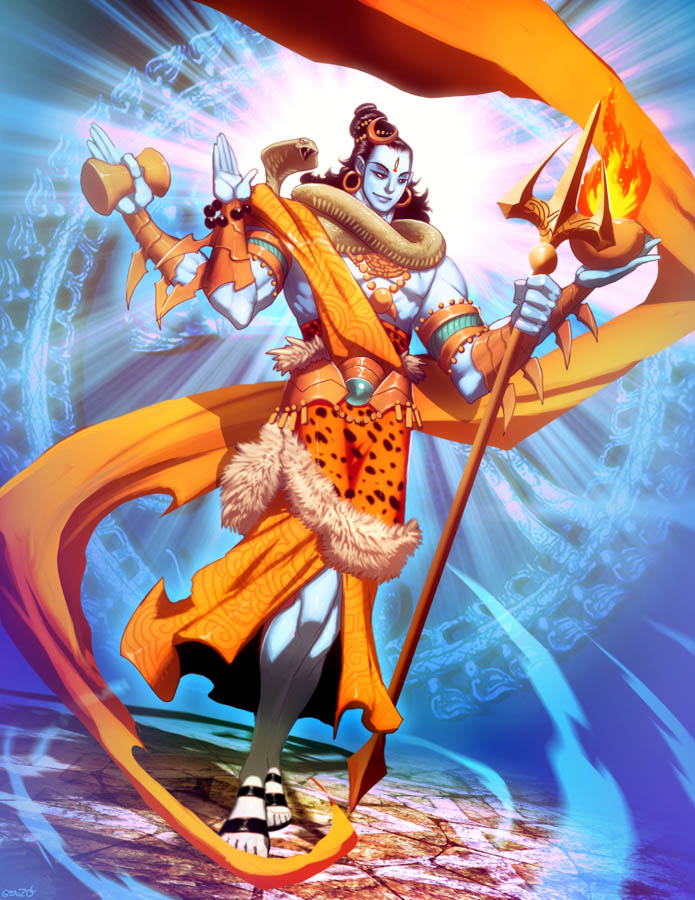
As for Shiva, that venerable god appears in many forms and many times differently, and we simply don't have the space or the time to try to show all of them. We chose the current portrait of him because of its ashen-pale skin and obvious physical skinniness, emphasizing his role as an ascetic and great practitioner of austerities. He is certainly a warrior figure to be feared in many of his stories, however - maybe you were looking for a picture more like this one by talented artist Genzoman?
Vishnu's portrait is definitely not one of my favorites on our site; while it's definitely intended to be Vishnu (according to the artist who painted it, who despite my complaints is way cooler than I am) and is not meant to depict Krishna, it lacks much of Vishnu's defining iconography (though a few touches, like his earrings and the sash representing the Vedas, are present). I've been on the lookout lately for a good image to replace it, so we'll just have to see what we can come up with!
Your question came in anonymously, so I'm afraid we can't contact you, but if you see this, thanks for your input!
Hi, there! First of all, thanks for writing in; we love to hear perspectives from all kinds of places and people, and we were pretty excited to get your note.
This site is for a roleplaying game called Scion, in which players create characters who are the children of various gods from around the world, including the gods of India. It's not intended to be a religious site for any faith, nor is it intended to be a source of information for those studying religions; we try to be accurate and capture the flavor and meaning of mythology as much as we can, but we shouldn't be looked to as a religious source for modern practitioners by any means. What you see here is a collection of information on the gods as they appear in our games, as well as rules for playing. It's never our intention to be offensive to anyone who practices these religions or worships these gods; the game is for entertainment purposes only. We're sorry if we caused any confusion!
As for Shiva, that venerable god appears in many forms and many times differently, and we simply don't have the space or the time to try to show all of them. We chose the current portrait of him because of its ashen-pale skin and obvious physical skinniness, emphasizing his role as an ascetic and great practitioner of austerities. He is certainly a warrior figure to be feared in many of his stories, however - maybe you were looking for a picture more like this one by talented artist Genzoman?
Vishnu's portrait is definitely not one of my favorites on our site; while it's definitely intended to be Vishnu (according to the artist who painted it, who despite my complaints is way cooler than I am) and is not meant to depict Krishna, it lacks much of Vishnu's defining iconography (though a few touches, like his earrings and the sash representing the Vedas, are present). I've been on the lookout lately for a good image to replace it, so we'll just have to see what we can come up with!
Your question came in anonymously, so I'm afraid we can't contact you, but if you see this, thanks for your input!
Monday, August 27, 2012
She Who is Brought by Elephants
Question: How would you guys manage Devayani, of Hindu mythology? I've been curious about her, so I figure I should ask - what's she like, in this Scion game?
At the moment, not like anything, as she hasn't made an appearance; our Deva Scions are still all wee little Hero-level children running about in the World, and most of them haven't met any deities other than their own parents. Skanda/Murugan and his wife Devayani are certainly members of the Devas and will probably be involved in their lives at some point (especially Akhileswar, since they'd be his brother and sister-in-law), but for the moment they've got all they can handle just reconciling with the existence of one or two gods, let alone a whole pantheon of them.
Devayani probably isn't much higher than Legend 9; she's an interesting little figure, but not really one who does a lot or is pivotal in a lot of myths (unlike her husband, who is an important badass who frequently does importantly badass things). I don't know what associated powers she could have other than perhaps animal from her vague association with elephants, and she's mostly eclipsed by Skanda's other wife, Valli (who actually does have a coherent myth about her courtship and marriage, while Devayani just gets offered up by her father), anyway. I imagine she'd be interesting to talk to, and might be politically fun considering that she's kind of the daughter of both Vishnu and Indra in different incarnations, but beyond that I'm not sure there's a lot I'd be planning to do with her.
Skanda, though - that dude is all over the Deva landscape. He's definitely someone to watch out for, and if he's around, Devayani may not be far behind.
Subscribe to:
Posts (Atom)