It's time for another big-bang post full of quick answers! For those who want to keep track of the ever-expanding vortex of the Questionado, it's currently at 194. We're down 7! Success!
Question: Do Scions automatically know the language of their pantheon?
No, they do not. They know whatever language they actually know, and won't magically learn their pantheon's native tongue just from being activated as a Scion. If you're thinking of that weird thing that the Percy Jackson books do, we're sorry to disappoint you - nobody ever has a language "hard-coded into their DNA". (But you can get Language Mastery and that's basically about as good!)
Question: Just noticed that on the Annuna you have a profile up for Nanshe (with 6 associated) but she is not listed as a playable god. Is there any particular reason for this or are you just holding off for a major Annuna update?
Sometimes gods get kicked off our rosters for not being high enough Legend, but we keep their pages around in case other people still want to look at them. You'll also find "secret" god-pages for Sif, Geb, Kebauet, Dian Cecht, and a few others.
Question: What gods would you suggest for an expanded British pantheon? At the moment I’m thinking of adding Tommy Atkins, Merlin, Herne the Hunter and Tom Hickathrift (A.K.A. Jack the Giant-Killer) to Britannia, John Bull and Robin Hood. I don’t want it to resemble Arthurian legend too much, as that’s a little too Christianised for my tastes, but I want it to stand out from the Tuatha and the Welsh gods as well.
Sorry, we can't help you with this one. We are passionate haters of the World at War pantheons, including the Allied/British pantheon, and would never make them a "pantheon" of gods of an equal standing with people like Ra or Zeus. At best, we'd consider them former Scions, undercover personas of various established gods, or in a few cases Legendary Mortals. (But we do consider Herne the Hunter to be an alternate persona of Cernunnos, if that helps you with anything.)
Question: First off, I definitely love what you did with the Inue. In terms of Native American pantheons, most of the fan stuff has been to take some of the gods from each pantheon and bring them together as one like the Manitou. What is your opinion on something such as that and do you feel each of the individual pantheons can stand on their own like the Inue?
We're not fans. We think the pantheons of all different areas of the world should have an equal shot at being Scion parents, and that there's no reason to assume that the tons of Native American pantheons wouldn't be just as distinct from one another as all the pantheons of the other continents.
Question: If a paleontologist Scion wanted to, could they make their personal Santum a chain of islands modeled after Las Cinco Muertes from the Jurassic Park franchise?
You can put whatever you want to in your Sanctum - it's your house and you can decorate it as you please! (But that only goes for in your house, so you won't be able to use it to create a free dinosaur army that can leave to lay waste to New York with you.)
Question: Do you think Gods' Honest is broken knack?
No - if we thought that, we wouldn't be letting our Scions use it all the time. I'm not sure why you think it's broken, since you didn't say, but feel free to tell us why in the comments.
Question: What do you do when a PSP boon requires a roll of a Virtue (like how Familial Sacrifice's pool is Conviction) and the Scion doesn't have that virtue? Do you just have them botch the roll, or do you have them use the next most appropriate virtue?
They can't make that roll; they have zero dice. They probably shouldn't have swapped it out, or should try to get it back if it was taken from them. However, they could still use a Virtue Channel or Legendary Deed to get some dice/autos if they still want to use the boon anyway.
Question: When purchasing dots of Epic Stamina, you get health levels. Are these -0, -1, -2 or -4?
Always -0. Dots of Epic Stamina also remove the wound penalty negatives from the health boxes you already have as you get more of them.
Question: When a Scion spends Legend, are Fatebonds only formed with those physically present? EX: if someone catches a film of them and uploads it onto YouTube.
Yes, you will only gain Fatebonds to people who are actually nearby when you spend the Legend. If someone recorded your deed and uploaded it to YouTube, no one who watched it would get Fatebound because you would not be spending any Legend when they saw it.
Question: I was looking through the graveyard, and Jesus Christ, what happened in Langley?
Vote for Strawberry Fields fiction, and find out. ;)
Question: So, weirdest question ever about Michael Chambers. How would any man or woman he sleeps with want to deal with a cold piece of metal on his penis? I can't imagine any woman wanting that inside them.
We... are not sure whether or not you're serious. But in case you are, you may want to do a careful and discreet Google of the term "Prince Albert piercing", and god go with you.
And we'll stick with those ten for today!

Showing posts with label North America. Show all posts
Showing posts with label North America. Show all posts
Tuesday, February 25, 2014

Tuesday, December 17, 2013
Cunning Canine Corporation
Question: Could we have a post on Native American coyote gods?
Yes, we can! The coyote is a very common totem among various Native American groups, and while like a lot of American gods he tends to be cast as a non-deity folktale figure or a pan-continental all-Native-American-tribes mega-figure, there are actually a lot of very specific (and interesting, and awesome!) different features and stories about coyote deities in various different areas of the country.
Of course, you guys know where my heart lies, so I'll start with the Aztecs. Their coyote god is named Huehuecoyotl - literally, "old, old coyote" - and he is a prankster extraordinaire, pulling tricks on his friends and the other gods and often ending up on the hook for them himself. He's occasionally said to be a son of Tezcatlipoca, which certainly explains his mischievous nature, or even sometimes an alternate aspect of Tezcatlipoca himself (in fact, some scholars even theorize that it was Huehuecoyotl, in the shape of Tezcatlipoca, who ruined the Third World by seducing Xochiquetzal away from Tlaloc). Look at this delightful motherfucker:
He also shares lordship over dance, music, tasty foods and partying with various other Aztec deities, so he's really just begging to hang out in an awesome club with Xochipilli, Patecatl and various other Mexican miscreants.
But farther north is where this question is really looking to dig in, with the coyote gods above the border. Starting up with the Ho-Chunk people of Wisconsin, we have Manikaksis, a coyote god who is not really much of a top dog. While he is definitely skilled at stealth and sneakery - even Wakdjunkaga, the major trickster of that pantheon, gave up on trying to equal him for sneakiness - he's also generally depicted as ineffective, comical and petty, even pitiful when compared to more powerful gods (especially his brother Sukcakega, the wolf god, considered his opposite number). This poor guy never wins in Ho-Chunk mythology, which should become extremely obvious when you consider the fact that the markings on coyote fur are supposedly the result of the star spirits pissing on him and leaving acidic stains after one of his pranks didn't go very well for him.
Sadly, I couldn't find a picture of Manikaksis, who apparently is elusive in art thanks to not being as important a god and therefore less popular for weaving or painting. If any of you guys out there have one, share it!
Zoom over west to the Oregon area, and the Salish coyote god Sinkalip (literally "the mimicker") is also a trickster god, but he's much more of an important figure, beloved for his high-spirited antics and hilarious shenanigans as well as his occasional heroic deeds, especially when it comes to slaying monsters and thus saving humanity (either on purpose or as a side effect of trying to impress everyone, but either way, good stuff, right?). In Salish mythology, he's paired not with a wolf but with a fox, and many of his escapades are accomplished with the good-natured help of his twin brother Whyayloo the fox god, who is also in charge of resurrecting him whenever his fool antics get him killed. Which is often, because that's kind of how the life of an American trickster god goes.
That's a guy who's off to screw some things up. Look at that face.
Then, nearby, we've got the Nez Perce coyote god, Itsayaya. He's also a trickster and he also makes terrifyingly bad decisions as a result - like that time he got all the bear god's children killed and then was like "Shit, I have just angered a bear god, I did not plan ahead for this" - but he also takes on even more of a centrally responsible role, not only killing monsters and other threats to humanity but also functioning as the original creator who made humans in the first place. His behavior ranges from the judicial and benevolent, such as when he turned the feuding wasp and ant into stone rather than let them squabble over food, to the nasty, such as when he tried to cheat a rival god out of meat and ended up getting one of his own sons killed in the process, but he's always important, regardless of what he's up to.
Even farther north, we have the Yakama people in Washington State, who worship the coyote god Spilyay, a rare case of a coyote god famous for being more intentionally helpful to humanity than some of his pantheon-mates. In particular, he's one of the first gods to predict the creation and civilization of mankind and goes out of his way to make sure that winter is mild and manageable and that that game animals are placed on earth and fish seeded in rivers and ponds, although of course later humanity fails to be properly grateful for this and he angrily goes about blowing up most of the food he placed to force the people to have to work hard to eke out a living. Alas, that typical coyote god temper never goes out of style.
He looks so innocent and helpful, though!
To the Karuk of northern California, Pihneefich is the coyote god, and tends to appear in fully zoomorphic form more often than some of the other American coyote deities, who are presumed to appear as humanoids most of the time. Pihneefich steals fire for the world, similar to Prometheus, and while still an important trickster figure does not have the great cosmic powers of some other canine deities from neighboring peoples. In fact, he's so pitiful when it comes to physical power and ability that the creator god Kareya took pity on him and gave him his supreme cunning in order to make up for his helplessness in other areas.
But he's pretty adorable, so it's hard not to love that face, right?
The Miwok of California have one of the most famous coyote gods: Olette, the creator, who created the earth, the ocean, other animals and humanity, in a large suite of myths about how he does so and what kinds of materials he uses that vary slightly from group to group within Miwok territory. He still has his moments of madness - getting into a giant brawl with fellow creator the lizard god over whether or not humans should have hands, a fight he obviously lost - but is generally more serious and benevolent. He, too, has a fox deity as a partner, in this case Silver Fox, his mate and the level-headed guiding force who makes sure that his sometimes reactionary handling of things doesn't prevent him from appropriately providing care and teaching to humanity.
Again, no art for this guy that I could positively identify as Miwok, so share 'em if you got 'em.
Jaunt east a bit more (we are all over the U.S., aren't we?) and we can find the Shoshone people of Wyoming, whose coyote god Itsappa is a classic trickster who steals food and relics, doesn't think ahead and often gets killed but resurrects himself to keep the fun going, and has more than enough rivalry going on with his brother Issa, the wolf god and main creator figure, to rival any other canine brotherhoods across the continent. Itsappa also steals fire and harasses his fellow gods, and plays less of a responsible and more of a comical role in myths.
And last but not least, Ma'ii, the Navajo coyote god, who splits his time between being a benevolent creator and inventor and a prankster who creates problems as a necessary chaotic balancing force. Ma'ii's responsible for creating things like time, stars and lunar cycles (because he thought just having normal day/night was boring for everyone), finding and guiding the first group of humans into the world to keep him company, and simultaneously stealing flame and creating the Milky Way as a by-product in order to get one over on a rival trickster god. As a trickster and notorious gamester, his occasional mean-spiritedness is often attributed to his hobbies, since competitiveness and disappointment lead to anger and misbehavior for those who don't always win.
By the way, I know those of us in the U.S. tend to think of coyotes as a southwestern phenomenon, only causing people much notice in places like Arizona and New mexico, but they're actually extremely widespread and common all the way up into Canada. Which means gods with coyote imagery can and do pop up anywhere and everywhere in North America!
And you guys, this post is long enough, so I'm going to stop there, but this is far from the total number of coyotes out there. The Ohlone, Lakota, Pomo and several other cultures also have coyote gods, and while some may be cross-pollinated borrowings from other nearby peoples, many of them have their own unique features and tales. It's a veritable smorgasbord of coyote gods, enough to form their own confederation of craziness if they wanted to (and could avoid blowing the whole thing up every few minutes). They are everywhere. They are Legion. They are going to ruin everyone's day.
Yes, we can! The coyote is a very common totem among various Native American groups, and while like a lot of American gods he tends to be cast as a non-deity folktale figure or a pan-continental all-Native-American-tribes mega-figure, there are actually a lot of very specific (and interesting, and awesome!) different features and stories about coyote deities in various different areas of the country.
Of course, you guys know where my heart lies, so I'll start with the Aztecs. Their coyote god is named Huehuecoyotl - literally, "old, old coyote" - and he is a prankster extraordinaire, pulling tricks on his friends and the other gods and often ending up on the hook for them himself. He's occasionally said to be a son of Tezcatlipoca, which certainly explains his mischievous nature, or even sometimes an alternate aspect of Tezcatlipoca himself (in fact, some scholars even theorize that it was Huehuecoyotl, in the shape of Tezcatlipoca, who ruined the Third World by seducing Xochiquetzal away from Tlaloc). Look at this delightful motherfucker:

He also shares lordship over dance, music, tasty foods and partying with various other Aztec deities, so he's really just begging to hang out in an awesome club with Xochipilli, Patecatl and various other Mexican miscreants.
But farther north is where this question is really looking to dig in, with the coyote gods above the border. Starting up with the Ho-Chunk people of Wisconsin, we have Manikaksis, a coyote god who is not really much of a top dog. While he is definitely skilled at stealth and sneakery - even Wakdjunkaga, the major trickster of that pantheon, gave up on trying to equal him for sneakiness - he's also generally depicted as ineffective, comical and petty, even pitiful when compared to more powerful gods (especially his brother Sukcakega, the wolf god, considered his opposite number). This poor guy never wins in Ho-Chunk mythology, which should become extremely obvious when you consider the fact that the markings on coyote fur are supposedly the result of the star spirits pissing on him and leaving acidic stains after one of his pranks didn't go very well for him.
Sadly, I couldn't find a picture of Manikaksis, who apparently is elusive in art thanks to not being as important a god and therefore less popular for weaving or painting. If any of you guys out there have one, share it!
Zoom over west to the Oregon area, and the Salish coyote god Sinkalip (literally "the mimicker") is also a trickster god, but he's much more of an important figure, beloved for his high-spirited antics and hilarious shenanigans as well as his occasional heroic deeds, especially when it comes to slaying monsters and thus saving humanity (either on purpose or as a side effect of trying to impress everyone, but either way, good stuff, right?). In Salish mythology, he's paired not with a wolf but with a fox, and many of his escapades are accomplished with the good-natured help of his twin brother Whyayloo the fox god, who is also in charge of resurrecting him whenever his fool antics get him killed. Which is often, because that's kind of how the life of an American trickster god goes.
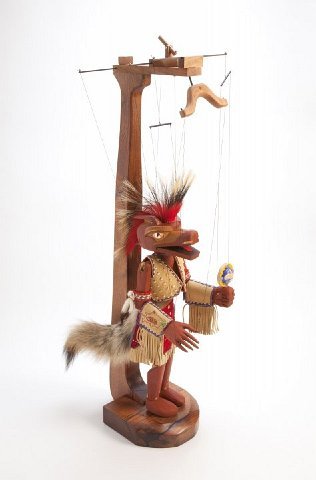
That's a guy who's off to screw some things up. Look at that face.
Then, nearby, we've got the Nez Perce coyote god, Itsayaya. He's also a trickster and he also makes terrifyingly bad decisions as a result - like that time he got all the bear god's children killed and then was like "Shit, I have just angered a bear god, I did not plan ahead for this" - but he also takes on even more of a centrally responsible role, not only killing monsters and other threats to humanity but also functioning as the original creator who made humans in the first place. His behavior ranges from the judicial and benevolent, such as when he turned the feuding wasp and ant into stone rather than let them squabble over food, to the nasty, such as when he tried to cheat a rival god out of meat and ended up getting one of his own sons killed in the process, but he's always important, regardless of what he's up to.

Even farther north, we have the Yakama people in Washington State, who worship the coyote god Spilyay, a rare case of a coyote god famous for being more intentionally helpful to humanity than some of his pantheon-mates. In particular, he's one of the first gods to predict the creation and civilization of mankind and goes out of his way to make sure that winter is mild and manageable and that that game animals are placed on earth and fish seeded in rivers and ponds, although of course later humanity fails to be properly grateful for this and he angrily goes about blowing up most of the food he placed to force the people to have to work hard to eke out a living. Alas, that typical coyote god temper never goes out of style.

He looks so innocent and helpful, though!
To the Karuk of northern California, Pihneefich is the coyote god, and tends to appear in fully zoomorphic form more often than some of the other American coyote deities, who are presumed to appear as humanoids most of the time. Pihneefich steals fire for the world, similar to Prometheus, and while still an important trickster figure does not have the great cosmic powers of some other canine deities from neighboring peoples. In fact, he's so pitiful when it comes to physical power and ability that the creator god Kareya took pity on him and gave him his supreme cunning in order to make up for his helplessness in other areas.

But he's pretty adorable, so it's hard not to love that face, right?
The Miwok of California have one of the most famous coyote gods: Olette, the creator, who created the earth, the ocean, other animals and humanity, in a large suite of myths about how he does so and what kinds of materials he uses that vary slightly from group to group within Miwok territory. He still has his moments of madness - getting into a giant brawl with fellow creator the lizard god over whether or not humans should have hands, a fight he obviously lost - but is generally more serious and benevolent. He, too, has a fox deity as a partner, in this case Silver Fox, his mate and the level-headed guiding force who makes sure that his sometimes reactionary handling of things doesn't prevent him from appropriately providing care and teaching to humanity.
Again, no art for this guy that I could positively identify as Miwok, so share 'em if you got 'em.
Jaunt east a bit more (we are all over the U.S., aren't we?) and we can find the Shoshone people of Wyoming, whose coyote god Itsappa is a classic trickster who steals food and relics, doesn't think ahead and often gets killed but resurrects himself to keep the fun going, and has more than enough rivalry going on with his brother Issa, the wolf god and main creator figure, to rival any other canine brotherhoods across the continent. Itsappa also steals fire and harasses his fellow gods, and plays less of a responsible and more of a comical role in myths.
And last but not least, Ma'ii, the Navajo coyote god, who splits his time between being a benevolent creator and inventor and a prankster who creates problems as a necessary chaotic balancing force. Ma'ii's responsible for creating things like time, stars and lunar cycles (because he thought just having normal day/night was boring for everyone), finding and guiding the first group of humans into the world to keep him company, and simultaneously stealing flame and creating the Milky Way as a by-product in order to get one over on a rival trickster god. As a trickster and notorious gamester, his occasional mean-spiritedness is often attributed to his hobbies, since competitiveness and disappointment lead to anger and misbehavior for those who don't always win.

By the way, I know those of us in the U.S. tend to think of coyotes as a southwestern phenomenon, only causing people much notice in places like Arizona and New mexico, but they're actually extremely widespread and common all the way up into Canada. Which means gods with coyote imagery can and do pop up anywhere and everywhere in North America!
And you guys, this post is long enough, so I'm going to stop there, but this is far from the total number of coyotes out there. The Ohlone, Lakota, Pomo and several other cultures also have coyote gods, and while some may be cross-pollinated borrowings from other nearby peoples, many of them have their own unique features and tales. It's a veritable smorgasbord of coyote gods, enough to form their own confederation of craziness if they wanted to (and could avoid blowing the whole thing up every few minutes). They are everywhere. They are Legion. They are going to ruin everyone's day.
Saturday, December 14, 2013
American Awesomesauce
I hope you guys forgive the general quality of this vlog. I'm tired and apparently my video camera is, too, but I'm here anyway!
Question: So, I know that this is sort of coming out of nowhere, but I was wondering if you could talk about the White Buffalo Calf Woman. Do you think she's Legend 12, and do you think the Lakota have enough Legend 12 gods that they might one day in the future qualify for a write-up (after the Navajo. Go Navajo!)?
Question: Since the other options on the poll are getting it, could you tell us a little bit about Navajo myth and culture?
Question: Guarani mythology eh? Yeah, can uh, can we get some o' that here? I mean, not right away, 'course, but, ya know, eventually maybe? Least a little?
The problem with doing these posts about various cultures is that now I want to write four new pantheons at once!
Question: So, I know that this is sort of coming out of nowhere, but I was wondering if you could talk about the White Buffalo Calf Woman. Do you think she's Legend 12, and do you think the Lakota have enough Legend 12 gods that they might one day in the future qualify for a write-up (after the Navajo. Go Navajo!)?
Question: Since the other options on the poll are getting it, could you tell us a little bit about Navajo myth and culture?
Question: Guarani mythology eh? Yeah, can uh, can we get some o' that here? I mean, not right away, 'course, but, ya know, eventually maybe? Least a little?
The problem with doing these posts about various cultures is that now I want to write four new pantheons at once!
Subscribe to:
Posts (Atom)