Question: Are there any other cultures that have a divine end of days scenario aside from the Aesir and Ragnarok?
Oh, sure, tons of them. Eschatology, the study of the events of the end of the world, is not a purely European concept at all; many other cultures have their own ideas of what will happen at the death of the universe, some of them specifically marked and dated, others only implied.
The Norse stories of Ragnarok are very specific about times, places and people involved and so on, largely because they're predicated on prophecies. Details have been furnished by seers and soothsayers who have the ability to see into the future of Fate's weave; other cultures may not have as strong an emphasis on prophetic visions, and instead base their end-of-the-world scenarios on information gleaned from scripture or estimations based on their cosmological concepts of time and space.
One of the most famous, thanks to its religion still being a thriving and living one, is the end of the Kali Yuga in Hinduism. According to Hindu theology, every "day" - equivalent to literally millions of years, varying from four to several hundred depending on the scripture and sect - for Brahma, who experiences time much more slowly than mere humans, is equal to four ages in the world, roughly 24,000 years total. These four ages are the Satya Yuga (Age of Truth), in which religion, wisdom and prosperity are the rule of the universe; the Treta Yuga (Age of Three, referring to the number of pillars of Dharma remaining to support things at this time), in which evil begins to afflict the world but great heroes also arise to combat it; the Dvapara Yuga (Age of Two, referring to the now only at half-strength number of pillars), in which humanity is flawed but also kingly and learns to expiate their sins through study of the holy Vedas; and the Kali Yuga (Age of Kali, here referring to the asura Kali, not the goddess of the same name), during which humanity has degenerated into wanton sin and depravity and forgotten all but the most basic teachings of Hinduism.
We're currently in the Kali Yuga, which started at the moment that Vishnu left his last earthly incarnation, according to most interpretations of Hindu mythology (yes, just as in Greek mythology, we are the worst ever crop of humanity. Go us). Just as in the Norse myths of Ragnarok, the end of the Kali Yuga - and therefore the end of the world, when Brahma blinks and restarts the world once more at the beginning of the Satya Yuga - there are several prophesied events, culminating in a final showdown between the asura Kali, who is the one who has destroyed all righteousness on earth during the centuries of the Kali Yuga, and Kalki, the final avatar of Vishnu, who is destined to defeat him and in so doing end the world and make it ready for the beginning of the Satya Yuga again.
There's a ton of scripture out there on the Kali Yuga, not to mention reams of literature written by Hindu theologists and philosophers over the past thousand years or two, so if you want to really dig into it in detail, libraries and the internet are ready to help.
Of course, seldom in Scion do we discuss the problems of the Deva without also mentioning the Yazata, so a quick side trip into Zoroastrianism gets us another awesome end of the world scenario. The ancient Persian word for the event is Frashokereti, meaning "things become excellent", and as in Hindu tradition the world is broken up into ages, although in this case there are three instead of four (the first two were the Age of Creation and the Age of Pollution or Combination), and we're currently heading into the Age of Separation, when good and evil fight for supremacy.
According to Zoroastrian prophecy in the Avesta, the end of the world will be ushered in by the Saoshyant, a special hero and the son of the great Ahura Mazda himself (or in other traditions, Zarathustra), born from a virgin who bathes in a lake in which a trace of the supreme god's semen was left in order to impregnate her. The Saoshyant (who in Scion terms is definitely a kind of super specialized Scion, although in what terms totally depends on your take on Ahura Mazda) will wield the weapons of Vahram, resurrect the righteous dead to live again and lead the Yazata against the evil forces of the daeva, eventually defeating them. The gods will then melt the world into rivers of molten lava and metal, which will wash over all living things; the worthy and good will be able to wade through them to become one with heaven in bliss, but the evil will be utterly destroyed, along with Angra Mainyu and all his daeva minions.
Slightly north of Persia we run into the Slavs, who have their own eschatological forecast; according to Slavic tradition, Svarog lives for one million years, each day of which is the entire lifespan of the World (more than a little bit similar to Brahma, eh?). Each "day", he slumbers in the egg of the sun until he awakens in the evening, at which point he sweeps everything in the universe - all creation, living things, even the other gods - into one big pile and reconstitutes them into the pure stuff of creation, which he then fashions into the next world. This is called Sweeping Day and happens continually and regularly, like clockwork, and each time he recreates the Bogovi to take over their traditional foes, reborn with no memory of the last world. There's no specific time frame given for this, so we don't know how many years each world lasts; technically, Sweeping Day could be at any time, which is sobering. Someone with Prophecy should get on figuring that out.
We've also got the Mesopotamian religions; while they don't have any particular predictions for what will happen when the world ends, they do have an exact date. According to Babylonian texts, the world has a lifetime of "twelve times twelve sars", where one sar is equal to 36,000 years, so therefore the world is scheduled to last exactly 5,184,000 years. Furthermore, at the time of their civilization, they believed that there were only twelve sars - 432,000 years - left to go and that the vast majority of the world's lifespan was already over. So if we assume that's counting from the beginning of the major time of power for the Babylonian empire, around 1800 B.C.E., we're looking at a precise date for the end of the world in the year 430,200 C.E. In other words, too far away to care (which is probably what all that theoretical math was supposed to mean in Babylonian texts in the first place).
The two other major end-times scenarios that come to mind - those of the Aztec and Egyptian religions - are conditional, meaning that they aren't scheduled as an inevitability but will happen only if specific events occur first. For the Aztecs, we're currently living in the fifth world; the previous four worlds were each destroyed by large-scale disasters brought on by squabbles between the gods, in each case leading with the defection or destruction of the current sun deity. While there is no forecasted end of the world, it's understood that if the current sun - now embodied by Tonatiuh and protected by Huitzilopochtli - is destroyed or goes rogue, the fifth world will be destroyed as well. Depending on the tradition, some Mexican sources imply that a sixth world would then be created with a new god serving as the sun, while others - possibly more modern or influenced by Christianity - claim that the fifth world is the last one and that its destruction would spell the final and incontrovertible end.
Things are far more uncomfortable for the Egyptians; their cosmology is based on the idea that Ra, as the original creator of the universe, may at any time decide to become tired of it. If that occurs, he will decide to simply go to sleep, and as a result the world will be destroyed until such time as he decides to wake up and give remaking a new one a shot. While this hasn't happened yet, it's been a very near thing at least once; in one Egyptian story, Ra decides he's disenchanted with the whole affair and is about to pull the plug, and Hathor, goddess of beauty, joy and sexuality, narrowly averts disaster by lifting up her skirt and flashing him a full view of her incredibly attractive genitals. Ra is so amused he laughs uproariously, and then decides that he couldn't possibly destroy anything that awesome, so the world lives on another day. He could, however, decide to destroy the world at any moment; the only other end-of-the-world note is that Osiris is the only god expressly said to survive that apocalypse and be able to converse with Ra afterward, although he's not always very thrilled about the prospect.
With all this madness going on, there are plenty of doomsday possibilities to play with for Scion games. This is your hour to shine, oracles and prophets!

Showing posts with label Vishnu. Show all posts
Showing posts with label Vishnu. Show all posts
Sunday, December 1, 2013

Monday, April 15, 2013
No, We Can't All Just Get Along
Question: In your game, what transpired to make the Trimurti, Quetzalcoatl and Tezcatlipoca the enemies of Odin?
Two separate events, actually.
Quetzalcoatl and Tezcatlipoca join the rest of their pantheon in hating most of Odin's guts. While the two pantheons were supposedly allies, working together and sealed as neighbors by the marriage of their children Geoff and Sangria, Odin was behind the scenes attempting to annex as much of Mexico as he could get away with, partly out of his usual Odin-esque desire for conquest and expansion and partly because he was hoping that entangling his Fate with that of the Aztlanti might help him get out of Ragnarok. The Mexican gods, embroiled as they were in fighting several Titans at the time, didn't notice what he was doing until serious damage had been done, and things eventually came to a cataclysmic and destructive head when they confronted each other. I won't say exactly what happened because it's going to be the subject of some of the upcoming stories about Geoff's band, but the rift between the two pantheons was massive and the vast majority of the Aztlanti now view Odin as a traitor to their alliance.
As for the Trimurti, in their case they were the aggressors. After having serious problems on the home front with a certain one of their members deciding to go batshit and try to uncreate a lot of stuff, they shanghaied Aurora's band into helping them defeat him and clean up the mess. Unfortunately, they didn't ask first, and being that they tend to have a somewhat lofty opinion of themselves, they really didn't feel like they needed to. When Aurora expressed some concern that their divine parents were likely to kick their asses for haring off on a trans-continental Indian adventure instead of doing what they'd been told to do, the Trimurti rolled up into Asgard and Odin's feasting hall while he was having dinner, dropped off the kids and declared in front of most of the Aesir that nobody was to punish them or they would have to answer to them. Then they went home, blissfully uncaring of the epic insult they had just delivered to the king of the Aesir, and the band had to deal with the unpleasant fallout.
While the shenanigans with the Trimurti are not ready to make it to fiction for a while yet, you can see some of the ramp-up of the problems between the Aesir and Aztlanti in some of the stories. In Foundations, the first evidence of problems in Mexico appears and the first accusations of Norse involvement are leveled; in Drums of War the Norse confirm what they're up to but have not yet erupted into actual conflict; in Bone, Muscle, Heart and Sinew Sangria and her fellow Aztlanti Scions begin dealing with the problem and attempting to safeguard their people, and in What Dreams May Come Woody's band sees the Aesir contingent hard at work in Mexico and is warned about the fighting that has begun to break out.
Two separate events, actually.
Quetzalcoatl and Tezcatlipoca join the rest of their pantheon in hating most of Odin's guts. While the two pantheons were supposedly allies, working together and sealed as neighbors by the marriage of their children Geoff and Sangria, Odin was behind the scenes attempting to annex as much of Mexico as he could get away with, partly out of his usual Odin-esque desire for conquest and expansion and partly because he was hoping that entangling his Fate with that of the Aztlanti might help him get out of Ragnarok. The Mexican gods, embroiled as they were in fighting several Titans at the time, didn't notice what he was doing until serious damage had been done, and things eventually came to a cataclysmic and destructive head when they confronted each other. I won't say exactly what happened because it's going to be the subject of some of the upcoming stories about Geoff's band, but the rift between the two pantheons was massive and the vast majority of the Aztlanti now view Odin as a traitor to their alliance.
As for the Trimurti, in their case they were the aggressors. After having serious problems on the home front with a certain one of their members deciding to go batshit and try to uncreate a lot of stuff, they shanghaied Aurora's band into helping them defeat him and clean up the mess. Unfortunately, they didn't ask first, and being that they tend to have a somewhat lofty opinion of themselves, they really didn't feel like they needed to. When Aurora expressed some concern that their divine parents were likely to kick their asses for haring off on a trans-continental Indian adventure instead of doing what they'd been told to do, the Trimurti rolled up into Asgard and Odin's feasting hall while he was having dinner, dropped off the kids and declared in front of most of the Aesir that nobody was to punish them or they would have to answer to them. Then they went home, blissfully uncaring of the epic insult they had just delivered to the king of the Aesir, and the band had to deal with the unpleasant fallout.
While the shenanigans with the Trimurti are not ready to make it to fiction for a while yet, you can see some of the ramp-up of the problems between the Aesir and Aztlanti in some of the stories. In Foundations, the first evidence of problems in Mexico appears and the first accusations of Norse involvement are leveled; in Drums of War the Norse confirm what they're up to but have not yet erupted into actual conflict; in Bone, Muscle, Heart and Sinew Sangria and her fellow Aztlanti Scions begin dealing with the problem and attempting to safeguard their people, and in What Dreams May Come Woody's band sees the Aesir contingent hard at work in Mexico and is warned about the fighting that has begun to break out.
Saturday, September 8, 2012
Dashavatara
Question: You mention Kalki as Vishnu's tenth and final Avatar in his writeup, but I counted, and there's only eight others mentioned. Did you forget an Avatar? Narasimha perhaps?
Well, damn - you're right. The writeup mentions Matsya the fish, Kurma the turtle, Varaha the boar, Vamana the dwarf, Parasurama the trickster, Rama the warrior, Krishna the teacher and Buddha the deceiver, but lacks a ninth figure.
Hindu theology actually disagrees on the ten most important avatars of Vishnu; he appears in many more than ten figures, and depending on the time period and sect many of them are considered more or less important on a situational basis. Narasimha, the rampaging lion-man who killed the invincible asura Hiranyankashapu is one of the most popular options, but there are several others, including Balarama, the first creation and protector of his brother Krishna, Vithoba, the enabler of poetic devotion, Jagganath, the war-leader of Orissa, Hayagriva, the horse-headed slayer of the identically-named demon Hayagriva, and Mohini, the enchanting dancer who tricked Bhamasura into killing himself.
Personally, I'm more inclined toward Narasimha and Mohini, as they seem to be the most universally noted in Hindu myth and many of the other avatars on the list are specific to a particular sect or area. What do you guys think?
Well, damn - you're right. The writeup mentions Matsya the fish, Kurma the turtle, Varaha the boar, Vamana the dwarf, Parasurama the trickster, Rama the warrior, Krishna the teacher and Buddha the deceiver, but lacks a ninth figure.
Hindu theology actually disagrees on the ten most important avatars of Vishnu; he appears in many more than ten figures, and depending on the time period and sect many of them are considered more or less important on a situational basis. Narasimha, the rampaging lion-man who killed the invincible asura Hiranyankashapu is one of the most popular options, but there are several others, including Balarama, the first creation and protector of his brother Krishna, Vithoba, the enabler of poetic devotion, Jagganath, the war-leader of Orissa, Hayagriva, the horse-headed slayer of the identically-named demon Hayagriva, and Mohini, the enchanting dancer who tricked Bhamasura into killing himself.
Personally, I'm more inclined toward Narasimha and Mohini, as they seem to be the most universally noted in Hindu myth and many of the other avatars on the list are specific to a particular sect or area. What do you guys think?
Thursday, September 6, 2012
Gods of Many Forms
Question: Hi, I an an Indian. I would just like to say that the picture of Lord Shiva used or created does not match his personality at all. He looks more like a warrior and less like the teenage boy that he is depicted as here. And the image of Lord Vishnu used is actually that of Lord Krishna. I'm impressed by the research done on Indian mythology, but I don't understand what this site is. Please correct the images, and if you want I will draw you guys one.
Hi, there! First of all, thanks for writing in; we love to hear perspectives from all kinds of places and people, and we were pretty excited to get your note.
This site is for a roleplaying game called Scion, in which players create characters who are the children of various gods from around the world, including the gods of India. It's not intended to be a religious site for any faith, nor is it intended to be a source of information for those studying religions; we try to be accurate and capture the flavor and meaning of mythology as much as we can, but we shouldn't be looked to as a religious source for modern practitioners by any means. What you see here is a collection of information on the gods as they appear in our games, as well as rules for playing. It's never our intention to be offensive to anyone who practices these religions or worships these gods; the game is for entertainment purposes only. We're sorry if we caused any confusion!
As for Shiva, that venerable god appears in many forms and many times differently, and we simply don't have the space or the time to try to show all of them. We chose the current portrait of him because of its ashen-pale skin and obvious physical skinniness, emphasizing his role as an ascetic and great practitioner of austerities. He is certainly a warrior figure to be feared in many of his stories, however - maybe you were looking for a picture more like this one by talented artist Genzoman?
Vishnu's portrait is definitely not one of my favorites on our site; while it's definitely intended to be Vishnu (according to the artist who painted it, who despite my complaints is way cooler than I am) and is not meant to depict Krishna, it lacks much of Vishnu's defining iconography (though a few touches, like his earrings and the sash representing the Vedas, are present). I've been on the lookout lately for a good image to replace it, so we'll just have to see what we can come up with!
Your question came in anonymously, so I'm afraid we can't contact you, but if you see this, thanks for your input!
Hi, there! First of all, thanks for writing in; we love to hear perspectives from all kinds of places and people, and we were pretty excited to get your note.
This site is for a roleplaying game called Scion, in which players create characters who are the children of various gods from around the world, including the gods of India. It's not intended to be a religious site for any faith, nor is it intended to be a source of information for those studying religions; we try to be accurate and capture the flavor and meaning of mythology as much as we can, but we shouldn't be looked to as a religious source for modern practitioners by any means. What you see here is a collection of information on the gods as they appear in our games, as well as rules for playing. It's never our intention to be offensive to anyone who practices these religions or worships these gods; the game is for entertainment purposes only. We're sorry if we caused any confusion!
As for Shiva, that venerable god appears in many forms and many times differently, and we simply don't have the space or the time to try to show all of them. We chose the current portrait of him because of its ashen-pale skin and obvious physical skinniness, emphasizing his role as an ascetic and great practitioner of austerities. He is certainly a warrior figure to be feared in many of his stories, however - maybe you were looking for a picture more like this one by talented artist Genzoman?
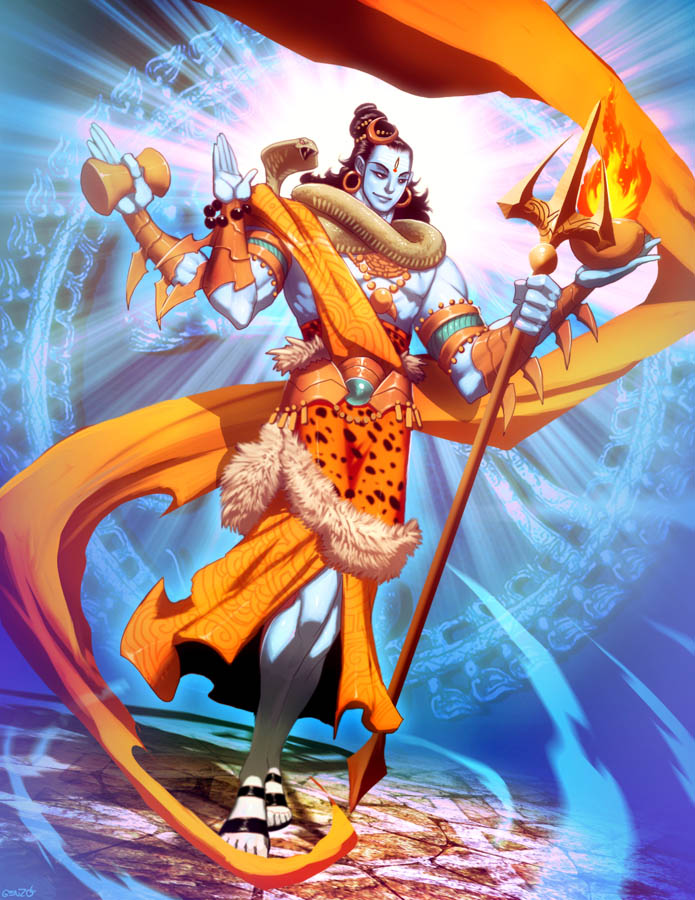
Vishnu's portrait is definitely not one of my favorites on our site; while it's definitely intended to be Vishnu (according to the artist who painted it, who despite my complaints is way cooler than I am) and is not meant to depict Krishna, it lacks much of Vishnu's defining iconography (though a few touches, like his earrings and the sash representing the Vedas, are present). I've been on the lookout lately for a good image to replace it, so we'll just have to see what we can come up with!
Your question came in anonymously, so I'm afraid we can't contact you, but if you see this, thanks for your input!
Wednesday, February 8, 2012
The World-Honored Enlightened One
Question: What place does the Buddha hold in Asian myth? In Chinese myths the Buddha was portrayed as the supreme authority the gods turned to when they couldn't find a solution on there own like with Son Goku. So how would that work in game, since the Buddha was either a human teacher like Muhammad or an avatar of Vishnu?
Big question that needs a big answer. The Buddha takes a lot of forms over a lot of religions and is an important figure for the Hindu, Chinese, Japanese, Koreans and Tibetans to name just a few, but he's never quite treated as the same across the board. It's one of those situations where Scion needs to make a choice (it hasn't, so instead STs get to) and different games may want to handle it completely differently.
The easiest way to handle the Buddha, and what we generally do for our games, is to give Vishnu the benefit of the doubt and decide that the Buddha really was one of his avatars, specifically arriving on earth in order to create religious confusion and discord and separate the truly faithful (i.e., Hindus) from the weak of will and easily led astray (i.e., everybody else). Historically, of course, this is a great example of a religion doing some quick and savvy political maneuvering to deal with a rival; when Buddhism became popular, Hindu leaders basically incorporated the idea of the Buddha as an avatar of Vishnu in order to in a single stroke paint the younger religion as both totally false and ultimately under the control of their own gods. As a religious rhetoric move, it was pretty ingenious. But from Scion's point of view, the original core of Buddhism ignores gods, and that makes it, like monotheism, a religion that really doesn't fit in the setting well; so, since there already is a mythological precedent for the Buddha as an avatar of Vishnu, that's what we go with. Easy as pie, and the resulting massive spin-off sprawl of Buddhism becomes merely humanity running with an idea on their own and incorporating indigenous gods into it as time goes by.
Buddhism in China, however, takes a lot of different forms thanks to mixing with and adopting deities from Taoism and Shenism over the course of centuries. It's no longer really the same animal that it was in its long-ago Hindu days; you could, as above, just rule that it's a human invention and make that the end of it, but then what about the boddhisattvas? This can be a fun place for historical editorializing in Scion - if Buddhism is originally a human-focused, god-free religion (or at least one that features its founder arguing against the existence of gods), why wouldn't gods move in on it to make it their own? Indigenous Chinese gods might have found the vehicle of Buddhism perfect for spinning off and making a name for themselves outside the rigid bureaucracy of the Shen, and it makes perfect sense for gods imported from India, such as Guanyin or Nezha, to become revered in the religion that also had its roots in their homeland. Philosophical Buddhism may have been a non-deity religion at its inception, but it certainly isn't now and hasn't been for a very long time; there's no reason gods couldn't have taken advantage of the situation for their own political benefit. Japan is much the same story, and could lead to interesting game politics if, say, Emma-O of Buddhism starts trying to lead a concerted assault on Underworld territory traditionally owned by Izanami of Shintoism.
You might also decide that Buddha is actually a god, messing around with founding his own religion for his own inscrutable reasons. Good candidates for this besides Vishnu would include Budai, the fat, laughing Buddha of China that has managed to rise from relative obscurity to being recognized even by those with no knowledge of eastern religions thanks to his association with Buddhism, or Tonpa Shenrab, an indigenous Tibetan god who has managed to become renowned as a (or the) Buddha despite being the founding deity of Tibetan mythology.
Another option, and one you may want to pursue if you're going with the idea of monotheistic religions as human inventions, is just that Gautama Buddha was really and truly nothing more than a normal human with a philosophical message that became incredibly popular and spread across Asia as a religion after his death. It would certainly underline the idea of human belief being important in the world despite its lack of direct effect on gods, and forcing Vishnu to invent an entire new persona to combat a religion created by mere humans is pretty entertaining.
It's a per-ST choice, like a lot of things in Scion; there's no clear answer and the books, despite using Buddhist deities in their eastern pantheons, tend to avoid the subject even more thoroughly than they avoid monotheism, so we're on our own as far as deciding that goes. We personally like the Vishnu avatar choice, since it keeps Buddhism's roots tied to the Hinduism it grew out of and emphasizes what dicks Hindu gods can be sometimes, but any of them are valid avenues to pursue for Scion.
Big question that needs a big answer. The Buddha takes a lot of forms over a lot of religions and is an important figure for the Hindu, Chinese, Japanese, Koreans and Tibetans to name just a few, but he's never quite treated as the same across the board. It's one of those situations where Scion needs to make a choice (it hasn't, so instead STs get to) and different games may want to handle it completely differently.
The easiest way to handle the Buddha, and what we generally do for our games, is to give Vishnu the benefit of the doubt and decide that the Buddha really was one of his avatars, specifically arriving on earth in order to create religious confusion and discord and separate the truly faithful (i.e., Hindus) from the weak of will and easily led astray (i.e., everybody else). Historically, of course, this is a great example of a religion doing some quick and savvy political maneuvering to deal with a rival; when Buddhism became popular, Hindu leaders basically incorporated the idea of the Buddha as an avatar of Vishnu in order to in a single stroke paint the younger religion as both totally false and ultimately under the control of their own gods. As a religious rhetoric move, it was pretty ingenious. But from Scion's point of view, the original core of Buddhism ignores gods, and that makes it, like monotheism, a religion that really doesn't fit in the setting well; so, since there already is a mythological precedent for the Buddha as an avatar of Vishnu, that's what we go with. Easy as pie, and the resulting massive spin-off sprawl of Buddhism becomes merely humanity running with an idea on their own and incorporating indigenous gods into it as time goes by.
Buddhism in China, however, takes a lot of different forms thanks to mixing with and adopting deities from Taoism and Shenism over the course of centuries. It's no longer really the same animal that it was in its long-ago Hindu days; you could, as above, just rule that it's a human invention and make that the end of it, but then what about the boddhisattvas? This can be a fun place for historical editorializing in Scion - if Buddhism is originally a human-focused, god-free religion (or at least one that features its founder arguing against the existence of gods), why wouldn't gods move in on it to make it their own? Indigenous Chinese gods might have found the vehicle of Buddhism perfect for spinning off and making a name for themselves outside the rigid bureaucracy of the Shen, and it makes perfect sense for gods imported from India, such as Guanyin or Nezha, to become revered in the religion that also had its roots in their homeland. Philosophical Buddhism may have been a non-deity religion at its inception, but it certainly isn't now and hasn't been for a very long time; there's no reason gods couldn't have taken advantage of the situation for their own political benefit. Japan is much the same story, and could lead to interesting game politics if, say, Emma-O of Buddhism starts trying to lead a concerted assault on Underworld territory traditionally owned by Izanami of Shintoism.
You might also decide that Buddha is actually a god, messing around with founding his own religion for his own inscrutable reasons. Good candidates for this besides Vishnu would include Budai, the fat, laughing Buddha of China that has managed to rise from relative obscurity to being recognized even by those with no knowledge of eastern religions thanks to his association with Buddhism, or Tonpa Shenrab, an indigenous Tibetan god who has managed to become renowned as a (or the) Buddha despite being the founding deity of Tibetan mythology.
Another option, and one you may want to pursue if you're going with the idea of monotheistic religions as human inventions, is just that Gautama Buddha was really and truly nothing more than a normal human with a philosophical message that became incredibly popular and spread across Asia as a religion after his death. It would certainly underline the idea of human belief being important in the world despite its lack of direct effect on gods, and forcing Vishnu to invent an entire new persona to combat a religion created by mere humans is pretty entertaining.
It's a per-ST choice, like a lot of things in Scion; there's no clear answer and the books, despite using Buddhist deities in their eastern pantheons, tend to avoid the subject even more thoroughly than they avoid monotheism, so we're on our own as far as deciding that goes. We personally like the Vishnu avatar choice, since it keeps Buddhism's roots tied to the Hinduism it grew out of and emphasizes what dicks Hindu gods can be sometimes, but any of them are valid avenues to pursue for Scion.
Subscribe to:
Posts (Atom)