Question: I'm not sure if this has been asked, or if you've already answered this somewhere else, but how do you deal with in-story Legend gain for stealthy or purposefully secretive characters who try to stay out of the spotlight?
You might find these three posts helpful, friend! It comes up pretty frequently, since figuring out how to reconcile Legend gain with flying under the radar can be difficult to wrap your head around.
The short answer is that you can be as stealthy, secretive and unnoticed as you want, but you still have to do important things. If you're doing awesome stuff, spending Legend and being part of important, mythic events, you'll go up in Legend; if you're hiding in the corner refusing to be involved, you won't. Stealthy characters are fully capable of going up in Legend all the time. They just have to do it with awesome feats that are sneaky.

Monday, February 18, 2013

You Could Name It "Hammered"
Question: How much is known about the Sami gods?
Less than we should know, unfortunately. The Sami, thanks to being nomadic in behavior and shamanistic in their beliefs, were seldom paid much attention to by folklorists studying the area, and most tales recorded about them are low-level spirits-and-monsters kinds of stuff. Early southern Europeans bothering them didn't even figure out that they had gods at all for a while, assuming that their religion was a generalized animism that venerated all life, and once people did figure them out it was all Christian proselytizing all the time. Very few of their myths have been recorded from their largely oral traditions and written down, and even fewer of those have been translated into English (why aren't you interested in neat stuff, English-speaking world, huh?).
Alas, what do those of us who don't speak Norwegian, Swedish or Finnish do? Well, we cry, mostly, but we can also go hunt up the only two real English sources on the subject: Laestadius' Fragments of Lappish Mythology, a nineteenth-century collection by a Christian writer with all the problems you would expect it to have, and Van Cleef's much more modern but also more poetry- and art-oriented God Wears Many Skins. If you happen to speak one of the three languages above, you're likely to have a whole lot better luck looking there than in the English arena. Past those, you'll find bits and pieces on Sami belief, shamanism and deities scattered throughout other books, as footnotes in books on their near neighbors the Norse, Finnish or Baltic people or as usually isolated mentions in general mythology books.
The Sami have a large cast of deities, but we don't know a great deal about many of them other than their names and general area of specialty, and others are identifiably borrowed from nearby cultures that they probably had a lot of contact with. The most obvious is their thunder-god, a big old badass named Diermmes/Thiermmes, who is also called Thoragalles and uses a giant hammer to smash giant trolls in the face. The parallels to Thor are obvious - but he's also sometimes referred to with the epithet Ukko, who happens to be the thunder-god of the Finnish pantheon (who also wields a hammer, and let's not forget Perun nearby with his axe - thunder gods). And yet Diermmes also has unique mythology of his own, most notably the story in which he is constantly pursuing a great golden reindeer around the world, which will end when he succeeds in killing it. He's obviously borrowing from other religions in the area, but the Sami stories about him don't always match up to the attributes he's borrowed from elsewhere.
Most mythographers, when they bother with the Sami at all, tend to lump them in with the Finnish pantheon; it's not really the worst decision anyone could be making, since the religions clearly influence each other and share gods, and its probable that they grew from the same root and simply went in different directions for the settled Finnish farmers and the wandering Sami herders. It's a similar situation to, say, Japanese mythology versus the beliefs of the indigenous Ryukyuan people of Okinawa, who do have their own unique concepts but who also share more than a little of the folklore of their northern neighbors.
To be honest, I think the Sami are very neat and I really wish there was more source material on their gods available (in a language I can read!). But I'm not sure we'll ever see them in Scion - definitely not in the official line, which doesn't have much to gain from a religion most players have no clue exists, and probably not from us, either, as I can't imagine there being enough demand for them and the better-known Finnish gods. But, like many other small pantheons, they are certainly possibilities to be used in games and more than excellent choices as NPCs to flummox Scions who spend their time up in the frozen north.
I think what I got out of this post most is that I really want to see Thor, Diemmas, Ukko, Perun and Perkunas get together and start a band or something.
Sunday, February 17, 2013
In Flanders' Fields
Question: So I noticed reading your Characters section that a lot of Scions got killed/captured then killed by the USA government. How were they able to do this? Were all the Scions Hero-level?
Alas... the unfortunate Strawberry Fields game. Its character roster is a military graveyard.
The game started with Ian Jupiter, Seamus McMann, Dierdre O'Riordan and Samuel Striker, a motley group of misfits who managed to clean up a few dangerous Titanspawn problems but were brought low by human military might. They were indeed Hero-level when they first ran into trouble with the law of the land, when their obviously augmented abilities and strange powers caught the attention of the United States government. In the first conflict between them, Sam was captured by overwhelming force and taken to a military hospital, where he was experimented upon in an attempt to figure out where his powers were coming from. The group then gained Amunet Ipi, Miles Laurent and Najarat Sekhar as they tried to heroically prevent the Titanspawn-fueled destruction of Las Vegas, but by then the government knew who half of them were and was mobilized in their direction. After a particularly spectacular battle in which Miles accidentally grew angel wings on live national newsfeeds, Najarat was killed in a tank-fight when he refused to submit to governmental authority, and Dierdre and Amunet were both captured and shipped off to the newly-created division at Langley Army Base dedicated to studying and containing magical phenomena.
Amunet died in captivity, having been thoroughly experimented on at the same time that her prophetic powers were exhausting and depleting her. Dierdre remained a prisoner for a long time; while she went up in Legend and became a Demigod in her own right, the government also had supernatural powers working for it, including Scions of equal power and carefully-placed Titanspawn agents, and she was unable to free herself alone.
Miles went underground to hide from the stir he'd accidentally caused, but Seamus, determined to rescue his cousin, rebuilt a new band of like-minded Celtic Scions to aid him after being instructed to do so in a prophecy from the Morrigan. He started with Alaina Bertrand, Jude Shriver, Luke Honre, Auggie MacDonough and Ignatius Rex, all of them now low-Legend Demigods, and they blazed a trail across the Americas looking for clues to where the captured Scions might have been taken. Luke was killed in the process, though by supernatural enemies instead of mortal ones, and was replaced by Killian Corvinus. They eventually figured out where she was being held and stormed the base in an attempt to free her.
As Legend 5 and 6 Demigods, the group of them could have succeeded fairly easily at storming a military base staffed only by mortals, but that wasn't what they were doing. There were at least four other opposing Scions in the base when they attacked it, not to mention several Titanspawn both inside and outside the containment areas. The attempt was a failure.
And future stories will talk about what exactly happened during that attempt and the events leading up to it, but so far nobody loves Seamus enough to vote him into the lead, so we'll all just have to wait. If you'd like to see a more detailed story about the problems of the Strawberry Fields gang, there are already a few fiction pieces up for them: start with All Good Things and then continue on through Troubled Waters, To Catch a Fallen Star, Angelfish and Man and Monster.
Shameless spoiler tease: the Strawberry Fields team, Seamus and Dierdre in particular, also have a future connection to the Skeins of Fate team, particularly Folkwardr, and being gone doesn't always mean you can't return. But that's a story for later!
ST Prep Time
| How much prep time do you consider appropriate for an ST in a given week? For instance: I often find myself scrambling to put something together and then I kick myself during the game when I realize that I’ve forgotten something. On a related note: I have gotten pretty good at improvising. |
Errgg.....? However much lets you enter the game feeling comfortable, proud, and excited about what is about to unfold. You dont know the exacts of it because of player free will, but before each session you should have an idea of where its going to go(unless something gets crazy), who the important npcs are that they might run into, and have any big important battles, artifacts, puzzles, etc, all figured out.
How much time that takes really depends on your skills and your ability to focus. When crafting stories and adventures it is VERY VERY easy to waste a ton of time on stuff that might not matter, and spend much more time then I would on a story while not getting nearly as much as I did done.
So with all that in mind, its very hard to answer your question. I can tell you how much time I spend, and you can figure it out from there. My spent time though is generally very focused and I can get a lot done in the time I use(also, I find working with pencil and paper for planning things infinitely faster. Much like an old person, the computer just slows me down most of the time).
Average Time Spent Before Story:
Hero: 8 hours
Demigod: 24 hours
God: 48 hours
Thats obviously not all in one sitting, but split up probably over the course of a week.
Then as the story unfolds, I generally do smaller prep time before each game.
Nothing major changed: 30 minutes
Big changes happened last game: 1 hour
Unexpected Big changes that change everything: 4 hours
Fuck....what did they do! Rewrite everything 8 hours
Take those same numbers and multiply by the original time to get demigod and god stuff.
Then usually once a story or so, I get bored and add a big Event, or minigame or something that will probably take me 8 or more hours to set up, but then runs for 3-4 games. But I generally dont start those til demigod.
Stupid late Vlog
I'm not sure why uploading videos from my iPad always takes forever....and have a tendency to fuck up. It's supposed to be what the iPad is for....
But! Finally here is the Vlog. I think if you live in Hawaii it's still on time.
fixed
Ed. by Anne: Now fixed again for embed!
But! Finally here is the Vlog. I think if you live in Hawaii it's still on time.
fixed
Ed. by Anne: Now fixed again for embed!
Saturday, February 16, 2013
With Strange Aeons
Question: Are Titans the natural evolution of gods who grow apathetic with the world? Are most gods destined to eventually become jaded, gaining in power over the eons, until they end up aloof embodiments of primordial power?
Well... maybe. I think that's definitely one way of approaching it.
As we've talked about before, there's a repeating cycle in many world mythologies where the older generation of deities is eventually overthrown by the younger, who rise up and then are later overthrown by their own children in turn. Scion both underlines this theme by giving players the opportunity to play those new children, rising up in power in a world made by their ancient forbears, but also subverts it, providing the war with the Titans as a different antagonist so that Scions are breaking the cycle by fighting their grandparents' generation instead of their parents'. There's a strong feeling in Scion, at least as written in the books, that the gods of the pantheons are "good guys", and since Scions are also good guys, they're not going to overthrow them and instead need something else to antagonize them. That's not surprising, since the gods of mythology were the ultimate good guys (or at least important guys) to their ancient cultures, and we've carried that idea forward with us to the modern day. Vikings love Thor! Samurai love Hachiman! So we love them, too, and we play Scion to hang out with them!
But many of the Titans were "good guys" in their day, too. Sure, there are bad apples who have always been malevolent and dangerous - creatures like Apep, Typhon or Angra Mainyu - but there are plenty of others who were, in their time, what the gods are to humanity now. Cronus presided over the idyllic Golden Age of humanity, when there was never crime or want or hunger; Danu is revered as the ancient mother of the Celtic peoples, giving rise to entire races and personifying their heritage. The actions of creation Titans like the Kotoamatsukami, Tiamat, Gaia or Svarog are the very stuff that created the world itself, without which there would be no huamnity (and in some cases, no other gods, either!). But these figures are all still Titans, no longer entirely one with the gods; they've either become so aloof, ancient and distant that humanity largely forgot about them or remembers them only as a faraway, uninvolved power (Tethys, for example, or El), or some triggering event caused them to become part of that cycle of uprising and revolt, as when the Dodekatheon rose up against Cronus and his siblings or the Tuatha de Danann destroyed the reigning powers that had possessed Ireland before them.
Theoretically, this makes it very likely that the current set of gods - many of whom have been entrenched in their positions for hundreds if not thousands of years - may themselves become Titans. They may be too inflexible to adapt to the new world of humanity, now that they're involved in it again; they may not understand what new humanity needs, or worse, try to drag them back into behaving in a way that suits them. They may have lost interest in the doings of mortals who no longer carry the same morals and prize the same gods that they once did, or they may look down on a world that doesn't show them due respect and lash out against it. They're in the perfect position to become Titans, and Scions, rising up now, are in the perfect position to become the new gods. The presence of an even older generation of Titans considerably confuses the issue, but even that doesn't preclude the cycle from continuing; it rather shows you where the gods maybe going, a sort of snapshot of the future.
So in a sense, yes, it's easy to say that Titanhood is a natural stage in the development of a powerful and important god. Lesser gods won't make it up there because they aren't potent enough powers, but if Dyaus Pita is a Titan because he grew past the point of being involved in humanity, doesn't it make sense that Indra may grow there, too, leaving his stormy Scions to take his place?
But at the same time, this isn't a sure thing, and not every god (or Scion) has to follow those rules. Some ancient, primordial gods remain involved with humanity and benevolent, acting by proxy through the other gods, like Ahura Mazda or Olodumare. Are they then Titans, because they don't directly do things, because they never truly interact with the world, because they're too big to be regular gods? Some ancient, primordial gods do keep doing things and are directly involved in their worlds, like Ra or Svarozhich. Are they not Titans, even though they were born millennia before some of the other gods and fill classic Titanic roles of world-creator and -shaper?
We talk a lot about the difference between Titans and gods, and we know what works for our games in the system as it is right now; Titans are beings that are too large and cosmic to really be able to interact with humanity, or too violent and opposed to it to be allowed to roam free. Gods are beings that are friends, providers or neutral parties to humanity, who have human-like passions and stories of their exploits. Titans are expressions of the great powers of the universe, thinking beings who are nevertheless not truly free agents because they serve the interests of the great power that motivates them. Gods are individual figures who may make whatever choices and allegiances they wish, but who are bound by the whims of all-consuming Fate. Titan Avatars have awe-inspiring superpowers gods can't because they draw on the power of their realms. Gods have personal expressions of their ultimate power that Avatars can't because they are their own selves in a way Avatars aren't anymore.
But when you boil it down to its essential root, the only difference between the two is this: one is a set of gods who are about humanity, and the other is a set of gods who are about the forces of the universe. And that's basically it.
We've had a lot of questions, suggestions and complaints on both sides of the fence about the difference between gods and Titans and why we treat them the way we do. Some people are furious that we would consider figures who aren't inherently evil to be Titans, or that we would treat Titans as having grey moral areas rather than being flat black-and-white antagonists. Some people are irritated that we still make a distinction between Titans and gods at all, complaining that since they're all just divine figures at various stages of development we should throw away any mechanical differences between them. Some people are offended by the inconsistent decisions about who and who isn't a Titan across different pantheons, citing differences in age, generation, association and behavior. And some people just want to see more maps and don't understand what the big deal is - who cares what they are exactly, as long as you can send your PCs up against them and watch them shine?
It's really not a question of whether gods become Titans so much as it's a question of what the definition of a Titan in Scion really is, and there are as many different ways to look at it as there are different Storytellers. For our part, we would say that gods becoming Titans is one of many evolutionary paths available to them; some gods will become so old, disconnected and aloof that they become Titans, while others will remain vital members of their pantheons despite their great age and still others will fade into the woodwork, remaining eternally minor gods whose Legend was long ago eclipsed by more potent members of their religions. It's not only possible for many gods to naturally evolve up into Titans, it's now distinctly likely, thanks to the pressure of various wars around them, the completely changed face of humanity since the last time they were involved and the rise of a new generation of modern Scions and gods to challenge them.
But it's not mandatory. There will always be a handful of the old guard who stick around practically forever thanks to their close ties to their people. There's no magic age when a god's expiration date is up and he flips over to Titan, and no magic answer that will please all Storytellers everywhere.
Friday, February 15, 2013
Love Me Do
Question: What do you think would happen if someone cursed Sangria with supernatural, uncontrollable empathy? Meaning, she was forced to feel the emotions of others around her.
Most of the time, violence, probably.
We actually messed around with this idea some way back in the day when the Better Next Time band were still demigods; Goze picked up Perfect Actor and we all went on a short binge of trying to figure out what Sangria would do if he dropped various emotions on her. It turned out to be mostly a non-issue because Goze never got all that much Appearance and Sangria's resistance roll is beastly, but for a while it was a fun issue to debate. We busted out Plutchik's wheel and everything. It was intense.
But the quick and easy answer is probably confusion and violence, most of the time. Sangria's not just standoffish or reserved; she is actually schizoid. She is broken. Her brain chemistry does not work properly. That means that these aren't just going to be emotional events she isn't ready for or won't enjoy, but often things that have legitimately never happened to her before and that she has no frame of reference for how to deal with. Add to that the fact that she's a hair-trigger quick destructive force, and throwing emotional crisis into her face is kind of like throwing a lit match into a bottle of grain alcohol.
So unless she was living on the planet of the happy flower people where nobody ever had negative emotions and she could just wander around confused about what was happening, she'd probably roll over into psychotic death machine pretty quickly. Something would suddenly be happening to her that had never happened before, she couldn't stop, she didn't understand and that was hurting and confusing her; the immediate instinctual response would be to destroy whatever was doing this obviously malevolent thing, which would just cause more negative emotions to build up around her, which would keep on fueling her until she'd either cleared the area or was unconscious. It would be a vicious cycle.
Sangria's not an entire emotional blank; she does have a limited spectrum of responses, including confusion ("something's not normal"), surprise ("something I didn't expect just happened"), respect ("something is in charge of me"), determination ("something is in my way"), dismay ("something I did failed") and disapproval ("something is wrong"). They're just a lot more muted than most peoples' reactions, and they leave out most of the emotions that involve heavy interaction with others. And she actually does occasionally have supernatural empathy foisted on her; Geoff's frequent use of Engender Love sparks very direct, strong emotion, which she understands as "a thing that happens when you're married to somebody" (Geoff's explanation), and when something goes really, really wrong she touches off Riastrad, in basically the same kind of reaction I was describing above.
Basically, if there weren't someone really, really skilled helping her manage the situation on deck with a lot of armor, dropping supernatural empathy on Sangria would make her full-blown crazy. She might be able to get used to it over time, but the collateral damage in the meantime would be off the charts.
Most of the time, violence, probably.
We actually messed around with this idea some way back in the day when the Better Next Time band were still demigods; Goze picked up Perfect Actor and we all went on a short binge of trying to figure out what Sangria would do if he dropped various emotions on her. It turned out to be mostly a non-issue because Goze never got all that much Appearance and Sangria's resistance roll is beastly, but for a while it was a fun issue to debate. We busted out Plutchik's wheel and everything. It was intense.
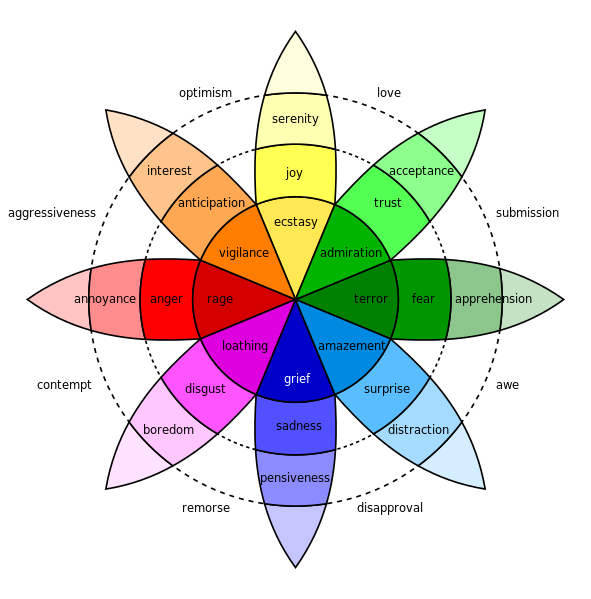
But the quick and easy answer is probably confusion and violence, most of the time. Sangria's not just standoffish or reserved; she is actually schizoid. She is broken. Her brain chemistry does not work properly. That means that these aren't just going to be emotional events she isn't ready for or won't enjoy, but often things that have legitimately never happened to her before and that she has no frame of reference for how to deal with. Add to that the fact that she's a hair-trigger quick destructive force, and throwing emotional crisis into her face is kind of like throwing a lit match into a bottle of grain alcohol.
So unless she was living on the planet of the happy flower people where nobody ever had negative emotions and she could just wander around confused about what was happening, she'd probably roll over into psychotic death machine pretty quickly. Something would suddenly be happening to her that had never happened before, she couldn't stop, she didn't understand and that was hurting and confusing her; the immediate instinctual response would be to destroy whatever was doing this obviously malevolent thing, which would just cause more negative emotions to build up around her, which would keep on fueling her until she'd either cleared the area or was unconscious. It would be a vicious cycle.
Sangria's not an entire emotional blank; she does have a limited spectrum of responses, including confusion ("something's not normal"), surprise ("something I didn't expect just happened"), respect ("something is in charge of me"), determination ("something is in my way"), dismay ("something I did failed") and disapproval ("something is wrong"). They're just a lot more muted than most peoples' reactions, and they leave out most of the emotions that involve heavy interaction with others. And she actually does occasionally have supernatural empathy foisted on her; Geoff's frequent use of Engender Love sparks very direct, strong emotion, which she understands as "a thing that happens when you're married to somebody" (Geoff's explanation), and when something goes really, really wrong she touches off Riastrad, in basically the same kind of reaction I was describing above.
Basically, if there weren't someone really, really skilled helping her manage the situation on deck with a lot of armor, dropping supernatural empathy on Sangria would make her full-blown crazy. She might be able to get used to it over time, but the collateral damage in the meantime would be off the charts.
Subscribe to:
Posts (Atom)